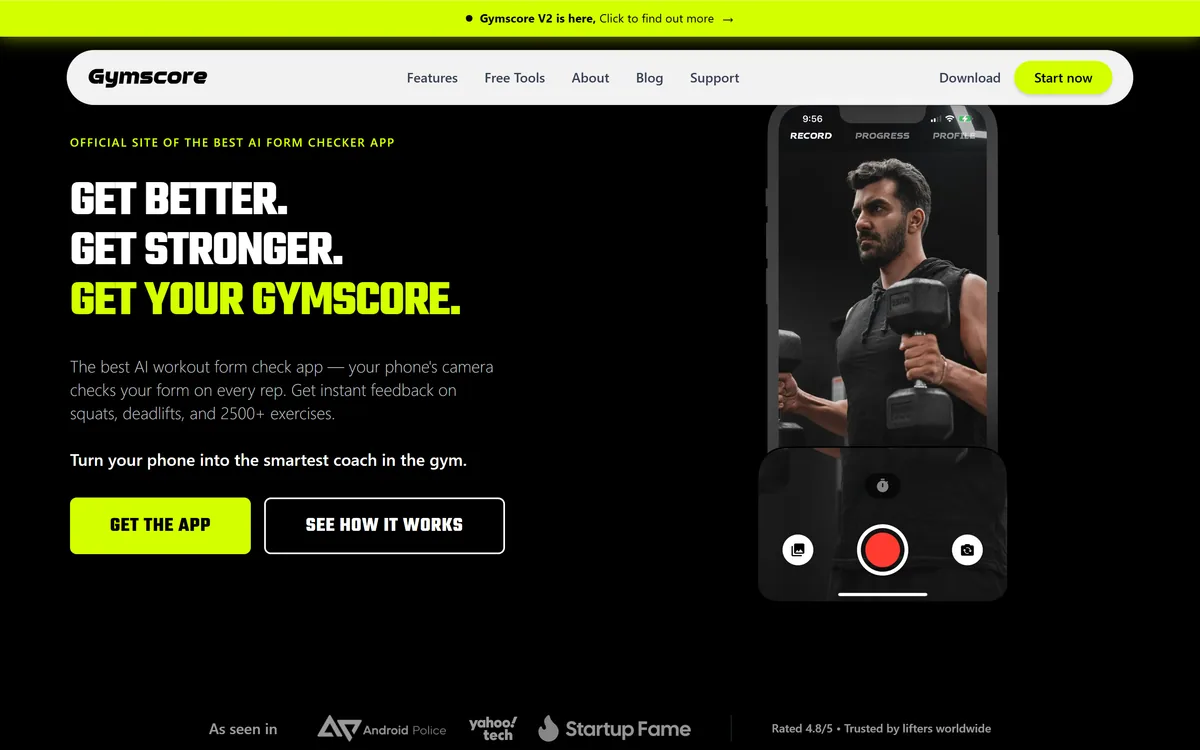
Gymscore analyses lifting technique from phone video, scoring each set from zero to one hundred across five movement categories and giving feedback on range of motion, posture, core stability and movement patterns across more than 2,500 exercises, alongside training plans and an AI coaching chat.
Gymscore displays a 98 percent accuracy rate among its headline statistics, while its own FAQ describes modern computer vision as tracking joint angles, bar path, depth and movement patterns with 95 percent-plus accuracy.
Two different figures in two places is worth noticing, and the more important problem is that neither says accurate at what.
Accuracy in pose estimation usually means how closely the software places a joint compared with a reference — an elbow within a few centimetres of where a human annotator marked it. That is a measurable, meaningful number.
It is not the same as being right about your squat. Correct joint positions still have to be interpreted into a judgement about depth, bracing and bar path, and that interpretation is where the disagreement between two human coaches would live too.
The FAQ is more honest than the statistic, saying directly that it is not perfect, nothing is, but that it is far better than guessing or watching yourself in a mirror — and consistent, analysing every rep the same way. That framing is right, and it is the one to hold: reliable comparison over time matters more than an accuracy percentage.
Placing a joint within a few centimetres is measurable. Deciding whether your squat was good is a judgement two coaches would argue about.
Camera Angle Decides The Result
The most genuinely useful thing on the site is a FAQ answer about setup: place the camera 30 to 60 degrees off-centre, diagonally in front, rather than directly ahead or fully to the side.
The reasoning given is sound and matches how a coach actually stands.
A front-on view shows knee tracking and lateral shift but flattens depth entirely — you cannot see how far the hip travelled. A pure side view shows depth and bar path but hides whether one knee is caving inward.
The diagonal captures both at some cost to each, which is why coaches instinctively stand there. Any analysis, human or machine, is limited by what the footage contains, and no algorithm recovers information the camera never saw.
This is also the honest answer to why results vary between sessions. A score that moves five points may reflect a different phone position rather than different technique, which is why fixing the setup is the first requirement for the numbers to mean anything at all.
A Score From Zero To One Hundred
The output is a single GymScore from zero to one hundred, broken across five movement categories, with feedback on range of motion, posture, core stability and movement patterns.
Reducing technique to one number is a real design decision with a genuine benefit and a genuine cost.
The benefit is comparability. A score you can watch move week to week gives technique the thing it has always lacked — a progress metric. Lifters track weight and reps obsessively because those are numbers; form goes untracked because it was never one.
The cost is that a composite hides which component moved. A score dropping from 82 to 76 could be depth, bracing, tempo or bar path, and those demand different corrections. The category breakdown is what rescues this, and it is where you should actually look.
The global percentile ranking is the feature to treat with more suspicion. Comparing your squat score against strangers filming at unknown angles with unknown loads is entertainment rather than information, and the only comparison that matters is against your own previous sets. Validated biomechanics with published error margins is what VueMotion offers instead of a composite.
Fix your camera position and use the same one every time.
Read the category breakdown, not the composite score.
Compare against your own previous sets, not the global ranking.
Film your working sets, not your warm-ups.
Take pain to a physiotherapist rather than to an app.
Reading The FAQ's Injury Claims
The frequently asked questions are extensive and clearly written for search, and several make assertions worth reading carefully. One states that bad form is the number one cause of gym injuries — not lifting too heavy or too often.
No source accompanies that, and it is a contested claim rather than a settled one.
The research on lifting injury is genuinely messy, and the factors that recur most consistently are load management and rapid progression — doing too much too soon — alongside technique. Presenting form as the single leading cause simplifies a picture that is not simple.
It also happens to be the claim that most supports the product, which is exactly when a citation matters most.
None of this means form does not matter. It plainly does, and objective feedback on it is genuinely valuable. But a lifter reading that page could reasonably conclude that good form makes volume and progression safe, and that is the belief most likely to get them hurt — which is why load management tools like Dr. Muscle sit beside form analysis rather than being replaced by it.
Beyond Scoring: Plans, Chat And An SDK
The platform extends past analysis into custom training plans built around goals, schedule, experience and equipment, an AI coaching chat for questions during a session, progress tracking, and a separate toolkit and SDK aimed at coaches.
The coaching toolkit is the more interesting business line, and it points at where this technology probably belongs.
A remote coach's hardest problem is exactly the one this solves. Their client trains alone, films inconsistently, and describes what happened rather than showing it — so the coach is working from self-report. Automated scoring across every set turns that into data.
Offering an SDK rather than only an app suggests the company understands that, and it is a more durable position than competing for individual subscriptions.
The consumer plan-building side is the weaker half. Custom plans built around goals and equipment are what every fitness app offers, and nothing on the page distinguishes this one — the form analysis is the reason to be here. For logging and progression, a dedicated tracker such as Jefit does more with the same effort.
Filming Your Lifts For Useful Feedback
The analysis is only as good as the footage, and most people film badly by default — too close, too far forward, and only when they feel strong.
This sequence produces video worth analysing and comparisons worth trusting.
Set the camera 30 to 60 degrees off-centre, diagonally in front.
Mark or remember the spot so every session is filmed identically.
Frame the whole body including the bar path, not just your torso.
Film working sets rather than warm-ups, where form actually breaks.
Read the category breakdown and fix one thing, not four.
Re-film the same lift weekly and compare against yourself.
Gymscore: Coverage And Claims
What it does
Analyses lifting technique from phone video and scores it
Score
Zero to one hundred, across five movement categories
Feedback areas
Range of motion, posture, core stability and movement patterns
Exercise coverage
2,500-plus, from barbell and dumbbell to machines, bodyweight and Olympic lifts
Input
Record on the phone camera or upload an existing video
Recommended setup
Camera 30 to 60 degrees off-centre, diagonally in front
Accuracy claims
98 percent in the statistics block; 95 percent-plus described in the FAQ
Other features
Custom training plans, AI coaching chat, progress tracking and global rankings
For coaches
An AI coaching toolkit and a Gymscore SDK
Free tools
A web-based workout program builder, with a free tier and no card required
Displayed rating
4.8 out of 5, with a top 100 fitness apps badge
Version
Gymscore V2 announced in a banner
Can An App Replace A Form Check?
Film your sets when
You train alone and nobody ever watches you lift.
You suspect something is wrong but cannot see what.
You want technique tracked over time rather than guessed at.
You will actually set the camera up the same way each session.
A coach reviews your training remotely and needs real footage.
Book a coach when
You are in pain, which needs assessment rather than scoring.
You are a complete beginner and need hands-on cueing.
You would treat a score as permission to add load.
You will film inconsistently, which makes comparison meaningless.
Your limiting factor is programming rather than technique.
More Gym And Lifting Tools
Other tools across technique, programming and tracking.
VueMotion — validated biomechanics rather than a composite score
Dr. Muscle — load management, which form analysis does not cover
Jefit — a detailed training log and exercise database
MacroFactor — the nutrition half of physical progress
What we could not confirm: what the accuracy percentages measure, since neither figure states accurate at what, nor why two figures differ; the source for the FAQ's claim that bad form is the leading cause of gym injuries; how the five movement categories are weighted into one score; whether any qualified coaches were involved in defining correct form; what operating company is behind the product, which no page we read names; and pricing, which we did not reproduce. We did not record or analyse a lift.
Editor's Verdict
3.6/5
Filming your sets is advice every coach gives and almost nobody follows, and automating the review is a sound idea — most lifters genuinely cannot see their own faults, and the mirror does not help. The camera angle guidance in its own FAQ is the most useful thing on the site, because setup is what actually determines whether the analysis means anything. Where it needs caution is the numbers: an accuracy percentage is quoted without saying accurate at what, the FAQ makes injury claims without sources, and no operating company is named anywhere we read. AInexfinder Editor Score: 3.6/5.
Gymscore pricing
AInexfinder does not list plan prices or billing details. For current pricing, plans, and trials, visit the official Gymscore website.
Daniel reviews AI tools the slow way — by actually using them on real projects. His reviews cover what works, what breaks, and who each tool is genuinely a good fit for.
Daniel and the AInexfinder editorial team research Gymscore using public product information, listing evidence, and (when available) hands-on checks. Scores reflect listing completeness and transparency — not paid placement.
Listings may include affiliate or sponsored placements, which are labeled when present. Editorial scores and cons are not sold. See our affiliate disclosure and review methodology.
BodBot is an AI personal trainer and nutritionist that builds workouts tailored to your goals, body and progress, adapting with every rep, with joint controls for injuries, wearable integration and data-driven nutrition across web, phone, tablet and watch.
Jefit is a workout planner and tracking app with a large exercise database, custom plan building, muscle recovery and one-rep-max metrics, and a community feed. Its adaptive plan analyses strength and fatigue to build the coming week, and periodization now applies to plans members build themselves.
The Running Genie is an AI running coach that syncs from Strava, Garmin, Polar, Suunto and Apple Health, then builds adaptive training plans for 5K through ultra using VDOT, 80/20 polarised training and periodisation principles.
Vici is a free iOS running coach that connects to Strava and your wearable, checks in each morning against recovery, sleep, HRV and resting heart rate, adapts the day's session accordingly, and reads every completed run in two stages before adjusting what comes next.
Dr. Muscle builds and adjusts strength training programmes automatically, picking your weights and reps from what you lifted last time. Built by an exercise scientist, it applies progressive overload and daily undulating periodization, publishes dated release notes going back to 2016, and runs on phone and Apple Watch.