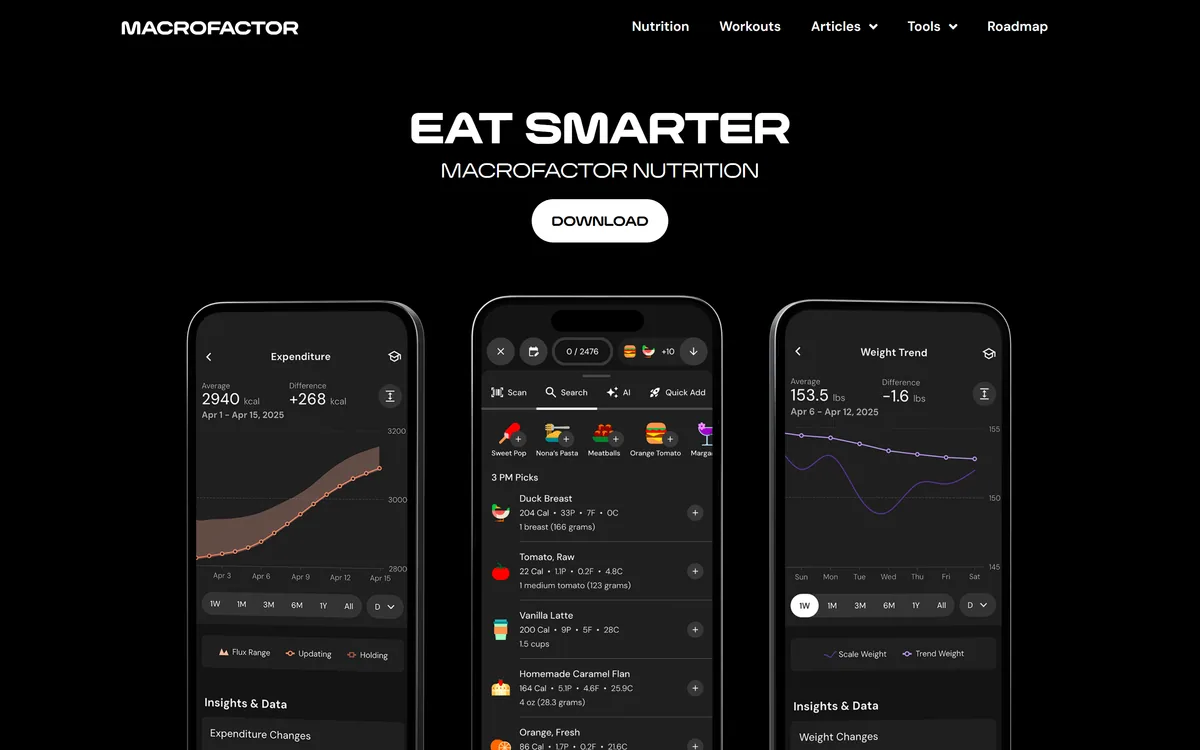
MacroFactor is a nutrition and workout tracking app whose coaching adapts weekly to your logged intake and weight trend, estimating your actual energy expenditure rather than using a formula. It publishes in-depth research articles alongside the apps and maintains a public roadmap.
macrofactor.com8 viewsAdded November 27, 202543K visitors
Every diet starts with a number that is made up. A calculator takes your height, weight, age and a rough activity guess, applies a formula derived from population averages, and hands you a daily target.
For any specific person that number can be several hundred calories out in either direction. People then eat to it, do not get the result it predicted, and conclude that they are broken or that tracking does not work.
MacroFactor's method is to stop guessing. Log what you eat and what you weigh, and the maths works backwards to what your expenditure actually is.
MacroFactor: A Coach That Adapts Weekly
Expenditure estimated from your own data rather than from a population formula that is wrong for most individuals.
Weekly adjustment — targets change as your body and behaviour change, not on a fixed schedule you set once.
Two apps: MacroFactor Nutrition and MacroFactor Workouts, downloadable separately.
Published in-depth research articles on rest times, warm-ups, reps in reserve and nutrient timing.
A public roadmap, release notes for both apps and a copyright running from 2021.
MacroFactor's homepage, captured 9 September 2026, showing the nutrition and workout products alongside published research.
How Does An Adaptive Diet Coach Work?
The premise is straightforward arithmetic applied consistently, which is why it works better than a formula.
If you log your intake and your weight over several weeks, the relationship between the two reveals your expenditure. Eating 2,400 calories a day while weight holds steady means you are expending roughly 2,400, regardless of what any calculator predicted.
That estimate then becomes the basis for targets, and it updates as the data accumulates. It also captures things a formula structurally cannot — how much you fidget, how your body responds to a deficit, what your job actually involves physically.
Adaptation matters most later in a diet, when metabolic adaptation and reduced spontaneous movement mean expenditure drifts down. A fixed target that was correct in week one is wrong by week eight, and most people experience that as a plateau they cannot explain.
The honest limit is that the whole thing rests on logging accuracy. The maths cannot distinguish an untracked weekend from a metabolic change, and the estimate degrades exactly as far as the logging does — which is why consistency-focused tracking apps across health categories all face the same constraint.
Eating 2,400 calories while your weight holds steady means you are expending 2,400 — regardless of what any calculator predicted.
Expenditure Estimated From Your Own Data
The reason this matters more than it sounds is that individual variation in energy expenditure is genuinely large.
Two people of identical height, weight, age and stated activity level can differ by several hundred calories a day in what they actually burn, and no formula input captures why.
Non-exercise activity is the biggest source of that variation and the least visible. Fidgeting, posture, walking pace, how much you move around a room — these accumulate to a substantial daily difference that nobody self-reports accurately.
This is also why so many people conclude they have a slow metabolism. Frequently they are right in the sense that matters — their expenditure is genuinely lower than the calculator predicted — and a measured estimate simply tells them the true number instead of arguing with them.
The corollary is reassurance. If a target derived from your own data is not producing results, the answer is nearly always logging accuracy rather than metabolism, which is a much more actionable conclusion.
Why Published Articles Signal Something
MacroFactor publishes long-form articles on rest times between sets, warm-up protocols, reps in reserve and post-workout nutrient timing, alongside a knowledge base and release notes.
Publishing this kind of material is a meaningful signal in a category that mostly does not.
Writing an article on what the research says about rest intervals means engaging with evidence that may contradict what would be convenient to claim — and doing so publicly, where anyone can check it.
It also tells you what kind of product it is. An app that discusses nutrient timing with nuance is aimed at people who want to understand the reasoning, not people who want to be told what to do without explanation.
The practical benefit is calibration. When the app makes a recommendation, you can find out why, and a recommendation you understand is one you follow correctly rather than approximately — which is the difference between a tracker being used for three weeks and being used for a year.
That approach is uncommon in consumer health software generally. Sleep tools such as SleepQ and habit apps like Insight Timer mostly present conclusions without the reasoning, which is fine until a recommendation conflicts with something a user already believes.
Publishing the reasoning is slower and it produces a different relationship with the user. Somebody who understands why a target moved is far less likely to abandon the app when it moves in a direction they did not expect.
Log everything, including the meals you would rather not — accuracy drives everything.
Give the estimate two to three weeks before judging it; it needs data to converge.
Weigh consistently, same time and conditions, since the trend is the input.
Expect expenditure to drift down in a long deficit — that is normal, not failure.
Read why a recommendation was made; understood advice gets followed properly.
Tracking Nutrition Without Giving Up
The honest weakness of every nutrition tracker is that most people stop using it, usually within a month.
The reasons are consistent. Logging is tedious, restaurant meals are guesswork, and one bad day makes the whole record feel ruined, which is when people quietly stop opening the app.
Adaptive systems have a specific advantage here. Because targets adjust to observed reality rather than to a plan you deviated from, a heavy week produces a revised estimate rather than a sense of failure — the system treats it as information.
That said, it still requires logging, and no design removes that. The apps that survive are the ones people use imperfectly rather than the ones they use perfectly for three weeks.
The realistic advice is to log consistently rather than precisely. An estimated restaurant meal logged is far more useful than an accurate one omitted, because a systematic small error still produces a usable trend and a gap does not.
Two Apps And A Published Roadmap
MacroFactor ships nutrition and workout tracking as separate downloads, with separate release notes, plus a public roadmap and a knowledge base.
Splitting them is defensible and slightly unusual. Nutrition and training tracking are different daily habits with different failure modes, and bundling them often means one gets used and the other becomes clutter.
The public roadmap is the more notable choice. Publishing what you intend to build invites people to hold you to it, and it is a commitment most consumer apps avoid precisely for that reason.
A copyright running from 2021 to 2026 indicates a product with several years behind it rather than a recent launch, which matters for something you would use daily over years.
The user success stories published with dates through 2026 serve a similar function — they are marketing, and dated marketing that continues to appear is at least evidence that the product is actively promoted and presumably maintained.
Making The First Fortnight Count
The way tracking apps get abandoned is a bad first fortnight: unfamiliar logging, an estimate that has not settled, and no visible progress.
This sequence gets through that period with the data intact.
Log everything for two weeks before judging any number, including the awkward meals.
Weigh at the same time under the same conditions, since the trend is the input.
Ignore daily weight fluctuation entirely; only the trend carries information.
Let the expenditure estimate converge before changing your target.
When progress stalls, check logging accuracy before assuming metabolism.
Read the reasoning behind a recommendation rather than only the number.
Should You Track With MacroFactor?
Start tracking when
Calculator-derived targets have consistently failed to produce the predicted result.
You have plateaued and cannot tell whether it is adaptation or logging drift.
You will log consistently, including the meals you would rather not.
You want to understand the reasoning rather than be handed a number.
You are training as well as dieting and want both tracked.
Skip tracking when
You have a history of disordered eating, where tracking can be harmful.
You will not log restaurant meals or social occasions.
You want an app that tells you what to eat rather than measuring what you did.
Daily weighing would be distressing rather than neutral.
You need clinical nutrition guidance for a medical condition.
Key features of MacroFactor
Adaptive nutrition coaching from logged data
Energy expenditure estimated rather than calculated from a formula
Weekly target adjustment
Separate workout tracking app
A food logging database
Published research articles
A knowledge base and public roadmap
Release notes for both apps
Pros & cons
Pros
7
Measures expenditure instead of predicting it, which is a genuinely better method
Captures individual variation that no formula input can represent
Weekly adaptation handles the drift that turns week one's target into week eight's plateau
Treats a heavy week as information rather than as failure
Published research articles indicate engagement with evidence rather than assertion
A public roadmap invites accountability most consumer apps avoid
Several years of history, with dated release notes for both apps
Cons
7
Everything depends on consistent logging, which most people abandon
The maths cannot distinguish an untracked weekend from a metabolic change
Requires regular weighing, which is not neutral for everyone
Not appropriate for anyone with a history of disordered eating
Measures what you did rather than telling you what to eat
Pricing and operating company are not stated on the pages we read
The expenditure algorithm itself is not described
Best For
People whose calculator-based targets never produced the predicted result
Anyone stuck at a plateau and unsure whether it is adaptation or logging
Trainees who want nutrition and training tracked together
Those who want to understand the reasoning behind a recommendation
Long-term users who will log imperfectly but consistently
MacroFactor Against Other Tracking Apps
Health apps differ by what they measure and how far they interpret it.
What we could not confirm: pricing and whether any tier is free, since we did not read a pricing page; the operating company, which the footer names only as the product with an Impressum we did not open; the exact algorithm behind the expenditure estimate; how food database accuracy is maintained; what health data is stored and where, beyond the existence of a Health Data Notice; and platform availability details. Nothing here is medical or nutritional advice, and anyone with a health condition should consult a clinician.
Editor's Verdict
4.2/5
Every calorie calculator gives you a number derived from a population formula, and every one of them is wrong for you specifically — sometimes by several hundred calories. MacroFactor's approach is to stop guessing and measure: log intake and weight, and it works backwards to what your expenditure actually is, then adjusts weekly. That is a genuinely better method and it is the reason the app has the reputation it has. The catch is inherent — it requires consistent, honest logging, and the accuracy of everything downstream depends entirely on that. AInexfinder Editor Score: 4.2/5.
MacroFactor pricing
AInexfinder does not list plan prices or billing details. For current pricing, plans, and trials, visit the official MacroFactor website.
Vendor pricing, credits, and billing policies change over time. Always confirm on the official site before you buy.
Frequently asked questions
What is MacroFactor?
MacroFactor is a nutrition and workout tracking app whose coaching adapts weekly based on your logged intake and weight trend, estimating your actual energy expenditure rather than applying a population formula. It ships as two apps and publishes research articles alongside them.
How does expenditure estimation work?
Arithmetic applied consistently. If you log intake and weight over several weeks, the relationship reveals expenditure — eating 2,400 calories while weight holds steady means you are expending roughly 2,400, regardless of what a calculator predicted.
Why are calorie calculators wrong?
Because individual variation is large. Two people of identical height, weight, age and stated activity can differ by several hundred calories a day in what they actually burn, and non-exercise activity — fidgeting, posture, walking pace — is the biggest and least visible source.
Do I really have a slow metabolism?
Possibly, in the sense that matters. Many people whose expenditure is genuinely lower than a calculator predicted have been told they must be logging wrong. A measured estimate simply gives them the true number instead of arguing with them.
Why does weekly adaptation matter?
Because expenditure drifts down during a long deficit through metabolic adaptation and reduced spontaneous movement. A fixed target correct in week one is wrong by week eight, and most people experience that as an unexplained plateau.
What happens if I log badly?
Everything downstream degrades. The maths cannot distinguish an untracked weekend from a metabolic change, so the estimate is only as good as the logging. When progress stalls, check logging accuracy before concluding anything about your metabolism.
Should I log precisely or consistently?
Consistently. An estimated restaurant meal logged is far more useful than an accurate one omitted, because a systematic small error still produces a usable trend while a gap does not. The apps that survive are the ones used imperfectly rather than perfectly for three weeks.
Why do published research articles matter?
Because writing about what the evidence says on rest intervals or nutrient timing means engaging publicly with findings that may contradict what would be convenient to claim. It also tells you the product is aimed at people who want the reasoning, not just the number.
How long before the estimate is trustworthy?
Give it two to three weeks of consistent logging before judging any number. The estimate needs data to converge, and the most common way people abandon adaptive trackers is by concluding in week one that the numbers are wrong.
Who should not use a tracking app?
Anyone with a history of disordered eating, for whom detailed food logging and regular weighing can be actively harmful. That is a genuine contraindication rather than a caveat, and it is worth taking seriously regardless of how good the underlying method is.
Daniel reviews AI tools the slow way — by actually using them on real projects. His reviews cover what works, what breaks, and who each tool is genuinely a good fit for.
Daniel and the AInexfinder editorial team research MacroFactor using public product information, listing evidence, and (when available) hands-on checks. Scores reflect listing completeness and transparency — not paid placement.
Listings may include affiliate or sponsored placements, which are labeled when present. Editorial scores and cons are not sold. See our affiliate disclosure and review methodology.
RecipeScan is an Apple-only cooking app that builds a pantry from photos, suggests recipes against what you already have, and coordinates three dishes onto one timeline. It adds grocery lists, budget tracking, calorie estimates and a hands-free cooking mode.
Eat This Much generates weekly meal plans from your calorie and macro targets, food preferences, budget, and schedule, then produces a grocery list that can be sent to Instacart or AmazonFresh — with keto, Mediterranean, paleo, vegan, and vegetarian options.
MyNetDiary tracks calories and nutrition against a staff-verified database of more than two million foods carrying up to 108 nutrients each, with barcode scanning, AI photo logging, restaurant menu analysis, wearable integrations and dedicated support for GLP-1 medication users.
Lumen is a portable metabolic device using a CO2 sensor and flow meter to read the carbon dioxide concentration in a single breath, indicating which fuel your body is using. It builds a daily plan of what to eat and when, flags muscle-loss risk, and guides fuelling around workouts.