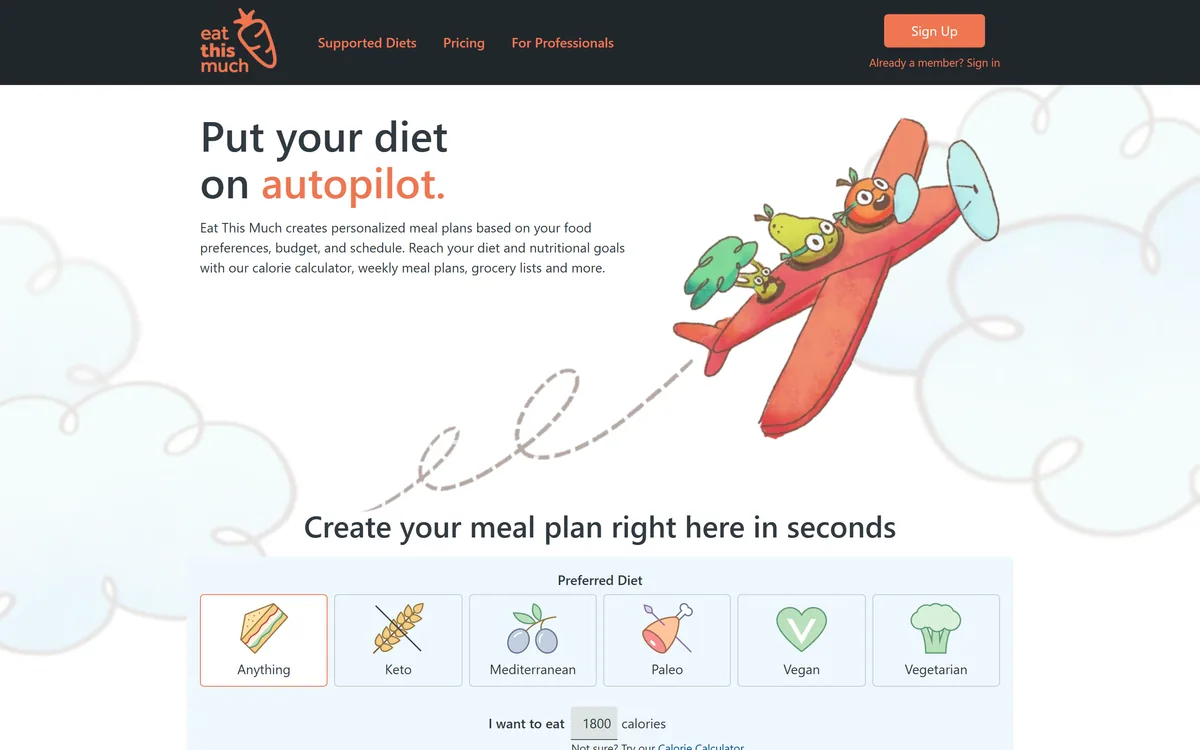
Eat This Much generates weekly meal plans from your calorie and macro targets, food preferences, budget, and schedule, then produces a grocery list that can be sent to Instacart or AmazonFresh — with keto, Mediterranean, paleo, vegan, and vegetarian options.
eatthismuch.com15 viewsAdded June 4, 2025916K visitors
Eat This Much solves a problem most nutrition apps ignore. Tracking what you ate is easy and widely served; deciding what to eat tomorrow, within your macros and your budget, is the part people actually give up on.
It generates the whole week automatically — meals that hit your targets, fit your schedule, respect your budget, and use ingredients you already have — then turns the result into a grocery list.
This review covers what the automation genuinely removes, the pantry and budget features that distinguish it, where generated plans break down, and who this suits.
Eat This Much removes the deciding, not the cooking — the plan and the shopping list arrive done.
Eat This Much Specification
Company
Eat This Much Inc.
Category
Automatic meal planning and nutrition tracking
Core function
Generates weekly meal plans from calorie and macro targets
Constraints it accepts
Food preferences, budget, and schedule
Pantry feature
Virtual pantry, prioritising ingredients you already own
Diets supported
Keto, Mediterranean, paleo, vegan, vegetarian, and custom
Grocery
Automatic grocery lists with Instacart and AmazonFresh integration
Also includes
Calorie calculator and weekly plan calendar
Platforms
Web, iOS, and Android
Free tier
Yes; specific macro target customisation sits on premium
Press
Named Best Meal Planning App of 2025 by CNN Underscored
Eat This Much, Briefly
What it does: generates a whole week of meals automatically from your calorie and macro targets, then builds the grocery list.
The constraint it respects: budget and schedule, not just nutrition — most planners ignore both.
Virtual pantry prioritises ingredients you already have, which is the feature that actually reduces food waste.
Diets covered: keto, Mediterranean, paleo, vegan, vegetarian, plus custom targets.
Grocery lists push to Instacart and AmazonFresh, closing the loop from plan to delivery.
Decision Fatigue Is The Actual Problem
Diets rarely fail on knowledge. Most people know roughly what they should eat; what defeats them is answering "what's for dinner" correctly, seven times a week, while tired.
A tracking app tells you afterwards that you got it wrong. A planning app removes the decision before it happens, which is a fundamentally different intervention.
That is why the automation matters more than the nutrition science here. The macros are not hard; the sustained daily choosing is.
Tracking tells you what you did. Planning decides what you will do. Only one of them changes the outcome.
The Constraints It Actually Respects
Plenty of tools generate meal plans. What separates this one is which real-world limits it accepts as inputs.
Calorie and macro targets — the nutritional frame, customisable on premium
Food preferences — so the plan excludes things you will not eat
Budget — rarely modelled elsewhere, and the reason many plans get abandoned
Schedule — simpler meals on days you have no time
Virtual pantry — prioritises what is already in your cupboard
Diet type — keto, Mediterranean, paleo, vegan, vegetarian, or custom
From Plan To Groceries
The grocery list is where a meal planner either earns its place or becomes another abandoned tab.
Eat This Much builds the list automatically from the week's plan, deduplicating ingredients across meals so you buy one bag of rice rather than seven entries for rice.
Integrations with Instacart and AmazonFresh close the loop — plan on Sunday, order in the same session, cook from what arrives. That continuity is what makes the habit stick, because the friction is concentrated into one sitting rather than spread across the week.
Setting It Up So The Plans Are Usable
Generated plans disappoint mainly when the inputs are lazy. A few minutes of setup changes the output substantially.
Set your calorie and macro targets before anything else — everything downstream depends on them.
Exclude foods you genuinely will not eat, not just foods you feel you should avoid.
Fill the virtual pantry honestly, including the half-used items, or you will keep buying duplicates.
Set your budget realistically; an unrealistic figure produces monotonous plans built from the cheapest staples.
Mark your busy days so the planner puts simple meals there rather than a 40-minute recipe.
Regenerate any individual meal you dislike rather than rejecting the whole week — the plan is meant to be edited.
Where Generated Plans Fall Down
Repetition is the most common complaint. Constraint satisfaction naturally converges on a narrow set of solutions, so tight macros plus a tight budget plus dietary exclusions produces the same few meals repeatedly.
Recipe quality is variable. The plans are nutritionally sound and not always appetising, and a meal you will not eat has no nutritional value at all.
It also assumes you cook. Households eating out, ordering in, or feeding people with different requirements get much less from it than a single person cooking for themselves.
And macro-level accuracy has a floor. Portion estimates, cooking losses, and ingredient variation mean the numbers are directionally right rather than precise — fine for most goals, insufficient for competitive preparation.
Free Versus Premium
There are free accounts, and the free tier is enough to judge whether automatic planning suits how you eat.
Specific macro target customisation sits behind premium, which is the line that matters: if you are eating to a general calorie goal, free may be sufficient; if you are hitting protein and carbohydrate targets precisely, you will need the paid tier.
Test the plan quality on the free tier first. The question is not whether the app works but whether you will actually cook what it produces.
Key features of Eat This Much
Automatic weekly meal plan generation from calorie and macro targets
Budget and schedule accepted as planning constraints
Virtual pantry that prioritises ingredients you already own
Automatic, deduplicated grocery lists
Instacart and AmazonFresh ordering integration
Keto, Mediterranean, paleo, vegan, vegetarian, and custom diets
Calorie calculator and weekly plan calendar
Web, iOS, and Android apps
Pros & cons
Pros
5
Removes the daily decision rather than only recording it afterwards
Budget as a real input, which most meal planners ignore entirely
Virtual pantry genuinely reduces duplicate buying and waste
Grocery list to delivery in one sitting concentrates the friction
Free tier is enough to judge whether automatic planning suits you
Cons
5
Plans repeat when macros, budget, and exclusions are all tight
Recipe appeal is variable — nutritionally sound is not always appetising
Assumes you cook; near-useless if you mostly eat out
Poor fit for households with conflicting dietary requirements
Macro precision is directional, not competition-grade
Best For
People cooking for themselves to a calorie or macro target
Anyone whose diet fails at the deciding stage rather than the knowing stage
Budget-conscious households wanting nutrition without overspending
Followers of keto, Mediterranean, paleo, vegan, or vegetarian diets
Anyone who wants planning and grocery ordering done in one session
Eat This Much Versus Other Health Tools
Planning, tracking, and coaching are different jobs, and most apps only do one.
Deciding what to eat is what defeats you, not knowing what to eat
You have specific calorie or macro targets to hit
Food budget is a real constraint on your planning
You want the grocery list produced and ordered in one sitting
It Will Not Suit
Households eating out or ordering in most days
Cooking for several people with conflicting requirements
Anyone who needs precise, competition-grade macro accuracy
People who find generated recipes unappetising enough to skip
Those wanting coaching and accountability rather than a plan
Other Health And Fitness Tools
These cover the parts of the same goal that a meal planner does not.
MyNetDiary — detailed nutrition tracking if you would rather log than plan
JEFIT — the training side, where meal planning alone will not get you there
Habit Coach AI — for when sticking to the plan is the actual problem
The Running Genie — structured running plans alongside the nutrition side
What We Checked Here
Last checked . Read from eatthismuch.com during this check, with the screenshot above captured at the same time.
Feature list, supported diets, and platform coverage taken from the site's own pages
Instacart and AmazonFresh integrations as Eat This Much lists them
The free tier and the premium gate on specific macro targets confirmed on the site
Company attributed to Eat This Much Inc. per the site footer
The CNN Underscored "Best Meal Planning App of 2025" mention reported as the site presents it, not independently verified
No plan prices published here, in line with this site's pricing policy
Nothing here is dietary or medical advice. Macro targets and calorie goals should be set with a qualified professional where health conditions are involved.
Editor's Verdict
4.3/5
Eat This Much has an AInexfinder Editor Score of 4.3/5.
Eat This Much pricing
AInexfinder does not list plan prices or billing details. For current pricing, plans, and trials, visit the official Eat This Much website.
Vendor pricing, credits, and billing policies change over time. Always confirm on the official site before you buy.
Frequently asked questions
How is Eat This Much different from a calorie tracker?
A tracker records what you already ate. Eat This Much decides what you will eat before the moment arrives, generating a whole week to your targets and producing the grocery list. That is a different intervention — planning rather than reporting.
Which diets does it support?
Keto, Mediterranean, paleo, vegan, and vegetarian, plus custom configurations. It also accepts food preferences so the plans exclude things you will not eat.
Does it handle my grocery shopping?
It builds the grocery list automatically from the week's plan, deduplicating ingredients, and integrates with Instacart and AmazonFresh so you can order in the same session you plan.
What is the virtual pantry for?
It tells the planner what you already have so those ingredients get used first. Filling it honestly — including half-used items — is the single biggest thing you can do to reduce duplicate buying and waste.
Why do my meal plans keep repeating?
Constraint satisfaction converges. Tight macros plus a tight budget plus dietary exclusions leaves few valid solutions, so the same meals recur. Loosening one constraint — usually budget — widens the variety noticeably.
Is Eat This Much free?
There are free accounts, and the free tier is enough to judge the plan quality. Specific macro target customisation sits on premium, so precise protein and carbohydrate targets need the paid tier.
Is it accurate enough for serious training?
For general goals, yes. For competitive preparation, no — portion estimates, cooking losses, and ingredient variation mean the numbers are directionally right rather than precise.
Daniel reviews AI tools the slow way — by actually using them on real projects. His reviews cover what works, what breaks, and who each tool is genuinely a good fit for.
Daniel and the AInexfinder editorial team research Eat This Much using public product information, listing evidence, and (when available) hands-on checks. Scores reflect listing completeness and transparency — not paid placement.
Listings may include affiliate or sponsored placements, which are labeled when present. Editorial scores and cons are not sold. See our affiliate disclosure and review methodology.
RecipeScan is an Apple-only cooking app that builds a pantry from photos, suggests recipes against what you already have, and coordinates three dishes onto one timeline. It adds grocery lists, budget tracking, calorie estimates and a hands-free cooking mode.
MyNetDiary tracks calories and nutrition against a staff-verified database of more than two million foods carrying up to 108 nutrients each, with barcode scanning, AI photo logging, restaurant menu analysis, wearable integrations and dedicated support for GLP-1 medication users.
MacroFactor is a nutrition and workout tracking app whose coaching adapts weekly to your logged intake and weight trend, estimating your actual energy expenditure rather than using a formula. It publishes in-depth research articles alongside the apps and maintains a public roadmap.
Lumen is a portable metabolic device using a CO2 sensor and flow meter to read the carbon dioxide concentration in a single breath, indicating which fuel your body is using. It builds a daily plan of what to eat and when, flags muscle-loss risk, and guides fuelling around workouts.