Habit Coach AI pairs habit tracking with a conversational coach you choose from several personalities, reaching you by text message, phone call or web chat. Its top tier adds weekly calls with a human coach, which places it somewhere between a tracking app and a coaching service.
habitcoach.ai9 viewsAdded July 14, 20258K visitors
The reason habit apps fail is not that they lack features. It is that they wait. A tracker sits on your phone in a state of patient readiness, and the day you most need it is precisely the day you do not open it.
Habit Coach AI is built around inverting that. The coach initiates contact — a text in the morning, a phone call if you have chosen one — so the interaction happens whether or not you remembered the app exists.
That is a real idea, and it deserves a serious look rather than dismissal as another wellness subscription. It also raises questions the site does not answer, about what the coaching is based on and what happens to the daily record of your intentions and failures.
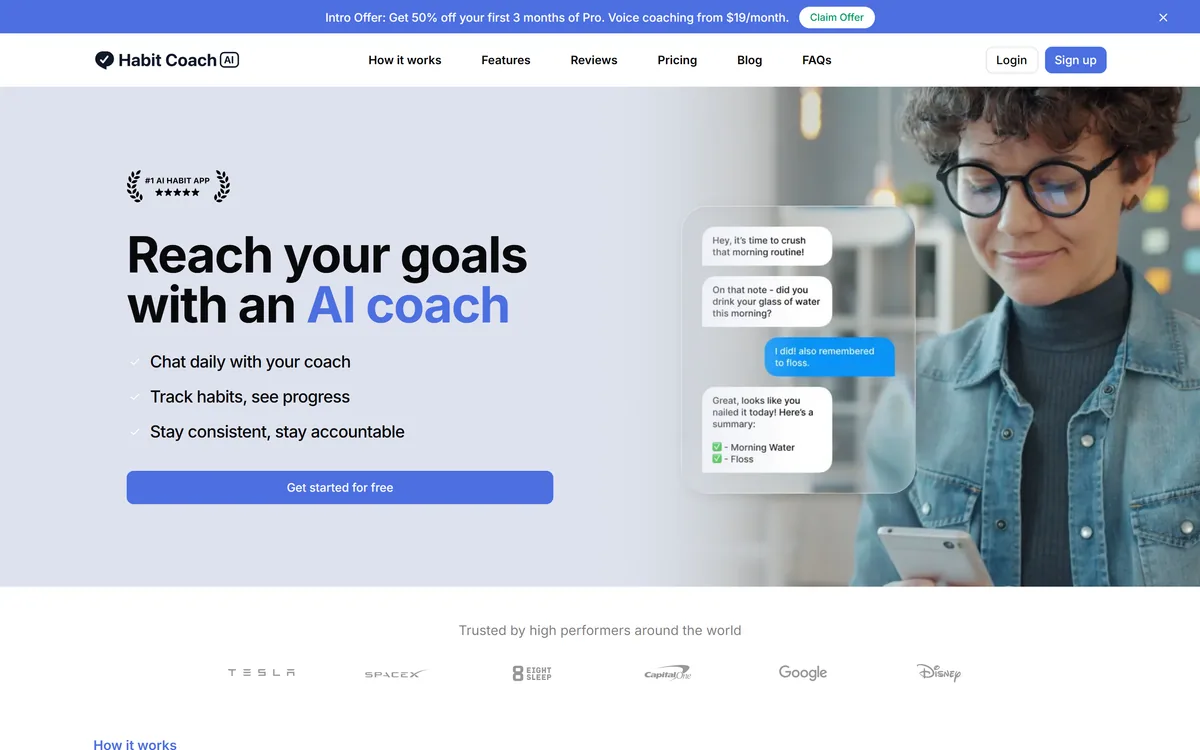
Habit Coach AI's homepage, captured 9 September 2026. Coach selection is presented up front, which tells you where the product thinks its appeal lies.
The Accountability Mechanism Is The Product
Strip away the personalities and the streak counters and one mechanism remains: something outside you asks, on a schedule you did not control in the moment, whether you did the thing.
This is the active ingredient in most accountability arrangements that work — a running partner waiting outside, a coach expecting a report, a friend who will ask. What those share is not motivation but the inconvenience of having to say no to someone.
A phone call is a stronger version of this than a notification, because a call is harder to dismiss without a decision. Whether an AI voice carries the same social weight as a person is the honest open question here, and the answer probably varies enormously by individual. Some people will feel the same reluctance to report failure to a machine; others will notice within a week that nothing is actually watching.
That is the thing to test on yourself rather than reason about. It is also why the top tier's weekly human call is the most interesting part of the product: it reintroduces the element that unambiguously works.
The mechanism that makes accountability work is not motivation. It is having to tell someone you did not do it.
Six Personas, One Underlying Model
The site offers a choice of coaches with distinct names and characters, from supportive to aggressively drill-sergeant.
It is worth being clear about what this is. These are personas layered on the same system, differing in tone rather than in the substance of what they know or the method they follow. Choosing the harsh one does not get you a different coaching philosophy; it gets you the same prompts delivered rudely.
That is not a criticism so much as a calibration. Tone genuinely matters — people abandon a coach whose manner grates on them, and matching it to your preference improves the odds you keep engaging. Just do not read the choice as selecting between approaches.
The practical advice is to pick the tone you would tolerate on your worst day rather than the one that sounds appealing when you are feeling motivated. The abrasive option is entertaining in week one and a reason to stop replying in week three.
What Is Missing: Any Stated Method
Habit formation is a field with genuine research behind it. There are well-known frameworks built on cues and rewards, on implementation intentions that specify when and where an action will happen, on making a behaviour small enough that it cannot be refused, and on the finding that missing a day matters far less than most people fear.
The site does not cite any of this. It describes tracking, consistency and accountability in general terms, without naming a framework, a method or anyone qualified who shaped the approach.
This is worth stating plainly and without exaggeration. Absence of a cited method does not mean the coaching is bad — the underlying models have absorbed a great deal of published behavioural material, and the advice you get will likely sound sensible. It means you have no way to evaluate the approach before subscribing, and no basis to distinguish it from Pattrn or any other product in the category.
For a tool whose whole proposition is behavioural change, that is the most significant gap. It also creates a specific risk: generic advice delivered confidently is harder to argue with than generic advice delivered tentatively, and a coach that sounds certain about your life while following no particular method is a poor combination.
Ask the coach directly what method it is applying, and judge the answer.
Watch whether it adapts when you say something is not working, or restates the same suggestion in new words.
Notice whether it ever tells you to make a habit smaller, which is what an experienced coach does when you keep missing.
Check whether it remembers what you said last week, since continuity is most of what a coaching relationship provides.
Treat any advice touching sleep, diet or mood as general information rather than guidance from a qualified professional — for mood specifically, a tool built for it such as Youper is the better fit.
Human Calls At The Top Tier Change The Category
The highest tier includes weekly coaching calls with a professional human coach. This deserves separating out, because it makes that tier a different kind of purchase from the ones beneath it.
AI-only tiers are software: automated contact, tracking and encouragement. The top tier is a coaching service with software attached. Those are not competing versions of the same thing, and they should not be evaluated against the same alternatives.
If the human calls are what you want, the honest comparison is not against other habit apps but against hiring a coach directly. Bundling gives you daily automated contact between sessions, which neither a standalone coach nor a programme app such as SHRED provides, and that is a real advantage of the combination.
What to establish before buying at that tier: who the coaches are and what they are qualified in, whether you get the same person each week, what happens if the match is poor, and how sessions are rescheduled. Continuity with one person is most of the value, and it is the detail a bundled offer most often omits.
A Two-Week Test Of Whether It Sticks
Habit tools are unusually easy to evaluate honestly, because the outcome is observable and arrives quickly. Run this before paying for anything beyond a first month.
The bar is step five. Almost every habit product produces a good first week; the second week is where the difference between a mechanism and a novelty shows.
Pick one habit only, and make it smaller than you think it needs to be. Ten minutes, not an hour.
Choose the coach tone you would tolerate on a bad day, not the one that sounds appealing today.
Turn on the most intrusive channel available to you — a call rather than a text — because the whole premise is that intrusion is the point.
Reply honestly when you miss. A tracker you lie to is a tracker measuring nothing, and this is the most common way these tools quietly stop working.
At day fourteen, ask one question: in the past week, did a check-in change what you actually did on a day you were going to skip? If not, the mechanism is not working for you, and no tier upgrade will change that.
If it did work, only then consider whether the human coaching tier is worth adding.
The Logo Wall, And What It Actually Shows
The site states that it is trusted by high performers and displays the marks of several very well-known employers.
It is worth understanding what a claim of this shape can and cannot support. If some users happen to work at large companies, the statement is literally true and tells you nothing — a consumer subscription with any traction will have users at large employers, because large employers have a lot of employees.
What it would mean if those companies had evaluated, endorsed or purchased the product is entirely different, and that is not what is being said. Read it as a description of who some individual users are, not as an institutional endorsement.
This matters because it is the only social proof on offer. There is no published outcome data, no retention figure, no independent study. For a behaviour-change product, that absence is more informative than the logos are, and it is why the two-week self-test above is the only evidence that should decide your purchase.
How Habit Coach AI Bills
There is a free entry point, and three paid tiers above it. The paid tiers are recurring subscriptions.
What changes between them is access rather than capability: the middle tiers expand messaging and channels, and the top tier adds the weekly human coaching call. That last step is the one that changes what you are buying.
The structure to be careful with is the one common to every wellbeing subscription. These products are bought during a burst of motivation and cancelled long after the motivation has gone, and the gap between those two moments is where the revenue is. Set a calendar reminder for a fortnight before renewal and run the day-fourteen question again.
We do not publish amounts, since tiers change. Do check before subscribing whether phone calls are metered or unlimited on your tier, since calls are the expensive channel and the most likely place for a cap.
A Coach That Phones You
The delivery channel is the differentiator — daily check-ins arrive by text message or phone call, not as a notification in an app you have to remember to open.
You pick a coach personality from several options, ranging from gentle to deliberately abrasive, and the tone is the main thing that changes.
Standard habit tracking underneath: streaks, calendar views, progress insights and weekly reports.
The top tier includes weekly calls with a human coach, which is a meaningfully different product from the AI-only tiers.
Based in Denver, with a free entry point and three paid tiers; the site publishes terms and conditions and a support address.
Habit Coach AI: What The Site States
Product type
AI habit coaching with tracking, delivered by outbound contact
Contact channels
Text message, phone call, and web chat
Coach personalities
Several named personas ranging from supportive to deliberately harsh
Fitness specifically, where the plan matters more than the prompt
What We Checked On Habit Coach AI
Last checked . Read from habitcoach.ai, including the footer and linked pages, with the screenshot above captured in the same session.
Product described as AI-powered coaching for habit formation and goal achievement, delivered across multiple channels
Daily check-ins confirmed as available by text message, phone call and web chat
Multiple named coach personalities confirmed, spanning supportive through to deliberately harsh in tone
Habit tracking features confirmed as daily streaks, progress insights, calendar views, automatic summaries, reminders and weekly reports
Weekly calls with a professional human coach confirmed as included at the highest tier only
Three paid subscription tiers confirmed above a free entry point
Company location stated as Denver, with a support email address published
Footer read directly and confirmed to link How it works, Features, Reviews, Pricing, FAQs, Blog, Terms and Conditions, and a Discord community
A trust claim naming several large employers appears on the site as social proof
What we could not confirm: the site cites no behavioural framework, research basis or named qualified adviser behind the coaching, so the method cannot be assessed; the employer names shown are presented as where users work rather than as institutional endorsements, and we found nothing indicating those companies evaluated or purchased the product; we found no privacy policy linked from the pages we read, which matters for a service built on daily personal disclosure; and no retention or outcome data is published, so the effectiveness claim rests on testimonials alone.
Other Habit And Wellbeing Tools
Worth comparing on mechanism rather than on feature lists, since mechanism is what determines whether you keep using one.
Pattrn — the closest comparison, using a fixed 60-day challenge instead of outbound contact
Liven — wellbeing and emotional regulation rather than task consistency
Youper — conversational support aimed at mood rather than habits
SHRED — structured fitness programming, if the habit you want is training
StillMind — meditation and attention, a different lever on the same problem
Editor's Verdict
3.6/5
Habit Coach AI scores moderately because its central design choice is genuinely sound: it comes to you by text and phone rather than waiting in an app you stopped opening, and outbound contact is the mechanism most habit trackers lack. Adding weekly human coaching calls at the top tier is an honest acknowledgement that software alone does not produce accountability. It loses ground because the site cites no behavioural method behind the coaching, because a wall of well-known employer logos under a trust claim is not evidence a tool works, and because a product built on daily personal disclosure publishes very little about how that data is handled. AInexfinder Editor Score: 3.6/5.
Habit Coach AI pricing
AInexfinder does not list plan prices or billing details. For current pricing, plans, and trials, visit the official Habit Coach AI website.
Vendor pricing, credits, and billing policies change over time. Always confirm on the official site before you buy.
Frequently asked questions
What does Habit Coach AI do?
It combines habit tracking with an AI coach that initiates contact — daily check-ins by text message, phone call or web chat — rather than waiting for you to open an app. You choose a coach personality, and the underlying tracker records streaks, progress and weekly reports. The top tier adds weekly calls with a human coach.
Is Habit Coach AI free?
There is a free entry point, with three paid recurring tiers above it. The tiers mainly expand messaging and channel access, and the highest adds weekly human coaching calls. We do not publish amounts because they change. Before subscribing, check specifically whether phone calls are capped on your tier, since calls are the expensive channel.
Is the coaching based on any recognised method?
The site does not say. It describes tracking, consistency and accountability without naming a behavioural framework, citing research, or identifying a qualified adviser behind the approach. That does not mean the advice is poor, but it does mean you cannot evaluate the method before paying, which is a real gap for a behaviour-change product.
What is the difference between the coach personalities?
Tone, not method. The personas — ranging from gentle to drill-sergeant — are different manners layered on the same underlying system rather than different coaching philosophies. Choose the one you would tolerate on a bad day rather than the one that sounds appealing while you are motivated; abrasive is entertaining in week one and a reason to stop replying by week three.
Do the human coaching calls make it worth the top tier?
Possibly, but evaluate that tier as a coaching service rather than as an app. Compare it against hiring a coach directly, where the bundled advantage is automated daily contact between sessions. Before buying, establish who the coaches are and what they are qualified in, whether you get the same person weekly, and what happens if the match is poor.
Is Habit Coach AI actually used by staff at large technology companies?
The site displays several well-known employer names under a trust claim. Read that as a statement about where some individual users work, not as institutional endorsement — nothing indicates those companies evaluated or purchased the product. Any consumer subscription with traction will have users at large employers.
How do I know within two weeks whether it is working?
Ask one question at day fourteen: in the past week, did a check-in change what you actually did on a day you were going to skip? Almost every habit product produces a good first week, so the second week is where a mechanism separates from a novelty. If the answer is no, upgrading a tier will not fix it.
Daniel reviews AI tools the slow way — by actually using them on real projects. His reviews cover what works, what breaks, and who each tool is genuinely a good fit for.
Daniel and the AInexfinder editorial team research Habit Coach AI using public product information, listing evidence, and (when available) hands-on checks. Scores reflect listing completeness and transparency — not paid placement.
Listings may include affiliate or sponsored placements, which are labeled when present. Editorial scores and cons are not sold. See our affiliate disclosure and review methodology.
Pattrn is an iOS discipline tracker built around a structured 60-day challenge. An AI agent turns a stated goal into milestones and a routine, you complete one habit a day, and the analytics report consistency, precision and your best-performing days rather than a streak count.
RecipeScan is an Apple-only cooking app that builds a pantry from photos, suggests recipes against what you already have, and coordinates three dishes onto one timeline. It adds grocery lists, budget tracking, calorie estimates and a hands-free cooking mode.
RelaxFrens is a personalised meditation and sleep app that builds a plan around your goals, schedule and daily mood check-ins. Its companion, Fren, guides breathing exercises and conversations, and the app uses streaks, badges, nature sounds and adjustable voices and session lengths.
moonbird is a tactile, screen-free handheld breathing coach that expands and contracts in your palm to pace your breath, reads your pulse and HRV, and pairs with an app whose Aura AI coach personalises the rhythm, aimed at calm and sleep as a wellbeing tool.
Aura is a personalised mental-wellness and sleep app bundling meditation, sleep tracks, hypnosis, CBT-style content, coaching, breathwork and more, with AI-driven recommendations and live coach and therapist sessions, offered as a freemium subscription and framed here as a wellbeing aid, not medical care.