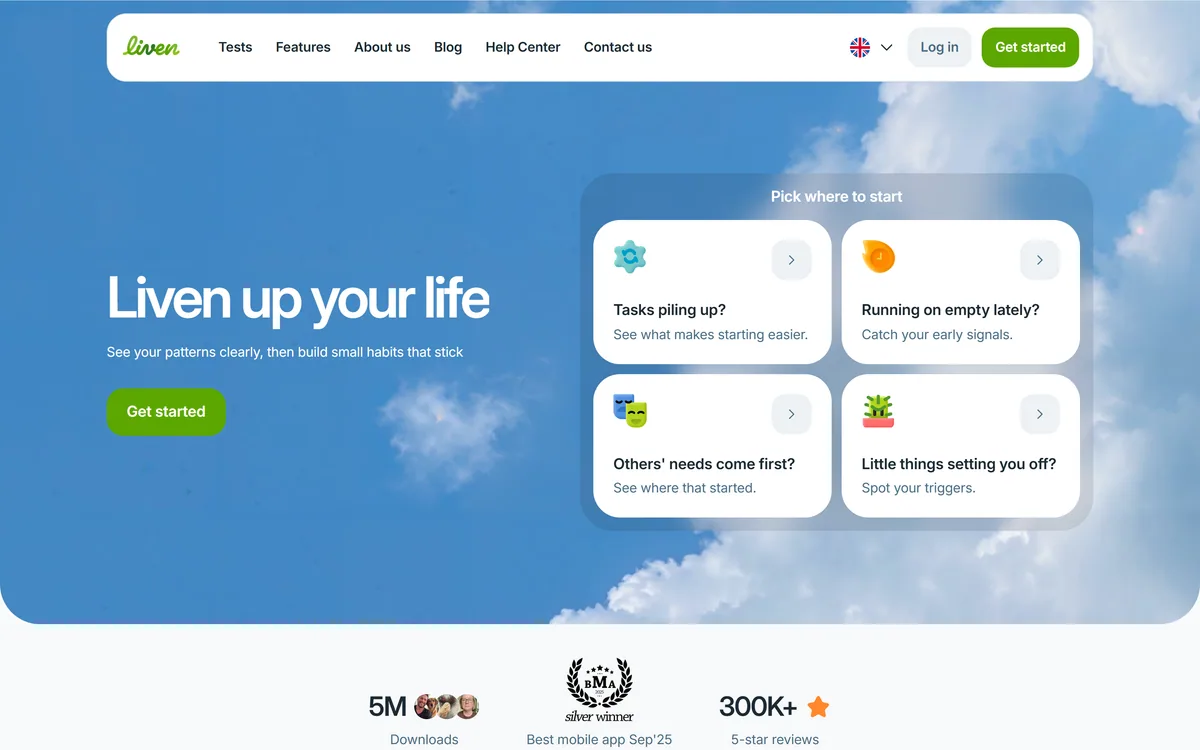
Liven is a wellbeing and self-development app combining short courses on procrastination, stress and burnout with mood tracking, guided journaling, habit building and an AI companion called Livie. The company states it was co-created with more than fifteen licensed therapists and psychologists.
Not therapy, and not medical advice. This is a review of a consumer wellbeing app. Liven is not a treatment, a diagnosis, or a substitute for professional mental health care. If you are struggling, speak to a doctor or a qualified therapist. If you are in crisis, contact your local emergency services or a crisis line — no app is the right thing to reach for at that point.
The named psychologists are the reason to take this more seriously than most of the category.
Content, Credentials And Reach
Category
Wellbeing, self-development and mood tracking
Core content
Micro-courses on procrastination, stress, burnout, emotional regulation and overthinking
Tracking
Mood tracking with pattern recognition over time
Reflection tools
Guided journaling prompts
AI companion
Livie, for non-judgemental conversation about feelings and challenges
Practice feature
Role-play for rehearsing difficult conversations
Progress
Personal Growth Map
Habit tools
Routine and habit building
Audio
Binaural beats and nature sounds
Human support
One-to-one coaching access
Stated clinical input
Co-created with 15+ licensed therapists and psychologists, including Dr Amanda Jensen in clinical psychology, Dr Maike Neuhaus in positive psychology and Dr Travis Fox in psychology
Platforms
iOS and Android
Languages
English, French, German, Portuguese and Spanish
Stated scale
5 million downloads and more than 300,000 five-star reviews, per the company
Recognition
Cited as a silver winner for best mobile app in a 2025 industry award
Charging model
Subscription with a trial period; no prices published here
What Liven Actually Offers
Liven is a mobile wellbeing app that combines short structured courses on things like procrastination and burnout with mood tracking, guided journaling and habit tools, rather than being a single-purpose meditation or therapy app.
Livie is the AI companion, positioned for non-judgemental conversation about how you are feeling, alongside role-play practice for difficult conversations.
The clinical involvement is named — the company states co-creation with more than fifteen licensed therapists and psychologists, and names several with doctoral qualifications.
Structure sits underneath it: a Personal Growth Map tracking progress, plus routine building, binaural beats and nature sounds.
Five million downloads and 300,000+ five-star reviews are cited, with iOS and Android apps in five languages.
Naming The Psychologists Is The Differentiator
The wellbeing app category is enormous and mostly unaccountable. Thousands of apps promise to reduce anxiety, and the overwhelming majority were built by product teams with no clinical involvement at all.
Liven states co-creation with more than fifteen licensed therapists and psychologists, and — more usefully — names several with their qualifications and specialisms. Dr Amanda Jensen in clinical psychology, Dr Maike Neuhaus in positive psychology, Dr Travis Fox in psychology.
Naming people is a meaningfully higher standard than the usual formulation. Developed with experts is unfalsifiable; a named individual with a stated doctorate is a person whose involvement can be checked and whose professional reputation is attached to the product.
That does not make the app clinically validated, and the distinction matters. Content designed by psychologists is not the same as an intervention tested in a trial and shown to produce an outcome. Very few consumer wellbeing apps have the latter, and Liven does not claim it.
What it does mean is that the material is more likely to reflect established practice — the courses on procrastination and emotional regulation draw on approaches with a real evidence base behind them, rather than being invented by a copywriter.
For a category where the floor is very low, that is a genuine reason to take this one more seriously than most, and it is worth weighing alongside Wysa and others that make comparable claims.
Developed with experts is unfalsifiable. A named psychologist with a stated doctorate is a person whose reputation is attached to the product, which is a different standard entirely.
Micro-Courses Suit The Problems They Target
The content format is short structured courses on specific difficulties — procrastination, stress, burnout, overthinking — rather than open-ended content, and that choice fits the subject matter well.
The reason is that these are behavioural patterns rather than moods. Procrastination is not something you feel better about; it is something you do differently, and changing it requires understanding the mechanism and then practising an alternative. A structured sequence suits that far better than a library you browse.
It also addresses the specific failure of meditation and mindfulness apps for a large group of users. Those apps are excellent for people who want to feel calmer and frustrating for people whose problem is that they cannot start the thing they need to do. Different problem, different tool.
Meditation-first apps like StillMind assume a calmer starting point. Micro-length matters too. Someone in the middle of burnout does not have the capacity for a forty-minute module, and a course that demands it becomes another thing they have failed at — which is precisely the wrong outcome.
Pairing this with mood tracking is a sensible combination rather than feature accumulation. Patterns are genuinely hard to see from inside: noticing that your low days cluster after poor sleep, or in a particular week of the month, is the kind of insight that only emerges from data you did not know you were collecting.
The guided journaling completes it. Prompted reflection is more useful than a blank page for most people, which is the same insight Rosebud is built around.
An AI Companion In An Emotional Context Needs Care
Livie is positioned as offering non-judgemental conversation and endless compassion, and this is the part of the product that warrants the most thought.
The appeal is real and worth acknowledging rather than dismissing. Many people have nobody to talk to at 2am, find it easier to articulate something difficult in writing than aloud, or want to think through a feeling without worrying about burdening a friend. An always-available, unjudging listener genuinely serves those needs.
The risks are equally real and less discussed. An AI companion is agreeable by design. It is built to be supportive, which means it is poorly placed to challenge a distorted thought, notice that a pattern is worsening, or say the uncomfortable thing a therapist would say. Validation is helpful; validation alone is not therapy.
It cannot escalate reliably. A qualified professional recognises risk indicators and knows what to do about them. Whether and how an AI companion detects and responds to someone in genuine crisis is the single most important question about any product in this category, and the site does not describe it.
It can substitute rather than supplement. Someone whose emotional needs are being partially met by an app may delay seeking help that would actually change things — which is the outcome nobody intends and the one worth naming.
The role-play feature is the more clearly positive use of the same technology. Rehearsing a difficult conversation before having it is a recognised technique, it has a defined endpoint, and it does not risk becoming the relationship itself.
Use the courses and mood tracking first — they are the parts with the clearest rationale.
Treat Livie as a place to order your thoughts, not as a source of assessment or advice.
Notice if you are talking to the app instead of to people, which is the pattern to watch for.
Use the role-play feature for its intended purpose — rehearsing a specific conversation.
If something is not improving over weeks, speak to a doctor or therapist rather than continuing alone.
Reading Five Million Downloads
The scale figures are prominent and they need the same handling as any consumer app's numbers.
Five million downloads counts installations, not people who used the app twice. Wellbeing apps have among the highest abandonment rates of any category — the widely observed pattern is that most users stop within days, and download counts capture intent rather than benefit.
More than 300,000 five-star reviews is a stronger signal because leaving a review requires effort. It is worth knowing that apps prompt for reviews at moments chosen to maximise positive responses, so the distribution skews upward everywhere — but a number that large across a real user base still means something.
The award citation is a silver placing in an industry marketing award, which is recognition of the product as a product rather than an assessment of whether it helps anyone.
None of these are misleading. They describe a real and reasonably popular app, and none of them tell you whether it will work for you — which in this category is unusually individual.
The figure that would be genuinely useful, and that essentially no wellbeing app publishes, is retention: what share of users are still engaging after a month. Its absence here is normal rather than suspicious.
What A Subscription Buys Here
This site does not publish plan prices. Liven's structure is subscription with a trial period, which is the near-universal shape in this category and carries a few things worth knowing.
Wellbeing apps are bought on impulse, frequently at a low moment, and abandoned within weeks — which makes them one of the categories where forgotten subscriptions accumulate most. Set a reminder before the trial ends rather than relying on remembering.
The specific question to establish is what sits behind the paywall. The site describes one-to-one coaching access alongside the automated features, and human coaching is materially more expensive to deliver than app content. Whether that is included, limited by session, or an additional purchase is worth knowing before subscribing, because it is the most valuable thing on the list.
Annual plans in this category typically carry a substantial discount over monthly, which is good value if you use it and a year of payments for three weeks of use if you do not. Monthly first is the sensible order.
The comparison worth running is against actual therapy. A wellbeing subscription costs a fraction of a session, and it is not the same product — for someone who needs therapy, the app is not a cheaper version of it. For someone who wants structure around ordinary difficulties, it is a reasonable thing to spend money on.
Free alternatives exist for several individual components — mood tracking, journaling, breathing exercises — so the subscription is buying the courses, the structure and the integration rather than any single feature.
Would This Help You?
Worth Downloading If
You are dealing with procrastination, overthinking or low-level burnout rather than a clinical condition
Structured short courses suit you better than open-ended meditation content
You want to see patterns in your mood that are hard to notice from inside
Guided prompts help you reflect where a blank journal page does not
You want to rehearse a difficult conversation before having it
Get Real Support If
You are experiencing symptoms that are affecting your ability to function
You are in crisis — contact emergency services or a crisis line, not an app
You would use the AI companion instead of talking to people in your life
You need diagnosis, treatment or medication, none of which an app provides
You have tried self-directed tools before and they have not helped
Key features of Liven
Micro-courses on procrastination, stress, burnout and emotional regulation
Mood tracking with pattern recognition over time
Guided journaling prompts
Livie, an AI companion for non-judgemental conversation
Role-play practice for difficult conversations
Personal Growth Map for tracking progress
Routine and habit building tools
Binaural beats and nature sounds
One-to-one coaching access
iOS and Android apps in five languages
Pros & cons
Pros
6
Naming psychologists with stated qualifications is a much higher standard than the category norm
Short structured courses suit behavioural problems better than open-ended content
Micro-length respects the reduced capacity of someone actually experiencing burnout
Mood tracking surfaces patterns that are genuinely hard to see from the inside
Role-play is a well-founded use of AI with a clear endpoint
Offering human coaching alongside the automated tools is the right acknowledgement of limits
Cons
6
An AI companion is agreeable by design, which is the opposite of what challenging a distorted thought requires
Nothing published about how the companion detects or handles someone in crisis
Download counts say nothing about whether people kept using it
Content built with psychologists is not the same as a validated intervention
Wellbeing subscriptions are unusually easy to forget after a low-moment purchase
Whether one-to-one coaching is included or extra is not made clear
Best For
People working on procrastination and follow-through
Anyone wanting structure around stress and low-level burnout
Those who prefer short courses to open-ended meditation content
People who want to see patterns in their own mood over time
Anyone rehearsing a difficult conversation before having it
Liven Beside Other Wellbeing Apps
These differ on what they are actually for, which matters more here than feature overlap.
Rosebud — guided journaling if reflection is the part you want
Habit Coach AI — habit and routine building without the wellbeing framing
StillMind — the calm-and-meditation end of the same category
Wellbeing Claims, Checked
Last checked . Read from theliven.com during this check, with the screenshot above captured at the same time.
Described as a wellbeing and self-discovery app offering micro-courses on procrastination, stress, burnout and emotional regulation
Mood tracking with pattern recognition and guided journaling stated on site
AI companion named as Livie, described as offering non-judgemental conversation
Role-play practice for difficult conversations stated on site
Personal Growth Map, routine and habit tools, binaural beats and nature sounds all stated
One-to-one coaching access referenced
Company states the app was co-created with more than fifteen licensed therapists and psychologists
Named experts include Dr Amanda Jensen in clinical psychology, Dr Maike Neuhaus in positive psychology and Dr Travis Fox in psychology
Platforms stated as iOS and Android, with multilingual support in English, French, German, Portuguese and Spanish
Scale stated as 5 million downloads and more than 300,000 five-star reviews
A 2025 industry award silver placing for best mobile app is cited
Subscription with a trial period referenced; no plan prices published here, in line with this site's pricing policy
Download counts, review totals and expert involvement are as stated by the company and were not independently verified. Content designed with psychologists is not the same as a clinically validated intervention, and the site makes no such claim. The material does not describe how the AI companion detects or responds to someone in crisis, which is the most important question about any product in this category — this app is not therapy, diagnosis or treatment.
Editor's Verdict
3.6/5
Naming the psychologists behind the content is the thing that separates this from the bulk of the wellbeing category, and pairing short courses with mood tracking and journaling is a coherent design rather than a feature list. The score is held down because an AI companion in an emotional context carries risks the app does not visibly address, and because five million downloads says nothing about whether anyone kept using it. AInexfinder Editor Score: 3.6/5.
Liven pricing
AInexfinder does not list plan prices or billing details. For current pricing, plans, and trials, visit the official Liven website.
Vendor pricing, credits, and billing policies change over time. Always confirm on the official site before you buy.
Frequently asked questions
What is Liven?
A mobile wellbeing app combining short courses on procrastination, stress and burnout with mood tracking, guided journaling, habit tools and an AI companion called Livie. The company states it was co-created with more than fifteen licensed therapists and psychologists.
Is Liven a replacement for therapy?
No, and it does not claim to be. Content designed with psychologists is not the same as a clinically validated treatment. If symptoms are affecting your ability to function, speak to a doctor or a qualified therapist rather than relying on an app.
What does Livie, the AI companion, actually do?
It offers non-judgemental conversation about how you are feeling. The caution worth holding is that an AI companion is agreeable by design, which makes it poorly placed to challenge a distorted thought or notice that a pattern is getting worse.
Are Liven's courses evidence-based?
The company names psychologists with doctoral qualifications who contributed, which is a higher standard than most of this category meets. That makes the material likely to reflect established practice — it is not the same as the app itself having been tested in a trial.
Is Liven free?
It is subscription-based with a trial period. Set a reminder before the trial ends — wellbeing apps are bought at low moments and abandoned within weeks, which makes them one of the easiest subscriptions to forget you are paying for.
Liven vs Wysa — which should I use?
Wysa is more clinically oriented and built around conversational support using CBT techniques. Liven is broader, with structured courses on things like procrastination alongside its companion. If your need is emotional support, Wysa; if it is self-development structure, Liven.
What should I do if I am in crisis?
Contact your local emergency services or a crisis line immediately. No wellbeing app is the right thing to reach for at that point, and Liven's material does not describe how its AI companion detects or responds to someone at risk.
Daniel reviews AI tools the slow way — by actually using them on real projects. His reviews cover what works, what breaks, and who each tool is genuinely a good fit for.
Daniel and the AInexfinder editorial team research Liven using public product information, listing evidence, and (when available) hands-on checks. Scores reflect listing completeness and transparency — not paid placement.
Listings may include affiliate or sponsored placements, which are labeled when present. Editorial scores and cons are not sold. See our affiliate disclosure and review methodology.
Youper is an AI emotional-health assistant built around conversational check-ins, mood tracking and journaling. The company has announced it is shutting down on 30 September 2026, after which accounts, chat history and personal data are permanently deleted.
Earkick is an iOS self-care app built around a panda companion, offering mood and anxiety check-ins, progress statistics, breathing and CBT exercises, soundscapes and a panic button. It states that everything stays on your device or in your own iCloud, with no registration and no tracking.
Soula is an emotional support companion built for women, distinguished by memory: it retains conversation history across sessions and surfaces patterns in stress, sleep and mood over weeks. It states plainly that it is not therapy, routes crises to human help, and is built by MAMATECH Ltd with GDPR compliance and encryption.
Mindsera is an AI journalling app that analyses entries as you write, surfaces patterns and emotions over time, and offers more than fifty mental models as structured prompts. It accepts typed, spoken and photographed handwritten entries, and runs on iOS, Android and the web.
Wysa is an anonymous, CBT-based AI mental-health support tool designed as a safer alternative to general AI, with human-in-the-loop clinical oversight, backed by peer-reviewed research, and sold to health systems, employers and insurers, not a substitute for professional care.
Moody Month is an iOS hormone-tracking app that gives daily forecasts across the cycle, perimenopause, pregnancy and postpartum, with symptom logging, wearable integration and content, from a women-owned team, with privacy you should still read carefully.