Mindsera is an AI journalling app that analyses entries as you write, surfaces patterns and emotions over time, and offers more than fifty mental models as structured prompts. It accepts typed, spoken and photographed handwritten entries, and runs on iOS, Android and the web.
Journalling has a well-documented problem, and it is not that people doubt it works. It is that a blank page at the end of a long day produces either nothing or the same three sentences you wrote yesterday.
Mindsera's response is to remove the blankness in two directions, which is a different bet from the guided-prompt approach of Reflectly. It supplies structure going in — frameworks that tell you what question to answer — and it supplies a response coming out, reading the entry and reflecting something back rather than filing it away.
Both halves are genuinely useful and both deserve scrutiny. This review covers what the mental models actually do, why the emotional analysis is more sophisticated than the category norm, the thing this product is careful not to claim, and the question about privacy that anyone should ask before writing their interior life into someone's database.
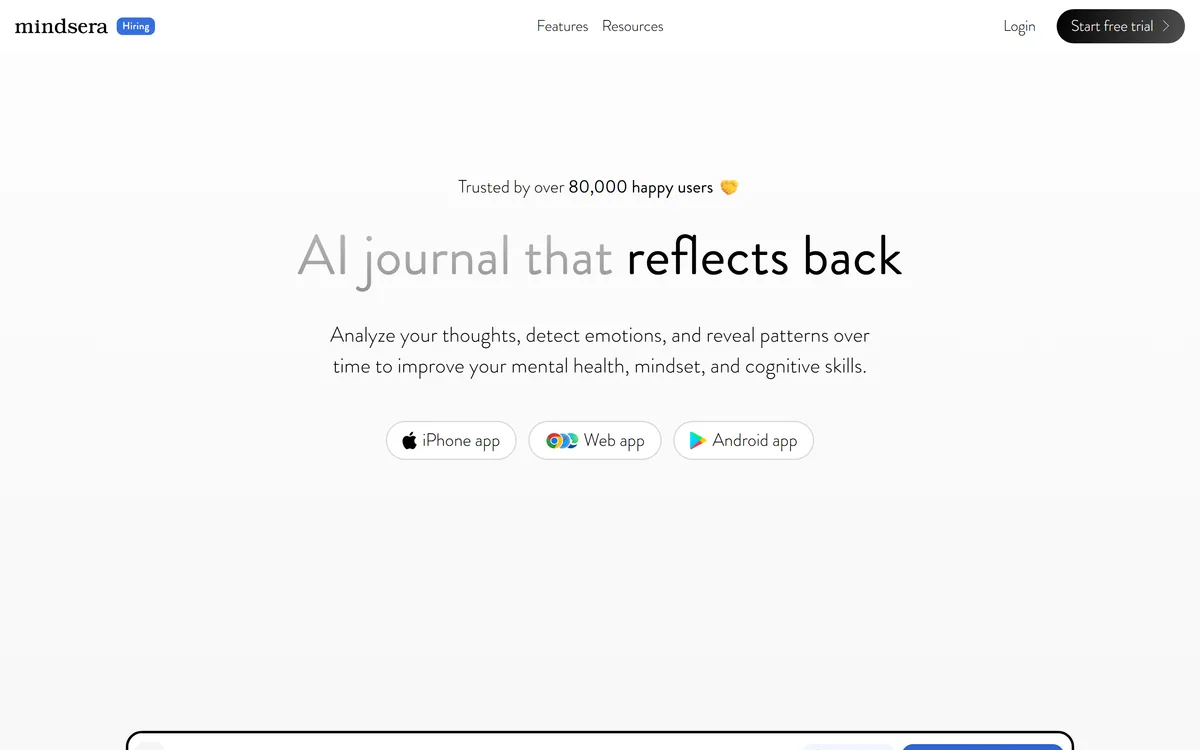
Mindsera's homepage, captured 9 September 2026. The pitch is analysis rather than storage, which is the whole distinction from a notes app.
Journaling With A Reader Attached
It reads as you write, highlighting passages and offering commentary through named lenses — alternative perspectives, thinking traps, stoic principles.
More than fifty mental models are offered as structured prompts, from first principles to regret minimisation, which solves the blank-page problem.
Emotions are mapped on Plutchik's wheel rather than a five-point mood slider, giving considerably more precision than most journalling apps attempt.
Three input methods: type, speak, or photograph a handwritten page and have the text extracted.
Available on iOS including Apple Watch, Android and the web, with a free trial before subscription.
Mindsera: The Stated Details
Product type
AI journalling and reflection app
Input methods
Typed text, voice journalling, and photographing a handwritten page for text extraction
Analysis
Real-time reading of entries, highlighting passages and offering commentary through named lenses
Framework library
50+ mental models offered as structured prompts and exercises
Emotional analysis
Mapped onto Plutchik's wheel of emotions
Pattern detection
Themes, recurring emotions and main ideas surfaced across entries over time
Platforms
iOS including Apple Watch, Android, and web
Positioning
Mental wellbeing, mindset and cognitive skills — not therapy or treatment
Pricing model
Free trial, then subscription
Stated user base
Over 80,000 users, per the homepage
Frameworks Mindsera Uses
Four of the named models in the library, and what each is actually for.
First principles thinking
Breaking a problem down to what you know to be true and reasoning up from there, rather than reasoning by analogy to how it is usually done.
Regret minimisation
Choosing by imagining yourself much older and asking which option you would regret not taking. Useful for decisions where short-term risk is distorting the picture.
Anti-goals
Defining what you want to avoid rather than what you want to achieve. Frequently clarifies a decision faster, because people know what they dread more precisely than what they want.
Plutchik's wheel
A model arranging eight primary emotions with varying intensities and blended states. Used here to name feelings more precisely than a mood rating can.
Fifty Mental Models As Writing Prompts
The library spans well over fifty frameworks — first principles thinking, anti-goals, regret minimisation, ikigai, energy audits, daily review and many more — offered as structured prompts and exercises rather than as reading material.
This is the most substantial thing about the product and it is easy to undersell. A mental model presented as an article is something you nod at and forget. The same model presented as three questions about a decision you are currently facing is a thinking tool, because it forces application rather than recognition.
The regret minimisation framework is a good example of the difference. Read as a concept it is a line about imagining yourself at eighty. Used as a prompt against a specific job offer you are agonising over, it produces a paragraph you would not otherwise have written, and occasionally changes your mind.
The honest limitation is that fifty frameworks is more than anyone needs and considerably more than anyone will use. Most people would get nearly all the value from four or five, applied repeatedly, and a large library invites browsing instead of thinking. Pick a small number and return to them.
A framework you read is a fact you forget. A framework applied to the decision in front of you is a tool.
Three Ways In: Type, Speak, Photograph
Entries can be typed, spoken aloud, or captured by photographing a physical journal, with the handwriting extracted into text.
The third of these is the thoughtful one, and it resolves a genuine tension. A meaningful number of people who journal seriously do it by hand and would not switch — writing longhand is slower, which is precisely the point, and a screen at bedtime is the thing they were escaping.
Photographing the page lets them keep the practice and still get the analysis, which is a better answer than asking them to abandon a habit that works. Whether handwriting recognition holds up on your particular script is the thing to test in a trial rather than assume.
Voice entry serves a different case: the drive home, the walk, the moment when thinking is happening and typing is not possible. It also tends to produce different material from typing — more rambling, less edited, and occasionally more honest for exactly that reason.
Plutchik's Wheel Instead Of A Mood Slider
Most journalling apps ask you to rate your mood from one to five. Mindsera analyses the text and maps emotions onto Plutchik's wheel, a model that arranges eight primary emotions with intensities and blends.
The choice matters more than it sounds. A five-point slider collapses everything into good or bad, which is close to useless for noticing anything about yourself. Plutchik's structure distinguishes anticipation from joy, and apprehension from fear — differences that carry real information about what is actually happening in a week.
It is also worth being clear about what the analysis is. A model is reading your words and inferring emotional content from them. It is not measuring your emotional state; it is characterising your description of it. Those come apart precisely when it matters most — when you are writing carefully around something rather than about it.
Used with that understanding, the pattern data over months is the genuinely valuable output. Individual entries are noise. A trend showing that a particular category of obligation reliably precedes a dip is the kind of thing nobody notices from the inside and a record makes obvious.
Read the emotional analysis as a description of your writing, not a measurement of you.
Weight the multi-month pattern heavily and any single entry's reading barely at all.
Notice when the analysis disagrees with how you felt — the disagreement is often the interesting part.
Do not treat a negative trend as a diagnosis; treat it as a prompt to talk to someone qualified.
Write honestly rather than for the analysis, or the record measures your performance instead of your life.
The Line This Product Does Not Cross
Mindsera positions itself around mental wellbeing, mindset and cognitive skills. Those are deliberately chosen words and the distinction they draw is the right one.
Journalling with structured reflection is a wellbeing practice with a reasonable evidence base behind it, and it is not what a conversational support tool such as Youper is doing either. It is not therapy, it is not treatment, and an AI reading your entries is not a clinician — it has no training, no duty of care, no ability to notice what you are not saying, and no way to act if something is seriously wrong.
That distinction matters most at the moment it is easiest to blur. Someone writing every night about the same worsening situation is exactly the person who might accept a supportive response as sufficient, and a tool that always answers thoughtfully can become a substitute for a conversation with a person who could actually help.
It is worth stating plainly rather than as a disclaimer: if what you are writing about is persistent, worsening, or involves thoughts of harming yourself, the correct next step is a doctor or a crisis service, not another entry. A journal is a good companion to that and a poor replacement for it.
Used within its actual scope — noticing patterns, thinking more clearly about decisions, building a reflective habit — the product is genuinely useful, and the value is real.
Your Journal Is The Most Sensitive File You Own
A journal contains material that exists nowhere else: what you actually think about your job, your relationships, your health, your fears. It is more revealing than your email and considerably more revealing than your search history.
That makes the handling of it the most important question about any product in this category, and the one users are least likely to ask before signing up.
The specific things worth establishing before you write anything real: whether entries are encrypted at rest, whether they are encrypted in a way that prevents the company reading them, whether entries are processed by a third-party model provider and under what terms, whether they are used for training, how long deleted entries persist, and what happens to everything if the company is acquired or closes.
The last of those is underrated. Consumer wellbeing apps are bought and sold regularly, and the acquirer's data practices are not the ones you agreed to.
Our advice is practical rather than alarming. Read the privacy policy before the first real entry, not after fifty of them, because by then the cost of leaving is a year of your interior life. And be aware that any journal processed by a language model is, by construction, being read by something.
One straightforward mitigation exists for particularly sensitive material: keep it on paper, or move it to a practice such as StillMind that records nothing at all. The photograph feature means you can still bring in what you want analysed and leave out what you do not.
A Fortnight Is The Right Trial Length
Journalling apps produce a strong first week and a revealing second one. The trial is long enough to see both if you use it properly.
The bar is step five. A journal you write for an audience — even an artificial one — stops being a journal, and that is the specific failure mode of this category.
Read the privacy policy first, before the first entry. This is the one product where that order genuinely matters.
Pick two mental models, not twenty. Use the same two for the fortnight rather than browsing the library.
Write at the same time each day, because the habit is the active ingredient and the analysis is the addition.
Test the input method you would actually use — if you write by hand, photograph a real page and see whether your handwriting survives extraction.
At day fourteen, reread your first entry and ask whether you wrote it honestly or wrote it to be read. If the latter, the tool is shaping the record rather than reflecting it.
Then look at the pattern view. If it shows you something you had not noticed, that is the product working; if it restates what you already knew, it is a well-designed notebook.
The Subscription, And Getting Your Entries Out
Access begins with a free trial and continues as a subscription. Apps for iOS, including Apple Watch, and Android are available alongside the web version.
The subscription structure is standard for the category and carries the standard risk with it: wellbeing subscriptions are bought in a moment of intent and cancelled long after the practice lapsed. Set a reminder before renewal and ask honestly whether you are still writing.
One consideration specific to journalling apps deserves more weight than price. Before committing to a year of entries, find out how you get them out. A journal you cannot export is a journal you can lose, and the ability to leave with your own material is worth more than any feature.
We do not publish amounts, since they change. Check the export options, the trial length and the cancellation terms together before subscribing.
Who Gets Value From Mindsera
Worth a fortnight if
You have tried to journal several times and stopped because you did not know what to write.
You are facing a genuine decision and want a structured way to think it through rather than circle it.
You want to notice patterns across months that are invisible from inside a single week.
You write by hand and want the analysis without abandoning the practice — the photograph route is built for exactly this.
You find mood sliders useless and want emotional vocabulary with more precision than good or bad.
Not for you if
You are looking for treatment for a mental health condition — this is a wellbeing tool and says so, and a qualified professional is the right answer.
The privacy of your journal is paramount and you would not accept a language model processing it, which is what makes the analysis possible.
You already journal consistently and find the practice works; adding an analyst may shape what you write rather than reflect it.
You want conversation in the moment rather than reflection after it, which is a different kind of tool.
You would find yourself writing for the analysis, which quietly turns a journal into a performance.
Key features of Mindsera
Real-time analysis of entries as you write, with passages highlighted and commentary offered
More than fifty mental models available as structured prompts and exercises
Emotional analysis mapped onto Plutchik's wheel rather than a simple mood rating
Pattern and theme detection across entries over weeks and months
Voice journalling for entries made away from a keyboard
Photograph a handwritten page and have the text extracted for analysis
Named analytical lenses including alternative perspectives, thinking traps and stoic principles
Apps for iOS with Apple Watch support, Android, and the web
Pros & cons
Pros
6
Framework prompts solve the blank-page problem that ends most journalling attempts
Mental models applied to a live decision are genuinely more useful than the same models read as articles
Plutchik's wheel gives real emotional vocabulary where competitors offer a five-point slider
Photographing handwritten pages respects a practice that works rather than demanding you abandon it
Pattern detection across months surfaces things invisible from inside a single week
Positioning is careful and honest — wellbeing and thinking, explicitly not therapy
Cons
6
The site blocked our automated fetch, so its privacy, encryption and data-handling terms could not be read
Emotional analysis characterises your writing rather than measuring your state, and the two diverge exactly when it matters
No underlying AI model is identified, so it is unclear who processes your most private material
Fifty frameworks is far more than anyone will use, and a large library invites browsing over thinking
The stated user figure is a vendor count with no published basis
Knowing an entry will be read can change what you write, which undermines the point of a journal
Best For
People who have repeatedly tried and failed to sustain a journalling habit
Anyone working through a significant decision who wants structure for it
Users who want long-term emotional and thematic patterns rather than daily records
Handwriting journallers who want analysis without giving up paper
Those who find mood ratings too blunt to be informative
Mindsera Against Other Reflection Tools
These products differ on what they do with what you write, which matters far more than how the writing interface looks.
Tool
Approach
What it gives back
Best for
Mindsera
Structured journalling with framework prompts
Analysis, emotional mapping and long-term patterns
People who want to think more clearly, not just record
Different mechanisms for adjacent problems — reflection, dialogue, habit and attention are not the same thing.
Youper — conversational support in the moment, drawing on therapeutic techniques
Reflectly — simpler guided journalling if the habit itself is the obstacle
Liven — structured wellbeing programmes rather than open-ended reflection
StillMind — meditation, for settling the mind rather than examining it
Pattrn — habit and consistency tracking, if what you want is behaviour rather than reflection
What The Screenshot Confirmed, And What It Could Not
Last checked . The site returned a 403 to our automated fetch, so facts here come from the captured screenshot above and from the vendor's own published articles and app listings.
Homepage headline and positioning confirmed from the captured screenshot: an AI journal that analyses thoughts, detects emotions and reveals patterns over time to improve mental health, mindset and cognitive skills
Platform availability confirmed from the screenshot as iPhone app, web app and Android app
A stated user figure of over 80,000 appears on the homepage
A framework library of more than fifty mental models is described across the product's own material, including first principles, anti-goals, regret minimisation, ikigai and daily review
Real-time analysis described as reading entries while you write, highlighting passages and offering commentary through named lenses including alternative perspectives, thinking traps and stoic principles
Emotional analysis described as using Plutchik's wheel of emotions rather than a simple mood rating
Three input methods described: typed text, voice journalling, and photographing a physical journal for text extraction
A free trial is offered on the homepage before subscription
What we could not confirm: the site blocked our automated fetch with a 403 response, so we could not read the footer, privacy policy or terms; consequently we cannot say how entries are encrypted, whether they are processed by a third-party model provider, whether they are used for training, how deletion works, or what export options exist. The 80,000 user figure is a vendor count with no published basis. No underlying AI model is identified. Read the privacy policy yourself before your first real entry — for this category, that is the single most important check.
Editor's Verdict
3.9/5
Mindsera scores respectably because it answers the question that stops most people journalling — what do I write about — with structured frameworks rather than a blank page, and because analysing an entry for patterns is something a paper notebook genuinely cannot do. Photographing a handwritten page is a thoughtful bridge for people who write by hand but want the analysis. It loses ground because the emotional feedback rests on a model reading text rather than on anything clinical, because a journal is the most private document most people keep and the site says little about encryption or data handling, and because the reflective distance that makes journalling valuable is partly created by nobody answering. AInexfinder Editor Score: 3.9/5.
Mindsera pricing
AInexfinder does not list plan prices or billing details. For current pricing, plans, and trials, visit the official Mindsera website.
Vendor pricing, credits, and billing policies change over time. Always confirm on the official site before you buy.
Frequently asked questions
What does Mindsera do?
It is an AI journalling app that reads your entries as you write, highlights passages and offers commentary through named lenses, maps emotional content onto Plutchik's wheel, and surfaces themes and patterns across entries over time. It also offers more than fifty mental models as structured writing prompts.
Is Mindsera free?
There is a free trial, after which it is a subscription, with apps on iOS including Apple Watch, Android and the web. We do not publish amounts because they change. Before committing, check the export options as well as the price — a journal you cannot get out of an app is a journal you can lose.
Is Mindsera a replacement for therapy?
No, and it does not claim to be — it positions itself around wellbeing, mindset and cognitive skills, which is the honest framing. An AI reading your entries has no clinical training, no duty of care and no ability to act. If what you are writing about is persistent, worsening, or involves thoughts of harming yourself, speak to a doctor or a crisis service.
Is my journal private in Mindsera?
We could not verify this. The site returned a 403 to our automated fetch, so we could not read its privacy policy or terms, and cannot say how entries are encrypted, whether a third-party model processes them, or whether they are used for training. Read the policy yourself before your first real entry. Note also that any journal analysed by a language model is, by construction, being read by something.
What are the mental models in Mindsera?
More than fifty thinking frameworks presented as prompts rather than reading — first principles thinking, anti-goals, regret minimisation, ikigai, energy audits and daily review among them. The value is in application: the same framework read as an article is forgettable, and used against a decision you are currently facing it produces something you would not otherwise have written.
Can Mindsera read my handwritten journal?
Yes — you can photograph a page from a physical journal and have the text extracted for analysis. This is one of the better ideas in the product, because it lets people who write by hand keep that practice while still getting the pattern analysis. Test it on your own handwriting during the trial rather than assuming it will cope.
How accurate is the emotion detection?
Treat it as a characterisation of your writing rather than a measurement of your feelings — a model inferring emotional content from words, which diverges from reality exactly when you are writing carefully around something. Read the multi-month pattern rather than any single entry, and note that where the analysis disagrees with how you felt is often the most interesting signal.
Daniel reviews AI tools the slow way — by actually using them on real projects. His reviews cover what works, what breaks, and who each tool is genuinely a good fit for.
Daniel and the AInexfinder editorial team research Mindsera using public product information, listing evidence, and (when available) hands-on checks. Scores reflect listing completeness and transparency — not paid placement.
Listings may include affiliate or sponsored placements, which are labeled when present. Editorial scores and cons are not sold. See our affiliate disclosure and review methodology.
Youper is an AI emotional-health assistant built around conversational check-ins, mood tracking and journaling. The company has announced it is shutting down on 30 September 2026, after which accounts, chat history and personal data are permanently deleted.
Soula is an emotional support companion built for women, distinguished by memory: it retains conversation history across sessions and surfaces patterns in stress, sleep and mood over weeks. It states plainly that it is not therapy, routes crises to human help, and is built by MAMATECH Ltd with GDPR compliance and encryption.
Earkick is an iOS self-care app built around a panda companion, offering mood and anxiety check-ins, progress statistics, breathing and CBT exercises, soundscapes and a panic button. It states that everything stays on your device or in your own iCloud, with no registration and no tracking.
Wysa is an anonymous, CBT-based AI mental-health support tool designed as a safer alternative to general AI, with human-in-the-loop clinical oversight, backed by peer-reviewed research, and sold to health systems, employers and insurers, not a substitute for professional care.
Moody Month is an iOS hormone-tracking app that gives daily forecasts across the cycle, perimenopause, pregnancy and postpartum, with symptom logging, wearable integration and content, from a women-owned team, with privacy you should still read carefully.
Liven is a wellbeing and self-development app combining short courses on procrastination, stress and burnout with mood tracking, guided journaling, habit building and an AI companion called Livie. The company states it was co-created with more than fifteen licensed therapists and psychologists.