Soula is an emotional support companion built for women, distinguished by memory: it retains conversation history across sessions and surfaces patterns in stress, sleep and mood over weeks. It states plainly that it is not therapy, routes crises to human help, and is built by MAMATECH Ltd with GDPR compliance and encryption.
soula.care7 viewsAdded February 17, 20266K visitors
There is a specific gap that most mental health provision does not reach, and Soula names it precisely: two in the morning, and the ordinary hard days.
Therapy happens on Tuesday at four, and a conversational tool such as Youper answers only while you are in it. A crisis line is for a crisis. The stretch in between — the low week, the thing you keep turning over, the night you cannot sleep and do not want to wake anyone — has historically had nothing in it at all.
Whether an AI companion should fill that gap is a fair question, and this review takes it seriously in both directions. What makes Soula worth examining rather than dismissing is that it draws its own boundary clearly, which most products in this category do not.
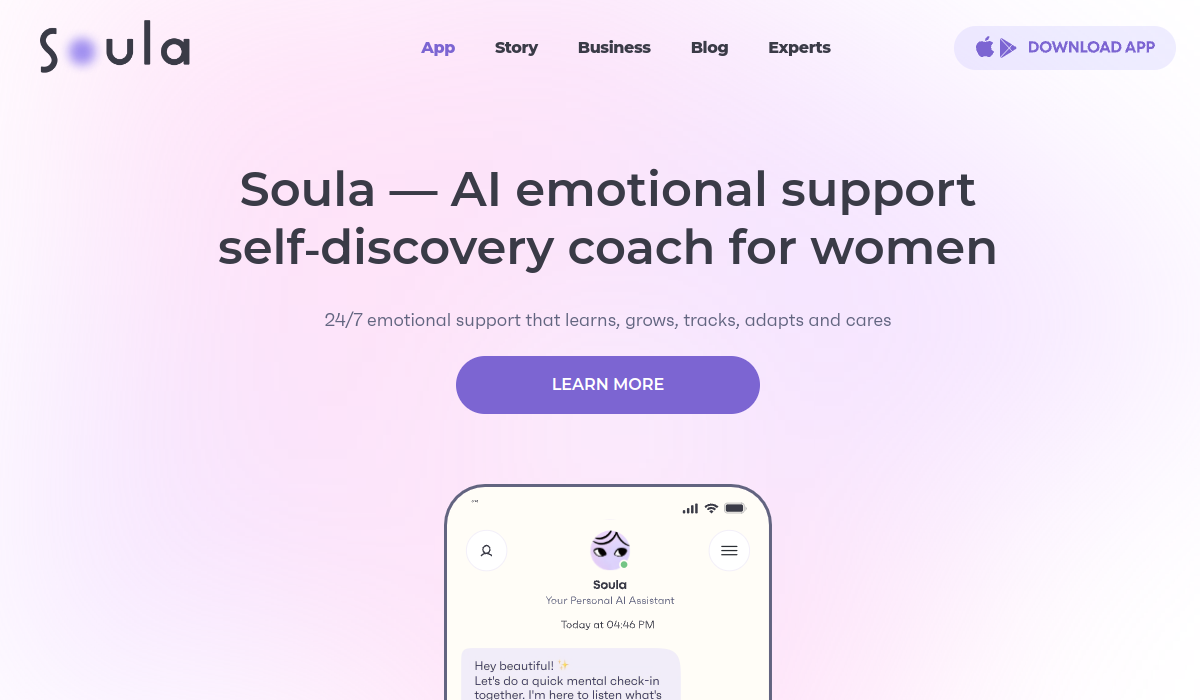
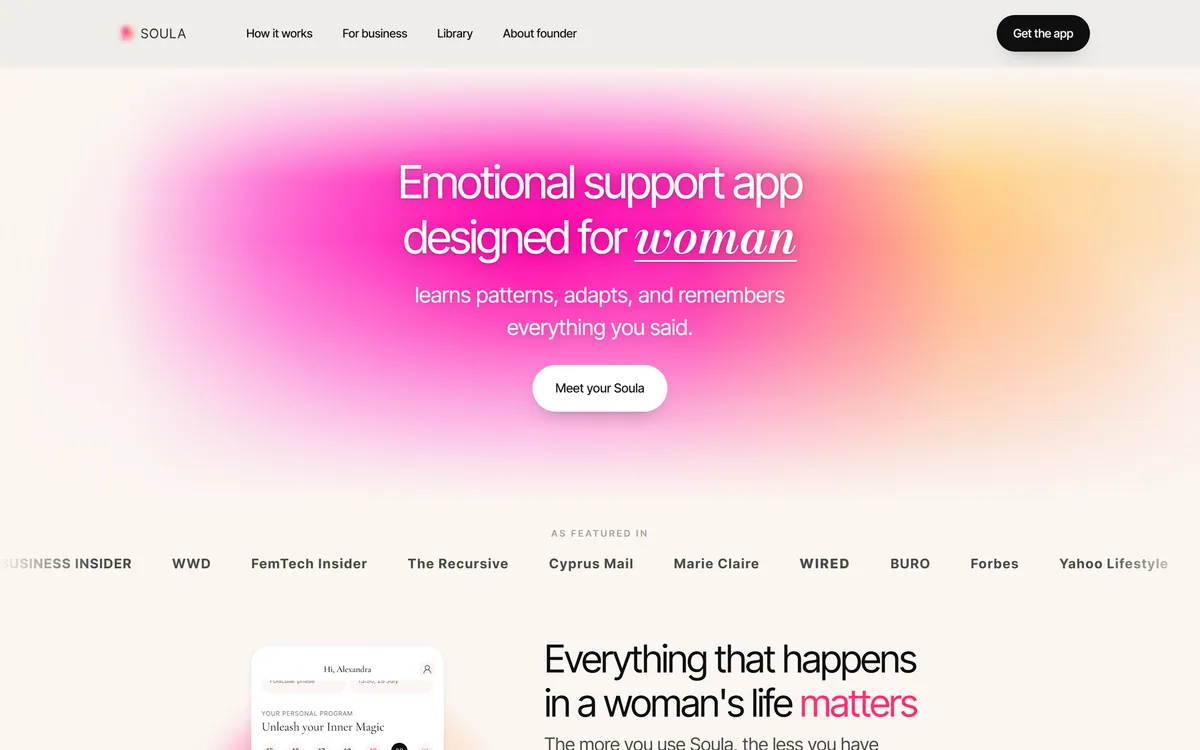
Soula's homepage, captured 9 September 2026. The boundary statement — companion, not therapy — is on the page rather than buried in terms.
What Is Soula, And What Is It Not?
An emotional support companion for women, stated by the company as explicitly not therapy and not medical treatment.
Memory is the differentiator — it retains conversation history across sessions, so you are not re-explaining your life every time you open it.
It looks for patterns over weeks in stress, sleep and mood rather than responding only to what you said today.
Crisis routing is built in: it is designed to recognise crisis situations and direct you to human help.
Built by MAMATECH Ltd, backed by Berkeley SkyDeck, Mountfund, Google for Startups and the R&I Foundation, with GDPR compliance, encryption and deletion on request.
Soula: What The Company States
Product type
AI emotional support companion for women
Positioning
Explicitly not therapy and not medical treatment
Memory
Retains conversation history across sessions
Pattern detection
Identifies stress, sleep and mood patterns over weeks
Daily interaction
30-second check-in on mood and sleep
Crisis handling
Recognises crisis situations and directs users to human help
Safety approach
Described as applying a clinical safety framework
Platforms
iOS and Android
Privacy
GDPR compliant, end-to-end encrypted, deletion available at any time, data never sold
Legal entity
MAMATECH Ltd
Founder
Natallia Miranchuk
Backers
Berkeley SkyDeck, Mountfund, Google for Startups, R&I Foundation
Pricing model
Freemium — free check-ins with a paid tier above
Published links
Terms, Privacy, Crisis resources
Memory Is The Feature That Changes The Experience
Soula retains conversation history across sessions and adapts to what it has accumulated. That sounds like a technical detail and it is the difference between a usable companion and a frustrating one.
Anyone who has tried a support chatbot knows the failure. You explain your situation, get a reasonable response, come back three days later and explain it all again — because the thing has no idea who you are. Repeating context is exhausting on a good day and impossible on a bad one, which is exactly when you would open it.
Continuity is also what a journalling tool such as Mindsera builds differently, and what makes support feel like support rather than a series of transactions. A friend who remembers what happened last month is doing something a stranger cannot, and that is true whether the friend is a person or not.
The pattern detection built on top is the more interesting half. Noticing that your sleep tends to deteriorate before your mood does, across weeks, is genuinely useful information — and it is the sort of thing nobody sees about themselves from the inside.
The consequence to hold onto is that memory is also accumulation. A product that remembers everything holds a record of your worst weeks, and that record has to be protected by something more durable than good intentions.
Being asked to re-explain your life is what makes most support chatbots useless on the day you actually need one.
Thirty-Second Check-Ins Are A Sensible Design
Soula offers a 30-second daily check-in on mood and sleep alongside longer conversation. The brevity is a deliberate and well-judged choice.
The reason wellbeing apps fail is not that people stop caring. It is that they ask for effort at exactly the moments effort is least available, and the day you skip becomes the week you skip becomes the app you delete.
A half-minute interaction survives a bad day in a way a journalling prompt does not, and consistency is what makes the pattern detection possible in the first place — sparse data produces no pattern worth reading.
It also lowers the threshold for the harder conversation, in a way a structured programme such as Liven does not. Someone who opens the app daily for something trivial is far more likely to use it on the night they need it than someone who has not opened it in three weeks.
Where The Crisis Boundary Sits
Soula states that it recognises crisis situations and directs users to human help, and that it applies a clinical safety framework. This is the most important thing about any product in this category, and it deserves examining rather than accepting.
The company's own framing is admirably clear: an emotional companion, not therapy or medical treatment, offering support in between, and encouraging clinical care where it is needed. Products that blur this line do real harm, and Soula does not blur it.
The gap is that no clinical adviser, clinician or validating body is named anywhere we could find. A clinical safety framework is a meaningful claim, and meaningful claims usually come with a name attached — a psychiatrist, a psychologist, a research partner who designed it.
That absence does not mean the framework is inadequate. It means a user cannot assess it, which for a product handling distress is a real limitation rather than a documentation quibble.
The practical position for a reader is straightforward and worth stating plainly. If you are experiencing thoughts of harming yourself, are in crisis, or have symptoms that are persistent or worsening, contact a doctor or a crisis service — not an app, and not this one. Soula's own material says the same thing, which is to its credit. Used for the ordinary hard days it describes, it is doing something reasonable.
For crisis, self-harm thoughts or worsening symptoms, contact a doctor or crisis service — not an app.
Treat it as company between appointments rather than as a substitute for them.
Notice if it becomes a reason not to talk to a person; that is the risk worth watching for in yourself.
Read the crisis resources linked in the footer before you need them, not during.
If you are already in care, tell your clinician you are using it — the pattern data may genuinely help them.
Who Is Behind Soula, And What Do They Promise?
Soula is built by MAMATECH Ltd, founded by Natallia Miranchuk, with backing from Berkeley SkyDeck, Mountfund, Google for Startups and the R&I Foundation.
That is more transparency than most consumer wellbeing apps offer, and it matters here more than in most categories. A named legal entity, a named founder and institutional backers are all things that can be checked, and they mean there is somebody accountable for the data.
On privacy the company states GDPR compliance, end-to-end encryption, deletion available at any time, and that it never sells user data. For a product holding months of intimate conversation, those are the right four commitments, and the deletion promise is the one that matters most — an emotional record you cannot remove is a liability you carry indefinitely.
Two things to weigh alongside that. Stated commitments are not audited controls, and no third-party attestation is offered. And end-to-end encryption is a term used loosely across the industry; if the service analyses your conversations to detect patterns, something is reading them, so ask what exactly is encrypted from whom.
None of this is a reason for alarm. It is a reason to read the privacy policy properly before the first real conversation rather than after fifty of them, because by then the cost of leaving is months of your interior life.
Giving It A Fair Two Weeks
There is a free tier, so this can be tested properly without committing. The point of a trial here is not whether the responses sound good — they will — but whether continuity produces anything you did not already know.
The bar is step five. Pattern detection is the claim that distinguishes this from any general assistant, and it is checkable.
Read the privacy policy and the crisis resources first. For this category that order genuinely matters.
Do the 30-second check-in daily rather than only on bad days, because sparse data produces no pattern worth reading.
Have one longer conversation in the first week about something that is actually bothering you, not a test topic.
In week two, reference something from week one without re-explaining it, and see whether the memory holds.
At day fourteen, ask it what patterns it has noticed. If it surfaces something you had not seen about your own sleep or mood, the product is working; if it restates what you told it, it is a well-written chatbot.
Then decide about paying — and check how deletion works before you do, not after.
What Soula Charges
The model is freemium, with free check-ins and a paid tier above them; amounts are not published on the pages we read. There are iOS and Android apps.
The structure is sensible for the category. Daily check-ins are the habit-forming part and cost the vendor little, so giving them away builds the pattern data that makes the paid experience worth having.
The consideration specific to this category is not price but exit. Before subscribing, establish two things: how you delete your history, and whether you can export it. A record of months of conversation is not something to leave inside a product you cannot get out of.
The other honest note is that wellbeing subscriptions are bought during a difficult period and cancelled long after it passes. Set a reminder before renewal and ask whether you are still opening it.
We do not publish amounts, since they change. Check whether the free check-in tier remains usable if you cancel, since that is the part most worth keeping.
Who Might Get Something From Soula
It may help when
The hard moments fall outside the hours when support is available — late at night, or on an ordinary difficult day.
You have abandoned support chatbots because re-explaining your situation each time was exhausting.
You want to notice patterns in your own sleep and mood that are invisible from inside a single week.
You are between appointments and want company rather than treatment in the gap.
You care that a named company with named backers is accountable for what you tell it.
It is the wrong tool when
You are in crisis or having thoughts of harming yourself — contact a doctor or a crisis service instead, which the company itself says.
Your symptoms are persistent or worsening, where clinical assessment is what is actually needed.
You would use it as a reason not to speak to a person, which is the risk this category carries.
You are unwilling to have months of intimate conversation held by a consumer app, however well intentioned.
You want a validated clinical intervention, since no clinical adviser or validation is named.
Key features of Soula
Conversational emotional support designed for women
Memory retained across sessions, so context does not need re-explaining
Pattern recognition across stress, sleep and mood over weeks
A 30-second daily check-in that survives a bad day
Crisis recognition with routing to human help
Personalisation that adapts as conversation history accumulates
iOS and Android apps with a free tier
Data deletion available at any time
Pros & cons
Pros
6
States its own boundary plainly — a companion, not therapy — which many products in this category avoid doing
Memory across sessions removes the re-explaining that makes most support chatbots unusable on a bad day
Pattern detection over weeks surfaces things invisible from inside a single week
Crisis routing to human help is designed in rather than left to the user to work out
A named legal entity, named founder and institutional backers, all of which can be checked
Deletion at any time, which is the privacy commitment that matters most for an emotional record
Cons
6
No clinical adviser or validating body is named behind the stated clinical safety framework
No outcome data, trial or published evidence of effectiveness
No underlying AI model or provider is identified
Encryption and privacy commitments are stated rather than independently attested
A product that remembers everything accumulates a record of your worst weeks
Any always-available companion carries a risk of becoming a reason not to speak to a person
Best For
Support outside the hours when other help is available
People who have found re-explaining themselves to a chatbot exhausting
Noticing personal patterns in sleep and mood over months
Company between appointments rather than instead of them
Users who want a named, accountable company behind a sensitive product
Soula Against Other Wellbeing Companions
Products in this space differ on what they are trying to be. Reading that correctly is the difference between something helpful and something that delays care.
Tool
Approach
Continuity
Boundary
Soula
Conversational companion for women
Memory across sessions with pattern detection
States clearly it is not therapy; routes crises to humans
Different mechanisms for adjacent needs — conversation, reflection, structured practice and attention are not the same thing.
Youper — conversational support drawing on recognised therapeutic techniques
Mindsera — structured journalling if you would rather write than converse
Liven — guided wellbeing programmes rather than open-ended conversation
StillMind — meditation, which records nothing and asks nothing of you
Habit Coach AI — if the gap is consistency and accountability rather than emotional support
Our Check On Soula's Claims
Last checked . Read from soula.care, including the footer, with the screenshot above captured in the same session.
Product described as an emotional support AI companion designed for women
Boundary quoted directly from the site: Soula is an emotional companion, not therapy or medical treatment
Memory across sessions confirmed, with adaptation based on accumulated conversation history
Pattern recognition described as identifying stress, sleep and mood patterns over weeks
A 30-second daily check-in interface confirmed on the site
Crisis routing described as recognising crisis situations and directing users to human help
Positioning quoted from the site: support in between, at 2am and on ordinary hard days, with clinical care encouraged where needed
Privacy claims confirmed on the site as GDPR compliance, end-to-end encryption, deletion at any time and never selling user data
Legal entity given as MAMATECH Ltd, founder named as Natallia Miranchuk
Backers listed as Berkeley SkyDeck, Mountfund, Google for Startups and the R&I Foundation
Availability confirmed as iOS and Android with a free tier
Footer read directly and confirmed to carry Terms, Privacy and Crisis resources links
What we could not confirm: no clinical adviser, clinician or validating body is named behind the stated clinical safety framework, so its adequacy cannot be assessed from outside; no outcome data, trial or peer-reviewed evidence is published; no underlying AI model or provider is identified; language support is not stated; and the encryption claim is not accompanied by a third-party attestation, which matters because pattern detection implies something is reading the conversations.
Editor's Verdict
3.8/5
Soula scores reasonably because it is unusually honest about its own boundary — it states outright that it is an emotional companion rather than therapy or medical treatment, routes crisis situations to human help, and describes itself as support in between rather than instead of care. Memory across sessions is a genuine differentiator, because being asked to re-explain your situation is what makes most support chatbots exhausting. It loses ground because no clinical adviser or validation is named behind the safety framework it claims, and because a product built on months of intimate disclosure asks for more trust than any privacy statement alone can settle. AInexfinder Editor Score: 3.8/5.
Soula pricing
AInexfinder does not list plan prices or billing details. For current pricing, plans, and trials, visit the official Soula website.
Vendor pricing, credits, and billing policies change over time. Always confirm on the official site before you buy.
Frequently asked questions
What is Soula?
Soula is an AI emotional support companion designed for women. It holds conversations, retains history across sessions so you are not re-explaining your situation, offers a 30-second daily check-in on mood and sleep, and identifies patterns across weeks. The company states plainly that it is an emotional companion, not therapy or medical treatment.
Is Soula a replacement for therapy?
No, and the company says so directly: Soula is an emotional companion, not therapy or medical treatment. It positions itself as support in between — at 2am and on ordinary hard days — and states it will encourage clinical care where that is what is needed. That clarity is the strongest thing about how it presents itself.
What happens if I am in crisis?
Soula is designed to recognise crisis situations and direct you to human help, and crisis resources are linked from the site. The honest guidance is broader than any app: if you are having thoughts of harming yourself, are in crisis, or your symptoms are persistent or worsening, contact a doctor or a crisis service rather than an app.
Is Soula free?
There is a free tier including check-ins, with a paid tier above it; amounts are not published on the pages we read. Before subscribing, establish two things specific to this category: how you delete your conversation history, and whether you can export it. Months of intimate conversation is not something to leave inside a product you cannot exit.
Is my conversation with Soula private?
The company states GDPR compliance, end-to-end encryption, deletion available at any time and that it never sells user data — the right four commitments for a product like this. Two caveats: these are stated rather than independently audited, and because the product detects patterns in your conversations, something is reading them, so ask what is encrypted from whom.
Who built Soula?
MAMATECH Ltd, founded by Natallia Miranchuk, with backing from Berkeley SkyDeck, Mountfund, Google for Startups and the R&I Foundation. That is more transparency than most consumer wellbeing apps provide, and it matters here — a named entity and named backers mean there is somebody accountable for what you tell it.
Why does memory across sessions matter so much?
Because re-explaining your situation is exhausting on a good day and impossible on a bad one — which is exactly when you would open the app. Continuity is also what makes pattern detection possible: noticing that your sleep deteriorates before your mood does requires weeks of data, not a single conversation.
Is Soula clinically validated?
Not as far as we could establish. The site describes applying a clinical safety framework, but names no clinical adviser, clinician or validating body behind it, and publishes no outcome data or trial. That does not mean the framework is inadequate — it means a user cannot assess it, which is a real limitation for a product handling distress.
How is Soula different from Youper?
Both are conversational support tools positioned below clinical care. Soula's distinguishing feature is memory across sessions with pattern detection over weeks, and it is designed specifically for women. Youper draws more explicitly on recognised therapeutic techniques. Try both if the fit is uncertain; the one you actually open on a bad day is the right one.
Can Soula replace talking to a friend?
It should not, and the honest risk to watch for is exactly that. An always-available companion that never gets tired can quietly become a reason not to call someone — which matters, because human relationships do things no software can. Used as company in the hours when nobody is available, it is doing something reasonable.
Daniel reviews AI tools the slow way — by actually using them on real projects. His reviews cover what works, what breaks, and who each tool is genuinely a good fit for.
Daniel and the AInexfinder editorial team research Soula using public product information, listing evidence, and (when available) hands-on checks. Scores reflect listing completeness and transparency — not paid placement.
Listings may include affiliate or sponsored placements, which are labeled when present. Editorial scores and cons are not sold. See our affiliate disclosure and review methodology.
Youper is an AI emotional-health assistant built around conversational check-ins, mood tracking and journaling. The company has announced it is shutting down on 30 September 2026, after which accounts, chat history and personal data are permanently deleted.
Earkick is an iOS self-care app built around a panda companion, offering mood and anxiety check-ins, progress statistics, breathing and CBT exercises, soundscapes and a panic button. It states that everything stays on your device or in your own iCloud, with no registration and no tracking.
Mindsera is an AI journalling app that analyses entries as you write, surfaces patterns and emotions over time, and offers more than fifty mental models as structured prompts. It accepts typed, spoken and photographed handwritten entries, and runs on iOS, Android and the web.
Wysa is an anonymous, CBT-based AI mental-health support tool designed as a safer alternative to general AI, with human-in-the-loop clinical oversight, backed by peer-reviewed research, and sold to health systems, employers and insurers, not a substitute for professional care.
Moody Month is an iOS hormone-tracking app that gives daily forecasts across the cycle, perimenopause, pregnancy and postpartum, with symptom logging, wearable integration and content, from a women-owned team, with privacy you should still read carefully.
Liven is a wellbeing and self-development app combining short courses on procrastination, stress and burnout with mood tracking, guided journaling, habit building and an AI companion called Livie. The company states it was co-created with more than fifteen licensed therapists and psychologists.