Wysa is an anonymous, CBT-based AI mental-health support tool designed as a safer alternative to general AI, with human-in-the-loop clinical oversight, backed by peer-reviewed research, and sold to health systems, employers and insurers, not a substitute for professional care.
An important note Wysa is a wellbeing support tool, not a crisis service or a substitute for professional care. Its own site states it is not designed for crises such as abuse or thoughts of suicide and cannot offer medical or clinical advice. It is for adults (18+). If you are in crisis, contact a professional or a suicide-prevention line.
People increasingly turn to AI when they are struggling, often to general chatbots that were never built for it. Wysa's whole premise is to be the opposite: AI support designed from the ground up to be safe in a mental-health context.
It is an anonymous, CBT-based support tool with human-in-the-loop clinical oversight, sold to health systems, employers and insurers as well as individuals, and backed by an unusually large evidence base. It belongs with purpose-built wellbeing tools like Sonia rather than with general assistants, precisely because of that safety-first design.
This review covers how Wysa keeps AI support safe, what it is honestly for and what it cannot do, how it reaches people, and who it helps, treated with the care the subject deserves.
Wysa pairs anonymous AI support with a deliberate, human-in-the-loop safety posture.
Anonymous, Evidence-Based Support Any Hour
Wysa's two foundations are anonymity and evidence. It lets people seek support without giving up their identity, which lowers the barrier for anyone who finds reaching out hard, and it grounds its approach in cognitive behavioural therapy techniques rather than open-ended chat.
That evidence base is genuinely notable. The vendor cites dozens of peer-reviewed publications, large-scale usage research and institutional recognition, which is far more than most apps in this space can point to, and a real reason to take it seriously.
It is available around the clock, which matters because distress does not keep office hours. But availability is not the same as crisis care, a distinction Wysa itself is careful about, and so are we.
Wysa's two foundations are anonymity and evidence: support without giving up your identity, grounded in CBT techniques rather than open-ended chat.
How Does Wysa Keep AI Support Safe?
Safety is not a feature bolted on; it is the architecture, which is what sets Wysa apart from a general chatbot repurposed for feelings.
CBT Techniques With A Human In The Loop
Wysa describes itself as 'safer by design': the AI never makes decisions on its own, and there is a human in the loop across its care pathways, so support stays explainable and defensible within a clinical workflow rather than improvised.
That posture is the responsible way to use AI here, and it is a sharper line than a wellbeing app like Youper or a meditation library draws. The AI guides and supports; it does not diagnose or decide, and a person oversees the pathway.
Where Wysa Sits In A Care Pathway
Rather than a standalone fix, Wysa positions itself across a continuum, from a first self-help step, to guided referral, to between-session support and care-team integration, including collaborative-care models with clinical partners.
Framing itself as one part of a pathway, not the whole of care, is exactly the right posture. For the calmer, self-directed end of wellbeing, a meditation app like Insight Timer complements it; Wysa's role is structured support that knows when to hand off.
What Wysa Is For, And What It Cannot Do
Wysa is for everyday mental-health support: managing stress, low mood, anxiety and the ordinary difficulties of life, with CBT tools and a non-judgemental space to talk, any time.
What it is not, by its own clear statement, is a crisis service or a source of medical or clinical advice. Its site is explicit that it is not designed to help with crises such as abuse or thoughts of suicide, and that people in those situations should seek professional help or a crisis line.
It is also for adults, with age restrictions on younger users. We echo all of this plainly because the worst outcome for any mental-health tool is someone mistaking it for care it does not provide. Used within its limits, it is a thoughtful, evidence-backed support; beyond them, it is the wrong tool and says so itself.
How Wysa Reaches People Through Partners
Wysa's model is largely business-to-business-to-consumer: it is sold to employers, health systems and insurers, who make it available to their people, and it powers some national support platforms, alongside individual access. It is demo-led for organisations. We do not publish prices; check the site.
For an individual, that means you may get Wysa through an employer or health plan rather than buying it directly, which is a reasonable route for a wellbeing benefit.
For an organisation, the value question is whether it genuinely extends access to support, Wysa cites figures on reach and reduced lost-time days, which are vendor-stated outcomes to weigh against your own population's needs and your duty of care.
A Responsible Way To Try Wysa
Because this is mental-health support, approach a trial thoughtfully and with its limits clearly in mind.
Be clear with yourself that this is everyday support, not crisis care or treatment.
Try the anonymous chat for a genuine, ordinary stressor and see whether the CBT tools help.
Notice whether it points you onward, to resources or a human, when something is beyond it.
If you are an organisation, review the evidence base and the human-in-the-loop model with a clinician.
Check the age restrictions and data-privacy terms before rolling it out to a population.
Pass/fail: Wysa is worth it if it provides safe, useful everyday support and escalates appropriately.
If you or someone you know is in crisis, contact a professional or a suicide-prevention line, not an app.
Wysa, The Careful Summary
Wysa is anonymous AI mental-health support: CBT-based, available any hour, and built as a safer alternative to general chatbots.
Safety is the design principle: the AI never decides on its own, with a human in the loop across care pathways.
It is heavily evidenced: the vendor cites dozens of peer-reviewed publications and large-scale usage research.
It is not a crisis service: not a substitute for professional care, and for adults only.
Is Wysa The Right Kind Of Support?
People Wysa Can Help
Adults wanting anonymous, everyday mental-health support
People who find reaching out to a person hard at first
Those who value a CBT-based, evidence-backed approach
Employers and health systems extending support at scale
Anyone wanting support that escalates to a human when needed
When Wysa Is Not Enough
Anyone in crisis, who needs professional help now
People seeking diagnosis or clinical treatment
Users under the app's age threshold
Those wanting a replacement for therapy
Situations involving abuse or risk of self-harm
Key features of Wysa
Anonymous, 24/7 AI support
CBT-based techniques
Human-in-the-loop oversight
Guided referral and between-session care
Care-model and clinical integration
A large peer-reviewed evidence base
Employer and health-system deployment
Explicit crisis and age safeguards
Pros & cons
Pros
5
Safety built into the design, not bolted on
Unusually strong, cited evidence base
Anonymous entry lowers the barrier
Positions itself as part of a care pathway
Honest about its limits and crisis boundaries
Cons
5
Not a crisis service or clinical treatment
Adults only, with age restrictions
Often reached via an employer, not directly
Outcome and reach figures are vendor-stated
An adjunct to, not a replacement for, therapy
Best For
Everyday anonymous support
People hesitant to reach out
CBT-based self-help
Employer wellbeing programmes
Health-system care pathways
Wysa Next To Other Wellbeing Apps
The useful comparison is with other mental-wellbeing tools, all of which sit alongside, not in place of, professional care.
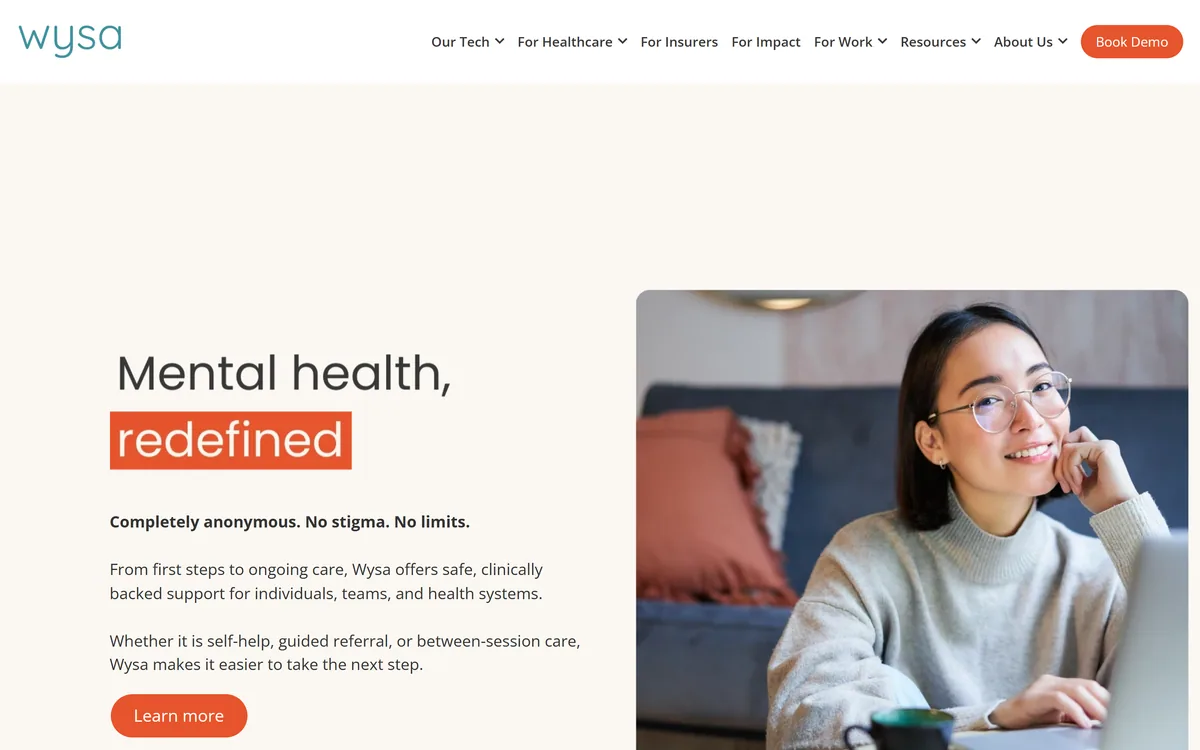
Last checked . Read from wysa.com during this check, with the screenshot above captured at the same time.
Anonymous, CBT-based AI mental-health support available any hour
A 'safer by design' posture where the AI does not decide alone
A human in the loop across care pathways
Positioning across a continuum from self-help to care-team support
A stated evidence base of dozens of peer-reviewed publications
A business-to-business-to-consumer model via employers and health systems
Explicit statements that it is not for crises or clinical advice
An age restriction limiting use to adults
No plan prices reproduced here, in line with this site's pricing policy
Wysa is a wellbeing support tool, not crisis care or a substitute for professional help, and is for adults only. Its reach and outcome figures are vendor-stated. Anyone in crisis should contact a professional or a crisis line.
Other Mental-Wellbeing Tools
Two AI wellbeing apps and a meditation library to weigh alongside Wysa, all adjuncts to professional care.
Youper — an AI emotional-health app with CBT tools
Insight Timer — guided meditation for calm and sleep
Editor's Verdict
4.0/5
Wysa earns 4.0 for doing mental-health AI the responsible way: anonymous, CBT-based support with a human in the loop, a safety-first architecture where the AI never decides alone, and an unusually strong peer-reviewed evidence base. It is explicit that it is not crisis care or a substitute for professional help and is for adults only, and within those honest limits it is a thoughtful, well-evidenced support tool. AInexfinder Editor Score: 4.0/5.
Wysa pricing
AInexfinder does not list plan prices or billing details. For current pricing, plans, and trials, visit the official Wysa website.
Vendor pricing, credits, and billing policies change over time. Always confirm on the official site before you buy.
Frequently asked questions
What is Wysa?
Wysa is an anonymous, CBT-based AI mental-health support tool designed as a safer alternative to general chatbots, with human-in-the-loop clinical oversight. It is backed by a large peer-reviewed evidence base and is offered to individuals as well as to employers, health systems and insurers.
Is Wysa a replacement for therapy?
No. Wysa is everyday wellbeing support, not a substitute for professional care or therapy, and it says so itself. It is designed to sit within a care pathway, from self-help to guided referral and between-session support, rather than to replace a clinician.
Can Wysa help in a crisis?
No. Wysa's own site states it is not designed for crises such as abuse or thoughts of suicide and cannot give medical or clinical advice. If you are in crisis, you should contact a professional or a suicide-prevention line rather than relying on an app.
How does Wysa keep its AI safe?
It is built 'safer by design': the AI never makes decisions on its own, and a human is in the loop across its care pathways, so support stays explainable and defensible within a clinical workflow. That safety-first architecture is the main thing separating it from a general chatbot.
Is Wysa anonymous?
Yes. Wysa lets people seek support without giving up their identity, which lowers the barrier for anyone who finds reaching out difficult. Anonymity is one of its core design choices, alongside grounding its approach in cognitive behavioural therapy techniques rather than open-ended chat.
Is Wysa backed by evidence?
The vendor cites an unusually large evidence base for the category, including dozens of peer-reviewed publications and large-scale usage research, along with institutional recognition. These are vendor-stated but verifiable, and they are a genuine reason to take Wysa more seriously than most wellbeing apps.
How do people get access to Wysa?
Largely through organisations: it is sold to employers, health systems and insurers who make it available to their people, and it powers some national support platforms, alongside individual access. So you may receive it as a benefit rather than buying it directly.
Is there an age restriction on Wysa?
Yes. Wysa is intended for adults, with restrictions on younger users. Anyone considering it for a younger person, or an organisation deploying it to a mixed population, should check the current age terms and safeguards on the site before proceeding.
Who should not use Wysa?
Anyone in crisis, who needs professional help immediately; people seeking a diagnosis or clinical treatment; users under its age threshold; and anyone looking for a replacement for therapy. Wysa is everyday support that escalates to a human when needed, not a clinical service.
How should an organisation evaluate Wysa?
Review the evidence base and the human-in-the-loop model with a clinician, check the age restrictions and data-privacy terms, and weigh its stated reach and lost-time figures against your population's actual needs and your duty of care, rather than taking the outcome claims at face value.
Daniel reviews AI tools the slow way — by actually using them on real projects. His reviews cover what works, what breaks, and who each tool is genuinely a good fit for.
Daniel and the AInexfinder editorial team research Wysa using public product information, listing evidence, and (when available) hands-on checks. Scores reflect listing completeness and transparency — not paid placement.
Listings may include affiliate or sponsored placements, which are labeled when present. Editorial scores and cons are not sold. See our affiliate disclosure and review methodology.
Youper is an AI emotional-health assistant built around conversational check-ins, mood tracking and journaling. The company has announced it is shutting down on 30 September 2026, after which accounts, chat history and personal data are permanently deleted.
Earkick is an iOS self-care app built around a panda companion, offering mood and anxiety check-ins, progress statistics, breathing and CBT exercises, soundscapes and a panic button. It states that everything stays on your device or in your own iCloud, with no registration and no tracking.
Soula is an emotional support companion built for women, distinguished by memory: it retains conversation history across sessions and surfaces patterns in stress, sleep and mood over weeks. It states plainly that it is not therapy, routes crises to human help, and is built by MAMATECH Ltd with GDPR compliance and encryption.
Mindsera is an AI journalling app that analyses entries as you write, surfaces patterns and emotions over time, and offers more than fifty mental models as structured prompts. It accepts typed, spoken and photographed handwritten entries, and runs on iOS, Android and the web.
Moody Month is an iOS hormone-tracking app that gives daily forecasts across the cycle, perimenopause, pregnancy and postpartum, with symptom logging, wearable integration and content, from a women-owned team, with privacy you should still read carefully.
Liven is a wellbeing and self-development app combining short courses on procrastination, stress and burnout with mood tracking, guided journaling, habit building and an AI companion called Livie. The company states it was co-created with more than fifteen licensed therapists and psychologists.