Youper is an AI emotional-health assistant built around conversational check-ins, mood tracking and journaling. The company has announced it is shutting down on 30 September 2026, after which accounts, chat history and personal data are permanently deleted.
If you arrived here to decide whether to try Youper, the decision has been made for you. The company has announced that the service closes on 30 September 2026, the apps have already been pulled from the App Store and Google Play, and new subscriptions are switched off.
If you are an existing user, this page is about one thing: getting your data out before it is deleted. From 1 October 2026 the company says accounts, chat histories and personal data are permanently removed from its servers and backups. For someone who has been checking in daily since 2019, that is a meaningful archive about to disappear.
Below: exactly what to do before the deadline, an honest account of what Youper was, and where people are moving instead.
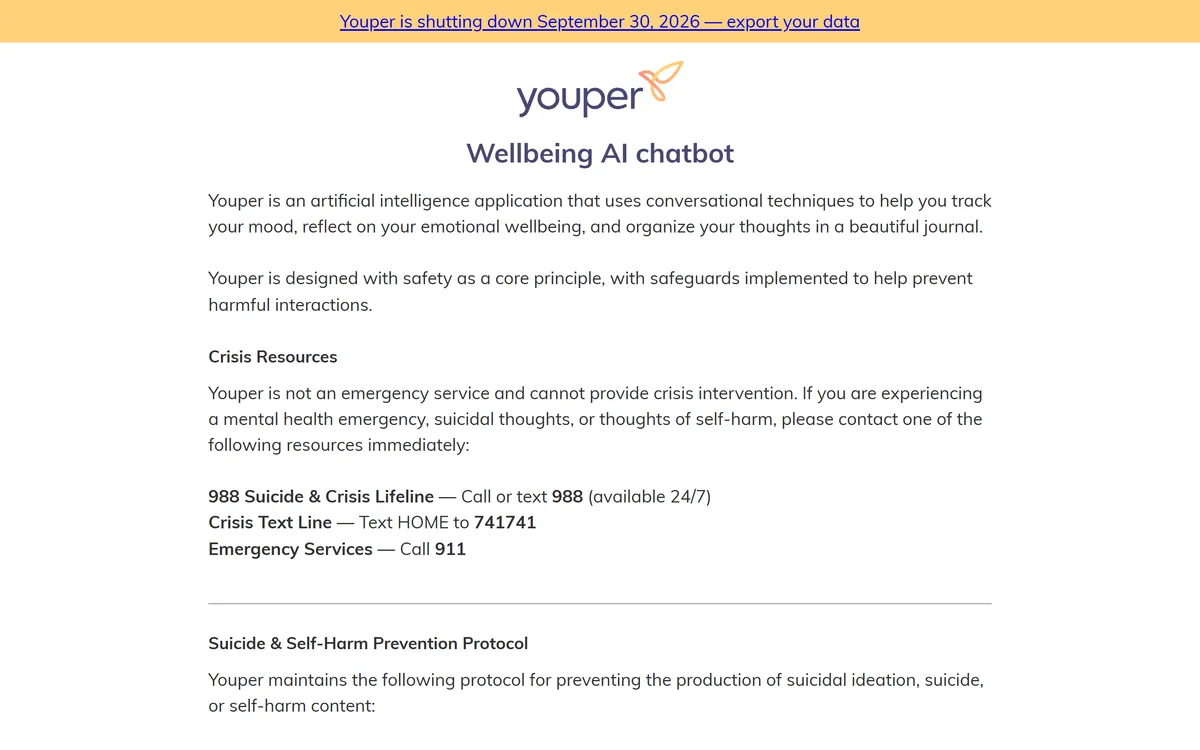
Youper's site still describes the product, alongside the notice that the service ends on 30 September 2026.
How We Confirmed The Closure
Last checked . Checked directly against Youper's own site and its published notices, alongside independent coverage of the shutdown. The screenshot above was captured during this check.
The 30 September 2026 end-of-service date and the 1 October deletion of accounts, chat history and personal data, taken from Youper's own shutdown notice
The export route through Settings → Request My Data, and the company's dedicated export page
Delisting from the App Store and Google Play, and the disabling of new subscriptions, reported in coverage of the closure
Regulatory position — not a medical device, not cleared or approved by the FDA, no medical advice, diagnosis or treatment — quoted from Youper's own disclaimer
The 18-and-over age policy stated on the site
The suicide and self-harm prevention protocol, including referral to 988 and the Crisis Text Line, described on Youper's site
Company identity as Youper, Inc. of San Francisco, with privacy policy, terms of use and contact details present in the site footer
Launch year of 2016 and the reported user figure of more than three million, from published coverage rather than a live company page
Dates and export routes can change during a wind-down. Confirm on Youper's own site before relying on anything here, and do not treat this page as medical advice. If you are in crisis, contact 988 in the US or your local emergency service rather than any app.
The Shutdown, In Five Lines
Youper closes on 30 September 2026. This is the company's own announcement, not a rumour.
From 1 October 2026 the data is gone — accounts, chat history and check-ins are deleted from servers and backups.
Export before the deadline via Settings → Request My Data. If years of journalling matter to you, do it today rather than on the 29th.
The apps are already delisted from the App Store and Google Play, and new subscriptions have been disabled.
Youper was never a medical device and was never FDA-cleared — worth knowing if you are looking for a replacement on the same terms.
Export Your Journal Before 30 September
Do this first and read the rest afterwards. The export request is quick, but it is not instant, and leaving it to the final week is how people lose years of entries.
Open Youper on the device where you are still signed in — the apps are delisted, so a fresh install may no longer be possible.
Go to Settings and choose Request My Data. The company also points users to an export page at start.youper.ai/export-data.
Wait for the export to be prepared and delivered rather than assuming it happens immediately.
Save the file somewhere you will still have in a year — a cloud drive or a backed-up folder, not only the phone.
Open the export and check it actually contains your entries and check-ins before the deadline passes, while there is still time to ask for it again.
Cancel any remaining billing arrangement through the App Store or Google Play, since subscriptions are managed there rather than by the app.
The export takes ten minutes. Recovering it after 1 October takes nothing, because there will be nothing to recover.
What Youper Actually Was
Youper launched in 2016, built by a team including a psychiatrist, and grew to more than three million users. The product was a conversational assistant for emotional health rather than a therapy service.
In practice that meant short guided conversations, mood tracking over time, and a journal that filled itself from those conversations. The technique borrowed from cognitive behavioural approaches — notice the thought, name the feeling, examine the reasoning — delivered as chat rather than as exercises.
It was adults-only by design, stated as 18 and over. And the company was consistently clear about the boundary: Youper was not a medical device, had not been cleared or approved by the US Food and Drug Administration, and did not provide medical advice, diagnosis or treatment.
The Safety Layer It Built
Youper published a suicide and self-harm prevention protocol with three parts: detection of distress in what a user writes, referral to crisis services including 988 and the Crisis Text Line, and content safeguards intended to stop the model producing harmful responses.
This is worth recording because it is the part of the category that matters most and is easiest to skip. Any replacement you consider should be judged on whether it has something equivalent, and whether it says so plainly.
Why The Distinction Between Support And Treatment Held
A conversational app that tracks mood and prompts reflection is a support tool. It is genuinely useful for noticing patterns, building a check-in habit, and putting words to a feeling before it becomes a spiral.
It is not treatment, and Youper never claimed otherwise. Anyone whose reason for using it was clinical — active depression, anxiety that interferes with living, crisis risk — needed a clinician alongside it, and needs one now more than ever.
What A Closure Like This Tells You About The Category
Youper is not the first AI mental-health app to close, and the pattern behind these exits is worth understanding before you pick a replacement.
Consumer wellbeing apps sit in an awkward position. Regulated medical products can bill through healthcare systems but must clear evidence and approval bars. Unregulated wellbeing tools avoid those bars but must survive on consumer subscriptions in a market where retention is brutal and the sceptical questions about AI and mental health have got louder.
The practical lesson for a user is unglamorous: assume any app holding a personal archive might close, and export periodically rather than at the end. Data portability is a feature you only notice the absence of once, and by then it is too late.
Check whether a replacement offers an export you can actually run yourself, before you commit years of entries to it
Prefer tools that state plainly what they are not — the ones overselling clinical benefit are the ones to be careful with
Look for a published crisis protocol, not just a disclaimer buried in terms
Treat a free tier as a way to test the export path as much as the product
Keep anything genuinely important to you in a format you control, not only inside one company's app
If You Still Need Something Tomorrow
Replacing Youper properly means being honest about which of its jobs you actually used.
If it was journalling and mood patterns, the reflective-journal tools cover that well and generally export cleanly. If it was the check-in habit, several conversational apps do the same thing. If it was calming down in the moment, a guided meditation tool is a closer fit than a chat interface.
And if any part of your use was clinical rather than supportive, this closure is a prompt to talk to a professional. An app closing should not be the thing that interrupts real care — which is precisely why real care should not depend on an app in the first place.
Youper Closure: The Dates And Details
Status
Shutting down
Service ends
30 September 2026
Data deleted from
1 October 2026, including backups
Export route
Settings → Request My Data, or the company's export page
App availability
Delisted from the App Store and Google Play
New subscriptions
Disabled
Launched
2016
Reported users
More than three million
Company
Youper, Inc., San Francisco, California
Age policy
18 and over; explicitly not intended for minors
Regulatory status
Not a medical device; not cleared or approved by the FDA
Crisis features
Distress detection, referral to 988 and Crisis Text Line, content safeguards
Do You Need To Do Something About This?
Act Before The Deadline If
You have journal entries or check-ins in Youper you would be sorry to lose
You are still signed in on a device — you may not be able to reinstall the app to export later
You have an active subscription running through the App Store or Google Play
You used Youper as part of managing something ongoing and need a replacement in place, not a gap
You were relying on it alongside clinical care and should tell your clinician the tool is going away
No Action Needed If
You tried it once and never returned — there is nothing to rescue
You were evaluating it as a new user; it is no longer available to sign up for
You already exported your data and cancelled billing
You only ever used it on a device you no longer have and never had entries worth keeping
You are researching the category rather than using any app in it
Key features of Youper
Conversational check-ins that guide reflection rather than deliver exercises
Mood tracking recorded over time
A journal populated from the conversations themselves
Techniques drawn from cognitive behavioural approaches
A published suicide and self-harm prevention protocol
Distress detection with referral to 988 and the Crisis Text Line
Content safeguards intended to prevent harmful model responses
A self-service data export, available until the shutdown date
Pros & cons
Pros
5
The conversational format lowered the barrier to a daily check-in more than a form ever did
Mood tracking over years produced patterns a person would not notice week to week
The company was consistently clear that it was not treatment and not FDA-cleared
A published crisis protocol, which is more than much of the category offers
A working data export, so users are not losing their archive without a route out
Cons
5
The service closes on 30 September 2026, which ends the discussion for new users
All accounts, chat history and personal data are deleted from 1 October 2026, backups included
Apps are already delisted, so reinstalling to export may not be possible
Never validated as a medical device, so it was never a substitute for clinical care
Adults only — no route for the under-18 users who arguably needed check-in tools most
Best For
Existing users who need to export their journal before 30 September 2026
Anyone cancelling a Youper subscription and looking for a replacement
People choosing a new AI wellbeing app who want to learn from this closure
Readers researching why consumer AI mental-health apps keep shutting down
Clinicians whose patients were using Youper as a between-sessions tool
Where Youper Users Are Going Instead
These do different parts of what Youper did. Match the replacement to the job you actually used it for.
Vendor pricing, credits, and billing policies change over time. Always confirm on the official site before you buy.
Frequently asked questions
Is Youper really shutting down?
Yes. The company has announced the service ends on 30 September 2026. The apps have already been removed from the App Store and Google Play, and new subscriptions are disabled.
What happens to my data after 30 September 2026?
From 1 October 2026, accounts, chat histories and personal data are permanently deleted from Youper's servers and backups. There is no stated recovery route after that point, which is why exporting now matters.
How do I export my Youper journal?
Open the app and go to Settings, then Request My Data. The company also points users to a dedicated export page. Do it while you are still signed in on a device — the apps are delisted, so a fresh install may not be possible.
Do I need to cancel my subscription separately?
Subscriptions bought through the App Store or Google Play are managed there, not inside the app, so cancel through your store account. New subscriptions are already disabled, but an existing recurring one is worth checking.
Was Youper ever approved as a medical treatment?
No. Youper stated plainly that it was not a medical device, had not been cleared or approved by the FDA, and did not provide medical advice, diagnosis or treatment. It was a support tool, and it described itself that way.
What is the closest replacement?
It depends which part you used. For the written archive and reflection, a journalling tool like Rosebud is closest. For quick daily mood check-ins, Earkick. For settling anxiety in the moment, a guided meditation app such as StillMind is a better fit than any chat interface.
I was using Youper to manage something serious. What should I do?
Tell whoever is involved in your care that the tool is going away, and put a replacement or a plan in place before the end of September rather than after. If you are in crisis, contact 988 in the US or your local emergency service — that has always been the right route, app or no app.
Daniel reviews AI tools the slow way — by actually using them on real projects. His reviews cover what works, what breaks, and who each tool is genuinely a good fit for.
Daniel and the AInexfinder editorial team research Youper using public product information, listing evidence, and (when available) hands-on checks. Scores reflect listing completeness and transparency — not paid placement.
Listings may include affiliate or sponsored placements, which are labeled when present. Editorial scores and cons are not sold. See our affiliate disclosure and review methodology.
Earkick is an iOS self-care app built around a panda companion, offering mood and anxiety check-ins, progress statistics, breathing and CBT exercises, soundscapes and a panic button. It states that everything stays on your device or in your own iCloud, with no registration and no tracking.
Soula is an emotional support companion built for women, distinguished by memory: it retains conversation history across sessions and surfaces patterns in stress, sleep and mood over weeks. It states plainly that it is not therapy, routes crises to human help, and is built by MAMATECH Ltd with GDPR compliance and encryption.
Mindsera is an AI journalling app that analyses entries as you write, surfaces patterns and emotions over time, and offers more than fifty mental models as structured prompts. It accepts typed, spoken and photographed handwritten entries, and runs on iOS, Android and the web.
Wysa is an anonymous, CBT-based AI mental-health support tool designed as a safer alternative to general AI, with human-in-the-loop clinical oversight, backed by peer-reviewed research, and sold to health systems, employers and insurers, not a substitute for professional care.
Moody Month is an iOS hormone-tracking app that gives daily forecasts across the cycle, perimenopause, pregnancy and postpartum, with symptom logging, wearable integration and content, from a women-owned team, with privacy you should still read carefully.
Liven is a wellbeing and self-development app combining short courses on procrastination, stress and burnout with mood tracking, guided journaling, habit building and an AI companion called Livie. The company states it was co-created with more than fifteen licensed therapists and psychologists.