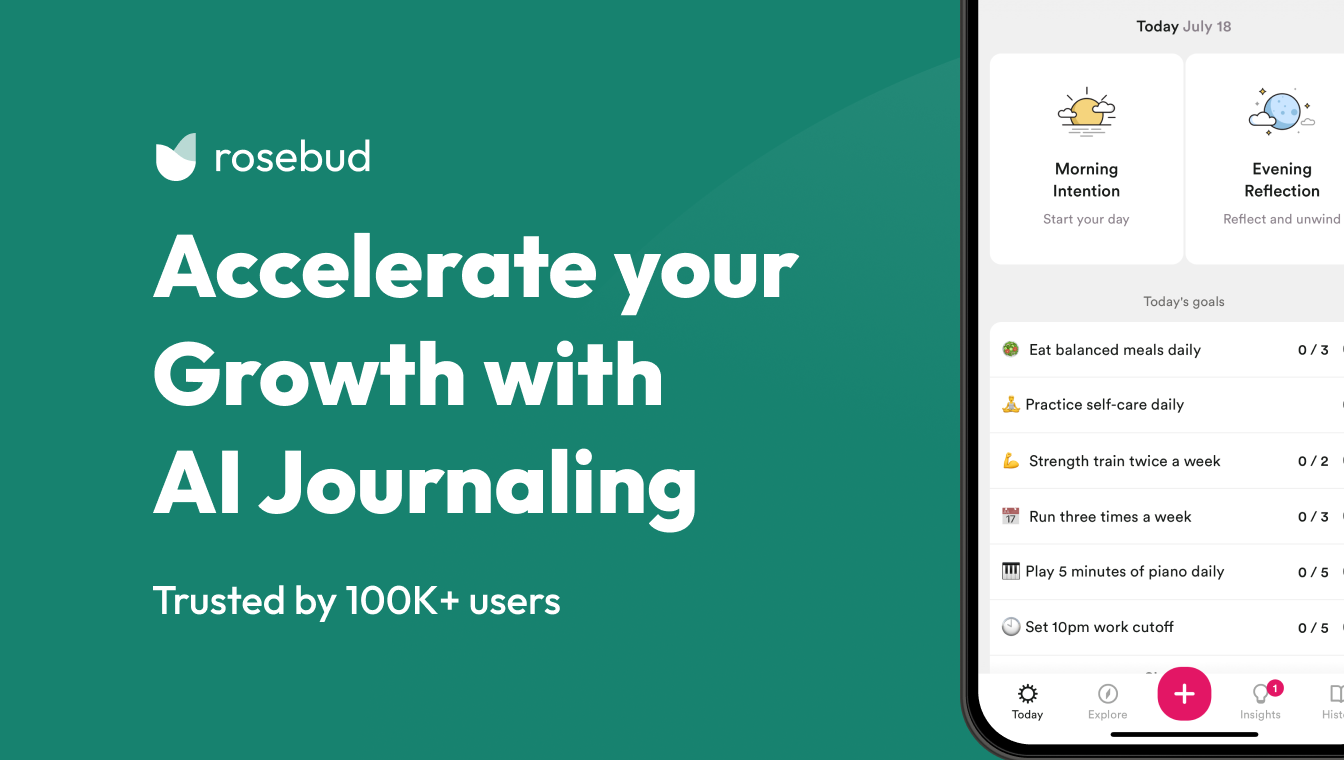
Rosebud is an AI journaling app that asks follow-up questions, remembers previous entries and surfaces patterns across them in weekly reports, combining guided reflection with habit-building and goal work. It displays a 4.73 rating from 5,311 ratings and endorsements from named therapists and coaches.
Rosebud's homepage, captured 9 September 2026, showing its personal growth journaling positioning.
Rosebud: What The App Does Daily
Guided journaling — it asks a follow-up rather than presenting a blank page.
Memory across entries, so today's reflection is read against previous months.
Weekly reports highlighting patterns and progress you would not spot yourself.
Voice entry for people who talk more easily than they write.
Not therapy — it cannot diagnose, treat, or intervene, and no app can.
Rosebud: Journalling That Remembers
The pitch is direct: process your emotions, spot patterns and uncover new insights about yourself, described as feeling better in minutes rather than months.
The mechanism that distinguishes it from a notes app is stated in three words — Rosebud remembers, and can help you make sense of it all.
Memory is the whole difference, and it addresses the specific reason paper journals fail.
A blank page asks nothing. You write until you run out of things to say, which for most people is about four sentences, and the entry sits there unread forever. The value of journalling is supposed to come from noticing patterns over time, and nobody rereads their own journal.
A system that has read every previous entry can do the thing you were never going to do yourself: notice that this is the fourth Sunday in a row you have written about the same argument, or that a worry you recorded in March resolved itself without your noticing.
The value of journalling is supposed to come from noticing patterns over time. Almost nobody rereads their own journal, which is why almost nobody gets it.
Crisis Language And What The App Does
This is the part of any wellbeing app that matters most and gets discussed least, so it is worth addressing directly.
One of the reviews displayed on the site describes the behaviour a reader would want: that the app knows its limitations and is quick to offer real professional help when it thinks you need it, working hard to help without overpromising its capabilities.
That is a good sign, and it is the right design. A journalling product will eventually receive an entry describing something serious — self-harm, abuse, acute crisis — because people write their worst days into journals. That is what journals are for.
What an app can do at that moment is limited but not nothing: recognise the situation, say clearly that it is not equipped for it, and surface a route to a person who is.
What it cannot do is assess risk, follow up, or take responsibility. A therapist who hears something alarming has a duty of care and a professional obligation to act. An app has neither, whatever it says in response. Anyone choosing a product in this category should test how it handles a difficult entry before relying on it, and should know the local crisis number independently of any app. Youper sits closer to the clinical end of this same category.
What Can An AI Journal Actually Do?
The underlying practice has real evidence behind it, and it is worth separating that from the technology.
Expressive writing — writing about difficult experiences over several sessions — has been studied since the 1980s, with findings on emotional processing and wellbeing replicated many times. Putting an experience into language appears to change how it is held.
None of that research involved an app, and none of it required one. What software changes is adherence, which in practice is the whole game.
The reason people do not journal is not scepticism. It is that a blank page at eleven at night loses to almost anything else, and there is no immediate feedback to reward the effort. A prompt that asks something specific is easier to answer than nothing, and a response afterwards makes the act feel less like shouting into a drawer.
The honest framing of the product, then, is that it makes a well-supported practice easier to sustain. That is genuinely valuable and considerably more modest than accelerating your personal growth. The site keeps a science section, which suggests the company is aware the distinction matters. Reflection builds the same practice around a review rhythm rather than a conversation.
Test how it responds to a difficult entry before you rely on it.
Know your local crisis number independently of any app.
Read the privacy policy — journal entries are unusually sensitive data.
Treat the weekly report as an observation, not a diagnosis.
Keep any professional support you already have.
Patterns Across Months Of Entries
The weekly report is described as an in-depth summary highlighting progress, alongside habit-building, goal identification and removing obstacles.
Pattern detection across your own writing is the most defensible thing in the product, because it does something you cannot practically do for yourself.
People are poor observers of their own longitudinal patterns. You know how you feel today and you have a rough sense of the last week, but the fact that your mood reliably dips on the same day, or that a particular relationship appears in every entry about stress, is invisible from the inside.
A system holding six months of entries can point at that. It is the same reason a therapist's observation that you always describe your work this way lands with such force — it is information about you that requires an outside view.
Two cautions apply. Pattern-finding systems find patterns whether or not they exist, and a confident observation about your psychology carries weight it may not have earned. And a weekly report is a description of what you wrote, not of you: entries skew toward the days you had something to process, which is a biased sample by construction. Read them as prompts for your own reflection rather than as findings. Mindsera approaches the same territory through mental models and structured frameworks.
Where A Journal Stops And Therapy Starts
The reviews displayed on the site include several comparing Rosebud favourably to professional treatment, one describing feedback as better than paid therapists and another calling it better than in-person therapy.
Those are real users describing their own experience honestly, and there is no reason to doubt what they felt. It still needs saying plainly, because the vendor cannot say it as bluntly as a reviewer can.
A journalling app is not therapy. It does not assess, diagnose or treat. It has no training, no supervision, no clinical accountability and no duty of care. It cannot notice what you are avoiding, because it only sees what you chose to write.
It also has a structural bias no therapist has: it is designed to be pleasant to use, and a product optimised for daily return will tend toward validation rather than challenge. Therapy is frequently uncomfortable on purpose, and that discomfort is often the mechanism.
What an app genuinely offers is availability. Three in the morning, between sessions, on a day when nothing is wrong enough to justify calling anyone — those are real gaps and filling them has real value. The named professionals endorsing the product, including a family therapist and a psychologist, are presumably endorsing it in that role rather than as a replacement for their own. If it is helping and you are also unwell, the correct configuration is both.
Journalling In A Way That Sticks
The failure mode is a fortnight of enthusiastic entries followed by nothing, which is what happens to most journals.
This sequence produces a habit rather than a burst.
Read the privacy policy before writing anything you would not want read.
Write a difficult entry early and see how the app responds.
Pick a fixed moment in the day rather than waiting for the urge.
Answer the follow-up question even when it is uncomfortable.
Read the weekly report as a question, not a verdict.
Tell your therapist you are using it, if you have one.
Is An AI Journal Right For You?
Write it down when
You have tried journalling and abandoned it more than once.
You want the patterns in your own writing surfaced for you.
You process things better by talking than by typing.
The gap between therapy sessions is where you struggle.
You want somewhere to put a thought at three in the morning.
Speak to a therapist when
You are in crisis, or thinking about harming yourself.
Your difficulties are interfering with work, sleep or relationships.
You would use it to avoid seeking help you already know you need.
You are not comfortable with entries stored on a provider's servers.
You want challenge rather than a system designed to be pleasant.
Rosebud: Features And Evidence
Category
AI journaling for reflection and personal growth
Core mechanic
Guided entries with follow-up questions and responses
Memory
Previous entries referenced when responding to new ones
Reporting
In-depth weekly reports highlighting patterns and progress
Scope
Journalling, habit-building and goal work in one product
Input
Typed and voice entry, across mobile and browser
Nudges
Reminders described by reviewers as text-message prompts
Security
Data stated as encrypted in transit and at rest
Ratings displayed
4.73 from 5,311 ratings, alongside a separate 4.9 figure
User counts
Both 100,000-plus and 150,000-plus appear on the same page
Endorsements
Named positive psychologist, executive coach, family therapist and IFS therapist
Published science
A dedicated science section in the site navigation
Key features of Rosebud
Guided journalling with follow-up questions
Memory across all previous entries
Weekly pattern and progress reports
Voice entry alongside typing
Habit-building and goal tracking
Reminder nudges to prompt reflection
Browser and mobile access
Encryption in transit and at rest
Pros & cons
Pros
7
Built on expressive writing, a practice with decades of supporting research
Memory across entries does the rereading nobody does for themselves
Prompted entries remove the blank-page barrier that ends most journals
Weekly reports surface longitudinal patterns invisible from the inside
Voice entry suits people who talk more easily than they write
A displayed review describes it pointing users toward professional help
Named, credentialed professionals endorse it publicly
Cons
7
Several displayed reviews frame it as a therapy substitute, which it is not
A product designed for daily return tends toward validation over challenge
It sees only what you chose to write, and cannot notice avoidance
Whether entries are readable by the provider is not stated
Two different user counts appear on the same page
Weekly reports describe your entries, which are a self-selected sample
Pattern-finding systems produce confident observations regardless of accuracy
Best For
People who have started and abandoned journals before
Anyone wanting somewhere to put a thought outside office hours
Users already in therapy looking for support between sessions
People who think out loud more easily than they write
Anyone curious about patterns in their own reflections
Rosebud Beside Other Journalling Apps
Reflection tools differ by how much structure they impose.
Last checked . Read from rosebud.app in a browser session on the date above, with the screenshot captured at the same time.
Positioned as an AI journal for personal growth, processing emotions and spotting patterns
Memory described as remembering entries and helping make sense of them together
Weekly in-depth reports described as highlighting progress
Combined scope stated as journalling, habit-building and emotional support
Voice entry described as speaking freely without burdening others
Security stated as data encrypted in transit and at rest
A rating of 4.73 shown from 5,311 ratings, alongside a separate 4.9 figure at the top of the page
User counts of 100,000-plus and 150,000-plus both shown on the same page
Endorsements from a named positive psychologist, executive coach, family therapist and IFS therapist
A science section present in the site navigation
Reviews displayed with names and dates, several comparing the app favourably to professional therapy
One displayed review stating the app knows its limitations and is quick to offer real professional help
What we could not confirm: how the app actually responds to an entry describing crisis or risk; whether entries are end-to-end encrypted or readable by the provider; why two different user counts appear on the same page; what the science section cites; and pricing. Reviews on the site are vendor-displayed. We did not create an account or write an entry.
Editor's Verdict
4.1/5
Rosebud is built on something that genuinely works. Expressive writing has decades of research behind it, and the barrier has always been that a blank page asks nothing of you — which is why most journals are abandoned by February. Asking a follow-up question and remembering what you wrote in March is a real fix for a real problem. What deserves saying plainly, because several reviews on the site do not: this is not therapy, and a product that people describe as better than their therapist needs its users to hear the distinction clearly from someone. AInexfinder Editor Score: 4.1/5.
Rosebud pricing
AInexfinder does not list plan prices or billing details. For current pricing, plans, and trials, visit the official Rosebud website.
Vendor pricing, credits, and billing policies change over time. Always confirm on the official site before you buy.
Frequently asked questions
What does Rosebud do?
It is a journal that responds. You write or speak an entry, it asks a follow-up, and because it has read your previous entries it can connect today's reflection to things you wrote weeks or months ago.
Why does memory make a difference?
Because the value of journalling comes from noticing patterns over time, and almost nobody rereads their own journal. A system that has read all of it can notice the fourth Sunday you wrote about the same argument.
Is journalling actually effective?
Expressive writing has been studied since the 1980s with replicated findings on emotional processing. None of that research required an app — what software changes is adherence, which in practice is most of the problem.
Is this therapy?
No. It cannot assess, diagnose or treat, has no clinical training or supervision, and carries no duty of care. Several reviews on the site compare it favourably to therapy; that is their experience, and the distinction still matters.
What happens if I write something serious?
One displayed review describes the app recognising its limits and pointing toward professional help, which is the right behaviour. Test how it responds yourself early, and know your local crisis number independently of any app.
Can I use it alongside therapy?
That is arguably the best configuration. It fills the gaps a therapist cannot — three in the morning, between sessions, days when nothing is wrong enough to call anyone. Tell your therapist you are using it.
How reliable are the weekly pattern reports?
Treat them as prompts rather than findings. They describe what you wrote, and entries skew toward days you had something to process — a biased sample by construction — while pattern-finding systems find patterns regardless.
Is my journal private?
The site states data is encrypted in transit and at rest. That protects a database that falls into the wrong hands, but does not by itself mean the provider cannot read entries, which requires end-to-end encryption — a fair question to ask directly.
Will it just tell me what I want to hear?
It is a structural risk worth knowing about. A product designed to be pleasant enough to return to daily leans toward validation, whereas therapy is often deliberately uncomfortable and that discomfort is frequently the mechanism.
Who should not use it?
Anyone in crisis or considering self-harm, anyone whose difficulties are interfering with work, sleep or relationships, and anyone who would use it to postpone help they already know they need.
Daniel reviews AI tools the slow way — by actually using them on real projects. His reviews cover what works, what breaks, and who each tool is genuinely a good fit for.
Daniel and the AInexfinder editorial team research Rosebud using public product information, listing evidence, and (when available) hands-on checks. Scores reflect listing completeness and transparency — not paid placement.
Listings may include affiliate or sponsored placements, which are labeled when present. Editorial scores and cons are not sold. See our affiliate disclosure and review methodology.
Youper is an AI emotional-health assistant built around conversational check-ins, mood tracking and journaling. The company has announced it is shutting down on 30 September 2026, after which accounts, chat history and personal data are permanently deleted.
Soula is an emotional support companion built for women, distinguished by memory: it retains conversation history across sessions and surfaces patterns in stress, sleep and mood over weeks. It states plainly that it is not therapy, routes crises to human help, and is built by MAMATECH Ltd with GDPR compliance and encryption.
Earkick is an iOS self-care app built around a panda companion, offering mood and anxiety check-ins, progress statistics, breathing and CBT exercises, soundscapes and a panic button. It states that everything stays on your device or in your own iCloud, with no registration and no tracking.
Mindsera is an AI journalling app that analyses entries as you write, surfaces patterns and emotions over time, and offers more than fifty mental models as structured prompts. It accepts typed, spoken and photographed handwritten entries, and runs on iOS, Android and the web.
Moody Month is an iOS hormone-tracking app that gives daily forecasts across the cycle, perimenopause, pregnancy and postpartum, with symptom logging, wearable integration and content, from a women-owned team, with privacy you should still read carefully.
Wysa is an anonymous, CBT-based AI mental-health support tool designed as a safer alternative to general AI, with human-in-the-loop clinical oversight, backed by peer-reviewed research, and sold to health systems, employers and insurers, not a substitute for professional care.