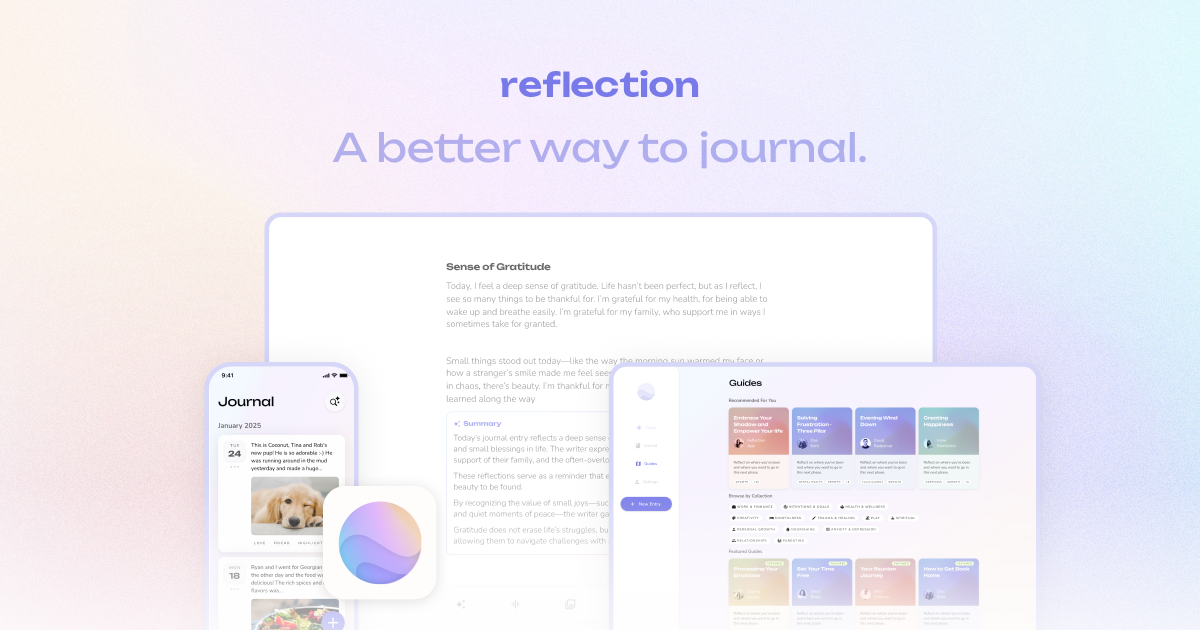
Reflection is an AI journalling app across iPhone, iPad, Mac, Android and web, offering voice journaling, photos, rich text, templates and biometric locking. Four features — voice calls, an AI coach, asking your journal questions and 100+ guided journeys — are marked coming soon.
reflection.app7 viewsAdded January 23, 202612K visitors
Journalling is one of the few self-improvement habits with a genuinely good evidence base behind it, and almost nobody sustains it. The pattern is a beautiful notebook, eleven days of entries, and then nothing for a year.
The reasons are consistent: not knowing what to write, entries feeling pointless because nothing comes of them, and the friction of finding the notebook when the thought arrives.
Reflection addresses all three — templates for the first, AI responses for the second, five synced platforms for the third — though only one of those is fully shipped today.
Reflection: A Journal That Talks Back
Available on iPhone, iPad, Mac, Android and web, always in sync — unusually broad for this category.
Voice journaling, photos and rich text, with biometric or passcode locking on the journal itself.
Four AI features are marked coming soon: voice calls, an AI coach, asking your journal questions and guided journeys.
Journaling templates for gratitude, goals and structured entries, which addresses the blank-page problem.
A displayed 4.8 stars from 3,000+ reviews, with named app store testimonials.
Reflection's homepage, captured 9 September 2026, showing the journalling app across platforms.
Does A Journal Need To Answer You?
Reflection's positioning is a journal that listens, and talks back, coaching you in real time and turning entries into insights.
The proposition is worth examining, because talking back is not obviously an improvement on a journal that does not.
The case for silence is real. Journalling works partly because nobody responds — you can write something contradictory, unfair or unresolved without anyone weighing in, and that lack of audience is what makes honesty possible.
The case for response is equally real and addresses the other failure. People abandon journalling because entries accumulate and nothing happens: you write the same worry for six weeks and nobody, including you, notices the pattern.
A follow-up question is a modest and well-judged version of talking back. It nudges past the surface without evaluating what you wrote, which is the distinction that matters — and it is a lighter touch than mood-tracking apps like Clarity take.
Journalling works partly because nobody responds. You can write something unfair or unresolved, and the absence of an audience is what makes honesty possible.
Four Features Marked Coming Soon
The site labels four capabilities as coming soon: Voice Call, AI Coach, Ask Your Journal and Guided Journeys.
Those four are the AI half of the product, and the honest reading is that Reflection today is a well-made cross-platform journal with the intelligence still ahead of it.
Marking them clearly is genuinely creditable. A great deal of software describes planned capability in the present tense and lets buyers discover the gap after signing up, and this does not.
It does mean that anyone evaluating on the strength of AI coaching is evaluating a roadmap. The right question is whether the shipped product — five-platform sync, voice entry, templates, locking — is worth using on its own merits.
Ask Your Journal is the most interesting of the four when it arrives, because it addresses the thing that makes long-term journalling valuable: retrieval. A decade of entries you cannot search is an archive; one you can question is a record.
Privacy In An App You Tell Everything
Reflection lists advanced privacy with Face ID, biometric or passcode locking, and describes the journal as beautiful and private.
Journals are the most sensitive personal data most people produce, and it is worth being precise about what a lock does and does not cover.
Device locking protects against the immediate and most likely risk — somebody picking up your unlocked phone. That is the threat model that matters day to day and biometric locking handles it well.
It says nothing about the rest. Whether entries are encrypted at rest on the server, whether the provider can read them, whether they contribute to any model training, and what happens if the company is acquired are separate questions that a Face ID prompt does not answer.
Those questions matter more here than in almost any other consumer category, because the content is by definition the things you would not say aloud. Anyone evaluating this should read the privacy policy properly rather than treating the lock icon as the answer.
Judge it on the shipped product, not the coming-soon features.
Read the privacy policy — a device lock is not encryption at rest.
Use templates on the days you have nothing to say; those are the ones that matter.
Write badly rather than not at all — polished entries are how the habit dies.
Keep an export, since a decade of entries inside one app is a dependency.
Five Platforms And Why That Matters
Reflection is available on iPhone, iPad, Mac, Android and web, described as always in sync.
Breadth across platforms sounds like a checkbox and is genuinely important for this specific habit.
Journalling happens at unpredictable moments — something occurs to you on a walk, in a meeting, at a desk, at midnight — and the entry that gets written is the one you could write at that moment.
An app on only one platform means the thought arrives when you have a different device, and it does not get written. Over months that is the difference between a habit and an intention.
Voice journaling serves the same purpose from another angle. Speaking an entry while walking captures thoughts that would not survive being typed later, and for many people it produces more honest writing than a keyboard does.
What A Journalling App Cannot Be
There is a boundary here that consumer wellbeing apps consistently blur, and it is worth stating plainly.
A journal is not therapy. Structured reflection has real benefits and it is not treatment, and an AI coach offering follow-up questions is not a clinician however well the questions are chosen.
The distinction matters most at exactly the moment it is easiest to ignore. Somebody journalling through a genuine crisis may find the app sufficient when it is not, and the absence of a person who can recognise that is the gap.
It also cannot notice deterioration. A human reading your entries over months would see a pattern; an app generating a follow-up question responds to the entry in front of it.
None of that argues against journalling, which is well supported and genuinely useful. It argues for keeping the categories separate — the same boundary sleep and mood tools like SleepQ have to hold, and for the same reason.
Guided practice is the adjacent option worth knowing about. Meditation apps such as RelaxFrens ask how you are and then supply a session, which suits people who want to be led rather than to write — and the two habits complement each other more than they compete.
Journaling In A Way That Lasts
Everyone who has abandoned a journal abandoned it the same way: entries got longer and more considered until writing one felt like a task.
This sequence keeps the habit small enough to survive a bad week.
Set a floor of three sentences rather than an aspiration of a page.
Use a template on the days you have nothing to say — those are the important days.
Write badly on purpose; polished entries are how journalling habits die.
Use voice entry when typing would mean not writing at all.
Read back a month at a time occasionally, since patterns are invisible day to day.
Export periodically, so a decade of entries does not live only in one app.
Reflection: Features And Availability
Product type
AI journalling and reflection app
Positioning
A journal that listens, and talks back
Platforms
iPhone, iPad, Mac, Android and web, always in sync
You have abandoned journals before because of friction rather than intent.
You switch between phone, laptop and tablet during a day.
Voice entry would let you capture thoughts you would otherwise lose.
Blank pages stop you, and templates would get you started.
You want a searchable record rather than a stack of notebooks.
Use paper when
You are evaluating it for the AI coaching, which is marked coming soon.
You write more honestly on paper, which many people genuinely do.
You are uncomfortable with your most private writing sitting on a server.
You need therapeutic support, which no journalling app provides.
You want a journal that never responds, which is a legitimate preference.
More Wellbeing And Journal Apps
Adjacent apps for reflection, mood and daily practice.
Clarity — mood tracking alongside written reflection
RelaxFrens — guided meditation rather than writing
Insight Timer — meditation practice as a daily habit
SleepQ — a measurable wellbeing signal rather than a subjective one
DreamSync — a structured programme with a named method
Reflection: Read From The Journal App
Last checked . Read from reflection.app in a browser session on the date above, with the screenshot captured alongside.
Positioned as a journal that listens, and talks back
Described as coaching you in real time and turning entries into insights
4.8 stars from 3,000+ reviews displayed
Availability stated across iPhone, iPad, Mac, Android and web, always in sync
Voice Call labelled COMING SOON
AI Coach labelled COMING SOON, described as offering a follow-up question drawn from the entry you just wrote
Ask Your Journal labelled COMING SOON, described as searching your history and answering in plain language
Guided Journeys labelled COMING SOON, described as 100+ programs created with wellness and personal growth experts
Voice journaling, photos and rich text, and journaling templates listed as features
Advanced privacy described as locking your journal with Face ID, biometrics or a passcode
Named App Store and Play Store testimonials displayed
What we could not confirm: pricing and what a free tier includes; whether entries are encrypted at rest and whether the provider can read them, which is the question that matters most here; whether journal content contributes to any model training; when the four coming-soon features are expected; the operating company, which the pages we read do not name; and whether entries can be exported. We did not create an account.
Editor's Verdict
3.7/5
The strongest thing about Reflection is what it already does rather than what it promises: journalling across five platforms with everything in sync, voice entry, biometric locking and templates for people who freeze at a blank page. That is a well-executed version of a simple thing. The four headline AI features — voice calls, an AI coach, asking your journal questions and guided journeys — are all marked coming soon on the site, which is disclosed honestly and means the product being marketed is not yet the product you would be buying today. AInexfinder Editor Score: 3.7/5.
Reflection pricing
AInexfinder does not list plan prices or billing details. For current pricing, plans, and trials, visit the official Reflection website.
Vendor pricing, credits, and billing policies change over time. Always confirm on the official site before you buy.
Frequently asked questions
What is Reflection?
Reflection is an AI journalling app across iPhone, iPad, Mac, Android and web, with voice journaling, photos, rich text, templates and biometric locking. Four AI features — voice calls, an AI coach, asking your journal questions and guided journeys — are marked coming soon.
Which features are actually available?
The journalling itself: five-platform sync, voice entry, photos and rich text, templates, reminders and locking. The AI half is marked coming soon on the site, which is disclosed honestly and means the marketed product is ahead of the shipped one.
Should a journal talk back?
There is a genuine case both ways. Journalling works partly because nobody responds — you can write something unfair or unresolved without anyone weighing in. But people also abandon it because entries accumulate and nothing happens, which a follow-up question addresses.
Which coming-soon feature matters most?
Ask Your Journal, because it addresses what makes long-term journalling valuable: retrieval. A decade of entries you cannot search is an archive; one you can question is a record, and that difference compounds the longer you keep it.
Is my journal private?
Device locking with Face ID or a passcode handles the immediate risk — somebody picking up your unlocked phone. It says nothing about encryption at rest, whether the provider can read entries, or training use. Read the privacy policy rather than trusting the lock icon.
Why does cross-platform matter for journalling specifically?
Because entries happen at unpredictable moments — on a walk, in a meeting, at midnight — and the entry that gets written is the one you could write then. An app on one platform means the thought arrives on the wrong device and never gets recorded.
Is voice journaling worth using?
For many people it produces more honest writing than a keyboard, and it captures thoughts that would not survive being typed up later. It also removes the friction of sitting down to write, which is where most journalling habits actually fail.
Is this therapy?
No. Structured reflection has real benefits and it is not treatment, and an AI coach offering follow-up questions is not a clinician however well the questions are chosen. The distinction matters most at exactly the moment it is easiest to ignore.
What can it not notice?
Deterioration. A person reading your entries over months would see a pattern; an app generating a follow-up question responds to the entry in front of it. Reading back a month at a time yourself is the practical substitute.
How do I keep the habit going?
Set a floor of three sentences rather than aspiring to a page, and write badly on purpose. Journals get abandoned when entries grow longer and more considered until writing one feels like a task — and use a template on the days you have nothing to say.
Daniel reviews AI tools the slow way — by actually using them on real projects. His reviews cover what works, what breaks, and who each tool is genuinely a good fit for.
Daniel and the AInexfinder editorial team research Reflection using public product information, listing evidence, and (when available) hands-on checks. Scores reflect listing completeness and transparency — not paid placement.
Listings may include affiliate or sponsored placements, which are labeled when present. Editorial scores and cons are not sold. See our affiliate disclosure and review methodology.
Youper is an AI emotional-health assistant built around conversational check-ins, mood tracking and journaling. The company has announced it is shutting down on 30 September 2026, after which accounts, chat history and personal data are permanently deleted.
Earkick is an iOS self-care app built around a panda companion, offering mood and anxiety check-ins, progress statistics, breathing and CBT exercises, soundscapes and a panic button. It states that everything stays on your device or in your own iCloud, with no registration and no tracking.
Soula is an emotional support companion built for women, distinguished by memory: it retains conversation history across sessions and surfaces patterns in stress, sleep and mood over weeks. It states plainly that it is not therapy, routes crises to human help, and is built by MAMATECH Ltd with GDPR compliance and encryption.
Mindsera is an AI journalling app that analyses entries as you write, surfaces patterns and emotions over time, and offers more than fifty mental models as structured prompts. It accepts typed, spoken and photographed handwritten entries, and runs on iOS, Android and the web.
Wysa is an anonymous, CBT-based AI mental-health support tool designed as a safer alternative to general AI, with human-in-the-loop clinical oversight, backed by peer-reviewed research, and sold to health systems, employers and insurers, not a substitute for professional care.
Moody Month is an iOS hormone-tracking app that gives daily forecasts across the cycle, perimenopause, pregnancy and postpartum, with symptom logging, wearable integration and content, from a women-owned team, with privacy you should still read carefully.