DreamSync is an iOS sleep app combining tracking and sleep-stage analysis with a 12-week CBT-I programme, an AI coach, smart alarm, snoring detection and behaviour correlation across caffeine, exercise, screen time, stress and alcohol. It works offline, requires no account, and stores all data locally.
SleepQ
Verified
SleepQ is an iOS sleep coach that runs structured seven-night experiments across eight sleep elements — wind-down, screens, caffeine, light and others — measuring before and after via Apple Health, with an AI coach reachable by chat and voice.
4.0Editor Score
sleepq.app8 viewsAdded January 16, 20268K visitors
Sleep advice is the most widely available and least useful health information there is. Avoid screens. Cut caffeine after two. Keep the room cool. All true on average, all impossible to act on with any confidence.
The problem is that averages describe nobody. Caffeine metabolism varies enormously between individuals for genuine genetic reasons, some people are unaffected by evening screens, and the variable actually wrecking your sleep may be one nobody mentioned.
SleepQ's answer is to run experiments. Change one thing for seven nights, measure what happened, and get an answer about you rather than about a population — which is the only version of this that produces action.
SleepQ: Experiments, Not Advice
- Seven-night experiments with before-and-after measurement, rather than a list of general recommendations.
- Eight sleep elements tested one at a time — wind-down, screens, caffeine, light and others.
- Apple Health integration does the measuring, syncing automatically rather than asking you to log.
- An AI coach by chat and voice, with daily summaries, weekly recaps and progress reports.
- Clear data commitments: encrypted in transit and at rest, never sold, and exportable or deletable from the app at any time.
SleepQ: Platform And Data Handling
| Product type | AI sleep coach built around structured experiments |
|---|---|
| Method | Personalised experiments in seven-night cycles with before and after measurement |
| Elements tested | Eight, including wind-down, screens, caffeine and light |
| Measurement | Automatic Apple Health integration |
| Coach | AI coach accessible by chat and voice |
| Reporting | Daily sleep summaries, weekly recaps and detailed progress reports |
| Annual feature | A sleep year-in-review on the premium annual tier |
| Platform | iOS only, via the App Store |
| Data handling | Encrypted in transit and at rest, never sold, exportable and deletable from the app at any time |
| Footer sections | Product (How it works, Experiments, Pricing, Science), Company (About, Contact), Legal (Privacy & Cookies, Terms), social links |
Why Run Seven-Night Experiments On Yourself?
SleepQ runs personalised experiments targeting eight sleep elements, in seven-night cycles with before and after measurement.
The structure is what makes it different from tracking. A sleep tracker shows you data and leaves you to draw conclusions from it, which people do badly — you slept poorly, you remember drinking coffee, and you construct a story. That is not evidence.
An experiment changes one variable deliberately, holds the rest constant, and compares a defined period against a baseline. That is a genuinely different epistemic activity, and it is what turns correlation into something closer to cause.
Seven nights is a sensible compromise. Long enough to average out an unusually bad night or an early meeting; short enough that people will complete it, which matters more than statistical elegance because an experiment nobody finishes measures nothing.
The honest limit is that seven nights against noisy data is a small sample. Sleep varies for a dozen reasons in any given week — stress, illness, weather, an argument — and a single seven-night cycle can easily show an effect that is not there. Treat one result as a hypothesis and a repeated result as a finding.
That is a different bet from applying a named clinical method. DreamSync runs a twelve-week CBT-I programme, which has stronger evidence behind it and answers a different question: how to treat insomnia rather than what affects your sleep.
A tracker shows you data and lets you construct a story. An experiment changes one thing and measures what happened. Those are different activities.
Eight Elements And Which Ones Move Numbers
The eight elements named include wind-down routine, screens, caffeine and light exposure, and the choice of which to test first matters more than most people assume.
The two with the strongest evidence behind them are light and timing. Light exposure drives circadian rhythm directly, and morning light in particular has more effect on when you fall asleep than almost anything you do in the evening — which is counterintuitive enough that most people never try it.
Caffeine is the one people expect to matter and where individual variation is largest. Its half-life differs substantially between people, which means the standard advice about an afternoon cut-off is right for some and irrelevant for others. This is exactly what a personal experiment answers and no article can.
Screens are the element most likely to disappoint. The evidence for blue light specifically is weaker than popular coverage suggests, and what actually keeps people awake is usually what they are doing on the device rather than the light coming off it.
The practical sequence is therefore to test light and timing first, because they have the largest average effect, then caffeine because the individual variation is greatest, and leave the elements you are most confident about until last — since those are where you are most likely to be wrong.
Apple Health Is Doing The Measuring
SleepQ syncs automatically with Apple Health rather than asking you to record anything, and that decision shapes what the results actually mean.
The benefit is compliance, and it is large. Manual sleep logs are abandoned within two weeks by almost everyone, and an experiment with missing data is not an experiment. Automatic measurement is the difference between a method that works and one that describes what would work.
The limitation is the source. Apple Health's sleep data comes from a watch or phone, which infers sleep from movement and heart rate rather than measuring brain activity. Total sleep time and sleep timing are reasonably robust; stage breakdowns are much softer.
That is fine for this purpose and worth understanding. An experiment comparing a baseline week to a test week uses the same measurement method for both, so a consistent bias affects both sides equally and the comparison still holds. You are measuring change, not absolute truth.
It does mean the numbers should not be read as clinical. A wearable saying you got ninety minutes of deep sleep is producing an estimate from an algorithm, and treating that figure as a fact about your brain is a mistake the device makes easy.
The honest limit of any consumer measurement is the same across the category. A nutrition tracker like MyNetDiary at least records what you actually ate; a wearable is estimating what your brain did.
- Test light exposure and timing first — they have the largest average effect.
- Save caffeine for early on, since individual variation there is the widest.
- Repeat any experiment whose result surprised you before believing it.
- Read change between weeks rather than absolute stage figures.
- Take loud snoring with breathing pauses to a doctor rather than into an experiment.
The Data Position Is Stated Clearly
SleepQ states that your sleep data is yours, encrypted in transit and at rest, never sold, and that you can export or delete everything from the app at any time.
That is a better commitment than most consumer health apps make, and it is worth reading each clause separately. Encryption in transit and at rest is table stakes. Never sold is a real commitment about the business model. Export and delete from within the app is the one that matters most and is offered least often.
The reason deletion matters is what this data is. Sleep timing reveals when you are at home, when you travel, when you are unwell and when your life is disrupted — and combined with the behavioural logging an experiment requires, the picture is unusually intimate.
It is also worth noting what is absent from the commitment. Never sold is not the same as never shared with processors, and encrypted is not the same as inaccessible to the operator. Those are ordinary arrangements rather than problems, and the difference is worth knowing.
The comparison worth making is with a local-only app, which removes the question rather than answering it. SleepQ's model requires a server — the AI coach and Apple Health sync both need one — so a clearly stated policy is the strongest position available to it.
Running A Sleep Experiment That Proves Something
The value of this app depends entirely on running the experiments properly, and the failures are predictable.
The most common is changing two things at once, which produces a result that explains nothing.
If the difficulty turns out to be doing the thing you decided on rather than knowing what it is, a habit tool such as Pattrn is the honest next purchase.
- Establish a baseline week where you change nothing, so there is something to compare against.
- Pick one element to test, and genuinely change only that one for the full seven nights.
- Do not start an experiment during a disrupted week — travel, illness or a deadline will drown the signal.
- Record what else happened, since the app cannot see the argument you had on Wednesday.
- Repeat any experiment whose result surprised you, because a single seven-night cycle can easily show an effect that is not there.
- Stop and see a doctor if you snore loudly with pauses in breathing, which is a medical question rather than an experimental one.
Is SleepQ Worth Seven Nights?
Try the experiments when
- You have read all the general sleep advice and none of it told you what applies to you.
- You already wear something that feeds Apple Health, so measurement costs you nothing.
- You will genuinely change one variable at a time for a full week.
- You want an answer about your own body rather than about a population average.
- Clear export and delete controls matter to you for health data.
See a doctor instead when
- You snore loudly with pauses in breathing, which points at sleep apnoea.
- Your poor sleep is likely secondary to depression, anxiety, pain or medication.
- You have chronic insomnia, where a structured CBT-I programme has better evidence.
- You are on Android, since this is iOS only.
- You would change three things at once, which produces a result explaining nothing.
Key features of SleepQ
Personalised seven-night experiments with before-and-after measurement
Eight sleep elements tested individually rather than all at once
Automatic Apple Health sync, removing manual logging
An AI coach available by chat and by voice
Daily summaries, weekly recaps and detailed progress reports
An annual sleep year-in-review on the premium annual tier
Export and delete of all data from within the app
Pros & cons
Pros
6- Experiments produce an answer about you rather than about a population average
- Seven nights is short enough that people finish, which matters more than statistical elegance
- Automatic measurement removes the manual logging that kills every self-tracking effort
- Comparing a baseline week to a test week cancels out consistent measurement bias
- Data commitments are clearly stated, including export and delete from within the app
- Voice access to the coach is a genuine convenience for a bedside app
Cons
6- Apple Health sleep data is inferred from movement and heart rate, not measured
- Seven nights against noisy data can easily show an effect that is not there
- iOS only, with no Android version mentioned
- Only four of the eight elements are named on the page we read
- No operating company, location or clinical adviser is identified
- Never sold is not the same as never shared with processors
Best For
- People who have read every sleep article and still do not know what applies to them
- Anyone already wearing a device that feeds Apple Health
- Testing whether caffeine genuinely affects your own sleep
- Users who want export and delete controls over health data
- Methodical people willing to change one variable at a time
SleepQ Beside Other Sleep Apps
Sleep apps differ on whether they track, teach a method, or test one variable at a time.
| Tool | Approach | Where data lives | Best for |
|---|---|---|---|
| SleepQ | Seven-night experiments on one variable | Cloud, with stated export and delete | Finding out what actually affects your sleep |
| DreamSync | A 12-week CBT-I programme | Entirely on the device | Chronic insomnia with an evidence-based method |
| Pattrn | Habit formation and consistency | Cloud | Doing the thing you decided to do |
| Insight Timer | A free library including sleep audio | Cloud | Winding down rather than diagnosing |
| MyNetDiary | Nutrition and caffeine tracking | Cloud | The intake side of the same picture |
SleepQ: What The Site Promises
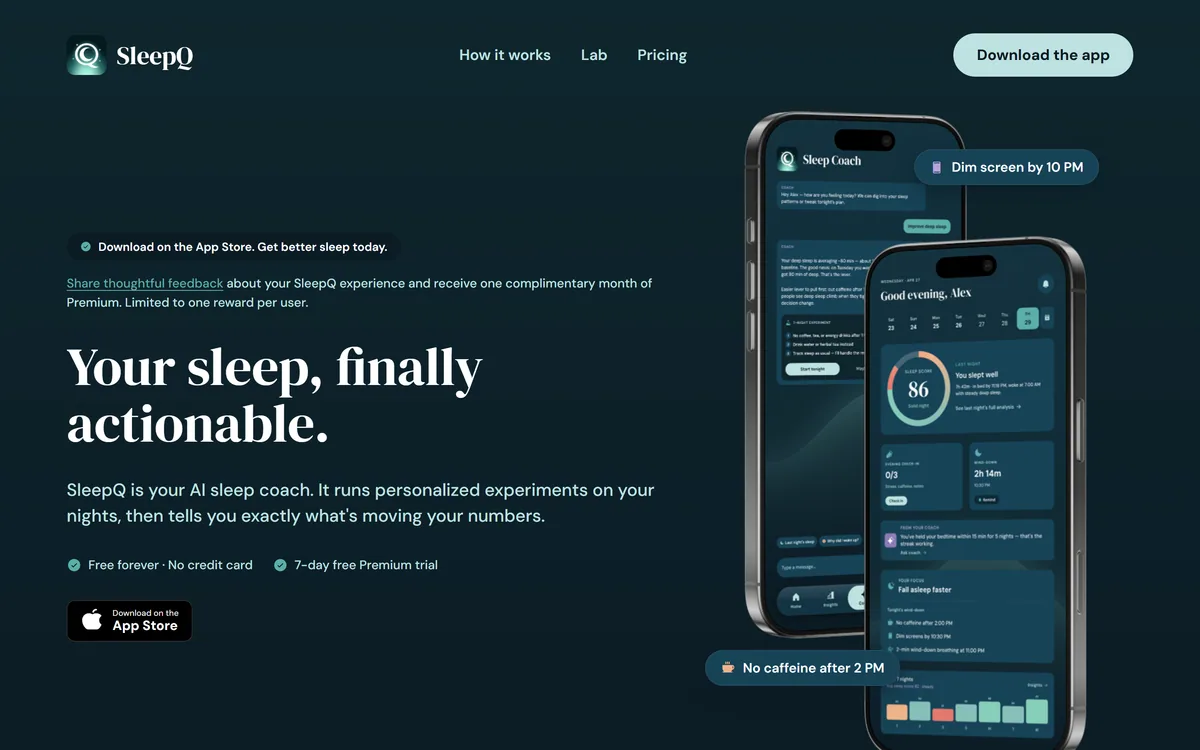
Last checked . Read from sleepq.app and its footer navigation, with the screenshot above captured in the same session.
- Positioned as an AI sleep coach that runs personalised experiments and reports what moves your numbers
- Seven-night experiment cycles with before and after measurement confirmed
- Eight sleep elements confirmed as targeted, including wind-down, screens, caffeine and light
- AI coach confirmed as accessible via chat and voice
- Apple Health integration confirmed as automatic syncing
- Daily sleep summaries and weekly recaps confirmed
- Detailed progress reports confirmed
- An annual sleep year-in-review confirmed on the premium annual tier
- Platform confirmed as iOS, available on the App Store, with no Android version mentioned
- Data handling stated on the site as encrypted in transit and at rest, never sold, with export and delete available from the app at any time
- Footer confirmed with Product links (How it works, Experiments, Pricing, Science), Company links (About, Contact), Legal links (Privacy & Cookies, Terms) and social profiles
- Copyright line confirmed as 2026
What we could not confirm: the operating company's legal name or location; pricing and what separates the premium tier; which underlying model powers the coach; what the eight elements are in full, since only four were named on the page we read; what the Science page cites, or whether any clinical adviser is involved; how experiment results are analysed statistically; and whether data is shared with processors despite never being sold. We did not use the app, so nothing here reflects tested results.
Other Sleep And Wellbeing Apps
Sleep sits between measurement, method and behaviour, and different apps take different routes.
- DreamSync — a named CBT-I programme with local-only data storage
- Pattrn — if the obstacle is doing the thing rather than knowing what to do
- Insight Timer — free wind-down and sleep audio
- MyNetDiary — tracking the caffeine and alcohol these experiments test
- Mosso — another quiz-led personal app, with a different evidence position
Editor's Verdict
4.0/5SleepQ's method is its whole argument, and it is a good one. General sleep advice is true on average and useless individually — everyone knows caffeine affects sleep, and almost nobody knows whether their own afternoon coffee matters. Running one change at a time over seven nights, with before-and-after measurement, is a genuine experiment rather than a suggestion, and it produces an answer about you. The data commitments are clearly stated and unusually strong. It scores below the top because Apple Health sleep data comes from consumer wearables that infer rather than measure, and because seven nights is a short window against noisy data. AInexfinder Editor Score: 4.0/5.
SleepQ pricing
AInexfinder does not list plan prices or billing details. For current pricing, plans, and trials, visit the official SleepQ website.
Visit official website for pricingVendor pricing, credits, and billing policies change over time. Always confirm on the official site before you buy.
Frequently asked questions
What is SleepQ?
SleepQ is an iOS sleep coach that runs structured seven-night experiments across eight sleep elements — wind-down, screens, caffeine, light and others — measuring before and after through Apple Health. It includes an AI coach reachable by chat and voice, daily summaries, weekly recaps and progress reports.
How is an experiment different from tracking?
A tracker shows you data and leaves you to construct a story from it, which people do badly. An experiment changes one variable deliberately, holds the rest constant, and compares a defined period against a baseline. That is a different epistemic activity, and it is what turns a correlation into something closer to a cause.
Is seven nights long enough to prove anything?
It is a compromise. Long enough to average out one bad night; short enough that people actually finish, which matters more than statistical elegance because an unfinished experiment measures nothing. But seven nights against noisy data can easily show an effect that is not there — repeat anything that surprised you.
Which sleep element should I test first?
Light and timing. Light drives circadian rhythm directly, and morning light in particular affects when you fall asleep more than almost anything you do in the evening — which is counterintuitive enough that most people never try it. Then caffeine, where individual variation is widest and personal data is most valuable.
How accurate is Apple Health sleep data?
Total sleep time and timing are reasonably robust; stage breakdowns are much softer, because a watch infers sleep from movement and heart rate rather than measuring brain activity. For this purpose that is fine — comparing a baseline week to a test week uses the same method for both, so a consistent bias cancels.
What does SleepQ do with my data?
The site states it is encrypted in transit and at rest, never sold, and that you can export or delete everything from the app at any time. Export and delete from within the app is the clause that matters most and is offered least often. Note that never sold is not the same as never shared with processors.
Do screens really affect sleep?
Less than popular coverage suggests, and this is the element most likely to disappoint in an experiment. The evidence for blue light specifically is weaker than the advice implies, and what usually keeps people awake is what they are doing on the device rather than the light coming off it.
When should I stop experimenting and see a doctor?
If you snore loudly with pauses in breathing, or wake gasping — that points at sleep apnoea, which is a medical question rather than an experimental one. Persistent insomnia can also be secondary to depression, anxiety, pain or medication, and testing your caffeine intake will not address any of those.
How does SleepQ compare to a CBT-I app?
Different purposes. A CBT-I programme applies a specific intervention with a strong clinical evidence base to chronic insomnia, over roughly twelve weeks. SleepQ finds out which variables affect your sleep, which is more useful when sleep is imperfect rather than clinically disordered.
Is SleepQ available on Android?
No — it is iOS only, distributed through the App Store, and the Apple Health integration is central to how the measurement works. No Android version is mentioned on the site, and the method would need a different data source to work on that platform.
Reviews
Log in to write a review.
User Reviews
No reviews yet. Be the first to share your experience with SleepQ.
Reviewed by Daniel Reed
Assigned reviewer
Daniel ReedSenior AI Tools Reviewer
Daniel reviews AI tools the slow way — by actually using them on real projects. His reviews cover what works, what breaks, and who each tool is genuinely a good fit for.
Hands-on reviewsProduct testingAI software
Daniel and the AInexfinder editorial team research SleepQ using public product information, listing evidence, and (when available) hands-on checks. Scores reflect listing completeness and transparency — not paid placement.
- Last verified
- Methodology
- How we review AI tools
- Sources used
- sleepq.app
- AInexfinder listing fields (features, pros/cons, description)
- Public vendor pages when available
- Editorial policy
- Listings may include affiliate or sponsored placements, which are labeled when present. Editorial scores and cons are not sold. See our affiliate disclosure and review methodology.
Related tools

RecipeScan is an Apple-only cooking app that builds a pantry from photos, suggests recipes against what you already have, and coordinates three dishes onto one timeline. It adds grocery lists, budget tracking, calorie estimates and a hands-free cooking mode.
FreemiumHealth & Lifestyle
RelaxFrens is a personalised meditation and sleep app that builds a plan around your goals, schedule and daily mood check-ins. Its companion, Fren, guides breathing exercises and conversations, and the app uses streaks, badges, nature sounds and adjustable voices and session lengths.
FreemiumHealth & Lifestyle
Youper is an AI emotional-health assistant built around conversational check-ins, mood tracking and journaling. The company has announced it is shutting down on 30 September 2026, after which accounts, chat history and personal data are permanently deleted.
FreemiumHealth & Lifestyle
moonbird is a tactile, screen-free handheld breathing coach that expands and contracts in your palm to pace your breath, reads your pulse and HRV, and pairs with an app whose Aura AI coach personalises the rhythm, aimed at calm and sleep as a wellbeing tool.
FreemiumHealth & Lifestyle
Aura is a personalised mental-wellness and sleep app bundling meditation, sleep tracks, hypnosis, CBT-style content, coaching, breathwork and more, with AI-driven recommendations and live coach and therapist sessions, offered as a freemium subscription and framed here as a wellbeing aid, not medical care.
FreemiumHealth & Lifestyle
Explore More
Embed this listing on your site
Featured on AInexfinder