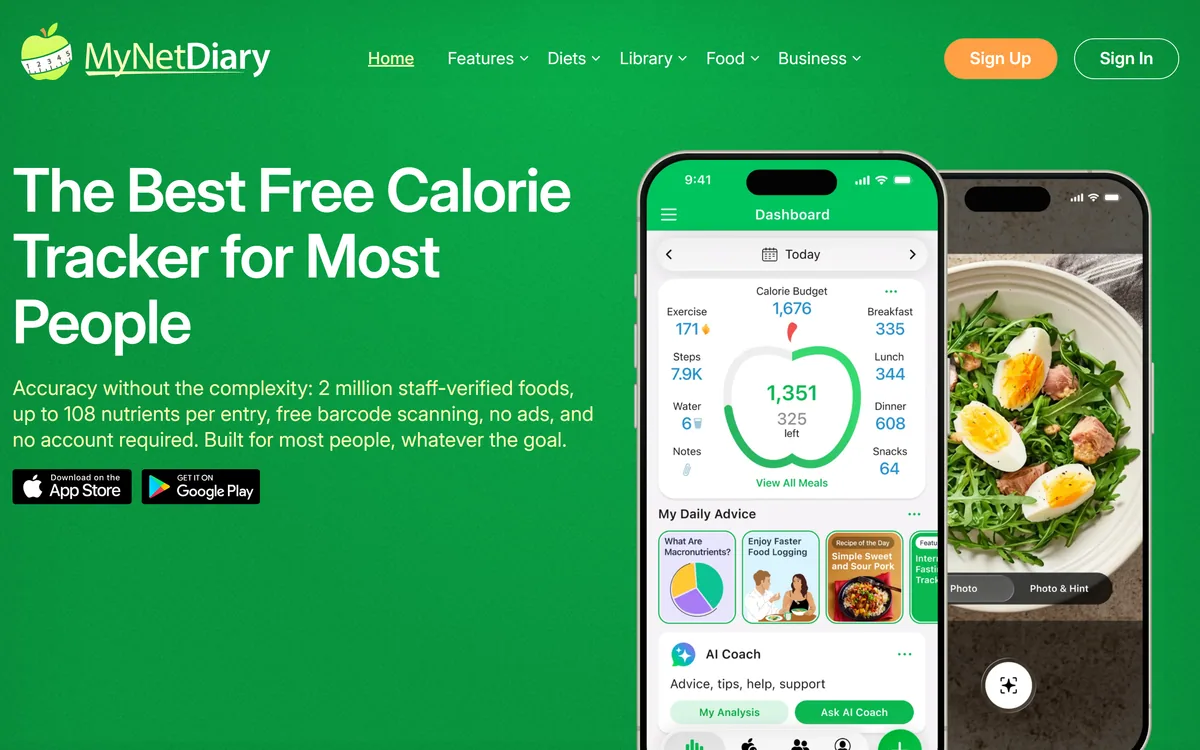
MyNetDiary tracks calories and nutrition against a staff-verified database of more than two million foods carrying up to 108 nutrients each, with barcode scanning, AI photo logging, restaurant menu analysis, wearable integrations and dedicated support for GLP-1 medication users.
mynetdiary.com9 viewsAdded April 4, 2026352K visitors
Calorie trackers all look the same on a screenshot, and they are not the same at all. The difference sits somewhere nobody photographs: the database.
A tracker built on user-submitted entries will happily tell you a chicken breast contains 90 calories or 310, because somebody typed both. Verified databases are the exception, and Cronometer is the other well-known one. You log diligently for three months, the numbers are wrong in an unknowable direction, and the entire exercise measured nothing.
MyNetDiary's central claim is that it solved this by being old and by employing people. Two million foods, verified by staff, drawn from USDA and research-grade nutrient data, with thousands of entries updated every day. This review covers whether that depth is worth choosing a tracker for, what the AI photo logging can and cannot do, and where a calorie count stops being useful information.
MyNetDiary's homepage, captured 9 September 2026. Database depth and AI features are presented together, which reflects how the product actually works.
MyNetDiary: The Verified Numbers
Product type
Calorie and nutrition tracking across iOS, Android and web
Database size
Over 2 million staff-verified foods
Nutrient depth
Up to 108 nutrients per entry
Data sources
USDA and NCC research-grade nutrient data
Update cadence
2,500 to 3,500 foods updated every day
Free tier includes
Barcode scanner, macro tracking, water and exercise logging, full nutrient detail, community access, no ads
AI features
Photo logging with portion estimation, 24/7 AI coach, restaurant menu scanning
Device integrations
Garmin, Apple Health, Apple Watch, Fitbit, Withings, Health Connect
Medication and injection tracking, digestive symptom logging, protein targets, meal plans, trend charts
Operating history
Stated as 20 years
Medical position
Site states the information provided does not constitute medical advice
Pricing model
Freemium, with Premium and Premium Plus tiers
Related product
PlateAI, an AI-first app from the same team
Photograph The Plate, Check The Numbers
The AI feature people will try first lets you photograph a meal and have foods identified, portions estimated and the entry logged with full nutritional detail.
It is genuinely useful and it needs to be understood correctly. Recognising that a plate contains rice, grilled chicken and broccoli is something models now do reliably. Estimating that there are 180 grams of rice rather than 240 is a fundamentally harder problem, and it is the number that determines the calorie count.
Portion estimation from a two-dimensional image involves inferring depth, density and what is hidden underneath. A photograph cannot see that the rice is piled rather than spread, or that the chicken was cooked in three tablespoons of oil. Those are not marginal differences — they are the difference between a 450-calorie meal and a 700-calorie one.
The right way to use it is as a logging accelerator rather than a measuring device. It removes the friction that causes people to stop logging altogether, which matters enormously, because an approximate log you maintain beats a precise log you abandon in week two.
For anything you eat regularly, log it accurately once — weighed, or scanned from the packet — and reuse that entry. Save the photograph for restaurant meals and unfamiliar food, where an estimate is the only option available anyway.
A photograph can tell you what is on the plate. It cannot tell you how much, and how much is the entire number.
The Barcode Is Still The Most Accurate Route
For packaged food, scanning the barcode remains substantially more reliable than any AI feature, and it is free on every tier.
The reason is straightforward: a barcode resolves to a specific product with a manufacturer-declared nutrition panel. There is no estimation involved. The only remaining variable is your portion, and that you can weigh.
This creates a practical hierarchy worth internalising. Scan the barcode where one exists. Weigh and use a verified database entry where one does not. Photograph only when neither is possible — a restaurant meal, someone else's cooking, food without packaging.
Following that order costs almost no extra effort and produces a log that is meaningfully more accurate than one built on photographs alone.
GLP-1 Support Is A Genuine Repositioning
MyNetDiary has built dedicated features for people taking GLP-1 receptor agonists: medication and injection tracking, digestive symptom logging, protein targets, specialised meal plans and trend charts.
This is a serious response to a real shift rather than a marketing label. These medications changed the problem calorie trackers were built for. When appetite is pharmacologically suppressed, eating too much stops being the difficulty and new ones appear: eating enough protein to limit muscle loss, managing nausea and digestive side effects, and maintaining nutrient adequacy on substantially reduced intake.
A tracker designed around restriction is the wrong tool for that, and neither is a meal planner such as Eat This Much. Protein targets, symptom logging and meal plans built for smaller volumes are the right ones, and building them is a considerably better response than adding the letters GLP-1 to a marketing page.
The essential caveat belongs here plainly. These are prescription medications with real side effects, and nutrition while taking them is a matter for the prescribing clinician and ideally a dietitian. A tracking app is a useful instrument for following medical advice; it is not a source of it, and the site's own material states that the information it provides does not constitute medical advice.
Used as an instrument — recording protein intake, noting which meals precede symptoms, giving your clinician real data rather than recollection — it is genuinely valuable.
Log protein first; on suppressed appetite it is the nutrient most likely to fall short.
Record digestive symptoms alongside meals, since the pattern is what a clinician can act on.
Bring the trend charts to appointments rather than trying to recall a fortnight of eating.
Treat any target the app sets as a starting point to discuss, not a prescription.
Watch for a downward trend in overall nutrient adequacy, not only in calories.
The Free Tier Is Unusually Complete
The free version includes barcode scanning, macro tracking, water logging, exercise tracking, full nutrient detail on entries, and community access — with no advertising and no account required to start.
That is a materially better free offering than this category normally provides, and it is worth being specific about why it matters. In most trackers, the barcode scanner is the first thing put behind a subscription, because it is the feature people use constantly. Giving it away means the core loop of accurate logging works without paying.
No advertising deserves mention too. An app you open five times a day, in which advertising would be shown against food and weight, is one where the absence of ads is a real quality-of-life difference and not merely a preference.
The paid tiers add advanced reports and the AI features. That is a defensible split: the AI tools cost the vendor money per use, and the free tier retains what you need for a genuinely accurate log.
It also means you can evaluate the thing that matters — whether the database contains the foods you actually eat — before paying anything. That is the only test that predicts whether you will still be using it in three months.
What A Calorie Tracker Cannot Know
A section this honest belongs in every review in this category, because the interface implies a precision the underlying science does not support.
Nutrition labels carry permitted tolerances, which in many jurisdictions run to around 20 per cent. Two identical apples differ in size and sugar content. Cooking changes availability of energy — the same potato yields differently depending on preparation. And energy expenditure varies between people with the same measurements.
So a daily total displayed as 1,847 calories carries a false precision. The honest reading is somewhere in the region of eighteen hundred, plus or minus a meaningful margin.
This does not make tracking useless — quite the opposite. Its value was never absolute accuracy; it is consistency and awareness — the same reason a training log such as SHRED works. Logged the same way over weeks, the trend is reliable even when each day's figure is not, and the act of recording changes eating behaviour on its own.
The practical implication is to weight the weekly average heavily and the daily total barely at all, and to resist adjusting your eating in response to a single day's number. That is also the mindset least likely to develop into an unhealthy preoccupation, which is a real risk with detailed food logging and one worth naming.
Two Weeks Of Honest Logging
Nutrition trackers are chosen on features and abandoned over friction. This sequence tests the friction, which is the thing that actually decides.
The bar is step two. If the foods you eat most are missing or wrong in the database, no amount of AI on top will fix it.
Before anything else, search the database for the ten foods you eat most often — including anything regional, home-cooked or from a local supermarket.
Check the entries against the packets in your kitchen. A database that is wrong on your staples is wrong on everything you will log.
Log a full week on the free tier only, using barcodes where possible and weighing where not. This establishes what accurate looks like for you.
Now photograph a few meals you have already logged accurately, and compare the AI estimate with the known figure. That difference is your error margin for every photographed meal.
Connect your wearable and confirm the exercise data flows without duplicating entries, which is a common and quietly distorting problem.
At day fourteen, look at the weekly averages rather than any daily total, and ask whether logging has become automatic or is still an effort you are forcing.
Freemium Done The Right Way Round
The model is freemium: a substantial free tier, with Premium and Premium Plus adding advanced reports and the AI tools including photo logging, the coach and menu scanning.
Two things make this structure better than the category norm. The free tier keeps barcode scanning and full nutrient detail, so accurate logging does not require payment. And the paid features are the ones with genuine per-use cost to the vendor, which is a more honest basis for a paywall than gating a core function to force conversion.
The decision worth making deliberately is whether you need the AI layer at all. If most of what you eat is packaged or home-cooked from known ingredients, barcode scanning and weighing will serve you better and cost nothing. If you eat out frequently, photo logging and menu scanning are what make logging survivable.
We do not publish amounts, since tiers change. Do check whether the tier you want is billed monthly or annually and how cancellation works before subscribing, and note the related product PlateAI from the same team if an AI-first approach appeals more than a database-first one.
Twenty Years Of Food Data
The database is the product — over two million staff-verified foods from USDA and NCC research data, carrying up to 108 nutrients per entry, with thousands of foods updated daily.
Staff-verified, not crowd-sourced, which is the distinction that determines whether your logged numbers mean anything at all.
AI photo logging and menu scanning sit on top: photograph a plate for an estimate, or scan a restaurant menu for tailored suggestions.
GLP-1 support is built in, with medication and injection tracking, digestive symptom logging, protein targets and matched meal plans.
The free tier is genuinely complete: barcode scanning, macro tracking, full nutrient detail and exercise logging, with no ads and no account needed to start.
Key features of MyNetDiary
Staff-verified database of over two million foods with up to 108 nutrients per entry
Barcode scanning for packaged foods, available on the free tier
AI photo logging that identifies foods and estimates portions from a picture of a plate
Restaurant menu scanning with recommendations matched to your targets
24/7 AI coach drawing on your logged data, weight trend and nutrient gaps
GLP-1 medication tracking with injection logging, symptom recording and protein targets
Wearable integrations across Garmin, Apple Health, Apple Watch, Fitbit, Withings and Health Connect
Support for ten named dietary approaches including keto, Mediterranean, DASH and vegan
Pros & cons
Pros
6
Staff-verified database sourced from USDA and research data, rather than crowd-sourced entries of unknown quality
Nutrient depth of up to 108 fields goes far beyond the calories-and-macros most trackers stop at
Free tier keeps barcode scanning and full nutrient detail, so accurate logging costs nothing
No advertising in an app you open several times a day around food and weight
GLP-1 features respond properly to a genuine change in how people manage weight
Broad wearable support means exercise data arrives without manual entry
Cons
6
AI photo logging estimates portions from a two-dimensional image, which is inherently imprecise and unfixable
The interface presents photo estimates with the same authority as scanned barcodes, which invites false confidence
Stated user numbers and operating history are vendor claims with no published basis
Database strength is US-centric, so regional and home-cooked foods may be less well covered
Detailed food logging carries a real risk of reinforcing disordered eating for some users
The AI coach's guidance is general information, not clinical advice, and the distinction is easy to lose in conversation
Best For
Anyone who needs micronutrient detail rather than calories alone
People frustrated by inconsistent crowd-sourced food databases
GLP-1 medication users tracking protein and digestive symptoms
Users working with a dietitian who need real data for appointments
Anyone who wants accurate logging without a subscription
MyNetDiary Against The Nutrition Trackers
Judge these on database quality first and interface second. The interface is what you see; the database is what determines whether your numbers mean anything.
Tool
Database approach
AI features
Free tier
MyNetDiary
Staff-verified, USDA and NCC sourced, updated daily
Photo logging, coach and menu scanning on paid tiers
Unusually complete — barcode scanning and full nutrient detail included
You want nutrient detail beyond calories and macros — micronutrients, fibre, sodium and the rest.
You have been burned by a crowd-sourced database giving three different answers for the same food.
You are taking a GLP-1 medication and need protein targets and symptom tracking rather than restriction tools.
You want accurate logging without paying, since barcode scanning and full nutrient detail are on the free tier.
You are working with a dietitian or clinician and need real data to bring to appointments.
Choose differently when
You want photo logging to be accurate rather than approximate — portion estimation from an image is inherently imprecise.
You have a history of disordered eating, where detailed food logging can reinforce a preoccupation; speak to a clinician before starting.
You eat mainly regional or home-cooked food unlikely to be well covered in a US-sourced database — test this before committing.
You want meal planning as the primary function rather than logging what you already ate.
You would find any daily number distressing rather than informative, given the real margin of error involved.
Other Health And Nutrition Tools
Adjacent problems — planning, recipes and training are different jobs from logging.
Cronometer — the closest comparison on data quality, with particular strength in micronutrients
Eat This Much — meal planning rather than logging, if deciding what to eat is the harder problem
RecipeScan — nutritional breakdown of recipes you cook rather than packaged foods
SHRED — structured training, the other half of most body-composition goals
The Running Genie — endurance training programming to pair with nutrition tracking
Confirming The Database Claims
Last checked . Read from mynetdiary.com, including the footer and feature pages, with the screenshot above captured in the same session.
Database stated as over 2 million staff-verified foods with up to 108 nutrients per entry
Data sources stated as USDA and NCC research-grade nutrient data
Update cadence stated as 2,500 to 3,500 foods every day
Free tier confirmed to include barcode scanning, macro tracking, water logging, exercise tracking, full nutrient detail and community access, with no ads and no account required to start
AI features confirmed as photo logging with food identification and portion estimation, a 24/7 AI coach, and restaurant menu scanning
Device integrations confirmed for Garmin, Apple Health, Apple Watch, Fitbit, Withings and Health Connect
Diet plans confirmed across calorie counting, low-carb, keto, high-protein, low-fat, Mediterranean, vegetarian, vegan, DASH and GLP-1
GLP-1 features confirmed as medication and injection tracking, digestive symptom logging, protein tracking, specialised meal plans and trend charts
Platform availability confirmed as iOS, Android and web
Medical disclaimer quoted directly from the site: the information provided does not constitute medical advice
Pricing structure confirmed as freemium with Premium and Premium Plus tiers, and a related product PlateAI from the same team
What we could not confirm: the stated user total and the twenty-year operating history are vendor claims with no published basis; no accuracy figure is published for AI photo portion estimation, and none could be, since estimating volume and density from a photograph is inherently imprecise; the app store ratings quoted on the site are as reported by the vendor; and we did not use the product, so nothing here reflects hands-on logging.
Editor's Verdict
4.2/5
MyNetDiary scores well because it is built on the thing that actually determines whether a nutrition tracker is useful — a staff-verified database of more than two million foods sourced from USDA and NCC research data, carrying up to 108 nutrients and updated by thousands of entries daily. Crowd-sourced databases are where most competitors quietly fail. Its free tier is unusually complete, and the GLP-1 features respond to a real change in how people manage weight. It loses ground because AI photo logging is inherently an estimate and the interface presents estimates with the same authority as scanned barcodes, and because the headline user figure is a vendor count with no published basis. AInexfinder Editor Score: 4.2/5.
MyNetDiary pricing
AInexfinder does not list plan prices or billing details. For current pricing, plans, and trials, visit the official MyNetDiary website.
Vendor pricing, credits, and billing policies change over time. Always confirm on the official site before you buy.
Frequently asked questions
What makes MyNetDiary different from other calorie trackers?
The database. It holds over two million staff-verified foods drawn from USDA and NCC research-grade data, carrying up to 108 nutrients per entry, with thousands updated daily. Most competitors rely heavily on user-submitted entries, which is why the same food can return wildly different values — and why a diligently kept log can end up measuring nothing.
Is MyNetDiary free?
There is a genuinely complete free tier: barcode scanning, macro tracking, water and exercise logging, full nutrient detail and community access, with no ads and no account required to start. Premium and Premium Plus add advanced reports and the AI features. We do not publish amounts — check the pricing page and the billing terms before subscribing.
How accurate is MyNetDiary's photo food logging?
Identification is reliable; portion estimation is not, and cannot be. A photograph cannot see depth, density or what is underneath, and portion is what determines the calorie count. Use it as a logging accelerator for restaurant meals and unfamiliar food. For anything you eat regularly, scan the barcode or weigh it once and reuse that entry.
Does MyNetDiary support GLP-1 medications?
Yes, with dedicated features: medication and injection tracking, digestive symptom logging, protein targets, specialised meal plans and trend charts. This addresses a real shift — when appetite is pharmacologically suppressed, the problem becomes eating enough protein and managing side effects, not restricting intake. Nutrition on these medications is still a matter for your prescribing clinician.
How accurate are calorie counts in general?
Less precise than any app's display implies. Nutrition labels carry permitted tolerances of around 20 per cent in many jurisdictions, identical-looking foods vary, and cooking changes available energy. A total shown as 1,847 calories honestly means roughly eighteen hundred, plus or minus a real margin. Weight the weekly average heavily and any single day barely at all.
Which fitness trackers work with MyNetDiary?
Garmin, Apple Health, Apple Watch, Fitbit, Withings and Health Connect are all listed. When you connect one, check that exercise data is not being counted twice — duplicate entries between an app and a wearable are a common problem and quietly distort your energy balance in the wrong direction.
Is MyNetDiary safe if I have had disordered eating?
Detailed food logging can reinforce a preoccupation with numbers for some people, and that risk is real regardless of which app is used. If you have a history of disordered eating, speak to a clinician before starting rather than after. The site itself states that the information it provides does not constitute medical advice.
Daniel reviews AI tools the slow way — by actually using them on real projects. His reviews cover what works, what breaks, and who each tool is genuinely a good fit for.
Daniel and the AInexfinder editorial team research MyNetDiary using public product information, listing evidence, and (when available) hands-on checks. Scores reflect listing completeness and transparency — not paid placement.
Listings may include affiliate or sponsored placements, which are labeled when present. Editorial scores and cons are not sold. See our affiliate disclosure and review methodology.
RecipeScan is an Apple-only cooking app that builds a pantry from photos, suggests recipes against what you already have, and coordinates three dishes onto one timeline. It adds grocery lists, budget tracking, calorie estimates and a hands-free cooking mode.
Eat This Much generates weekly meal plans from your calorie and macro targets, food preferences, budget, and schedule, then produces a grocery list that can be sent to Instacart or AmazonFresh — with keto, Mediterranean, paleo, vegan, and vegetarian options.
MacroFactor is a nutrition and workout tracking app whose coaching adapts weekly to your logged intake and weight trend, estimating your actual energy expenditure rather than using a formula. It publishes in-depth research articles alongside the apps and maintains a public roadmap.
Lumen is a portable metabolic device using a CO2 sensor and flow meter to read the carbon dioxide concentration in a single breath, indicating which fuel your body is using. It builds a daily plan of what to eat and when, flags muscle-loss risk, and guides fuelling around workouts.