The Running Genie is an AI running coach that syncs from Strava, Garmin, Polar, Suunto and Apple Health, then builds adaptive training plans for 5K through ultra using VDOT, 80/20 polarised training and periodisation principles.
therunninggenie.com13 viewsAdded December 9, 202515K visitors
Every runner who has followed a printed training plan knows its failure mode. Week seven says twelve miles with eight at marathon pace. Week seven also finds you three nights short of sleep, mildly ill, and two days off a race you ran too hard. The plan does not know any of this, so it says twelve miles anyway.
The Running Genie's argument is that a plan reading your actual completed runs can do better than one written before the block started. It syncs from the platforms runners already use, analyses what you ran, and adjusts what comes next.
This review covers what the underlying training science actually is, why the integration list matters more than the AI, what the analysis can and cannot infer, and who is better served by a coach or a free plan.
The plan adapts to the runs you actually did — which is the entire difference from a PDF training block.
The Case For An Adaptive Plan
It reads your real training from Strava, Garmin, Polar, Suunto, Apple Health or an uploaded FIT, GPX or TCX file.
Plans adapt to what you actually ran, not to what a fixed sixteen-week block assumed you would run.
The science is named and conventional — Daniels' VDOT, 80/20 polarised training, periodisation. That is a good sign, not a boring one.
Distances run 5K to ultra, with a dedicated 16-week marathon build covering pacing and taper.
It cannot see your life — sleep, work stress, a niggle you have not mentioned. Everything it does not measure, you still have to manage.
Will This Actually Improve Your Running?
Likely Yes If
You are training for a specific race and running four or more times a week
You already use Strava or Garmin and have training history it can read
You suspect your easy runs are not actually easy
You have no coach and no confident grasp of how to structure a block
You want a plan that reacts when a week goes badly instead of pretending it did not
Save Your Money If
You are running through an injury or a recurring niggle — that needs a physiotherapist
You are close to your competitive ceiling, where a human coach adds more than load data
You just want to finish a first 5K, which a free plan handles perfectly well
You run without a watch, leaving nothing for the adaptation to read
You will override every downward adjustment the plan makes
The Training Science It Is Built On
The site names its foundations — Daniels' Running Formula and VDOT, 80/20 polarised training, and periodisation. This is worth pausing on, because naming conventional, well-established principles is a better signal than claiming a proprietary breakthrough.
VDOT As The Calibration Layer
VDOT is Jack Daniels' system for deriving training paces from a recent race performance. Rather than guessing what your easy pace or threshold pace should be, it computes them from a result you have actually produced.
The value in an app is that recalibration happens automatically. A runner improving through a block should be training at progressively faster paces, and a plan that keeps prescribing January's paces in March is quietly under-training you.
Why 80/20 Is The Rule Most Runners Break
Polarised training says roughly 80% of running should be genuinely easy and 20% genuinely hard. The overwhelmingly common amateur error is spending the whole week in a moderate middle — too hard to recover from, too easy to drive adaptation.
This is precisely the pattern an app can catch that a runner cannot, because it requires honestly comparing intended intensity against what your data says you actually did. Most runners believe their easy runs are easy. Their heart rate files frequently disagree.
Periodisation And The Taper
Periodisation structures a block into phases building towards a target date rather than repeating the same week indefinitely. The 16-week marathon plan includes pacing and taper optimisation, and the taper is the part amateurs most reliably get wrong — usually by cutting volume too late and arriving tired.
An adaptive plan helps here mainly by being harder to argue with than your own enthusiasm in the final fortnight.
The Integration List Is The Real Feature
Sign-in and sync work with Strava, Garmin, Polar, Suunto, Apple Health on iOS and Health Connect on Android, plus manual upload of FIT, GPX and TCX files.
That breadth matters more than any coaching claim, for a blunt reason: a coaching app that cannot see your runs is a calendar. Every runner already has a watch and a platform they have used for years, and no one is switching ecosystems for a training plan.
The manual file upload is the useful backstop. Treadmill sessions, a borrowed watch, a device that syncs badly — the ability to drop in a file keeps the picture complete, and an adaptive plan built on an incomplete picture adapts to the wrong thing.
Coaching software lives or dies on whether it can see your training. Everything else is downstream of the sync.
What The Analysis Can And Cannot Infer
The platform surfaces pace, distance and training load, with per-run feedback and monthly challenges, leaderboards and shareable run cards on the social side.
Training load is the genuinely useful metric, because it is the one a runner cannot hold in their head. Cumulative stress across weeks is what determines whether you are building fitness or building an injury, and it is invisible run to run.
But be clear about the limits of what a file contains. It shows pace, distance, elevation, cadence and — if you wear a strap or a decent optical sensor — heart rate. It does not show that you slept five hours, that you are three weeks into a stressful project, that you ran through calf tightness you decided to ignore, or that today's heat made an easy effort read as a hard one.
A plan that adapts to the measured half of your training while the unmeasured half is what actually breaks runners is still an improvement on a plan that adapts to nothing. It is not a coach who can hear that something is off in how you describe your week.
Getting An Honest Plan Out Of It
Adaptive plans reward honesty in setup and discipline in use — mostly the discipline to run easy days easy.
Connect your primary platform first and let it read your existing history, so the starting point reflects your real current fitness rather than an aspiration.
Give it a genuine recent race or time trial for VDOT calibration. An optimistic input produces paces you cannot sustain and a block you will fail.
Set a real target race and date — periodisation is meaningless without something to periodise towards.
Run the easy days properly easy. This is where 80/20 is won or lost, and it will feel too slow for the first fortnight.
Upload treadmill and off-device runs manually rather than leaving gaps the load calculation cannot see.
When the plan adjusts downward after a hard week, let it. Overriding every reduction turns an adaptive plan back into a fixed one you happen to be losing to.
Ignore the leaderboards during a build. Competitive comparison is exactly how an easy week becomes a moderate one.
Who Is Better Off Elsewhere
A runner working through injury needs a physiotherapist and a coach who can see them move, not an algorithm reading pace files. Nothing in a GPS trace reveals a biomechanical problem.
A competitive runner near their ceiling is generally better served by a human coach, because at that level the useful adjustments come from context, race tactics and conversation rather than from load numbers.
And a beginner whose only goal is finishing a first 5K can reach it on a free couch-to-5K plan. Adaptive coaching solves a problem that appears once training gets complicated enough to be worth adapting.
The sweet spot is the committed amateur: someone training seriously for a specific race, running four to six times a week, without a coach and without the physiological knowledge to structure a block properly alone.
Coaching, Data And Distances
Product type
AI running coach with adaptive training plans
Race distances
5K through ultra-marathon
Marathon plan
16 weeks, including pacing and taper optimisation
Training science
Daniels' Running Formula (VDOT), 80/20 polarised training, periodisation
Platform sync
Strava, Garmin, Polar, Suunto
Phone health data
Apple Health on iOS, Health Connect on Android
Manual upload
FIT, GPX and TCX files
Analytics
Pace, distance and training load visualisation
Per-run feedback
Personalised commentary on each activity
Social features
Monthly challenges, leaderboards, shareable run cards
Extras
Free calculators and running guides
Key features of The Running Genie
Adaptive training plans that change based on runs you actually completed
VDOT-based pace calibration from a recent race or time trial
80/20 polarised intensity distribution built into plan structure
Periodised builds targeting a specific race date
16-week marathon plan with pacing and taper optimisation
Sync from Strava, Garmin, Polar, Suunto, Apple Health and Health Connect
Manual upload of FIT, GPX and TCX files for off-device runs
Training load visualisation alongside pace and distance
Per-run AI feedback rather than raw statistics only
Monthly challenges, leaderboards and shareable run cards
Pros & cons
Pros
5
Names conventional, well-established training science instead of claiming a proprietary secret
Broad device support means it fits the ecosystem you already run in
Automatic VDOT recalibration keeps paces current as fitness improves
Training load is the metric runners most need and least able to track in their heads
Manual file upload keeps treadmill and off-device runs from leaving gaps in the data
Cons
5
Cannot see sleep, stress, illness or a niggle you have not reported — the factors that actually derail blocks
No substitute for a physiotherapist when something hurts, since a GPS trace shows no biomechanics
Competitive runners generally get more from a human coach than from load analysis
Leaderboards and challenges push against the easy-day discipline that 80/20 depends on
Requires a watch and consistent syncing; without data there is nothing to adapt to
Best For
Committed amateurs training for a specific race without a coach
Runners who suspect their easy days are secretly moderate days
Marathon runners who need taper discipline more than motivation
People already invested in Strava, Garmin, Polar or Suunto
Anyone moving from a fixed printed plan to something that reacts to a bad week
Running Genie Versus Other Training Apps
Coaching, tracking and strength are separate jobs, and most runners eventually want two of the three.
Tool
Focus
Adapts to your data
Best for
The Running Genie
Adaptive running plans on named training science
Yes, from synced runs
Committed amateurs training for a race without a coach
Training is one input. Strength, recovery and fuelling decide whether the training sticks.
Cycling Coach AI — the same adaptive coaching approach for the bike
Fitbod — strength programming, the injury-prevention work most runners skip
Welltory — recovery and readiness signals that pace data cannot provide
MacroFactor — nutrition tracking that adapts, which matters in a heavy block
Eat This Much — meal planning around the calorie demands of marathon training
Confirmed Against The Product Site
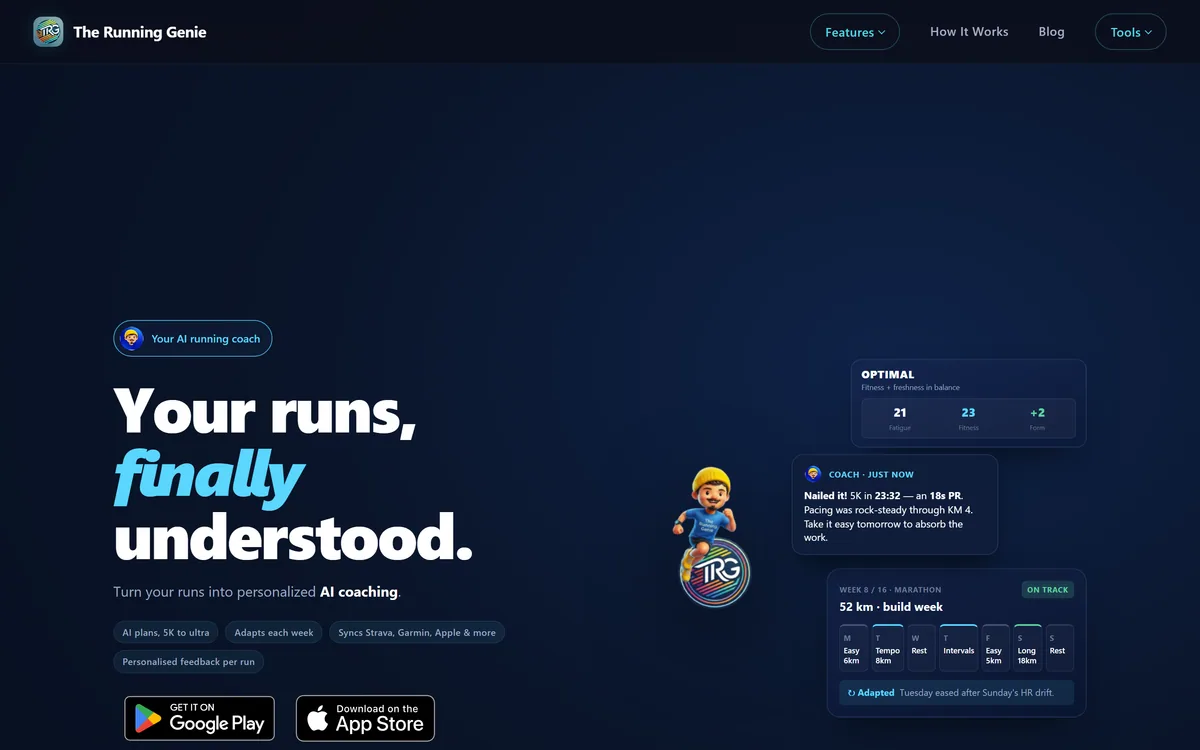
Last checked . Read from therunninggenie.com during this check, with the screenshot above captured at the same time.
Training science cited on the site as Daniels' Running Formula (VDOT), 80/20 training methodology and periodisation
Integrations with Strava, Garmin, Polar, Suunto, Apple Health and Health Connect, plus manual FIT, GPX and TCX upload
Adaptive training plans covering 5K to ultra-marathon, and a 16-week marathon plan with pacing and taper optimisation
Running analytics covering pace, distance and training load, with per-run AI feedback
Monthly challenges, leaderboards and shareable run cards listed as social features
Guides, blog, free calculators, community and support sections, plus privacy policy and terms of service, present in the site footer
No plan prices published here, in line with this site's pricing policy
Explanations of VDOT, polarised training and periodisation reflect the established literature rather than claims made by The Running Genie. Cautions about injury and unmeasured load apply to every data-driven training app, not this one specifically.
Editor's Verdict
4.2/5
The Running Genie has an AInexfinder Editor Score of 4.2/5.
The Running Genie pricing
AInexfinder does not list plan prices or billing details. For current pricing, plans, and trials, visit the official The Running Genie website.
Vendor pricing, credits, and billing policies change over time. Always confirm on the official site before you buy.
Frequently asked questions
What does 'adaptive' actually mean here?
The plan reads the runs you completed and adjusts what comes next, rather than following a fixed block written before you started. If a week goes badly, the following week reflects that instead of assuming you did the sessions on paper.
What is VDOT and why does it matter?
VDOT is Jack Daniels' method for deriving training paces from a recent race result rather than guessing them. In an app the benefit is automatic recalibration — as you get faster, your prescribed paces move with you instead of staying at January's numbers.
Which devices and platforms does it support?
Strava, Garmin, Polar and Suunto for direct sync, Apple Health on iOS and Health Connect on Android, plus manual upload of FIT, GPX and TCX files for treadmill runs or anything that did not sync cleanly.
Can it tell if I am overtraining?
It can see training load, which is a genuine early signal and one runners cannot track unaided. It cannot see sleep, work stress, illness or a niggle you have not mentioned — and those are frequently what actually breaks a block. Treat load as one input, not a verdict.
Is it a replacement for a coach?
For a committed amateur without one, it covers most of what a coach would structure. For a competitive runner near their ceiling, no — at that level the valuable adjustments come from context and conversation rather than from analysing pace files.
Why does the 80/20 rule keep coming up?
Because most amateurs break it. Roughly 80% of running should be genuinely easy and 20% genuinely hard, and the common error is a whole week in the moderate middle — too hard to recover from, too easy to adapt to. Your heart rate data usually disagrees with your sense of how easy your easy runs are.
Is it useful for a first 5K?
Less than you would hope. A free couch-to-5K plan handles that goal fine. Adaptive coaching starts paying off once training is complex enough to be worth adapting — a real race target, several runs a week, and paces that need to keep moving.
Daniel reviews AI tools the slow way — by actually using them on real projects. His reviews cover what works, what breaks, and who each tool is genuinely a good fit for.
Daniel and the AInexfinder editorial team research The Running Genie using public product information, listing evidence, and (when available) hands-on checks. Scores reflect listing completeness and transparency — not paid placement.
Listings may include affiliate or sponsored placements, which are labeled when present. Editorial scores and cons are not sold. See our affiliate disclosure and review methodology.
Jefit is a workout planner and tracking app with a large exercise database, custom plan building, muscle recovery and one-rep-max metrics, and a community feed. Its adaptive plan analyses strength and fatigue to build the coming week, and periodization now applies to plans members build themselves.
BodBot is an AI personal trainer and nutritionist that builds workouts tailored to your goals, body and progress, adapting with every rep, with joint controls for injuries, wearable integration and data-driven nutrition across web, phone, tablet and watch.
Gymscore analyses lifting technique from phone video, scoring each set from zero to one hundred across five movement categories and giving feedback on range of motion, posture, core stability and movement patterns across more than 2,500 exercises, alongside training plans and an AI coaching chat.
Vici is a free iOS running coach that connects to Strava and your wearable, checks in each morning against recovery, sleep, HRV and resting heart rate, adapts the day's session accordingly, and reads every completed run in two stages before adjusting what comes next.
Dr. Muscle builds and adjusts strength training programmes automatically, picking your weights and reps from what you lifted last time. Built by an exercise scientist, it applies progressive overload and daily undulating periodization, publishes dated release notes going back to 2016, and runs on phone and Apple Watch.