Jefit is a workout planner and tracking app with a large exercise database, custom plan building, muscle recovery and one-rep-max metrics, and a community feed. Its adaptive plan analyses strength and fatigue to build the coming week, and periodization now applies to plans members build themselves.
For most of its life Jefit was a logbook — the app people used because the exercise database was deep, the charts were real, and it did not try to be a lifestyle brand.
That history is the asset. A training log with years of your own sets in it is the hardest thing in fitness software to walk away from.
What has changed is that the log now programmes. Periodization runs on plans you built yourself, which is a considerably harder feature than applying it to a template the company wrote.
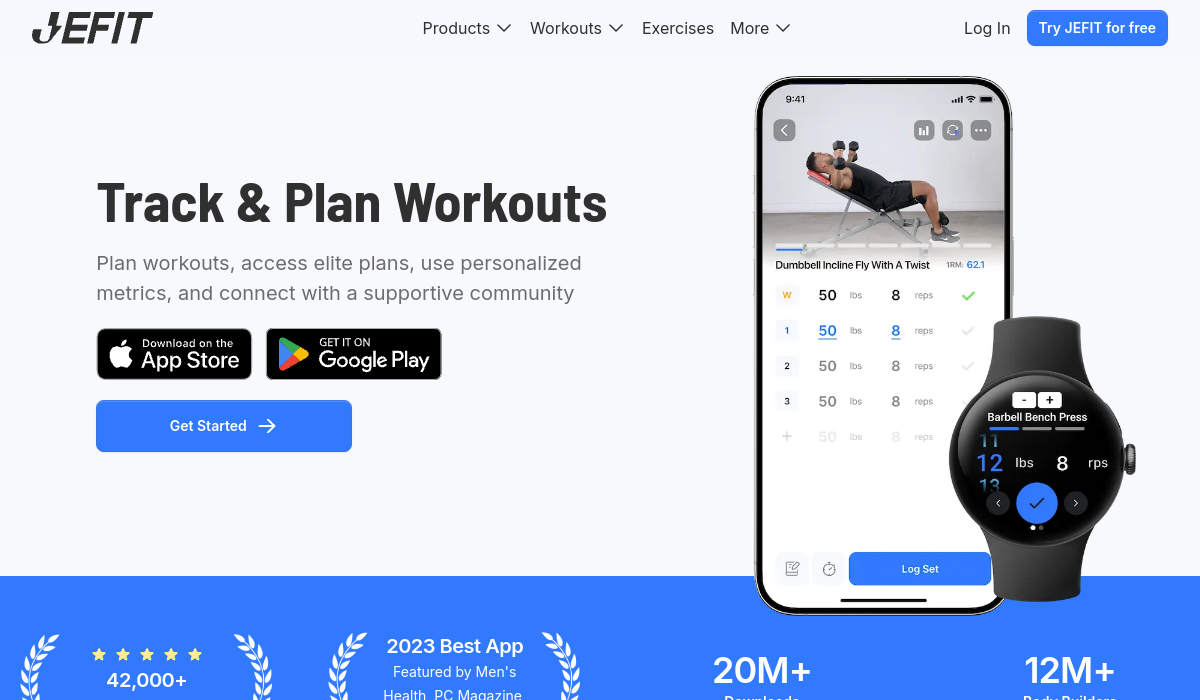
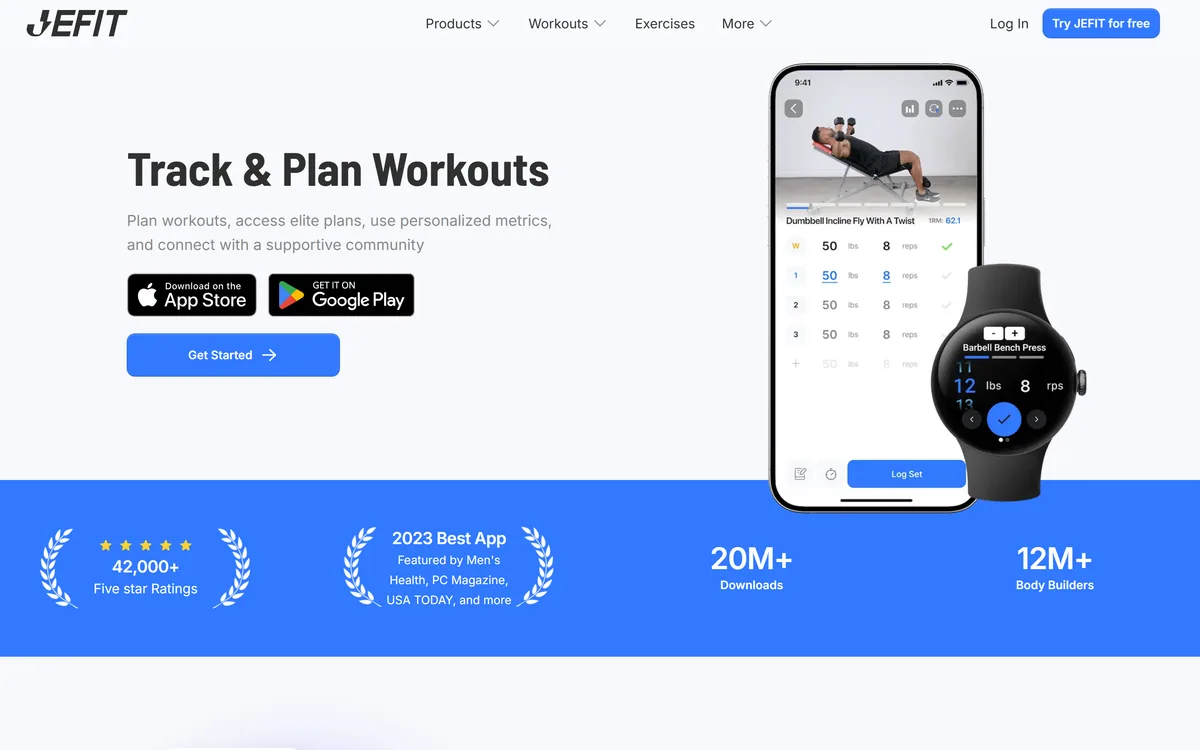
Jefit's homepage, captured 9 September 2026.
Jefit: A Logbook That Became A Coach
Periodization on plans you built yourself — the app raises effort phase by phase and schedules the recovery.
An adaptive plan that reads strength and fatigue to build the coming week, with a two-minute setup that leaves your current plan intact.
Real metrics: muscle recovery breakdown, one-rep-max estimates, workout time and weightlifting charts.
A large exercise database with instructions and form guidance, plus thousands of expert-designed plans.
Jefit Inc., with 42,000-plus five-star ratings and a community of members claimed in the millions.
What Does Adaptive Mesocycle Training Mean?
Jefit describes its adaptive plan as running mesocycle training for you, with a four-phase structure and weekly signals deciding when to advance, hold or deload.
Those three words — advance, hold, deload — are the whole of intelligent programming, and most lifters only ever do the first.
A mesocycle is a block of roughly four to six weeks in which effort accumulates and then is deliberately reduced. Advancing means adding load or volume. Holding means repeating a week because the last one was not absorbed. Deloading means cutting deliberately so adaptation can catch up.
Left to themselves, people advance until something breaks. Progress feels like adding weight, so holding feels like failure and deloading feels like quitting — which is why so many lifters cycle between progress and injury rather than progressing steadily.
Automating the decision removes the psychology from it. When an app says hold, it is not a judgement about your commitment, which makes it far easier to accept than the same instruction from yourself. Handing over weight selection entirely is the next step along, and Dr. Muscle's whole premise.
Advance, hold, deload. Left to themselves, people only ever do the first, because holding feels like failure and deloading feels like quitting.
Periodization On Plans You Built Yourself
The change Jefit announced most recently is specific: periodization now works on the plans you build yourself, keeping your exercises while the app raises the effort phase by phase and schedules the recovery.
That distinction matters more than it sounds, and it is the harder half of the problem.
Applying periodization to a template is straightforward, because the company wrote the template and knows what every exercise is for. Applying it to something a user assembled means inferring intent from a list — which movements are the main lifts, which are accessories, what is being trained on which day.
It also solves the real adoption problem. Lifters are attached to their own programmes, often unreasonably, and will not abandon one they built for a better-structured one they did not. Meeting them inside their own plan is the only route that gets used.
The trade is that inference can be wrong. A plan the app misreads will be periodised against the wrong assumptions, which is worth watching for in the first block — particularly if your programme is unusual.
Why A Deep Exercise Database Still Matters
Alongside the coaching, Jefit's oldest asset remains its exercise database — with instructions, form guidance and the ability to build plans around preferred exercises, rest times, supersets, equipment and frequency.
Database depth sounds like a checkbox and is actually what determines whether an app survives contact with a real gym.
The failure is specific and universal. Your programme calls for an exercise, the gym does not have the machine, and you need a substitute right now — logged properly so the history stays continuous. An app with a shallow database forces you to log something approximate or nothing at all.
The same applies to the equipment filter. A plan built assuming a full commercial gym is useless in a hotel or a garage, and the ability to rebuild around what is actually available is the difference between training and skipping.
Supersets and rest time configuration matter for the same reason — they let the app represent how you actually train rather than an idealised version, and a log that does not match reality stops being kept. Endurance training has the same problem and a different answer, which is where Vici sits.
Import or rebuild your existing plan rather than adopting a template.
Log honestly, including the sets that went badly.
Accept the hold and deload weeks — they are the point.
Set the equipment filter before travelling.
Watch the first block to check the app read your plan correctly.
Twelve Million Members And A Feed
The site displays a member community in the millions, a download total roughly double that, and 42,000-plus five-star ratings, alongside a social feed of members posting about their sessions.
Those three numbers describe different populations and only one is about current use.
Downloads accumulate over the lifetime of an app and include everyone who installed it once. Members counts registrations. Five-star ratings count people who liked it enough to say so — a smaller and more meaningful population, and 42,000 of them is a substantial figure.
The community feed is the feature that divides users cleanly. For some it is why the app is opened daily — a small accountability structure that costs nothing and works.
For others it is exactly what they came to a logbook to avoid. Strength training is unusual in that its motivational structure is largely internal, and a feed of other people's sessions can be as demotivating as it is encouraging. Worth knowing that it can be ignored rather than being the product.
The Metrics That Actually Change Training
Jefit's metrics list includes muscle recovery breakdown, one-rep-max estimates, workout time and weightlifting charts.
Two of those change what you do, and two are mostly interesting.
The muscle recovery breakdown is the genuinely useful one. It answers the question people get wrong constantly — whether a muscle group has recovered enough to be trained again — and it is the mechanism behind most avoidable overuse in self-programmed lifting.
One-rep-max estimation is the other. It lets a plan prescribe percentages without you testing a true maximum, which is both safer and more practical, since testing a genuine one-rep max is a hard session in itself.
Workout time and cumulative volume charts are motivational rather than instructive. Seeing lifetime tonnage rise is satisfying and it does not tell you what to do differently — the same distinction that separates progress tracking in MacroFactor from the targets it actually sets.
Logging Workouts You Will Still Log In March
The value of a training log is entirely a function of its continuity, and almost every log dies in the same six weeks.
This sequence builds a record that survives long enough to be worth having.
Rebuild your current plan in the app rather than adopting a new one.
Log during the session on your phone or watch, never afterwards from memory.
Record the sets that went badly — the algorithm needs them more than the good ones.
Let the periodization schedule your holds and deloads.
Set an equipment filter for the gym you actually use.
Review the recovery breakdown weekly rather than the volume chart.
Is Jefit The Right Training Log For You?
Track every set when
You want a training history that will still be there in five years.
You have your own programme and will not abandon it for a template.
You keep advancing until something hurts and never deload.
You need to substitute exercises when equipment is unavailable.
One-rep-max estimates would let you train to percentages properly.
Keep a notebook when
You train three movements and remember the numbers.
A social feed would be a distraction rather than accountability.
You want the app to write the programme rather than structure yours.
Technique is your limiting factor rather than progression.
You would log from memory afterwards, which defeats the purpose.
Jefit: Database And Community
Company
Jefit Inc., per the footer
Core function
Workout planning and set-by-set tracking
Adaptive plan
Analyses strength and fatigue to build the coming week, with a stated two-minute setup
Periodization
Applied to plans members build themselves, with phase-by-phase effort and scheduled recovery
Mesocycle structure
Described as four phases with weekly signals to advance, hold or deload
Plan building
Preferred exercises, rest times, supersets, equipment and frequency
Metrics
Muscle recovery breakdown, one-rep-max estimates, workout time and weightlifting charts
Prebuilt plans
Thousands, described as designed by experts
Devices
Mobile and watch logging
Community
A member feed, with membership stated in the millions
Ratings
42,000-plus five-star ratings displayed
Press
Coverage cited from named consumer and technology publications
Key features of Jefit
Set-by-set workout logging on phone or watch
Custom plan building with supersets and rest times
Periodization applied to self-built plans
Adaptive weekly planning from strength and fatigue
Muscle recovery breakdown
One-rep-max estimation and progress charts
A large exercise database with instructions
Thousands of prebuilt expert plans
Pros & cons
Pros
7
Periodization on plans you built yourself is the harder and more useful feature
Advance, hold and deload automated removes the psychology from deloading
A deep exercise database survives contact with a real gym's equipment
Muscle recovery breakdown addresses the most common self-programming error
One-rep-max estimates let you train to percentages without testing a max
A long operating history means a training log that will still exist
42,000-plus five-star ratings is a substantial and meaningful sample
Cons
7
Inferring intent from a user-built plan can be wrong, especially for unusual programmes
Download, member and rating figures measure three different populations
The community feed is a distraction for anyone who came for a logbook
Exercise database size is only cited inside a press quote, not stated directly
How muscle recovery is calculated is not explained
Volume charts are motivational rather than instructive
Free versus elite tier differences are not spelled out on the pages we read
Best For
Lifters who want a permanent training history
People attached to a programme they built themselves
Anyone who advances every week and never deloads
Gym users who frequently need equipment substitutions
Intermediate lifters ready to train to percentages
Jefit Against Other Workout Trackers
Gym apps differ by how much they decide and how much they record.
What we could not confirm: the current size of the exercise database, which appears only inside a cited press quote; how the periodization feature infers which exercises in a user-built plan are main lifts versus accessories; how the muscle recovery breakdown is calculated; what separates the free tier from elite membership in practice; how the download, member and rating figures relate to each other; and pricing, which we did not reproduce. We did not install the app or log a session.
Editor's Verdict
4.1/5
Jefit spent years being the serious person's logbook — a deep exercise database, real metrics and a training history that goes back further than most apps have existed. What it has added is the interesting part: periodization applied to plans you built yourself, rather than only to templates the company wrote. That is the harder engineering problem and the more useful feature, because people are attached to their own programmes and will not abandon them for a better structured one. The community feed is either the reason you stay or noise you ignore. AInexfinder Editor Score: 4.1/5.
Jefit pricing
AInexfinder does not list plan prices or billing details. For current pricing, plans, and trials, visit the official Jefit website.
Vendor pricing, credits, and billing policies change over time. Always confirm on the official site before you buy.
Frequently asked questions
What is Jefit?
A workout planner and tracking app with a large exercise database, custom plan building and real training metrics. Its adaptive plan reads strength and fatigue to build the coming week, and periodization now applies to plans you build yourself.
What is a mesocycle?
A training block of roughly four to six weeks in which effort accumulates and is then deliberately reduced. Jefit describes a four-phase structure with weekly signals deciding whether to advance, hold or deload.
Why does automating deloads matter?
Because people will not do it themselves. Progress feels like adding weight, so holding feels like failure and deloading feels like quitting. When the app says hold, it is not a judgement about your commitment, which makes it far easier to accept.
What changed with periodization on custom plans?
It now applies to programmes you built rather than only to templates. That is the harder problem — the app must infer which movements are main lifts and which are accessories — and the more useful one, since lifters will not abandon their own plans.
Could it read my plan wrong?
It could, particularly if your programme is unusual. Inference from a list of exercises is not the same as being told what each one is for, so watch the first block and check the progression matches what you intended.
Why does the exercise database matter?
Because your programme will call for a machine your gym does not have, and you need a substitute logged properly so the history stays continuous. A shallow database forces you to record something approximate, and an inaccurate log stops being kept.
Which metric should I actually watch?
The muscle recovery breakdown. It answers whether a muscle group is ready to be trained again, which is the question self-programmed lifters get wrong most often. Volume charts are satisfying and tell you nothing to change.
Do I have to use the community feed?
No, and opinions divide cleanly. For some it is a free accountability structure that gets them to the gym; for others it is exactly what they came to a logbook to avoid. It can be ignored without losing the app.
How reliable are the displayed numbers?
The 42,000-plus five-star ratings is the meaningful one — it counts people who liked it enough to say so. Downloads accumulate over a decade and members counts registrations, so the three describe different populations.
How should I start?
Rebuild your current programme in the app rather than adopting a template, and log during sessions rather than from memory afterwards. The value of a training log is entirely its continuity, and continuity dies when logging becomes a chore.
Daniel reviews AI tools the slow way — by actually using them on real projects. His reviews cover what works, what breaks, and who each tool is genuinely a good fit for.
Daniel and the AInexfinder editorial team research Jefit using public product information, listing evidence, and (when available) hands-on checks. Scores reflect listing completeness and transparency — not paid placement.
Listings may include affiliate or sponsored placements, which are labeled when present. Editorial scores and cons are not sold. See our affiliate disclosure and review methodology.
BodBot is an AI personal trainer and nutritionist that builds workouts tailored to your goals, body and progress, adapting with every rep, with joint controls for injuries, wearable integration and data-driven nutrition across web, phone, tablet and watch.
Gymscore analyses lifting technique from phone video, scoring each set from zero to one hundred across five movement categories and giving feedback on range of motion, posture, core stability and movement patterns across more than 2,500 exercises, alongside training plans and an AI coaching chat.
The Running Genie is an AI running coach that syncs from Strava, Garmin, Polar, Suunto and Apple Health, then builds adaptive training plans for 5K through ultra using VDOT, 80/20 polarised training and periodisation principles.
Vici is a free iOS running coach that connects to Strava and your wearable, checks in each morning against recovery, sleep, HRV and resting heart rate, adapts the day's session accordingly, and reads every completed run in two stages before adjusting what comes next.
Dr. Muscle builds and adjusts strength training programmes automatically, picking your weights and reps from what you lifted last time. Built by an exercise scientist, it applies progressive overload and daily undulating periodization, publishes dated release notes going back to 2016, and runs on phone and Apple Watch.