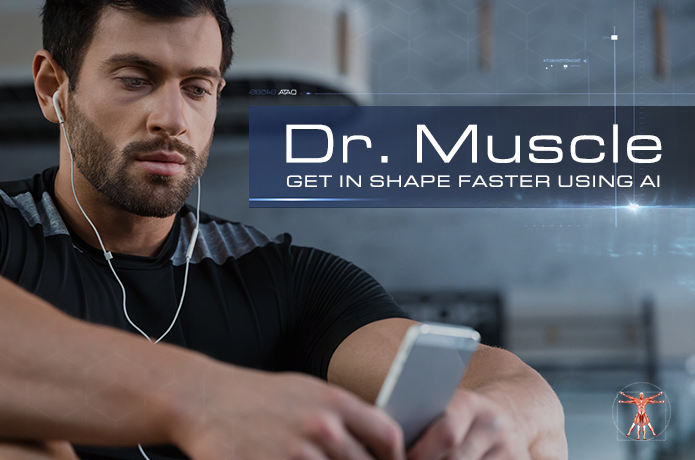
Dr. Muscle builds and adjusts strength training programmes automatically, picking your weights and reps from what you lifted last time. Built by an exercise scientist, it applies progressive overload and daily undulating periodization, publishes dated release notes going back to 2016, and runs on phone and Apple Watch.
dr-muscle.com7 viewsAdded October 5, 202510K visitors
The reason most people stop making progress in the gym is not effort or programme choice. It is that nobody decides what weight goes on the bar, so the same weight goes on the bar for months.
Dr. Muscle exists to make that decision. It reads what you lifted last session, how it went, and prescribes the next one — weight, reps and all.
The maker matters here more than in most fitness software: an exercise scientist built the progression logic, and the app has been shipping dated releases since 2016.
Dr. Muscle's homepage, captured 9 September 2026.
Dr. Muscle: Progressive Overload On Autopilot
Picks your weight and reps each session from what you actually lifted last time, rather than a fixed schedule.
Built by an exercise scientist, applying progressive overload and daily undulating periodization.
Release notes since 2016, published with version numbers and dated fixes — a decade of shipping.
Ratings around 4.4 across four platforms, with the interface criticised in its own displayed reviews.
Dr. Muscle X in preview, alongside an Apple Watch app and a long-running training blog.
What Is Daily Undulating Periodization?
Dr. Muscle names its methods openly — progressive overload and daily undulating periodization among a stated 27-plus features.
Both terms describe a decision about how effort is distributed, and understanding the second explains most of what the app is doing.
Progressive overload is the foundational principle: to keep adapting, the demand has to keep rising. More weight, more reps, more sets or less rest. Nothing grows from repeating the same session indefinitely.
Periodization is how that increase is organised across time. Traditional linear periodization moves in blocks — weeks of high volume, then weeks of high intensity — which works and demands you commit months in advance.
Daily undulating periodization varies the stimulus within the week instead: heavy on Monday, moderate Wednesday, higher-rep Friday. The evidence base for it is at least as good as linear for trained lifters, and it suits real life better, because a bad Monday costs you one session rather than derailing a block.
Nobody decides what weight goes on the bar, so the same weight goes on the bar for months. That is what actually stalls people.
Autoregulation And Being Honest With The App
The app's core loop is autoregulation — adjusting today's prescription from yesterday's performance — and one of its own reviewers names the requirement precisely: be honest with yourself while you use it.
That is the whole failure mode in one sentence.
An algorithm that reads your logged sets can only be as good as the logging. A set of eight recorded as clean when the last two were grinding, ugly reps produces a prescription that is too heavy next session, and then the session after.
The reverse is equally destructive. Sandbagging a set because you were tired teaches the algorithm that you are weaker than you are, and the weights stop rising.
Which means the discipline this app asks for is unusual: not effort, but accurate self-report. That is a different skill from training hard, and it is the one that decides whether the automation works — the same dependency that makes food logging in MacroFactor either powerful or pointless.
An Exercise Scientist Behind The Algorithm
The site attributes the app to a named exercise scientist, with a Quebec address in the footer, and frames the product as built on research rather than opinion.
In fitness software that provenance is worth more than in most categories, because the field is unusually full of confident nonsense.
Strength training has a large, genuinely good evidence base — on volume, frequency, proximity to failure and progression rates — and almost none of it reaches consumer apps, which mostly encode whatever the founder's own training looked like.
An app whose progression rules come from someone who reads the literature is making different mistakes from one that does not, and it can be argued with on the evidence.
The blog supports the claim. A long-running training archive, including a critical review of a competing app written from a stated exercise physiology background, is the sort of output that would be difficult to sustain without the underlying expertise. A deeper exercise database and a permanent training history are a different priority, and Jefit's.
Log sets honestly — the algorithm is only as good as your reporting.
Learn the exercise technique before letting an app add weight to it.
Give it a full mesocycle before judging the progression.
Read the release notes to see what is actually being fixed.
Use the settings; several reviewers say the defaults are not the ceiling.
Ratings Across Four Places And What They Say
Dr. Muscle displays its scores across four sources and does not round any of them up: 4.5 on Facebook, 4.5 on the Apple App Store, 4.3 on Google Play, and an overall 4.4 from 921 ratings.
A vendor publishing a 4.3 next to its 4.5s is doing something unusual, and the reviews it chooses to display are more revealing still.
Among the testimonials on the homepage sit criticisms: an interface that took time to adapt to and is not the most user-friendly, a full-screen mode that hides the clock, and a recommendation that beginners still book some in-person sessions to learn safe technique.
The last of those is the one worth crediting. An app selling itself as a replacement for a personal trainer publishing a review that says beginners should hire one anyway is choosing accuracy over conversion.
The positive reviews carry the same specificity — one from a lifter of sixty-five years' experience, another mentioning a named human checking in alongside the AI. Details like that are the texture of real feedback rather than a curated wall.
A Release Archive Going Back To 2016
The site publishes an app updates archive labelled 2016 to today, with individual entries carrying full release notes and version numbers for both iOS and Android — fixed crashes, a chat that stopped responding, a freeze during a workout, slow home page loading.
This is the least persuasive-looking and most persuasive thing on the site.
Marketing claims are cheap. Ten years of dated release notes describing unglamorous bug fixes cannot be assembled retroactively, and they answer the question that actually matters about a subscription app: will it still exist and still be maintained in two years.
It also tells you what kind of company it is. A team publishing that it fixed four rare crashes in a version is not managing perception; the site separately claims 50-plus updates a year, and the archive supports it.
The corollary is that a decade-old codebase carries a decade of interface decisions, which is very likely what the usability criticism reflects — and probably why Dr. Muscle X exists as a preview alongside it. What none of it covers is technique, which needs a camera — Gymscore's territory rather than a programming app's.
Training With An App That Picks Your Weights
Handing weight selection to software is a genuine change in how you train, and the transition is where people give up on it.
This sequence makes the algorithm's job possible rather than fighting it.
Complete the setup honestly, including current lifts rather than best-ever lifts.
Log every set as it actually happened, including the ugly reps.
Follow the prescription for a full cycle before overriding anything.
Spend an evening in the settings — several reviewers say that is where the value is.
Learn technique from a coach if you are new, whatever the app can prescribe.
Reassess after a mesocycle rather than after a bad session.
Dr. Muscle: Method And Maker
Maker
Attributed to a named exercise scientist, with a Quebec, Canada address in the footer
Positioning
Described as the world's first AI pocket personal trainer
Core loop
Reads your logged sets and prescribes the next session's weights and reps
Methods named
Progressive overload and daily undulating periodization
Feature count
27-plus, per the site
Update cadence
Stated at 50-plus updates per year
Release archive
Published app updates dating from 2016 to the present, with version numbers
Platforms
iOS and Android, with an Apple Watch app
In preview
Dr. Muscle X, announced as an early preview
Displayed ratings
4.5 Facebook, 4.5 Apple App Store, 4.3 Google Play, 4.4 overall from 921
Human element
A reviewer describes a named person checking in alongside the AI
Content
A long-running training blog published alongside the app
Key features of Dr. Muscle
Automatic weight and rep prescription per session
Progressive overload applied continuously
Daily undulating periodization
Adaptive adjustment from logged performance
Exercise instruction video and technique notes
Workout history and lifetime volume tracking
Apple Watch companion app
A published release archive and training blog
Pros & cons
Pros
7
Solves the decision most lifters avoid — what weight to use today
Names its training methods rather than hiding them behind an algorithm
Built by someone with a stated exercise science background
A decade of dated release notes is evidence no marketing can fake
Publishes a 4.3 rating alongside its 4.5s rather than cherry-picking
Displays reviews criticising its own interface
One displayed review recommends beginners still see a trainer
Cons
7
The interface draws repeated criticism in its own testimonials
The progression algorithm's actual logic is not published
Autoregulation depends entirely on you logging sets honestly
Human oversight is mentioned by a reviewer, not defined by the site
What Dr. Muscle X changes is not explained
The 921 rating count's scope across four sources is unclear
A decade-old product carries a decade of interface decisions
Best For
Intermediate lifters stalled on the same weights
People who dislike programming their own training
Anyone who wants the training method named and arguable
Lifters returning after a break and unsure where to restart
Long-term users who care whether an app will still exist in two years
Last checked . Read from dr-muscle.com in a browser session on the date above, including the full footer. The screenshot was captured at the same time.
Positioned as the world's first AI pocket personal trainer, framed as ChatGPT for fitness
Described as built by an exercise scientist with 27-plus features
Progressive overload and daily undulating periodization both named as methods
Update cadence stated at 50-plus times per year
An app updates archive published, labelled 2016 to today, with dated release notes and version numbers
Ratings displayed as 4.5 Facebook, 4.5 Apple App Store, 4.3 Google Play and 4.4 overall from 921
Displayed reviews include criticism of the interface and of a full-screen mode hiding the clock
One displayed review recommends beginners take some in-person sessions to learn safe technique
A reviewer describes a named human checking in alongside the AI
Dr. Muscle X announced as an early preview, and an Apple Watch app referenced
A long-running training blog published under a separate name
Footer confirms a named individual and a Quebec, Canada address, with terms, privacy and contact links
What we could not confirm: how the progression algorithm actually decides a prescription, since no method beyond the named principles is published; how much human oversight exists or whether it applies to all users; what Dr. Muscle X changes; whether the 921 rating count aggregates the four displayed sources or one of them; the exercise database size; and pricing, which we did not reproduce. We did not install the app or follow a programme.
Editor's Verdict
4.0/5
Dr. Muscle solves the least glamorous and most common problem in lifting: deciding what weight to put on the bar today. Its progression logic comes from an exercise scientist rather than a marketing team, and the release archive running back to 2016 is the kind of evidence that cannot be manufactured — a decade of dated bug fixes is a real product. The interface draws consistent criticism in its own displayed reviews, and the ratings sit around 4.4 rather than the 4.8s this category usually claims. Both are more believable for it. AInexfinder Editor Score: 4.0/5.
Dr. Muscle pricing
AInexfinder does not list plan prices or billing details. For current pricing, plans, and trials, visit the official Dr. Muscle website.
Vendor pricing, credits, and billing policies change over time. Always confirm on the official site before you buy.
Frequently asked questions
What is Dr. Muscle?
A strength training app that prescribes your weights and reps each session based on what you lifted last time. It applies progressive overload and daily undulating periodization, and was built by a named exercise scientist.
What is daily undulating periodization?
Varying the training stimulus within the week — heavy one day, moderate the next, higher reps later — rather than in month-long blocks. The evidence for it is at least as strong as linear periodization for trained lifters, and it survives a disrupted week better.
How much does honest logging matter?
Completely. A set of eight logged as clean when the last two were grinding produces a prescription that is too heavy next session. Sandbagging does the opposite. The discipline this app needs is accurate self-report, not effort.
Does it replace a personal trainer?
For programming, largely. For technique, no — and one of the reviews the site chooses to display says exactly that, recommending beginners take some in-person sessions to learn to lift safely first.
Why do the release notes matter?
Because ten years of dated bug fixes cannot be assembled retroactively. They answer the question that actually decides a subscription: whether the app will still exist and still be maintained in two years.
Are the ratings good?
They are around 4.4 across four platforms, which is more believable than the 4.8s this category usually claims — particularly since the vendor publishes its lowest score alongside its highest rather than selecting.
What do people criticise about it?
The interface, consistently, in the reviews the site itself displays — not the most user-friendly, taking time to adapt to, and a full-screen mode that hides the clock. The training logic is not what draws complaints.
How long before I can judge it?
A full mesocycle, four to six weeks. Any progression algorithm judged on a fortnight is being judged on its starting estimate rather than on how it adapts, and a single bad session tells you nothing.
Is there human involvement?
One displayed review describes a named person checking in alongside the AI, which suggests some oversight exists. The site does not define what that covers or whether it applies to everyone, so treat it as a bonus rather than a feature.
Who should not use it?
People who enjoy programming their own training and are good at it, lifters peaking for a meet with a coach, and anyone new enough that technique rather than load is the thing holding them back.
Daniel reviews AI tools the slow way — by actually using them on real projects. His reviews cover what works, what breaks, and who each tool is genuinely a good fit for.
Daniel and the AInexfinder editorial team research Dr. Muscle using public product information, listing evidence, and (when available) hands-on checks. Scores reflect listing completeness and transparency — not paid placement.
Listings may include affiliate or sponsored placements, which are labeled when present. Editorial scores and cons are not sold. See our affiliate disclosure and review methodology.
BodBot is an AI personal trainer and nutritionist that builds workouts tailored to your goals, body and progress, adapting with every rep, with joint controls for injuries, wearable integration and data-driven nutrition across web, phone, tablet and watch.
Jefit is a workout planner and tracking app with a large exercise database, custom plan building, muscle recovery and one-rep-max metrics, and a community feed. Its adaptive plan analyses strength and fatigue to build the coming week, and periodization now applies to plans members build themselves.
Gymscore analyses lifting technique from phone video, scoring each set from zero to one hundred across five movement categories and giving feedback on range of motion, posture, core stability and movement patterns across more than 2,500 exercises, alongside training plans and an AI coaching chat.
The Running Genie is an AI running coach that syncs from Strava, Garmin, Polar, Suunto and Apple Health, then builds adaptive training plans for 5K through ultra using VDOT, 80/20 polarised training and periodisation principles.
Vici is a free iOS running coach that connects to Strava and your wearable, checks in each morning against recovery, sleep, HRV and resting heart rate, adapts the day's session accordingly, and reads every completed run in two stages before adjusting what comes next.