Vici is a free iOS running coach that connects to Strava and your wearable, checks in each morning against recovery, sleep, HRV and resting heart rate, adapts the day's session accordingly, and reads every completed run in two stages before adjusting what comes next.
The gap between a training plan and a coach is not knowledge. It is that a plan does not know you slept badly, travelled on Tuesday, or came back from a race more tired than the calendar assumes.
Vici is built entirely around closing that gap. Every morning it reads your wearable, asks one question, and decides whether today's session stands or bends.
That daily adaptation, rather than the plan itself, is what it is actually selling — and it is the right thing to sell.
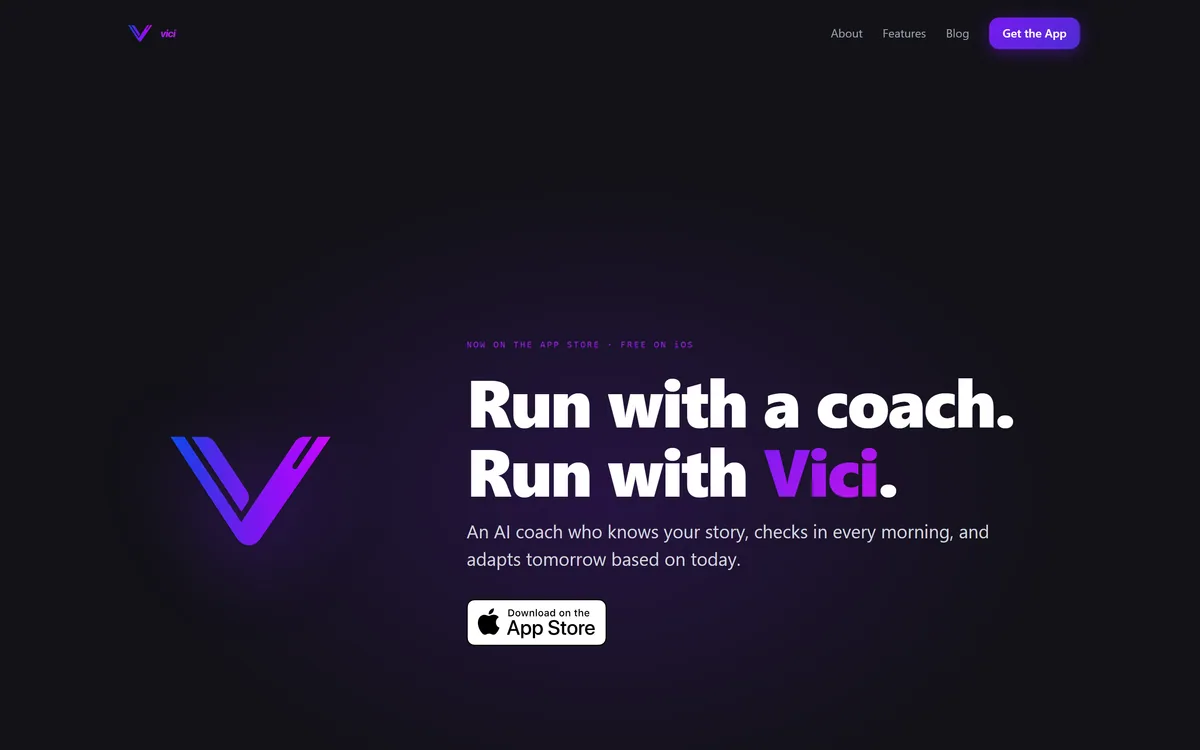
Vici's homepage, captured 9 September 2026, showing the daily coaching loop.
Can An App Coach Like A Real Coach?
Vici's own framing is direct: an AI coach who knows your story, checks in every morning, and adapts tomorrow based on today. It also insists it is not a chatbot but a coach with tools.
That distinction is worth taking seriously, because it separates two very different products that look similar in a screenshot.
A chatbot answers what you ask. A coach holds a model of you — your history, your patterns, what a hard week does to you — and initiates. The difference shows up in whether the app tells you something before you think to ask.
The daily briefing is the mechanism for that, and it is the feature that most determines whether the app changes your training or just records it.
Where an app genuinely cannot match a coach is in the things a person notices and a sensor does not: how you look at the start of a session, that you have mentioned the same niggle three weeks running, that your life is falling apart and the training should not be the priority this month.
A chatbot answers what you ask. A coach tells you something before you think to ask. That is the whole distinction.
The Best Day, Worst Day Philosophy
Vici's blog states a specific position on training paces: most apps average your race results, but a bad race day should not drag down your training paces — your best day reveals your fitness, your worst day reveals your circumstances.
That is a real coaching opinion, not marketing copy, and it is worth knowing whether you agree with it before adopting the app.
The argument in its favour is sound. A race ruined by heat, illness or a missed start is not evidence about your aerobic capacity, and averaging it in prescribes training that is too easy for months.
The counter-argument is equally real. Training from your best day alone risks prescribing sessions calibrated to a peak you were briefly capable of, which is a well-worn route to injury for anyone who is honest about how often that peak occurs.
Publishing the philosophy at all is the point in Vici's favour. An algorithm that quietly makes this choice is much harder to argue with than one whose reasoning you can read and disagree with. MacroFactor takes the same position about publishing how its algorithm decides.
Daily Readiness And Adapting The Session
The morning check-in pulls recovery, sleep, HRV and resting heart rate automatically, then asks what the site calls the one question that shapes today's training: are you ready, or are we backing off?
Its example of an adaptation is precise in a way that reveals the thinking. Five one-mile repeats become four when the legs need it — at the same pace band.
Holding the pace and cutting the volume is exactly what an experienced coach does, and it is not what most adaptive apps do. Slowing the session preserves the workout on paper and destroys its purpose, because the physiological stimulus lives in the intensity.
Cutting a repetition keeps the stimulus and lowers the dose. That single design choice tells you the people building this understand training rather than just data.
The caution belongs on the inputs rather than the logic. HRV is noisy, sensitive to measurement conditions, and meaningful mainly as a trend against your own baseline — so a single low morning is weaker evidence than the number's precision suggests.
Connect Strava first — the history is what calibrates everything.
Give it several weeks before judging, so a baseline exists.
Answer the morning question honestly rather than optimistically.
Treat a single low HRV reading as noise, not a verdict.
Take pain, as opposed to fatigue, to a physiotherapist rather than an app.
Two-Stage Activity Coaching Explained
When a run ends, Vici splits its response in two. Stage one syncs the activity, matches it to the planned workout and gives an immediate read on splits, heart rate, pace deltas and execution against the prescription. Between the stages sits a journal with sliders and an adaptive freeform question written from your data. Stage two is a deeper analysis with observations and adjustments to the next session.
The structure is more considered than it first appears, and the journal in the middle is the reason.
Data explains what happened to your body and not why. A slow run because you were dehydrated and a slow run because you are getting ill look identical in the file, and lead to opposite coaching decisions.
Asking you before the deeper analysis lets your context inform the conclusion rather than arriving after it. That is the correct order and very few apps get it right.
The adaptive question is the nice touch — generating it from your data means it can ask about the specific thing that looks odd rather than presenting the same form after every run, which is how journaling features usually die. Dedicated journalling apps like Reflection approach the same problem from the other direction.
What Free Forever Means Here
Vici states that the core coaching experience — the plan, the daily check-ins, every post-run read and conversations with the coach — is free forever, with premium features possibly arriving later.
That is an unusually clear commitment, and it is worth reading precisely rather than gratefully.
What it promises is that the coaching loop described on the site stays free. What it leaves open is what a premium tier would eventually contain, and a company that has not yet decided cannot tell you.
The realistic read is that free is a deliberate strategy at this stage. An AI coach improves with data and credibility, and both are easier to acquire without a paywall in front of them.
Two testimonials, both labelled early user, is honest labelling and also a thin evidence base. That combination — genuine transparency about being early — is the fairest way to describe where this product currently sits. For movement quality rather than training load, VueMotion measures what nothing on your wrist can.
Training With An Adaptive Plan
An adaptive coach only works if you feed it honestly, and the temptation to report readiness you do not feel is the main way people undermine one.
This sequence gets the loop running properly before you ask much of it.
Connect Strava so it can read your actual training history.
Set a specific goal with a date rather than a vague ambition.
Complete the morning check-in daily, including on rest days.
Use the journal for context the sensors cannot see.
Apply the proposed adjustments rather than overriding them for a month.
Review the logged reasoning when you disagree, and say so in Ask Vici.
Vici: Coaching Loop And Maker
Company
Vici Performance Inc., per the footer
Platform
iOS, live on the App Store, with an Android waitlist
Cost
Core coaching stated as free forever
Data connection
Strava for training history, plus wearable signals
Morning signals
Recovery, sleep, HRV and resting heart rate, pulled automatically
Adaptation example
Five one-mile repeats become four, at the same pace band
Post-run stage one
Immediate read of splits, heart rate, pace deltas and execution
Journal
Sliders for execution plus an adaptive freeform question generated from your data
Post-run stage two
Deep analysis with observations and adjustments to the next session
Ask Vici
Proposes a specific change, applied in one tap, with reasoning logged
Plan views
Today, this week and the full plan
Founders
Two runners; co-founder Chris Dunn writes on the blog about a 2:29:50 Berlin marathon
Vici: A Running Coach That Reads Your Recovery
A morning check-in reading recovery, sleep, HRV and resting heart rate before deciding what you run.
Sessions adapt in real time — five mile repeats become four when the legs need it, at the same pace band.
Two-stage post-run coaching: an immediate read against the prescription, then deeper analysis and adjustment.
Ask Vici proposes a specific change you apply with one tap, with the reasoning logged.
Free forever for the core, on iOS, from Vici Performance Inc., with an Android waitlist.
Key features of Vici
Daily morning check-in from wearable signals
Real-time session adaptation at constant pace bands
Two-stage post-run coaching analysis
Journal with an adaptive question generated from your data
Ask Vici for proposals applied in one tap
Chronological coaching feed
Dashboard, analytics and full run log
Strava connection for training history
Pros & cons
Pros
7
Adapts volume while holding pace, which is what a real coach does
The journal sits before the deep analysis, so context informs the conclusion
Publishes an actual coaching philosophy you can agree or disagree with
Reasoning behind every proposed change is logged rather than hidden
Core coaching stated as free forever, unambiguously
Adaptive journal questions avoid the same form after every run
Built by runners with a stated competitive record
Cons
7
iOS only, with Android on a waitlist
HRV is noisy and a single reading carries less signal than it appears to
Two testimonials, both labelled early user, is a thin evidence base
Supported wearables beyond Strava are not enumerated
No stated involvement of qualified coaches in the training logic
A future premium tier's contents are undefined
Cannot see form, gait or the things a coach notices in person
Best For
Runners training for a specific race with a date
People whose fixed plans keep colliding with real life
Wearable users with sleep and HRV data going unused
Runners who want the reasoning behind an adjustment
Anyone unable to justify the cost of a human coach
Vici Against Other Fitness Apps
Health apps differ by whether they measure, plan or actually adapt.
What we could not confirm: which wearables and platforms are supported beyond Strava; how the coaching model is built or what it is trained on; how readiness is calculated from HRV and sleep; whether any qualified coaches were involved in designing the training logic; what a future premium tier would contain; and how the app behaves over a full training block, which two early testimonials cannot establish. We did not install the app or connect an account. Vici is not medical advice and pain should be assessed by a clinician.
Editor's Verdict
4.0/5
Most training apps hand you a plan and leave you to follow it whether or not your body agrees. Vici's whole design is the opposite — read the wearable, ask one question, and change today's session before you run it. That daily adaptation is what a human coach actually provides, and the two-stage post-run read is more thoughtful than anything else at this price, which is nothing. It is early, iOS-only and thin on independent evidence, but the core coaching is free forever and the people behind it are runners with real credentials. AInexfinder Editor Score: 4.0/5.
Vici pricing
AInexfinder does not list plan prices or billing details. For current pricing, plans, and trials, visit the official Vici website.
Vendor pricing, credits, and billing policies change over time. Always confirm on the official site before you buy.
Frequently asked questions
What is Vici?
A free iOS running coach from Vici Performance. It connects to Strava and your wearable, checks in each morning against recovery, sleep, HRV and resting heart rate, adapts the day's session, and reads every completed run in two stages.
How does the daily adaptation work?
It reads your wearable signals and asks one question — ready, or backing off. Its own example is five one-mile repeats becoming four at the same pace band, which is the right adjustment because the training stimulus lives in the intensity.
Why cut repetitions rather than slow down?
Because slowing a session preserves it on paper and destroys its purpose. Cutting a repetition keeps the physiological stimulus and lowers the dose, which is what an experienced coach does and what most adaptive apps get wrong.
Is it really free?
The site states the core coaching experience is free forever — plan, daily check-ins, post-run reads and conversations — with premium features possibly arriving later. What a premium tier would contain is not defined, because it likely has not been decided.
How reliable is HRV as a readiness signal?
It is meaningful as a trend against your own baseline and noisy as a single reading, being sensitive to measurement conditions, alcohol and timing. Treat one low morning as noise; a run of them is worth listening to.
What is the two-stage post-run read?
An immediate analysis of splits, heart rate and execution against the prescription, then a journal where you add context, then a deeper analysis that adjusts the next session. The journal sitting in the middle is what makes the order correct.
Why does the journal matter?
Because a slow run from dehydration and a slow run from oncoming illness look identical in the data and demand opposite decisions. Asking you before the deeper analysis lets your context shape the conclusion rather than arrive after it.
Can it replace a human coach?
Not entirely. It cannot see how you look at the start of a session, remember that you have mentioned the same niggle three weeks running, or judge that training should not be the priority this month. It handles the load management well.
Is it available on Android?
Not yet — it is live on the App Store for iOS, with an email waitlist for Android. The site addresses this directly rather than leaving it ambiguous, which is worth noting if you are not on iPhone.
What should I do about pain?
See a clinician. An adaptive coach can manage fatigue and load intelligently, but pain is a different category of signal and no app — this one included — is positioned to assess an injury.
Daniel reviews AI tools the slow way — by actually using them on real projects. His reviews cover what works, what breaks, and who each tool is genuinely a good fit for.
Daniel and the AInexfinder editorial team research Vici using public product information, listing evidence, and (when available) hands-on checks. Scores reflect listing completeness and transparency — not paid placement.
Listings may include affiliate or sponsored placements, which are labeled when present. Editorial scores and cons are not sold. See our affiliate disclosure and review methodology.
BodBot is an AI personal trainer and nutritionist that builds workouts tailored to your goals, body and progress, adapting with every rep, with joint controls for injuries, wearable integration and data-driven nutrition across web, phone, tablet and watch.
Jefit is a workout planner and tracking app with a large exercise database, custom plan building, muscle recovery and one-rep-max metrics, and a community feed. Its adaptive plan analyses strength and fatigue to build the coming week, and periodization now applies to plans members build themselves.
Gymscore analyses lifting technique from phone video, scoring each set from zero to one hundred across five movement categories and giving feedback on range of motion, posture, core stability and movement patterns across more than 2,500 exercises, alongside training plans and an AI coaching chat.
The Running Genie is an AI running coach that syncs from Strava, Garmin, Polar, Suunto and Apple Health, then builds adaptive training plans for 5K through ultra using VDOT, 80/20 polarised training and periodisation principles.
Dr. Muscle builds and adjusts strength training programmes automatically, picking your weights and reps from what you lifted last time. Built by an exercise scientist, it applies progressive overload and daily undulating periodization, publishes dated release notes going back to 2016, and runs on phone and Apple Watch.