Welltory is a health and wellbeing app that analyses heart-rate variability and other biomarkers from your phone camera or wearables to estimate stress, energy and recovery, with guidance on sleep, workouts and habits. It is a wellness tool, not a medical device or diagnosis.
Heart-rate variability, the small variation in time between heartbeats, has become a popular window into stress and recovery. Welltory is one of the best-known apps built around it.
It analyses HRV and other biomarkers from your phone or wearables, then translates them into insights about stress, energy, recovery, sleep and workouts, with alerts and longer-term trends. It sits among wellbeing apps like SleepSpace, with a broader focus on overall energy and stress.
This review covers how Welltory reads your body's signals, whose needs its insights suit, how its free app and subscription differ, and why it is no substitute for a doctor.
Welltory analyses heart-rate variability and biomarkers to estimate stress and energy.
Welltory HRV-App Facts
What it is
An HRV-based health and wellbeing app
Signals
HRV plus other biomarkers (vendor says 100+)
Sources
Phone measurements and connected wearables
Insights
Stress, energy, recovery, sleep, workouts
Alerts
Warning signs and changes over time
Science
HRV is widely studied; algorithms are proprietary
Reach
Very large user base (vendor-stated)
Access
Free app, with a paid subscription
Heart-Rate Variability Turned Into Daily Guidance
Welltory's core idea is to take a measurement most people never look at, heart-rate variability, and make it useful. Higher or lower HRV relative to your own baseline can reflect stress, recovery and how your nervous system is coping, and Welltory turns those readings into plain-language guidance.
It combines HRV with other signals, including heart rate, sleep and activity from wearables, and presents them as energy, stress and recovery insights, plus suggestions about what drains or restores you.
Welltory leans on science in its marketing: HRV is a widely studied biomarker, and the company describes proprietary algorithms and a large dataset built over years. Those are reasonable foundations, but the specific algorithms are not independently transparent.
The honest framing is that Welltory can help you notice patterns, such as how sleep, alcohol, stress or training affect you, but it is a wellness tool. It does not diagnose conditions, and its readings are estimates that work best as trends over time.
Welltory helps you notice patterns in stress and recovery, but its readings are estimates and it does not diagnose anything.
How Does Welltory Read Your Body's Signals?
The app pairs measurement with interpretation, framed as daily guidance rather than raw numbers.
HRV Measurements, Wearables And Biomarkers
Welltory can take readings with a phone or pull data from connected wearables, combining HRV with heart rate, sleep and activity. Regular measurements build a personal baseline, which matters because HRV is highly individual and best compared against your own history rather than other people's.
For relaxation and mindfulness content rather than measurement, a meditation app like Aura Health takes a different approach; Welltory starts from data.
Energy, Stress And Sleep Insights, Not Diagnosis
From those readings, Welltory estimates stress, energy and recovery, flags changes and suggests actions on sleep, workouts and recovery. These insights can be motivating and useful, but they are not a diagnosis, and features that track health markers such as blood pressure should be treated as wellness tracking, not medical monitoring.
If you want guided breathing to calm your nervous system in the moment, a device-and-app approach like Moonbird focuses on that single habit.
Who Welltory's Insights Suit
Welltory suits people curious about their stress and recovery, such as busy professionals worried about burnout, people training regularly who want to time hard and easy days, and anyone trying to understand how lifestyle changes affect them.
It suits wearable owners who want a more interpretive layer on top of raw data, and people who respond well to daily nudges and visual trends.
It suits less well anyone looking for a medical answer: symptoms such as chest pain, palpitations, persistent fatigue or abnormal readings need a doctor. It is also not ideal for people who find constant self-measurement stressful, which can backfire.
The best way to use it is as a trend tool: measure consistently at similar times, look at weekly patterns, and use insights to adjust habits, not to self-diagnose.
How Welltory's Free App And Subscription Differ
Welltory offers a free app with core measurements and a paid subscription that unlocks deeper insights and features. We do not publish prices, which change; check the site or app store.
The value question is whether the insights change your behaviour: if they help you sleep, train or manage stress better, a subscription can be worthwhile; if you only glance at numbers, the free tier may be enough.
The sensible approach is to use the free app consistently for a couple of weeks to build a baseline before deciding whether the paid insights add enough.
A Two-Week Welltory Trial Plan
Because HRV is personal and noisy, give Welltory a consistent two-week trial before judging it.
Measure at the same time each day, ideally in the morning under similar conditions.
Connect a wearable if you have one, to add sleep and activity context.
Note what you did each day (sleep, training, alcohol, stress) alongside readings.
After two weeks, look at trends rather than single readings.
Check whether the suggestions are specific enough to act on.
Pass/fail: Welltory is worth keeping if its trends help you change habits.
See a doctor for worrying symptoms; do not use the app to self-diagnose.
Welltory, The HRV Brief
Welltory is an HRV-based wellbeing app: it turns heart-rate variability and other signals into stress, energy and recovery insights.
It works with a phone or wearables: measurements can come from the camera or from connected devices.
It aims to change habits: guidance on sleep, workouts, recovery and energy drains.
It is not medical care: HRV is informative but not diagnostic, and health concerns belong with a doctor.
Welltory HRV Terms
HRV
Heart-rate variability: the variation in time between heartbeats, often used as an indicator of stress and recovery.
Baseline
Your personal normal range, built from repeated measurements, against which daily readings are compared.
Recovery
How well your body has bounced back from stress, training or poor sleep, estimated from HRV and other signals.
Biomarker
A measurable signal from the body, such as heart rate or HRV, used to infer aspects of health.
Is Welltory Worth Tracking Your HRV With?
People Welltory's Data Can Help
Professionals watching for burnout
People timing training and recovery
Wearable owners wanting interpretation
Anyone exploring how habits affect them
People motivated by daily trends
When Welltory Is No Substitute For A Doctor
Anyone seeking a medical diagnosis
People with worrying symptoms who need a doctor
Those stressed by constant self-measurement
Anyone expecting precise clinical readings
People who will not measure consistently
Key features of Welltory
HRV measurement
Wearable integrations
Stress and energy insights
Recovery tracking
Sleep and workout guidance
Health alerts
Trend dashboards
Personal baselines
Pros & cons
Pros
5
Makes HRV understandable
Works with phone or wearables
Useful for spotting habit patterns
Motivating visual trends
Free app to start
Cons
5
Not a medical device or diagnosis
Readings are estimates and noisy
Proprietary algorithms not transparent
Can encourage over-measurement
Deeper insights need a subscription
Best For
Stress and burnout awareness
Training recovery
Wearable owners
Habit experiments
Self-tracking
Welltory Compared With Sleep And Calm Apps
The useful comparison is with other wellbeing apps, by what each focuses on.
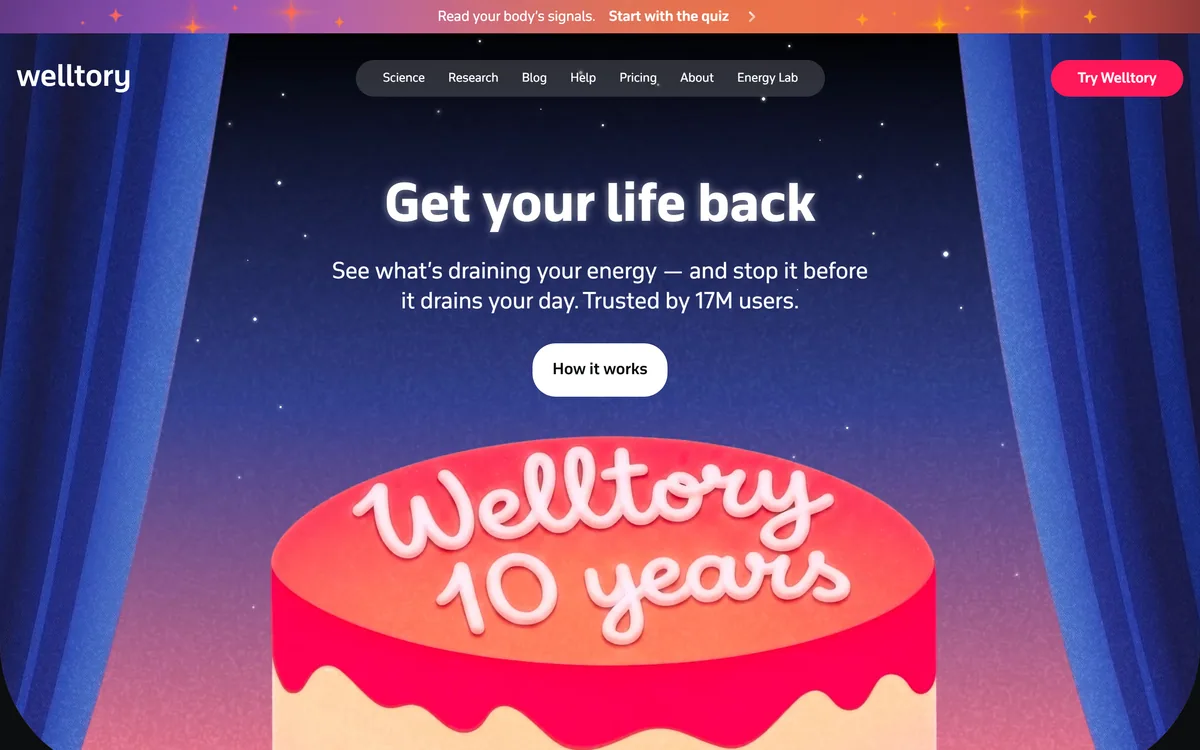
Last checked . Read from welltory.com during this check, with the screenshot above captured at the same time.
An HRV-based health and wellbeing app
Insights on stress, energy, recovery, sleep and workouts
Health monitoring with alerts (wellness, not diagnosis)
Measurements from a phone and connected wearables
Claims of 100+ biomarkers and proprietary algorithms
Vendor-stated user, rating and partner figures
An Energy Lab and research pages
A free app with a paid subscription
No prices reproduced here, in line with this site's pricing policy
Welltory is a wellness app, not a medical device. HRV readings are estimates best read as personal trends, and health concerns or abnormal readings should be discussed with a doctor.
Wellbeing Apps To Compare With Welltory
A sleep app, a meditation app and a breathing tool to compare with Welltory.
Welltory earns 3.8 as a polished way to make heart-rate variability useful: measurements from your phone or wearables become stress, energy and recovery insights with guidance on sleep, workouts and habits. It can genuinely help people notice how their lifestyle affects them, especially over consistent weeks of tracking. It is a wellness tool, though: readings are estimates, its algorithms are proprietary, and any worrying symptom or abnormal reading belongs with a doctor rather than an app. AInexfinder Editor Score: 3.8/5.
Welltory pricing
AInexfinder does not list plan prices or billing details. For current pricing, plans, and trials, visit the official Welltory website.
Vendor pricing, credits, and billing policies change over time. Always confirm on the official site before you buy.
Frequently asked questions
What is Welltory?
Welltory is a health and wellbeing app that analyses heart-rate variability and other biomarkers from your phone or wearables to estimate stress, energy and recovery, with guidance on sleep, workouts and habits.
What is HRV?
Heart-rate variability is the variation in time between heartbeats. It is widely studied as an indicator of stress and recovery, and is best compared against your own baseline rather than other people's.
Is Welltory a medical device?
No. It is a wellness app. Its readings are estimates, and it does not diagnose conditions. Discuss symptoms or abnormal readings with a doctor.
Do I need a wearable for Welltory?
No. Welltory can take measurements using a phone, and it can also connect to wearables for richer sleep and activity data.
How accurate is Welltory?
HRV readings vary with timing, posture, breathing and device. Measuring consistently and reading weekly trends gives more meaningful results than any single number.
Is Welltory free?
Welltory has a free app with core features and a paid subscription for deeper insights. We do not publish prices, which change; check the site or app store.
Can Welltory detect health problems?
It can flag changes in your readings, but it is not designed to diagnose disease. Treat alerts as prompts to pay attention and see a professional if you are concerned.
Who is Welltory best for?
People who want to understand stress, energy and recovery, such as busy professionals, people who train regularly and wearable owners who want interpreted insights.
When should I measure HRV with Welltory?
At a consistent time, typically in the morning under similar conditions, so readings are comparable from day to day.
Are Welltory's research claims reliable?
HRV itself is well studied, but Welltory's specific algorithms are proprietary and its user and rating figures are vendor-stated. Judge it on whether its insights help you over time.
Daniel reviews AI tools the slow way — by actually using them on real projects. His reviews cover what works, what breaks, and who each tool is genuinely a good fit for.
Daniel and the AInexfinder editorial team research Welltory using public product information, listing evidence, and (when available) hands-on checks. Scores reflect listing completeness and transparency — not paid placement.
Listings may include affiliate or sponsored placements, which are labeled when present. Editorial scores and cons are not sold. See our affiliate disclosure and review methodology.
Jefit is a workout planner and tracking app with a large exercise database, custom plan building, muscle recovery and one-rep-max metrics, and a community feed. Its adaptive plan analyses strength and fatigue to build the coming week, and periodization now applies to plans members build themselves.
BodBot is an AI personal trainer and nutritionist that builds workouts tailored to your goals, body and progress, adapting with every rep, with joint controls for injuries, wearable integration and data-driven nutrition across web, phone, tablet and watch.
Gymscore analyses lifting technique from phone video, scoring each set from zero to one hundred across five movement categories and giving feedback on range of motion, posture, core stability and movement patterns across more than 2,500 exercises, alongside training plans and an AI coaching chat.
The Running Genie is an AI running coach that syncs from Strava, Garmin, Polar, Suunto and Apple Health, then builds adaptive training plans for 5K through ultra using VDOT, 80/20 polarised training and periodisation principles.
Vici is a free iOS running coach that connects to Strava and your wearable, checks in each morning against recovery, sleep, HRV and resting heart rate, adapts the day's session accordingly, and reads every completed run in two stages before adjusting what comes next.
Dr. Muscle builds and adjusts strength training programmes automatically, picking your weights and reps from what you lifted last time. Built by an exercise scientist, it applies progressive overload and daily undulating periodization, publishes dated release notes going back to 2016, and runs on phone and Apple Watch.