Cycling Coach AI reads your Strava or intervals.icu history to find your actual fitness, builds a plan around a named goal and the days you can ride, and adjusts daily against completed rides, sleep and HRV. Workouts export to Garmin, Wahoo, Zwift, Rouvy and MyWhoosh, with strength and nutrition alongside.
cyclingcoachai.com7 viewsAdded September 14, 20257K visitors
Every structured cycling plan works until the week it meets your life. A meeting runs late, a child gets ill, the group ride turns into a race, and by Thursday the plan and your training have nothing to do with each other.
Cycling Coach AI is built around that collision rather than around the plan. It reads what you actually rode, what your sleep and HRV suggest, and rewrites what comes next.
The setup is the part worth noticing: it starts from your ride history rather than from a questionnaire about how fit you think you are.
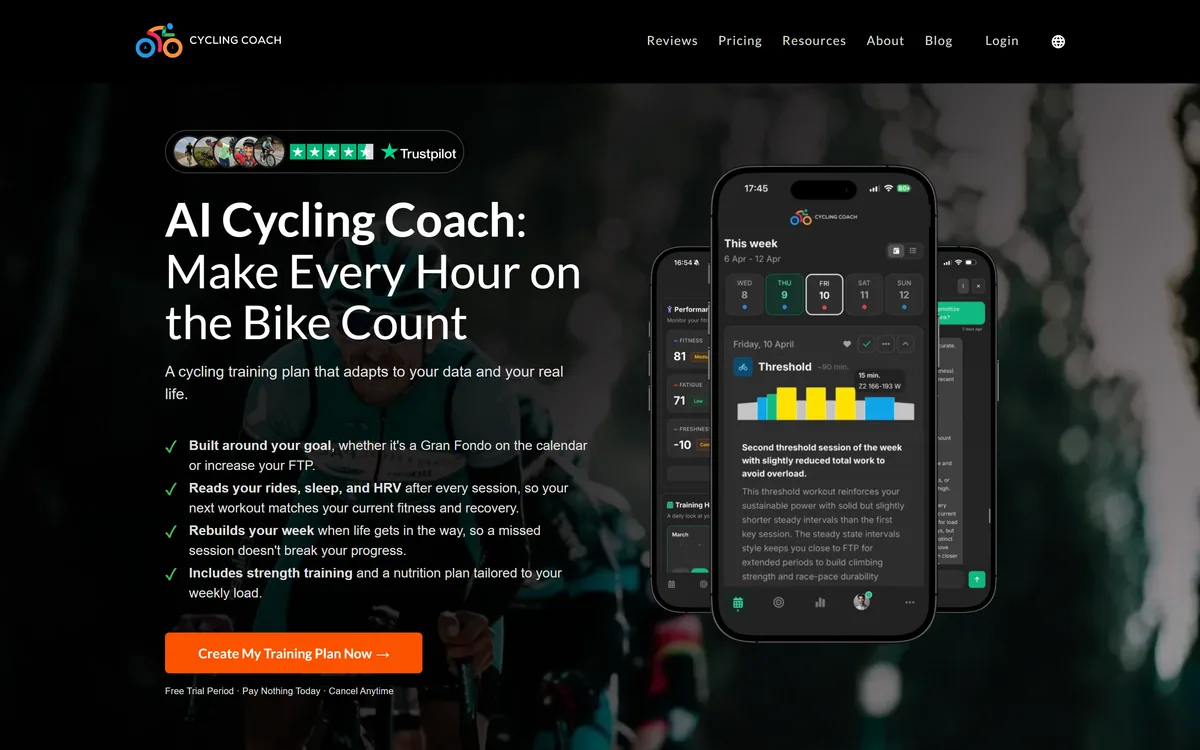
Cycling Coach AI's homepage, captured 9 September 2026.
Cycling Coach AI: Plans Built From Your Ride History
Imports from Strava or intervals.icu and reads your power curve, training load and recent trends — no questionnaire.
Adapts daily against completed rides, sleep and HRV, and reorganises the week when a session is missed.
Exports to your head unit — Garmin and Wahoo — or to Zwift, Rouvy and MyWhoosh indoors.
Strength and nutrition included, scaled to your weekly training load rather than sold separately.
An honest review wall: dated testimonials from riders in eight countries, some naming bugs and memory gaps.
How Does A Coach Read Power, Sleep And HRV?
The onboarding connects Strava or intervals.icu and imports your ride history, analysing your power curve, training load and recent trends to establish where your fitness actually sits.
That is a meaningfully better starting point than the alternative, and worth understanding why.
A questionnaire asks you to self-report — your FTP, your weekly hours, your experience. People are systematically wrong about all three, usually optimistic, and a plan built on an inflated FTP prescribes intervals you cannot complete and a training block you abandon.
A power curve is evidence. It shows what you have actually produced for five seconds, one minute, five minutes and twenty, and the shape of it says whether you are a sprinter who fades or a diesel who cannot go deep.
Sleep and HRV then modulate the daily decision rather than the plan. That split is correct — long-term structure comes from fitness, short-term adjustment comes from recovery — and it is the same architecture that Vici applies to running.
A questionnaire asks what you think your FTP is. A power curve shows what you actually produced. Only one of those builds a plan you can finish.
What HRV Can And Cannot Tell A Cyclist
HRV appears in almost every adaptive training product now, and it is worth knowing what it is actually measuring before you let it move your week around.
Heart rate variability reflects autonomic balance — roughly, how much your parasympathetic nervous system is in charge. Suppressed values are associated with accumulated fatigue, illness onset, poor sleep, alcohol and stress.
The catch is that it cannot tell those apart. A low reading after a hard block means one thing; the same reading after a bad night and a glass of wine means another, and the two demand opposite responses.
It is also noisy enough that a single morning is close to meaningless. HRV is a trend measurement against your own rolling baseline, and it needs weeks of data before that baseline exists.
Which is why the daily check-in question matters more than the number. The app asking how you feel is not decoration — it is the input that disambiguates a signal the sensor genuinely cannot resolve on its own.
Rebuilding The Week When Life Interferes
The site's third promise is the one that decides whether a training app survives past month two: it rebuilds your week when life gets in the way, so a missed session does not break your progress.
The failure mode it addresses is psychological rather than physiological.
Missing one session costs almost nothing in fitness terms. What it costs is the sense that you are following the plan, and once that is gone the next missed session is easier, and by week four the app is a notification you dismiss.
Rescheduling automatically removes the guilt mechanic entirely. There is no backlog, no sense of being behind, just a week that reflects the days you actually have.
One of its riders describes the same behaviour from the other direction — the plan adapting when an unplanned club ride adds load rather than only when a session is missed. That is the harder half, and the one that separates real adaptation from a rescheduling calendar.
Connect Strava or intervals.icu before anything else — the history is the input.
Set a real goal with a date, not a vague ambition.
Tell it honestly which days you can ride, including the ones you cannot.
Let it absorb an unplanned club ride rather than logging it and moving on.
Give it several weeks before judging, so a baseline exists.
Head Unit, Trainer And Platform Support
Sessions are built with specific power or heart rate targets and export to Garmin and Wahoo head units, or ride on Zwift, Rouvy and MyWhoosh.
That list is the practical test of whether a cycling app is usable, and it is longer here than most.
A structured interval session you have to memorise is a session you execute badly. Four by eight minutes at a specific power with three minutes recovery needs to appear on the device in front of you, counting down, or you will drift.
Covering both outdoor head units and three indoor platforms means the plan follows the weather rather than assuming it. Naming MyWhoosh alongside Zwift and Rouvy is a small signal that the integration work is real rather than aspirational.
The gap worth checking during a trial is the return path. Exporting a workout is straightforward; having the completed file come back, get matched to what was prescribed, and inform the next session is the part that actually makes the loop close. JOIN Cycling makes a similar promise from a coach-designed starting point rather than from your own history.
Reading A Review Wall With Dates On It
The testimonials on this site are unusual and worth reading properly. Each carries a name, a country flag and a date, spread across mid-2025 to September 2026, and several describe a specific event the rider was training for.
More striking is what they are allowed to say. One rider notes that the AI memory needs improving because it sometimes forgets things. Another says he likes how quickly the bugs they find get sorted out.
Publishing criticism on your own homepage is either an oversight or a decision, and the consistency of it here suggests a decision.
What it tells a prospective buyer is more useful than a wall of five-star praise: the product is genuinely in use by riders training for real events across several countries, and it is still rough in places.
The specificity supports it too — a hundred-kilometre gravel ride with a date, a mountain race with distance and elevation, a time trial alongside amateur racing. Those are details a fabricated testimonial rarely bothers with. The gym half of a training week sits outside all of it, which is where a log like Jefit belongs.
Building A Season Around One Event
Adaptive plans work best when they are pointed at something. Without a date, every week is the same week and the adaptation has nothing to aim at.
This sequence sets the loop up so it can actually coach rather than schedule.
Connect your ride history first and let it read your power curve.
Pick one event with a real date and enter it as the goal.
Enter your genuine availability, not your aspirational availability.
Push workouts to your head unit and execute to the targets, not to feel.
Log unplanned rides so the load is accounted for rather than invisible.
Reassess after one full block before changing anything yourself.
Cycling Coach AI: Data And Integrations
Positioning
An AI cycling coach built on your own ride data
Data sources
Strava or intervals.icu ride history, plus sleep and HRV
Initial analysis
Power curve, training load and recent trends
Goals supported
Gran fondo, FTP improvement or general speed on a group ride
Session targets
Specific power or heart rate per interval
Head units
Garmin and Wahoo
Indoor platforms
Zwift, Rouvy and MyWhoosh
Daily adaptation
Reads completed rides, sleep and HRV to adjust the coming week
Missed sessions
The week reorganises rather than leaving a backlog
Beyond riding
Strength training and a nutrition plan scaled to weekly load
Trial
A free trial period with nothing payable up front, per the site
Testimonials
Dated and attributed across eight countries, mid-2025 to September 2026
Key features of Cycling Coach AI
Ride history import from Strava or intervals.icu
Power curve and training load analysis
Goal-based plans with a target date
Daily adaptation on rides, sleep and HRV
Automatic weekly rebuild after a missed session
Structured workouts with power or heart rate targets
Export to Garmin, Wahoo, Zwift, Rouvy and MyWhoosh
Strength training and nutrition scaled to weekly load
Pros & cons
Pros
7
Starts from your power curve rather than a self-reported FTP
Separates long-term structure from short-term recovery adjustment correctly
Rebuilding the week removes the guilt mechanic that kills training apps
Absorbs unplanned rides rather than only rescheduling missed ones
Covers outdoor head units and three indoor platforms
Strength and nutrition included rather than sold as an upsell
Publishes dated, attributed testimonials including critical ones
Cons
7
Riders on its own site report bugs and gaps in AI memory
HRV cannot distinguish training fatigue from a bad night, and the app cannot either
Whether completed workouts flow back automatically is not stated
No qualification stated behind the nutrition plan
Our capture stopped before the footer, so the operating company went unread
Nothing here assesses injury, which is where cyclists most need a person
A new product, with the review record only reaching back to mid-2025
Best For
Time-crunched cyclists with unpredictable weeks
Riders with years of unused Strava history
Amateurs training for a specific gran fondo or gravel event
Cyclists who want strength and fuelling handled together
Anyone whose fixed plans keep collapsing by week three
Cycling Coach AI Against Other Cycling Platforms
Endurance apps differ by what they adapt to and how often.
MacroFactor — nutrition adapted to your training load
VueMotion — movement quality rather than training load
Cycling Coach AI: Verified Across The Review Wall
Last checked . Read from cyclingcoachai.com in a browser session on the date above, with the screenshot captured at the same time.
Positioned as an AI cycling coach with a plan that adapts to your data and your real life
Setup described as connecting Strava or intervals.icu, with ride history imported automatically
Initial analysis stated as power curve, training load and recent trends
Goals offered including a gran fondo, an FTP increase or a faster weekly group ride
Sessions described as built with specific power or heart rate targets
Export stated to Garmin and Wahoo, with indoor riding on Zwift, Rouvy and MyWhoosh
Daily adaptation described as reading completed rides, sleep and HRV
Missed sessions stated to trigger a reorganised week rather than a backlog
Strength training and a nutrition plan stated as included and scaled to weekly load
A free trial period advertised with nothing payable up front and cancellation any time
Testimonials displayed with names, country flags and dates from mid-2025 to September 2026
Two displayed testimonials name product shortcomings — bugs being fixed, and AI memory that sometimes forgets
What we could not confirm: our capture ended inside the testimonial list before the site footer, so we read nothing below that point and make no claim in either direction about what is published there, including the operating company. We also could not confirm which wearables supply sleep and HRV beyond a Garmin watch named by one rider; whether completed workouts flow back automatically to inform the next session; how the nutrition plan is generated or whether a qualified dietitian was involved; and pricing, which we did not reproduce. We did not connect an account or ride a plan.
Editor's Verdict
3.8/5
The premise here is right: a plan built from your actual power curve beats a generic block, and a plan that reorganises when you miss Tuesday beats one that quietly becomes irrelevant by week three. Strength and nutrition alongside the riding is more than most cycling apps attempt. What holds the score is maturity rather than design — its own review wall is dated across 2025 and 2026 and includes riders mentioning bugs and patchy AI memory. That candour is to its credit, and it also tells you what stage the product is at. AInexfinder Editor Score: 3.8/5.
Cycling Coach AI pricing
AInexfinder does not list plan prices or billing details. For current pricing, plans, and trials, visit the official Cycling Coach AI website.
Vendor pricing, credits, and billing policies change over time. Always confirm on the official site before you buy.
Frequently asked questions
What is Cycling Coach AI?
An AI cycling coach that imports your Strava or intervals.icu history, analyses your power curve and training load, builds a plan around a goal and your available days, then adapts daily against completed rides, sleep and HRV.
Why does it start from ride history?
Because a questionnaire asks you to self-report an FTP and people are systematically optimistic about theirs. A power curve is evidence — it shows what you actually produced, and a plan built on it is one you can complete.
How much should I trust the HRV adjustment?
As a trend against your own baseline, not as a daily verdict. HRV cannot distinguish training fatigue from a bad night, illness or stress, which is why the check-in question matters as much as the sensor reading.
What happens when I miss a session?
The week reorganises rather than leaving a backlog. That matters more psychologically than physiologically — one missed ride costs almost no fitness, but the sense of falling behind is what makes people abandon a plan entirely.
Does it handle an unplanned club ride?
One of its own riders describes exactly that — the plan adjusting when unplanned load arrives rather than only when a session is missed. That is the harder half of adaptation and worth testing during a trial.
Which devices does it work with?
Workouts export to Garmin and Wahoo head units, and to Zwift, Rouvy and MyWhoosh for indoor riding. Naming three indoor platforms rather than only Zwift suggests the integration work is real rather than planned.
Does it cover strength and nutrition?
Both are stated as included and scaled to your weekly training load. That is more than most cycling apps attempt, though the site does not say what qualification sits behind the nutrition side.
Is the product mature?
Not entirely, and its own testimonials say so — one rider mentions bugs being fixed quickly, another that the AI memory sometimes forgets things. Publishing that is to its credit and also tells you what stage it is at.
How reliable are the testimonials?
More than most. Each carries a name, a country and a date, and several name a specific event with distance and elevation. Fabricated testimonials rarely include that level of checkable detail, or criticism.
How long before I can judge it?
One full training block. The adaptation needs a baseline before it can be intelligent, and any plan judged on its first fortnight is being judged on setup rather than on coaching.
Daniel reviews AI tools the slow way — by actually using them on real projects. His reviews cover what works, what breaks, and who each tool is genuinely a good fit for.
Daniel and the AInexfinder editorial team research Cycling Coach AI using public product information, listing evidence, and (when available) hands-on checks. Scores reflect listing completeness and transparency — not paid placement.
Listings may include affiliate or sponsored placements, which are labeled when present. Editorial scores and cons are not sold. See our affiliate disclosure and review methodology.
Jefit is a workout planner and tracking app with a large exercise database, custom plan building, muscle recovery and one-rep-max metrics, and a community feed. Its adaptive plan analyses strength and fatigue to build the coming week, and periodization now applies to plans members build themselves.
BodBot is an AI personal trainer and nutritionist that builds workouts tailored to your goals, body and progress, adapting with every rep, with joint controls for injuries, wearable integration and data-driven nutrition across web, phone, tablet and watch.
Gymscore analyses lifting technique from phone video, scoring each set from zero to one hundred across five movement categories and giving feedback on range of motion, posture, core stability and movement patterns across more than 2,500 exercises, alongside training plans and an AI coaching chat.
The Running Genie is an AI running coach that syncs from Strava, Garmin, Polar, Suunto and Apple Health, then builds adaptive training plans for 5K through ultra using VDOT, 80/20 polarised training and periodisation principles.
Vici is a free iOS running coach that connects to Strava and your wearable, checks in each morning against recovery, sleep, HRV and resting heart rate, adapts the day's session accordingly, and reads every completed run in two stages before adjusting what comes next.
Dr. Muscle builds and adjusts strength training programmes automatically, picking your weights and reps from what you lifted last time. Built by an exercise scientist, it applies progressive overload and daily undulating periodization, publishes dated release notes going back to 2016, and runs on phone and Apple Watch.