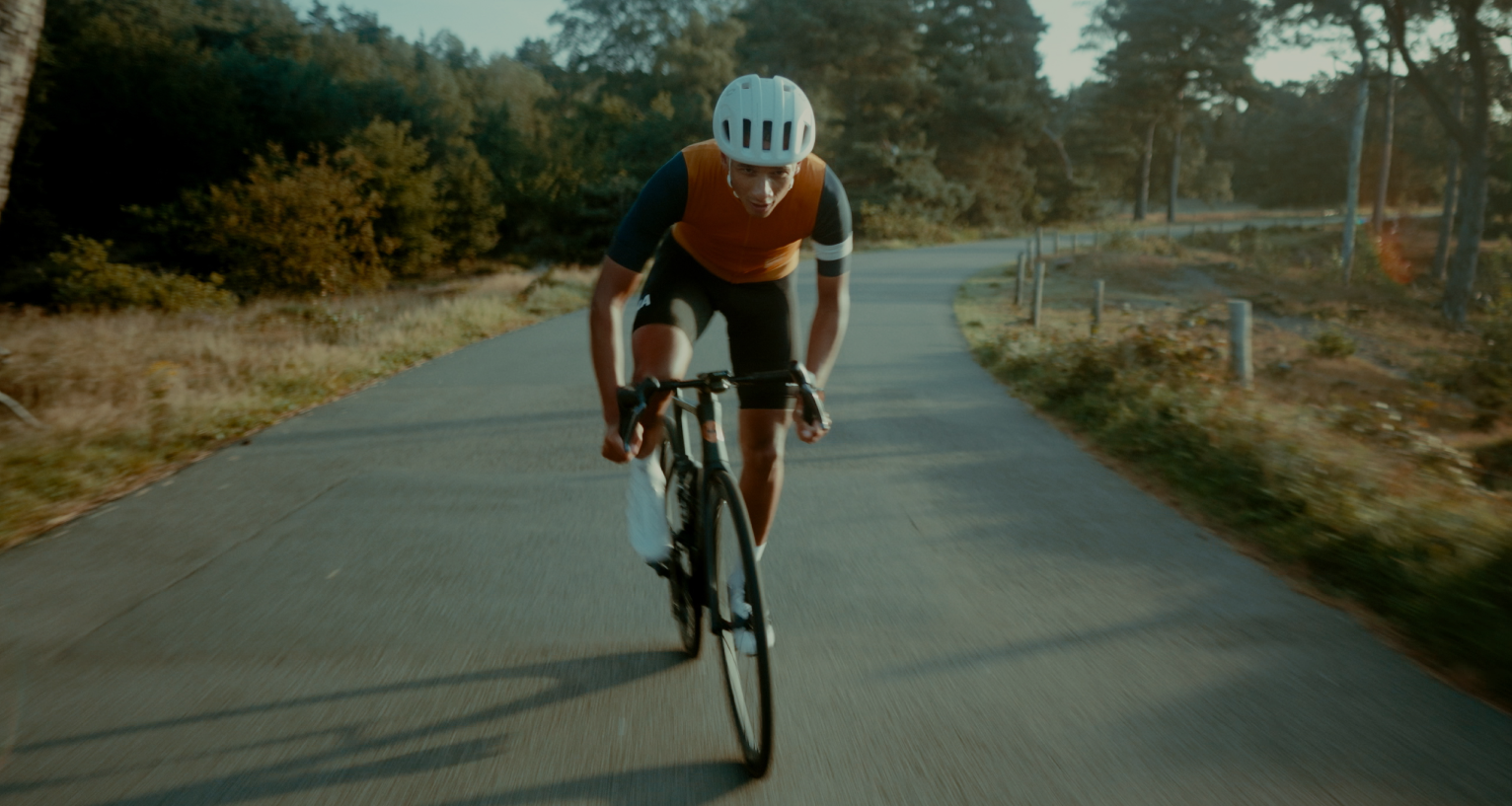
JOIN Cycling builds dynamic training plans that adjust to your availability, your progress and the rides you were not supposed to do. Designed by World Tour level coaches, it covers build, improve, peak and event-specific plans, integrates with the platforms you already ride on, and works in four languages.
The hardest problem in amateur cycling is not knowing what session to do. It is that the session you should do on Tuesday and the two hours you actually have on Tuesday are unrelated facts.
JOIN's design assumes that from the start. You tell it your availability, it fills the hours, and when the week changes the plan changes with it.
The coaching credentials are the other half of the pitch: the plans come from World Tour level coaches, and the app is the delivery mechanism rather than the expertise.
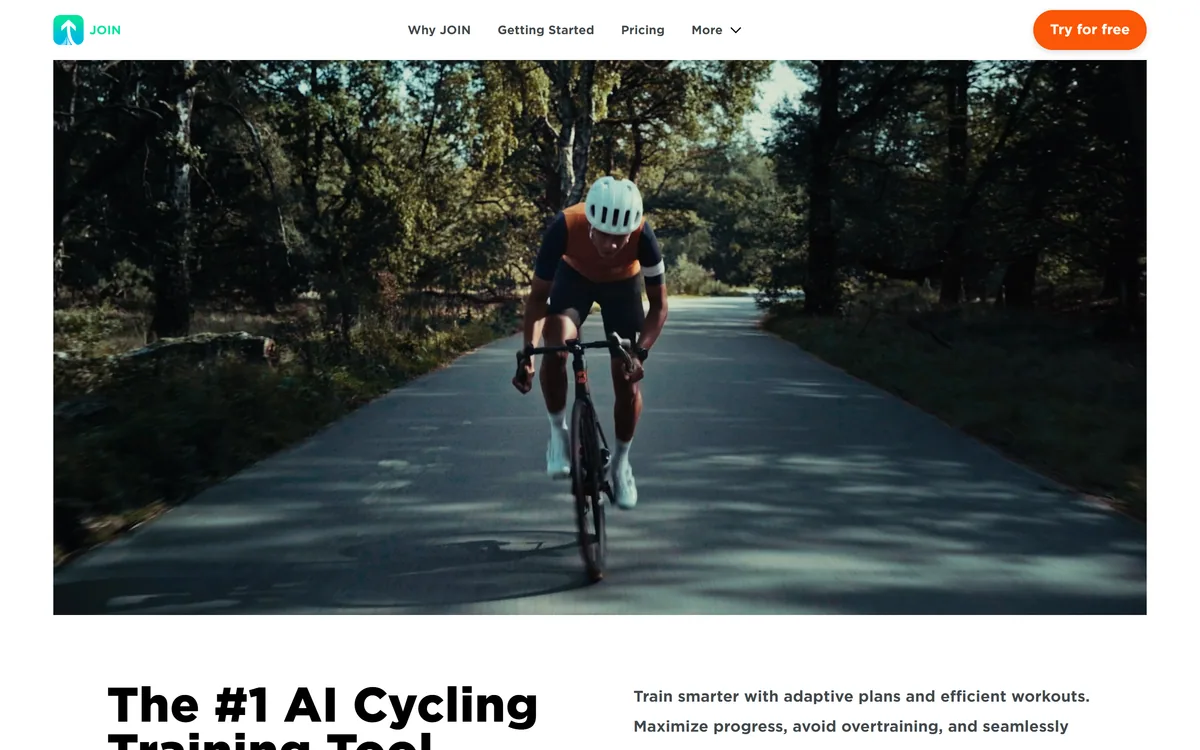
JOIN Cycling's homepage, captured 9 September 2026.
JOIN Cycling: Plans Around Your Availability
Plans designed by World Tour level coaches, with the software handling scheduling rather than the physiology.
Adapts to unplanned rides, not just missed ones — a club spin changes the week rather than being ignored.
Four plan families: build, improve, peak performance and event-specific.
Improvement figures published — 14 watts of FTP and 24 percent level gain in three months, without a stated method.
Four languages — English, Dutch, German and French — with a clear European club-riding centre of gravity.
JOIN Cycling: Coaching And Numbers
Positioning
Described on its own site as the number one AI cycling training tool
Plan design
By World Tour level cycling coaches, per the site
Adaptation
To availability, progress and unplanned rides
Plan families
Build, improve, peak performance and cycling events
Integrations
Connects with favourite apps and devices; Strava and Zwift linked in the footer
Claimed FTP gain
14 watts in the first three months
Claimed level gain
24 percent in the first three months
Goal completion
82.4 percent of users stated to have reached their cycling goal
Languages
English, Dutch, German and French
Community
An ambassador programme, a named ambassador and a Dutch-language podcast
How Do Adaptive Plans Handle An Unplanned Club Ride?
One of JOIN's own riders describes the thing that matters most about this app: the way it adapts the training plan based on unplanned workouts such as club spins.
That sentence describes the harder half of adaptation, and most apps only do the easy half.
Rescheduling a missed session is straightforward — the work did not happen, move it. Absorbing work that did happen but was not prescribed is a different problem, because the load is real and it has to be accounted for in what comes next.
A Saturday club ride that turns into three hours at threshold is a hard session whether or not anyone planned it. A calendar-based plan will still prescribe intervals on Sunday. A load-based plan will not.
Getting this right is what separates a training app from a spreadsheet with notifications, and it is the specific capability worth testing in a trial — do one unplanned hard ride and see whether next week acknowledges it.
Rescheduling a session you missed is easy. Absorbing a hard ride nobody prescribed is the part that makes a plan real.
World Tour Coaches And What That Buys
JOIN states that its plans are designed by World Tour level cycling coaches and used by elite athletes alongside beginners.
Coaching pedigree is worth something specific here, and it is not what people assume.
It does not mean you receive an elite athlete's programme — you should not, because a professional's training block assumes twenty-five hours a week and a support structure you do not have.
What it means is that the underlying session design, progression logic and periodisation come from people who have watched thousands of athletes respond to training. The judgement about what belongs in a plan is the expertise; scaling it down is the software's job.
The claim is also structurally checkable in a way most software credentials are not. Coaching is a small world, coaches are named publicly, and a company overstating that association would be corrected quickly by the people it named. Building a plan from your own ride history rather than a coach's template is the alternative, and Cycling Coach AI's approach.
Fourteen Watts And Reading Improvement Claims
Three figures sit under a science-based heading: 14 watts of FTP improvement in the first three months, 24 percent level improvement in the same period, and 82.4 percent of users reaching their cycling goal.
The precision of that last number is doing something the other two are not, and it deserves reading carefully.
82.4 percent is quoted to one decimal place, which implies a specific denominator someone counted. What is not stated is who was counted, over what period, or how a cycling goal was defined and confirmed as reached.
The 14-watt figure has the same shape. It is a plausible improvement for a rider who has not trained structurally before, and a meaningless one for someone already doing organised intervals. Without knowing who the population was, the number describes selection as much as coaching.
None of this suggests the figures are wrong. It means they cannot tell you what will happen to you, and the honest version of the claim is the mechanism underneath: structured training with adequate recovery reliably beats unstructured riding, which was true before any of these apps existed.
Test whether an unplanned hard ride changes next week.
Ask what population any improvement figure was measured on.
Set your availability honestly, including the days you cannot ride.
Give it a full block before judging the coaching.
Check that the plan family matches your actual season.
Do You Need A Power Meter For This?
JOIN's own FAQ carries this question, which is a good sign that it comes up constantly — and the answer matters more than it first appears.
Structured training is prescribed in zones, and zones can be derived from power or from heart rate. Both work. They fail differently.
Power measures what you are producing right now, immediately and without lag. It is the reason interval training became precise, and it is why a session on a power meter can be executed exactly as written.
Heart rate measures your body's response, which arrives thirty to ninety seconds late, drifts upward across a long ride, and moves with heat, caffeine, sleep and stress. For steady endurance work that is fine. For a thirty-second effort it is useless.
The practical answer is that heart rate is enough to start and a power meter is what you buy when short intervals become the point. If you are riding indoors on a smart trainer you already have power, which is why so many riders acquire it without deciding to. Runners face the same question about wrist data, which Vici answers with readiness rather than power.
The Case For A Narrow Cycling App
JOIN does one thing. There is no strength module, no nutrition plan, no running — just cycling plans that adapt.
That narrowness is worth weighing against the alternative rather than treating it as a gap.
A broader platform covering riding, lifting and fuelling is genuinely more convenient, and it makes trade-offs a specialist does not. Every additional discipline dilutes the attention any one of them receives, and cycling periodisation is deep enough to absorb a whole company.
The counter-argument is real too: training load is systemic. Heavy squats on Thursday affect Saturday's ride whether or not your cycling app knows about them, and a plan blind to your gym work is planning on partial information.
So the choice is between depth and completeness, and it depends on how much non-cycling training you actually do. A rider whose only other activity is a weekly commute loses nothing; one doing three gym sessions a week is asking a coach to plan with its eyes half closed — which is the argument for pairing it with MacroFactor or a strength log rather than expecting one app to cover everything.
Training For An Event Around A Job
The event you have entered is the only thing that makes structure meaningful. Without a date, adaptive training is just riding with extra notifications.
This sequence gets the plan pointed at something and keeps it honest about your week.
Enter the event and its date before choosing a plan family.
Set availability to the hours you will genuinely ride, not your best week.
Connect your ride data so completed sessions feed the next ones.
Log every unplanned ride, especially the hard ones.
Execute intervals to the prescribed zone rather than to feel.
Review at the end of a block, not at the end of a bad week.
Key features of JOIN Cycling
Adaptive plans built around stated availability
Adjustment for unplanned rides as well as missed sessions
Plans designed by World Tour level coaches
Build, improve, peak and event-specific plan families
Integration with common cycling apps and devices
Overtraining prevention as a stated design goal
Progress tracking against plan
Interface in four languages
Pros & cons
Pros
7
Absorbs unplanned hard rides, which is the harder half of adaptation
Coaching pedigree is a publicly checkable claim rather than a vague one
Plan families map cleanly onto real season structure
Narrow focus means cycling periodisation gets full attention
Four languages suit European club riding, where much of its base is
Overtraining prevention treated as a design goal rather than a disclaimer
The site's own FAQ addresses the power meter question directly
Cons
7
Improvement figures carry no stated method or comparison group
The 82.4 percent completion figure does not define a cycling goal
No strength or nutrition, so non-cycling load is invisible to the plan
Individual coaches behind the plans are not named
Whether heart-rate-only riders get equivalent plan quality is unstated
Integration list is described generally rather than enumerated
Nothing here assesses injury, which remains a job for a person
Best For
Amateur cyclists with an event on the calendar
Riders whose available hours change every week
Club riders whose weekends wreck structured plans
European riders wanting the app in their own language
Anyone wanting coach-designed structure without a coach's fee
JOIN Cycling Against Other Training Apps
Training platforms differ by discipline and by how far the adaptation reaches.
What we could not confirm: which coaches designed the plans or which teams they work with; the population, period or method behind the 14-watt, 24 percent and 82.4 percent figures, or how a cycling goal was defined and confirmed; which specific devices and platforms the integrations cover; whether heart-rate-only training receives the same plan quality as power; and pricing, which sits on a separate page we did not reproduce. We did not connect an account or follow a plan.
Editor's Verdict
4.0/5
JOIN's positioning is narrower and more confident than most training apps: coaches designed the plans, the software handles the scheduling, and the whole thing bends around a busy life rather than assuming one. Its riders consistently describe the same behaviour — the plan absorbing an unplanned club ride instead of ignoring it — which is the specific thing that separates adaptation from a calendar. The improvement figures are the weak part, presented without a method or a comparison group. Four languages and a Dutch coaching lineage make it unusually well suited to European club riders. AInexfinder Editor Score: 4.0/5.
JOIN Cycling pricing
AInexfinder does not list plan prices or billing details. For current pricing, plans, and trials, visit the official JOIN Cycling website.
Vendor pricing, credits, and billing policies change over time. Always confirm on the official site before you buy.
Frequently asked questions
What is JOIN Cycling?
A cycling training app that builds adaptive plans around your availability and progress, with the sessions designed by World Tour level coaches. It covers build, improve, peak and event-specific plans and works in four languages.
How does it handle a club ride I did not plan?
It adjusts, according to its own riders. That is the harder half of adaptation — absorbing load that happened but was not prescribed, rather than only rescheduling sessions you missed. Test it in a trial with one unplanned hard ride.
Do I need a power meter?
No, but it changes what the plan can do. Heart rate lags thirty to ninety seconds, drifts across a long ride and moves with heat and sleep — fine for endurance work, useless for short intervals. Power is what you buy when intervals become the point.
Is the 14-watt FTP improvement realistic?
Plausible for a rider new to structured training, and close to meaningless for someone already doing organised intervals. Without knowing the population it was measured on, the figure describes who signed up as much as what the coaching did.
What does World Tour coach design actually give me?
Not an elite athlete's programme — that assumes twenty-five hours a week you do not have. It means the session design and progression logic come from people who have watched thousands of athletes respond, with the software scaling it down.
Does it cover strength training?
No. It is cycling only, which means it plans without knowing about your gym work. If you lift three times a week that is a real blind spot; if your only other activity is a commute, it costs you nothing.
What is sweet spot training?
Riding just below threshold — hard enough to drive adaptation, sustainable enough to repeat often. It is where time-limited riders get most of their return, which is why plans built around busy schedules lean on it heavily.
Will it stop me overtraining?
Preventing overtraining is named as a design goal, and load-based planning helps. It still depends on you logging what you actually rode — a plan that does not know about Saturday's three-hour effort cannot protect you from Sunday's.
Is it suitable for beginners?
The site says it is designed for cyclists at every level, and beginner riders appear in its testimonials describing the AI chat as the useful part. The structure benefits new riders most, since they have the furthest to move.
How long before I can judge it?
One full training block. Adaptation needs data before it can be intelligent, and judging any plan on its first two weeks is judging the setup rather than the coaching.
Daniel reviews AI tools the slow way — by actually using them on real projects. His reviews cover what works, what breaks, and who each tool is genuinely a good fit for.
Daniel and the AInexfinder editorial team research JOIN Cycling using public product information, listing evidence, and (when available) hands-on checks. Scores reflect listing completeness and transparency — not paid placement.
Listings may include affiliate or sponsored placements, which are labeled when present. Editorial scores and cons are not sold. See our affiliate disclosure and review methodology.
Jefit is a workout planner and tracking app with a large exercise database, custom plan building, muscle recovery and one-rep-max metrics, and a community feed. Its adaptive plan analyses strength and fatigue to build the coming week, and periodization now applies to plans members build themselves.
BodBot is an AI personal trainer and nutritionist that builds workouts tailored to your goals, body and progress, adapting with every rep, with joint controls for injuries, wearable integration and data-driven nutrition across web, phone, tablet and watch.
Gymscore analyses lifting technique from phone video, scoring each set from zero to one hundred across five movement categories and giving feedback on range of motion, posture, core stability and movement patterns across more than 2,500 exercises, alongside training plans and an AI coaching chat.
The Running Genie is an AI running coach that syncs from Strava, Garmin, Polar, Suunto and Apple Health, then builds adaptive training plans for 5K through ultra using VDOT, 80/20 polarised training and periodisation principles.
Vici is a free iOS running coach that connects to Strava and your wearable, checks in each morning against recovery, sleep, HRV and resting heart rate, adapts the day's session accordingly, and reads every completed run in two stages before adjusting what comes next.
Dr. Muscle builds and adjusts strength training programmes automatically, picking your weights and reps from what you lifted last time. Built by an exercise scientist, it applies progressive overload and daily undulating periodization, publishes dated release notes going back to 2016, and runs on phone and Apple Watch.