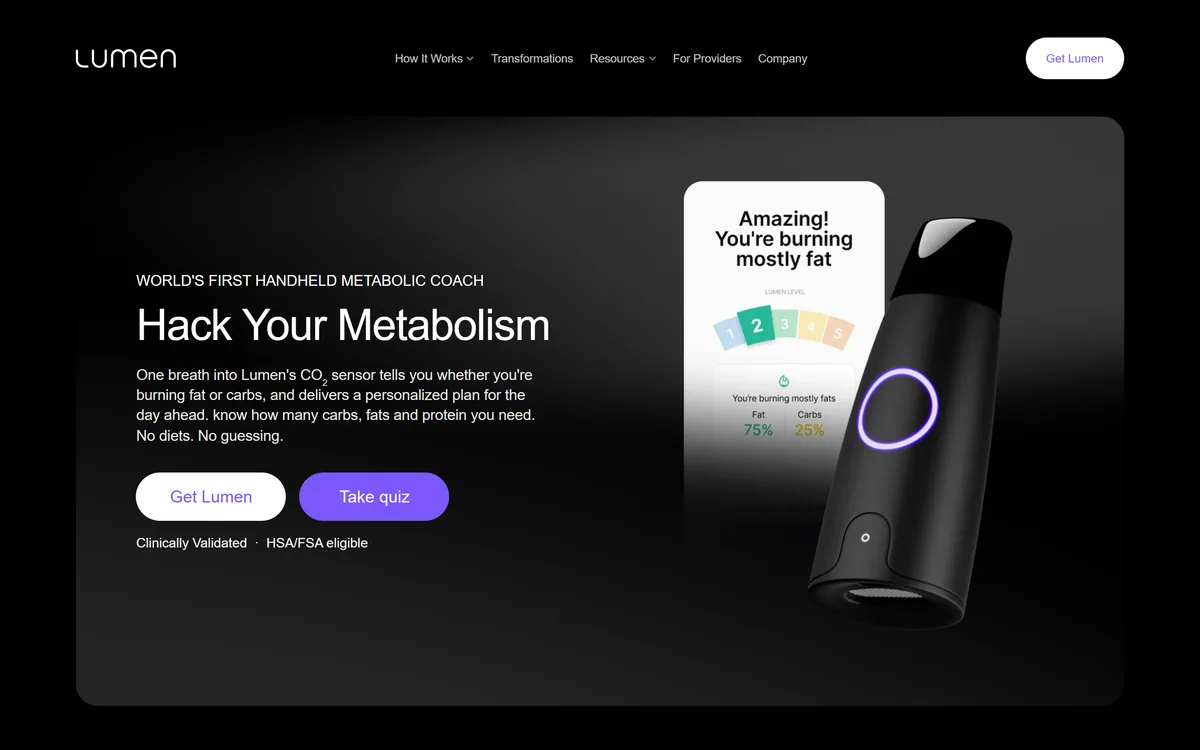
Lumen is a portable metabolic device using a CO2 sensor and flow meter to read the carbon dioxide concentration in a single breath, indicating which fuel your body is using. It builds a daily plan of what to eat and when, flags muscle-loss risk, and guides fuelling around workouts.
A CO2 sensor and flow meter reading a single breath to indicate whether you are burning fat or carbohydrate.
Ten seconds at home against roughly forty minutes in a laboratory, by the company's own comparison.
A daily plan of what to eat, how much and when, based on how your body woke up.
Peer-reviewed validation cited, with university collaborations named — rare in consumer health hardware.
Metaflow LTD, HSA and FSA eligible, with 40-plus integrations to other health apps and wearables.
How Can A Breath Measure Metabolism?
Lumen's own FAQ explains the mechanism plainly: when mitochondria use carbohydrate as fuel they release more carbon dioxide into the blood, and when they burn fat they release less. The device reads CO2 concentration in a breath and infers which is dominant.
That is real physiology rather than marketing, and it is worth understanding both what it captures and what it approximates.
The underlying principle is the respiratory quotient — the ratio of carbon dioxide produced to oxygen consumed. Burning carbohydrate produces roughly one molecule of CO2 per molecule of O2 used; burning fat produces closer to seven per ten. That ratio has been used in laboratories for a century.
The important nuance is that a laboratory measures both gases. Lumen measures carbon dioxide concentration and flow, and derives the rest — which is a well-founded simplification and not the identical measurement.
So the honest framing is a directional daily signal rather than a clinical result. Whether you are more toward fat or carbohydrate this morning is what it tells you, and that is enough to act on without being what a metabolic cart would report.
A laboratory measures two gases and calculates a ratio. Lumen measures one and infers it — a well-founded approximation, not the same reading.
Metabolic Flexibility And Why It Matters
The concept underneath the product is metabolic flexibility: the ability to switch efficiently between burning fat and carbohydrate depending on what is available and what you are doing.
It is a genuine research area rather than a wellness invention, and the argument for tracking it is coherent.
A metabolically flexible person burns fat while fasted or at rest and switches readily to carbohydrate under intensity. An inflexible one stays stuck on carbohydrate, which shows up as hunger between meals, energy crashes and difficulty using stored fat.
That flexibility is trainable through fasting windows, exercise and how carbohydrate is distributed across a day — which is exactly what the daily plan is trying to influence.
The caution is proportion. Metabolic flexibility is one useful marker among many, and a single number measured daily invites the belief that it is the marker. Sleep, training load, stress and total energy balance all move it, so a bad reading is more often information about your week than about your metabolism.
Clinical Validation And What It Covers
Lumen states that it is clinically validated, that the technology is validated by peer-reviewed scientific research, and that it is trusted by top universities and research centres, with a footnoted citation to published work.
Citing a specific paper is meaningfully better than claiming to be science-backed, and it is worth knowing what such validation typically establishes.
A device validation study compares the device against the reference method — in this case metabolic cart indirect calorimetry — across a set of participants and conditions, and reports how closely they agree. That answers whether the device measures what it claims.
It does not answer the separate question of whether acting on the reading improves health outcomes. Those are two different studies, and consumer health devices routinely cite the first while implying the second.
The distinction matters for expectations. The measurement being sound is genuinely established; whether following a daily plan derived from it produces better results than any other reasonable diet approach is a claim that would need a controlled trial with a comparison group, and the site's outcome figures are footnoted to its own user data analysis rather than to one.
Read the cited paper — it validates the measurement, not the outcome.
Breathe at the same time each morning, before eating or coffee.
Treat one reading as noise and a week as information.
Budget for the subscription, not just the device.
Check HSA or FSA eligibility if that applies to you.
Daily Macros Without Counting Calories
The output is a personalised daily plan showing what to eat, how much and when, described as no calorie counting and no guessing, with guidance on when to break a fast and how to fuel around training.
Removing calorie counting is the strongest part of the proposition, and the reason is behavioural rather than physiological.
Counting works and almost nobody sustains it. The tracking burden is high, accuracy decays quickly, and the practice makes many people's relationship with food worse rather than better.
Replacing it with one ten-second measurement and a daily target is a genuinely lower-friction system, and adherence is what actually determines whether any nutrition approach works.
The complication is that a macro target still requires knowing roughly what you ate, so the counting has not entirely gone — it has moved from precise to approximate. Anyone who wants the precise version alongside will still reach for a dedicated tracker like MacroFactor, and the two answer different halves of the same question.
Reading The Endorsements And Transformations
The homepage carries two kinds of social proof: statements from named doctors and health figures, and transformation testimonials citing specific weight loss and body fat changes.
Both deserve reading carefully, and for different reasons.
Named professional endorsements establish that the device is taken seriously by people who work in the field, which is worth something. They are also, as a category, commercial relationships more often than not, and none of them constitutes evidence about outcomes.
The transformation figures are individual results, selected. Someone losing a substantial amount of weight while using a device also changed what they ate, and attributing the outcome to the measurement rather than the change is precisely the inference these sections invite.
The most useful number on the page is the least prominent: an asterisk attributing outcome data to the company's own 2024 user data analysis. That is honest labelling — it tells you the source is internal rather than independent, which is exactly what a reader needs in order to weight it correctly. Training load is the other half of the same picture, tracked by Vici for runners and Jefit in the gym.
Using A Metabolic Device Sensibly
The failure mode with a daily biomarker is treating each reading as a verdict on yesterday, which turns a useful signal into a source of anxiety.
This sequence gets the value without the fixation.
Breathe first thing, before food, coffee or training, every day.
Ignore the first fortnight — you are establishing a baseline.
Look at the weekly trend rather than the morning number.
Follow the daily plan for a full month before judging it.
Use the pre-workout reading to decide fuelling, not to skip training.
Take any health concern to a clinician rather than to a breath score.
Key features of Lumen
Handheld CO2 sensor with flow meter
Ten-second morning breath measurement
Daily personalised eating plan
Fat and carbohydrate fuel indication
Muscle-loss risk flagging
Pre- and post-workout fuelling guidance
Fasting window guidance
Integration with 40-plus health apps and wearables
Pros & cons
Pros
7
Puts a measurement that required a laboratory into a pocket
Cites peer-reviewed validation rather than claiming to be science-backed
University collaborations named rather than implied
Removes calorie counting, which almost nobody sustains
Footnotes its outcome data as internal rather than presenting it as independent
HSA and FSA eligibility makes the hardware cost manageable for some
Warranty, subscription and refund policies all published
Cons
7
Infers from one gas where laboratory testing measures two
Validation of the measurement is not validation of the outcome
Transformation testimonials are selected individual results
Professional endorsements are not disclosed as commercial or otherwise
A device plus an ongoing subscription is a substantial commitment
A daily number invites fixation for anyone prone to it
Metabolic flexibility is one marker among many, not the marker
Best For
People for whom calorie counting has repeatedly failed
Athletes fine-tuning fuelling around training
Anyone who would genuinely act on a daily signal
Users with HSA or FSA funds to allocate
People curious about metabolic flexibility as a trainable quality
Lumen Against Other Health Trackers
Health tools differ by what they physically measure.
Last checked . Read from lumen.me in a browser session on the date above, including the full footer and FAQ. The screenshot was captured at the same time.
Positioned as the world's first handheld metabolic coach
Mechanism stated as a CO2 sensor and flow meter reading CO2 concentration in a single breath
The FAQ explains that mitochondria release more CO2 burning carbohydrate and less burning fat
Comparison drawn between roughly forty minutes in a lab and around ten seconds at home
Described as clinically validated and validated by peer-reviewed scientific research
Collaborations with universities and research centres stated
A daily personalised plan described covering what to eat, how much and when
Muscle-loss risk flagging described alongside pre- and post-workout readings
40-plus integrations with health apps and wearables stated
HSA and FSA eligibility displayed alongside the purchase option
Outcome figures footnoted as reported in the company's own 2024 user data analysis, with a separate published citation
Footer confirms Metaflow LTD, warranty and safety, subscription policy, refund and return policy, and information security pages
What we could not confirm: what the cited validation study measured and against which reference method, which we did not read; whether the device's inference from a single gas performs equivalently across body compositions and conditions; whether following the daily plan produces better outcomes than other approaches, which would require a controlled trial rather than user data; whether the named professional endorsements are commercial relationships; and pricing for the device and subscription, which we did not reproduce. We did not use the device, and nothing here is medical advice.
Editor's Verdict
3.9/5
Lumen takes a measurement that genuinely used to require a laboratory and puts it in a pocket, which is a real piece of engineering rather than a repackaged wearable. It cites peer-reviewed validation and university collaboration, which almost nothing in consumer health does. The honest caveat is what a single gas can tell you: full metabolic testing measures oxygen and carbon dioxide, and inferring fuel use from CO2 alone is a well-founded approximation rather than the same measurement. Treat it as a daily signal, not a laboratory result. AInexfinder Editor Score: 3.9/5.
Lumen pricing
AInexfinder does not list plan prices or billing details. For current pricing, plans, and trials, visit the official Lumen website.
Vendor pricing, credits, and billing policies change over time. Always confirm on the official site before you buy.
Frequently asked questions
What is Lumen?
A handheld device using a CO2 sensor and flow meter to read carbon dioxide in a single breath, indicating whether your body is burning fat or carbohydrate, and building a daily plan of what to eat and when around that reading.
How does the science work?
Mitochondria release more carbon dioxide when burning carbohydrate and less when burning fat. The underlying principle is the respiratory quotient — the ratio of CO2 produced to O2 consumed — which laboratories have used for a century.
Is it the same as a laboratory test?
No. A metabolic cart measures both oxygen and carbon dioxide and calculates the ratio. Lumen measures CO2 concentration and flow and infers the rest, which is a well-founded approximation rather than the identical measurement.
What does clinically validated mean here?
Typically that the device was compared against the reference method and agreed closely. That establishes it measures what it claims. Whether acting on the reading improves outcomes is a separate study, and a different kind of claim.
What is metabolic flexibility?
The ability to switch efficiently between burning fat and carbohydrate. Flexible metabolism burns fat at rest and switches to carbohydrate under intensity; inflexible metabolism stays stuck on carbohydrate, which shows up as hunger and energy crashes.
Does it really replace calorie counting?
It replaces precise counting with approximate targets, which is a genuinely lower-friction system — and adherence determines whether any nutrition approach works. You still need to know roughly what you ate, so the counting has moved rather than gone.
How should I read a bad morning?
As noise. A single reading is affected by sleep, alcohol, training the day before and stress. The weekly trend is the information; treating each morning as a verdict turns a useful signal into a source of anxiety.
How reliable are the transformation stories?
They are selected individual results, and everyone in them also changed what they ate. Attributing the outcome to the measurement rather than the behaviour change is the inference those sections invite, and it is worth resisting.
What about the doctor endorsements?
They establish that the device is taken seriously by people who work in the field, which is worth something. They are also commonly commercial relationships, and none of them is evidence about outcomes for you.
Who should not buy it?
Anyone with a diagnosed metabolic or eating disorder, for whom this is a clinical matter rather than a consumer one, and anyone likely to fixate on a daily number. Nothing here is medical advice, and a clinician is the right destination for a health concern.
Daniel reviews AI tools the slow way — by actually using them on real projects. His reviews cover what works, what breaks, and who each tool is genuinely a good fit for.
Daniel and the AInexfinder editorial team research Lumen using public product information, listing evidence, and (when available) hands-on checks. Scores reflect listing completeness and transparency — not paid placement.
Listings may include affiliate or sponsored placements, which are labeled when present. Editorial scores and cons are not sold. See our affiliate disclosure and review methodology.
RecipeScan is an Apple-only cooking app that builds a pantry from photos, suggests recipes against what you already have, and coordinates three dishes onto one timeline. It adds grocery lists, budget tracking, calorie estimates and a hands-free cooking mode.
Eat This Much generates weekly meal plans from your calorie and macro targets, food preferences, budget, and schedule, then produces a grocery list that can be sent to Instacart or AmazonFresh — with keto, Mediterranean, paleo, vegan, and vegetarian options.
MyNetDiary tracks calories and nutrition against a staff-verified database of more than two million foods carrying up to 108 nutrients each, with barcode scanning, AI photo logging, restaurant menu analysis, wearable integrations and dedicated support for GLP-1 medication users.
MacroFactor is a nutrition and workout tracking app whose coaching adapts weekly to your logged intake and weight trend, estimating your actual energy expenditure rather than using a formula. It publishes in-depth research articles alongside the apps and maintains a public roadmap.