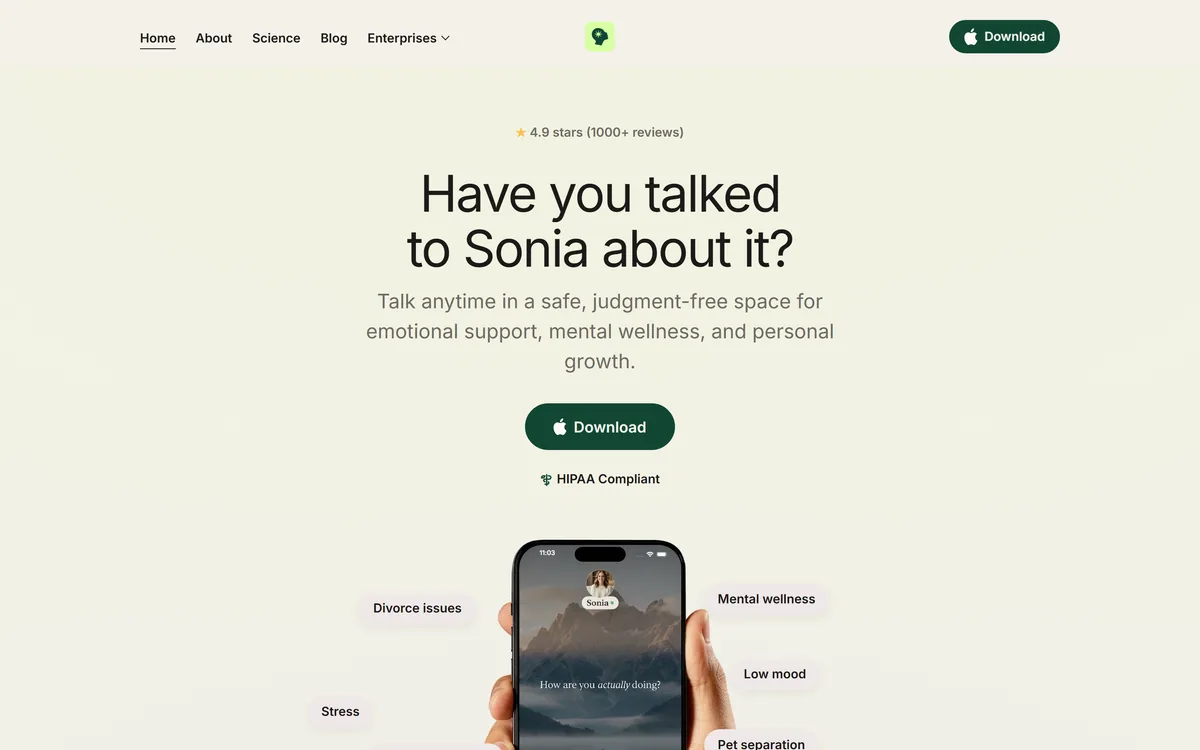
Sonia is an AI emotional-support app grounded in CBT principles, offering a private, 24/7 space to talk through everyday stress, mood and life transitions. It is HIPAA-compliant and built with mental-health professionals, but it is not a replacement for therapy or crisis care.
soniahealth.com10 viewsAdded November 10, 20256K visitors
AI emotional-support apps deserve a careful, slightly sceptical review, because the subject matters and the downside of overselling is real. Sonia belongs to a growing category that offers a private space to talk through what is on your mind, any time, without the cost or waiting list of a therapist.
It is grounded in cognitive behavioural therapy principles, is HIPAA-compliant, and was built alongside researchers and licensed mental-health professionals. What it is, honestly, is support for the everyday weight people carry, and what it is not, equally honestly, is a replacement for professional care or a tool for a crisis.
This review covers what Sonia can genuinely help with and where its limits are, the research and privacy behind it, how it is priced, and who it suits, held to a higher bar of caution than a typical productivity tool.
Sonia offers a private, judgment-free space to talk, with a clear stance that it is not clinical care.
How We Approached This Sonia Review
Last checked . Read from soniahealth.com during this check, with the screenshot above captured at the same time, and held to a higher bar of caution given the subject.
An AI emotional-support app grounded in CBT principles
A private, 24/7 space for everyday stress, mood and life transitions
Explicitly not a diagnosis, treatment or crisis tool, per its own framing and ours
HIPAA-compliant, with privacy and security described as central
Developed with researchers, psychologists and licensed professionals
A 400-participant university study cited with its stated limitations
A public stance against engagement-maximising design
Backed by Y Combinator and notable founders; based in San Francisco
No plan prices reproduced here, in line with this site's pricing policy
The study and its results are the vendor's own, presented with limitations; this is encouraging early evidence, not proof. If you are in crisis, contact your local emergency services or a crisis helpline rather than an app.
Sonia In Four Honest Points
Sonia is an AI emotional-support app grounded in CBT principles, offering a private, judgment-free space to talk any time.
It is for the everyday: stress, low mood, relationship friction, life transitions, not for diagnosis, treatment, or crisis situations.
It is built responsibly: HIPAA-compliant, developed with psychologists, and openly states it is not a substitute for professional care.
It does not try to trap you: the team publicly frames success as helping you, not maximising time in the app.
Sonia AI Support Facts
What it is
AI emotional-support and mental-wellness app
Approach
Grounded in CBT principles
Availability
24/7, on your phone
For
Everyday stress, mood, relationships and life transitions
Not for
Diagnosis, treatment, or crisis and emergency situations
Privacy
HIPAA-compliant, private and secure
Built with
Researchers, psychologists and licensed professionals
Evidence
A 400-participant university study, with stated limitations
Backing
Y Combinator and notable founders; San Francisco
A Judgment-Free Space To Talk Things Through
Sonia's core offer is simple and genuinely useful: somewhere to put the thing you keep carrying, at the moment you are carrying it, without feeling judged. It listens, responds, and checks in afterwards, and users describe going in heavy and coming out lighter.
Part of what makes that work is the absence of a human audience. Several users note it is helpful even knowing it is AI, precisely because there is no social cost to being messy or repetitive, the breakup you have talked about too many times, the small worry that feels silly to raise. That is a real, modest benefit worth taking seriously.
It sits in a category with other AI mental-wellness apps like Wysa and Youper, so the comparison worth making is on approach, evidence and privacy rather than on which has the warmest marketing.
What Sonia offers is modest and real: somewhere to put the thing you keep carrying, at the moment you are carrying it, without feeling judged.
What Can Sonia Help With, And What It Cannot?
The most important part of any review like this is the boundary between useful support and clinical care, so it deserves its own section rather than a footnote.
Everyday Stress, Mood And Life Transitions
Sonia is pitched at the ordinary difficulties of being a person: work pressure, relationship stress, low confidence, trouble sleeping, grief, a major life change. For naming a feeling, slowing down before reacting, or thinking a situation through, it can be a helpful, always-available first step.
Used that way, as a supportive companion for the everyday, it is a reasonable tool, and the CBT grounding gives it more structure than simply talking into a void. A breathing-focused app like Brizzy complements it for the in-the-moment physical side of stress.
Where Sonia Is Not A Substitute For Care
This is the line that matters. Sonia does not diagnose or treat mental-health conditions, and it is not a replacement for a therapist, a doctor or professional care. For a diagnosable condition, ongoing treatment, or anything clinical, a qualified professional is the right call, not an app.
And it is explicitly not for a crisis. If you are in crisis or thinking about harming yourself, contact your local emergency services or a crisis helpline immediately rather than an app. A responsible review has to state that plainly, and to its credit Sonia's own materials point users toward real limits rather than overclaiming.
The Research, Privacy And Anti-Addiction Stance
What moves Sonia above the average app in this space is how seriously it treats the responsibilities that come with the territory. It cites a 400-participant university study in which users reported improvements in mood and reductions in stress, and, notably, it publishes the study's design, findings and stated limitations rather than a cherry-picked number. Treat it as encouraging early evidence from the vendor, not proof.
On privacy, it is HIPAA-compliant and frames confidentiality as central, which matters a great deal for something you tell your most private thoughts. As always with health data, read the current privacy policy for the specifics of what is stored and shared.
Most strikingly, the team publicly states it is not trying to keep you in the app, an explicit rejection of the engagement-maximising design that makes so many apps harmful. For a wellness product, designing against addiction rather than for it is the single most trust-building choice it could make.
How Sonia Prices Emotional Support
Sonia is a mobile app with a subscription, positioned as affordable emotional support relative to the cost of traditional therapy, and it offers enterprise partnerships so organisations can provide it to employees or members.
AInexfinder does not publish plan prices, which change and are best read in the app. The fair way to frame the cost is as a low-cost supplement to, not a replacement for, professional care, useful for everyday support between or instead of nothing, but not a substitute for treatment when treatment is what is needed.
Try it before committing to judge whether talking to it actually helps you, since the benefit is personal and not everyone finds an AI companion useful.
Trying Sonia For A Week With Clear Expectations
Because the benefit is personal and the limits are important, trial Sonia deliberately and with the right expectations.
Set the expectation up front: this is everyday support, not therapy or crisis care.
Talk to it about a real, non-crisis thing on your mind and see whether it helps you think or feel clearer.
Notice whether the check-ins afterwards feel supportive or intrusive, and adjust them.
Read the Science page and the privacy policy so you know what the evidence and data handling actually are.
Judge honestly whether talking to an AI helps you personally, which not everyone finds it does.
Pass/fail: Sonia is worth keeping only if it genuinely eases the everyday weight for you, as a supplement to real-world support.
If anything you are facing is clinical or a crisis, stop and reach a professional or a helpline instead.
Key features of Sonia
Conversational emotional support on CBT principles
A private, judgment-free space available 24/7
Follow-up check-ins between conversations
Meditations and journaling
Support for everyday stress, mood and transitions
HIPAA-compliant privacy and security
Developed with mental-health professionals
Enterprise partnerships for employee wellbeing
Pros & cons
Pros
5
A genuinely useful, always-available space for everyday support
Anyone who wants a private, always-available space to talk things through
People dealing with everyday stress, low mood or a life transition
Those who find it easier to open up without a human audience
People who want CBT-style structure rather than just venting
Anyone seeking a low-cost supplement between or alongside real support
When Sonia Is The Wrong Tool To Reach For
Anyone in crisis or thinking about self-harm, who should contact emergency services or a helpline
People with a diagnosable condition needing professional treatment
Those looking for a replacement for a therapist or doctor
Anyone expecting diagnosis or a clinical outcome from an app
People who simply do not find talking to an AI helpful
Other Mental-Wellness Apps To Know
Comparable supportive tools, and a breathing app for the physical side of stress.
Wysa — an established conversational CBT-based support app
Youper — an emotional-health assistant with mood tracking
Brizzy — guided breathing for in-the-moment calming
Editor's Verdict
4.0/5
Sonia earns 4.0 for being a genuinely useful everyday-support companion that is unusually responsible, CBT-grounded, HIPAA-compliant, transparent about its evidence, and openly against addictive design; it is rightly capped, and must be, because it is not a substitute for therapy or crisis care, and its benefit is personal and its evidence still early. AInexfinder Editor Score: 4.0/5.
Sonia pricing
AInexfinder does not list plan prices or billing details. For current pricing, plans, and trials, visit the official Sonia website.
Vendor pricing, credits, and billing policies change over time. Always confirm on the official site before you buy.
Frequently asked questions
What is Sonia?
Sonia is an AI emotional-support app grounded in cognitive behavioural therapy principles. It offers a private, judgment-free space to talk through everyday stress, mood and life transitions any time. It is HIPAA-compliant and built with mental-health professionals.
Is Sonia a replacement for therapy?
No. Sonia is everyday emotional support, not clinical care. It does not diagnose or treat mental-health conditions and is not a substitute for a therapist or doctor. For a diagnosable condition or ongoing treatment, see a qualified professional rather than an app.
Can I use Sonia in a crisis?
No. Sonia is not for crisis or emergency situations. If you are in crisis or thinking about harming yourself, contact your local emergency services or a crisis helpline immediately. An app is not the right tool at that moment.
Does talking to an AI actually help?
For everyday stress and mood, many people find it helps to name a feeling, slow down, or think a situation through with a responsive, judgment-free companion, and some find it easier precisely because there is no human audience. The benefit is personal, though, and not universal.
Is Sonia private?
Sonia is HIPAA-compliant and frames confidentiality and security as central, which matters for something you share private thoughts with. As with any health app, read the current privacy policy for the specifics of what is stored and how it is handled.
What evidence is there that Sonia works?
Sonia cites a 400-participant university study in which users reported improved mood and reduced stress, and publishes the study's design, findings and limitations. Treat that as encouraging early evidence from the vendor rather than definitive proof of clinical effect.
How does Sonia compare with Wysa or Youper?
All are supportive, non-clinical AI wellness apps grounded in CBT-style techniques. The useful comparison is approach, evidence and privacy rather than marketing. Try more than one, since which companion helps is personal, and remember the same boundaries apply to all of them.
Is Sonia free?
Sonia is a subscription app, positioned as affordable relative to traditional therapy, with enterprise partnerships for organisations. We do not publish prices. Frame the cost as a low-cost supplement to real-world support, not a replacement for treatment, and try it before committing.
Does Sonia try to keep me hooked on the app?
Notably, the team publicly states it is not trying to keep you in the app, rejecting the engagement-maximising design common in consumer apps. For a wellness product, designing against addiction rather than for it is a strong, trust-building choice.
Who is behind Sonia?
Sonia is based in San Francisco and backed by Y Combinator along with founders of several well-known companies, and it is developed alongside researchers, psychologists and licensed mental-health professionals. That professional involvement is part of why it handles its limits responsibly.
Daniel reviews AI tools the slow way — by actually using them on real projects. His reviews cover what works, what breaks, and who each tool is genuinely a good fit for.
Daniel and the AInexfinder editorial team research Sonia using public product information, listing evidence, and (when available) hands-on checks. Scores reflect listing completeness and transparency — not paid placement.
Listings may include affiliate or sponsored placements, which are labeled when present. Editorial scores and cons are not sold. See our affiliate disclosure and review methodology.
Youper is an AI emotional-health assistant built around conversational check-ins, mood tracking and journaling. The company has announced it is shutting down on 30 September 2026, after which accounts, chat history and personal data are permanently deleted.
Earkick is an iOS self-care app built around a panda companion, offering mood and anxiety check-ins, progress statistics, breathing and CBT exercises, soundscapes and a panic button. It states that everything stays on your device or in your own iCloud, with no registration and no tracking.
Soula is an emotional support companion built for women, distinguished by memory: it retains conversation history across sessions and surfaces patterns in stress, sleep and mood over weeks. It states plainly that it is not therapy, routes crises to human help, and is built by MAMATECH Ltd with GDPR compliance and encryption.
Mindsera is an AI journalling app that analyses entries as you write, surfaces patterns and emotions over time, and offers more than fifty mental models as structured prompts. It accepts typed, spoken and photographed handwritten entries, and runs on iOS, Android and the web.
Wysa is an anonymous, CBT-based AI mental-health support tool designed as a safer alternative to general AI, with human-in-the-loop clinical oversight, backed by peer-reviewed research, and sold to health systems, employers and insurers, not a substitute for professional care.
Moody Month is an iOS hormone-tracking app that gives daily forecasts across the cycle, perimenopause, pregnancy and postpartum, with symptom logging, wearable integration and content, from a women-owned team, with privacy you should still read carefully.