AssemblyAI sells voice AI infrastructure: production APIs for pre-recorded and real-time speech-to-text on its Universal models, a Speech Understanding API that turns transcripts into structured insight, a Voice Agent API over a single WebSocket, and guardrails including PII redaction and content moderation.
assemblyai.com13 viewsAdded August 4, 202520K visitors
There is a category error that costs teams months, and it is worth naming before anything else: a transcription product and a speech API are not the same purchase.
A transcription product such as Otter.ai gives you an interface, a file list and an export button. A speech API gives you an endpoint, and everything a user would touch is yours to build. Buying the second when you wanted the first means paying to develop a product you could have subscribed to.
AssemblyAI is unambiguously the second. It describes itself as voice AI infrastructure for developers, and every part of the platform assumes there is an engineering team on the other side. This review covers what the models do, why the understanding layer matters more than the transcript, and the specifications you will have to dig for.
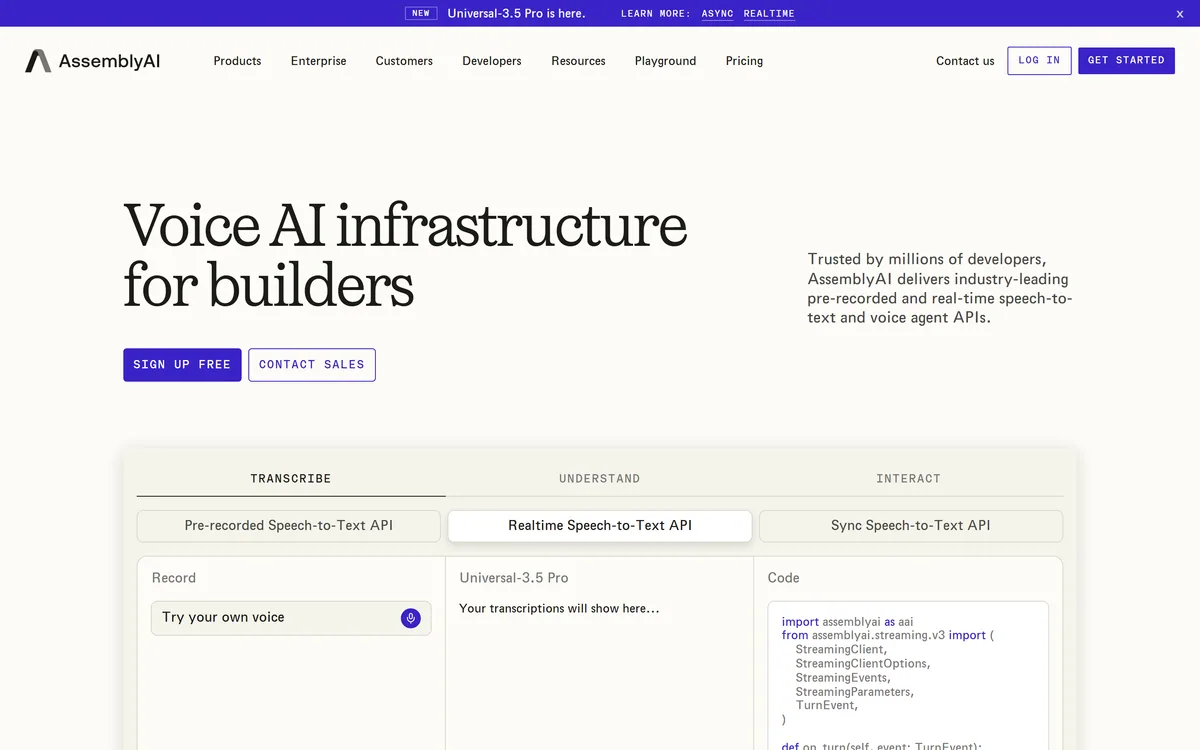
AssemblyAI's homepage, captured 9 September 2026. The positioning is infrastructure for developers rather than a transcription product for end users.
What Does AssemblyAI Actually Sell?
Speech-to-text as infrastructure, not a transcription app — production APIs you build a product on, with no end-user interface.
Two speech models with different jobs: Universal-3.5 Pro is the highest-accuracy pre-recorded model and the recommended default; Universal-2 covers broader languages and legacy features.
Real-time and pre-recorded are separate paths, and a Voice Agent API runs speech-to-speech agents over a single WebSocket.
Speech Understanding is the second product — structured insight from transcripts rather than the transcript itself.
Guardrails are first-class: PII redaction, profanity filtering and content moderation ship as platform features rather than as something you build.
Universal-3.5 Pro And What Changed
AssemblyAI documents two pre-recorded models with an explicit division of labour. Universal-3.5 Pro is described as the highest-accuracy model and the recommended default. Universal-2 is positioned for broad language coverage and legacy feature support.
That split is more useful than a single flagship, and the honesty is worth crediting. Speech recognition accuracy and language breadth pull against each other — the best English model is rarely the best Vietnamese one, because the training data and the acoustic modelling differ.
For a buyer the implication is concrete. If your audio is English-language customer calls, take the Pro model and expect the better result. If your product serves a long tail of languages, check Universal-2's coverage against your actual language mix before committing, because a model that is excellent in twelve languages is useless if your users speak the thirteenth.
Around the models sit the features that make transcripts usable: speaker labels for diarisation, word-level timestamps, language detection, custom spelling, key terms, and medical terminology support. Custom spelling matters more than it sounds — every product has proper nouns, product names and jargon that a general model will render phonetically and wrongly, forever, until you tell it otherwise.
The best English model is rarely the best model for your thirteenth language. A vendor offering two and telling you which is which is being straight with you.
Can You Trust A Transcript You Did Not Check?
No speech system is perfect, and the way they fail matters more than the rate at which they fail.
Recognition errors are not random. They cluster on exactly the words that carry meaning — names, numbers, technical terms, and anything spoken quickly or over background noise. A transcript can be 95 per cent accurate overall and wrong on the account number, which is the only part anyone needed.
This has a direct design consequence. If a transcript drives an automated action — routing a case, updating a record, triggering a payment — build a confidence threshold and a human path for anything below it. Word-level timestamps exist partly so a person can jump to the audio and check rather than reading the whole thing.
It also means you should measure on your own audio rather than trusting any benchmark. The same caution applies to Speechmatics and every rival: vendor accuracy figures are measured on clean corpora; your audio has hold music, crosstalk, accents and a caller in a car. Transcribe fifty of your own recordings, count the errors that would actually matter, and that number is the only one worth planning around.
Why Speech Understanding Is The Harder Half
AssemblyAI sells a Speech Understanding API for structured insight from transcripts, separately from the transcription itself. That separation reflects where the real work sits.
A transcript is not an answer. Nobody wants ten thousand words of a support call; they want to know what the customer asked for, whether it was resolved, how the caller sounded, and whether anything needs escalating. Getting from one to the other used to mean building a second pipeline with its own models and its own maintenance burden.
Buying that layer rather than building it is usually the right call for a product team, for an unglamorous reason: the second pipeline is the one that rots. Transcription is stable; summarisation, classification and sentiment analysis have to be revised every time the underlying models improve, and that is a permanent cost on your roadmap rather than a one-off.
Pairing it with a voice generator such as ElevenLabs completes an agent, and the LLM Gateway points at the same idea — a route to language models over the same platform, so the understanding step does not require separate vendor management.
The judgement to apply is where the derived output is trusted. Summaries are fine as an aid to a human reading the transcript. Sentiment scores driving an automated escalation decision deserve considerably more scepticism, because inferring emotional state from words is unreliable in exactly the cases — sarcasm, restraint, cultural difference — where it would matter.
Use transcription output for search, records and evidence — it is checkable against the audio.
Use derived summaries to help a person read faster, not to replace their reading.
Treat sentiment as weak signal, and never as the sole trigger for an automated action.
Apply PII redaction at ingest if you will store transcripts, not as a later cleanup step.
Keep the audio, since every derived output can be regenerated but the recording cannot.
Voice Agents Over A Single WebSocket
The Voice Agent API runs speech-to-speech agents over a single WebSocket, and the architectural detail in that sentence is the whole point.
The conventional way to build a voice agent chains three services: speech-to-text, then a language model, then text-to-speech, each with its own connection and its own latency. The delays add, and the result is the stilted pause everyone recognises from automated phone systems — the thing that makes callers press zero.
Collapsing that into one connection is a latency argument rather than a feature. Conversational turn-taking has a fairly narrow tolerance; past roughly a second of silence, people start talking over the system or assume it has failed. Every hop you remove buys headroom.
The trade is control. A chained pipeline lets you swap the language model, tune the voice, and inspect each stage independently. A single integrated path is faster and gives you fewer places to intervene.
The right choice follows from what the agent does. For a scripted, high-volume interaction where speed is the experience — checking an order, booking a slot — integrated latency wins. For an agent that needs careful reasoning, tool use and auditable steps, the chained approach remains easier to build and debug.
Benchmarking It On Your Own Audio
Every speech vendor publishes accuracy measured on clean corpora, and your audio is not clean. The only benchmark that predicts what you will get is one you run yourself, and it takes an afternoon.
The bar is step four. An error rate on words that carry meaning is the number your product actually depends on, and it is very different from an overall rate.
Collect fifty real recordings that span your actual conditions — background noise, accents, crosstalk, a caller on a bad line. Not your cleanest samples.
Load your domain vocabulary into custom spelling and key terms before you start. Skipping this is the most common reason a first test disappoints.
Transcribe them all on Universal-3.5 Pro, and repeat on Universal-2 if any of your languages sit outside the major ones.
Count errors only on words that would change an outcome — names, numbers, product terms, dates. An overall accuracy figure hides exactly the failures that matter.
Test diarisation separately on your hardest recordings, since speaker attribution degrades on crosstalk long before transcription does.
If you are building an agent, measure round-trip latency on the streaming path rather than the pre-recorded one; they are different services with different characteristics.
How AssemblyAI Bills For Audio
Speech APIs in this category are metered by audio duration rather than by seat, and the practical unit is hours or minutes of audio processed.
That model has a property worth designing around: cost scales with volume, not with team size. A three-person startup processing a large volume of calls pays more than a hundred-person company processing few, which is unusual and generally fair.
The variables that move a bill are duration, whether you use the real-time path, and how many understanding features you layer on. Streaming is typically priced differently from pre-recorded because it is a different service, and each derived output is additional work.
The engineering lever most teams miss is not sending audio you do not need. Silence trimming, voice activity detection, and simply not transcribing hold music are the difference between a predictable bill and a surprising one at scale.
We do not publish amounts, since rates change. Model your cost on real audio duration from a representative week, and check whether committed-volume terms exist before you scale — in this category they usually do, and they are worth asking about.
AssemblyAI: The Developer Specification
Product type
Voice AI infrastructure — APIs, not an end-user application
Pre-recorded models
Universal-3.5 Pro (highest accuracy, recommended default) and Universal-2 (broader language coverage, legacy features)
Real-time
Streaming speech-to-text as a separate API
Voice agents
Voice Agent API running speech-to-speech over a single WebSocket
Understanding layer
Speech Understanding API for structured insight from transcripts
Model access
LLM Gateway for language model calls through the same platform
Transcript features
Speaker labels, word-level timestamps, language detection, custom spelling, key terms, medical terminology, transcript post-processing
Developers and product teams building speech into their own applications
Pricing model
Usage-based on audio duration; streaming and pre-recorded priced separately
Speech API Terms That Decide A Build
Five terms that determine whether a speech platform fits what you are building.
Word error rate (WER)
The standard accuracy measure — insertions, deletions and substitutions against a reference transcript. Useful for comparing models on the same audio, and misleading across different audio, because clean corpora flatter everyone.
Diarisation
Working out who spoke when, and labelling the transcript accordingly. Essential for calls and meetings, and the feature most likely to degrade with crosstalk or similar-sounding voices.
Streaming versus pre-recorded
Two different services. Streaming returns partial results as audio arrives and optimises for latency; pre-recorded sees the whole file and optimises for accuracy. Expect different models, different prices and different results.
PII redaction
Automatically removing personal data — names, card numbers, addresses — from a transcript. Apply it at ingest if you store transcripts, because retro-fitting redaction over stored data is far harder.
Custom spelling and key terms
Telling the model your proper nouns, product names and jargon in advance. The cheapest accuracy improvement available, and the one teams most often skip.
Key features of AssemblyAI
Universal-3.5 Pro for highest-accuracy pre-recorded transcription
Universal-2 for broader language coverage and legacy feature support
Real-time streaming speech-to-text as a separate API path
Voice Agent API running speech-to-speech agents over a single WebSocket
Speech Understanding API producing structured insight from transcripts
Speaker labels, word-level timestamps and automatic language detection
Custom spelling and key terms for product names, proper nouns and jargon
Guardrails covering PII redaction, profanity filtering and content moderation
Pros & cons
Pros
6
Two documented models with an honest division between accuracy and language breadth
The understanding layer removes a second pipeline that would otherwise need permanent maintenance
PII redaction and moderation as platform features rather than something each customer rebuilds
Single-WebSocket voice agents remove latency hops that make automated calls feel broken
Custom spelling and key terms give a cheap, immediate accuracy improvement on domain vocabulary
Usage-based pricing scales with audio volume rather than headcount
Cons
6
No word error rate or accuracy figure published on the pages a buyer would read first
Supported language count is not stated on the homepage or the speech-to-text product page
Compliance certifications are not surfaced where procurement would look for them
Streaming latency figures and SDK language coverage are not published on those pages
Infrastructure only — there is no end-user interface, so it is the wrong purchase for internal note-taking
Derived outputs such as sentiment are far less reliable than the transcript itself, and it is easy to trust them equally
Best For
Product teams embedding speech recognition in their own applications
Voice agent builders where conversational latency is the experience
Teams handling regulated audio who need PII redaction at ingest
Companies with variable audio volume that suits usage-based pricing
Developers who want the understanding layer without maintaining a second pipeline
AssemblyAI Against The Speech APIs
Speech vendors differ on whether they sell you an endpoint or a finished product. Buying the wrong shape is the most expensive mistake in this category.
Tool
Sells
Strongest at
Watch out for
AssemblyAI
APIs for developers
Documented models plus an understanding layer you would otherwise build
Specs like WER, language counts and certifications are not on the marketing pages
You are building speech into your own product and need an endpoint rather than an interface.
You want the understanding layer — summaries, structure, moderation — without maintaining a second pipeline.
You handle regulated or sensitive audio and want PII redaction as a platform feature rather than something you write.
You are building a voice agent where conversational latency is the product experience.
Your volume varies, and usage-based pricing suits you better than per-seat billing.
Look at alternatives when
You want to transcribe your own meetings — that is a product purchase, and paying to build one is a costly mistake.
Your language mix sits in the long tail; check coverage against your actual users before committing.
You need near-perfect accuracy on difficult audio, where human transcription is still the honest answer.
Your procurement needs published compliance certifications up front, since these are not on the marketing pages.
You have no engineering capacity, in which case an off-the-shelf application will serve you better.
Sources For This AssemblyAI Review
Last checked . Read from assemblyai.com, including the speech-to-text product page, with the screenshot above captured in the same session.
Positioning confirmed as voice AI infrastructure for developers building products that transcribe, understand and act on speech
Product set confirmed as production APIs for speech-to-text, real-time transcription, a Voice Agent API, Speech Understanding, Guardrails and an LLM Gateway
Universal-3.5 Pro documented as the highest-accuracy pre-recorded model and recommended default
Universal-2 documented as the model for broad language coverage and legacy feature support
Voice Agent API described as running speech-to-speech agents over a single WebSocket
Transcript features listed on the product page: language detection, word-level timestamps, speaker labels, custom spelling, prompting, key terms, medical terminology and transcript post-processing
Guardrails confirmed as including PII redaction, profanity filtering and content moderation
Speech Understanding API described as producing structured insights from transcripts
What we could not confirm: no word error rate or accuracy figure is published on the pages we read; the number of supported languages is not stated on either the homepage or the speech-to-text product page; compliance certifications such as SOC 2, HIPAA and GDPR are not stated there either, so request them directly if procurement requires them; SDK languages and streaming latency figures are not given on those pages; and no company legal name, headquarters or funding detail appears on them.
Other Voice And Transcription Tools
The first question is whether you need an API or an application. Everything else follows from that.
Speechmatics — the closest API competitor, worth comparing on your own audio and language mix
Rev — human transcription where an error would be unacceptable
Otter.ai — a finished meeting product if you do not want to build anything
ElevenLabs — the other half of a voice agent — speech generation rather than recognition
Cleanvoice AI — cleaning up audio before transcription, which improves every downstream result
Editor's Verdict
4.4/5
AssemblyAI scores highly because it sells to the right buyer in the right shape: developers who need speech as infrastructure, given documented models, a streaming path, and an understanding layer that turns a transcript into something a product can act on. Splitting Universal-3.5 Pro for accuracy from Universal-2 for breadth of language coverage is an honest acknowledgement that no single model wins on both. It loses ground because the marketing pages do not publish word error rates, language counts or compliance certifications where a buyer would look for them, so the specifications that decide a build have to be dug out of documentation. AInexfinder Editor Score: 4.4/5.
AssemblyAI pricing
AInexfinder does not list plan prices or billing details. For current pricing, plans, and trials, visit the official AssemblyAI website.
Vendor pricing, credits, and billing policies change over time. Always confirm on the official site before you buy.
Frequently asked questions
What is AssemblyAI?
AssemblyAI is voice AI infrastructure for developers: production APIs for pre-recorded and real-time speech-to-text, a Speech Understanding API that extracts structured insight from transcripts, a Voice Agent API for speech-to-speech agents, and guardrails including PII redaction and content moderation. It is an API platform, not an end-user transcription app.
Which AssemblyAI model should I use?
Universal-3.5 Pro is documented as the highest-accuracy pre-recorded model and the recommended default. Universal-2 exists for broader language coverage and legacy feature support. If your audio is mostly one major language, take the Pro model; if you serve a long tail of languages, check Universal-2's coverage against your actual user mix first.
How accurate is AssemblyAI?
No word error rate is published on the pages we read, and any published figure would be measured on clean audio rather than yours. The reliable approach is to transcribe fifty of your own real recordings and count the errors that would actually matter. Recognition errors cluster on names, numbers and technical terms — the words that carry the meaning.
Is AssemblyAI free?
It is a usage-based API priced by audio duration, with streaming and pre-recorded typically priced differently. We do not publish amounts because rates change. Model your cost on a representative week of real audio, and ask about committed-volume terms before scaling — in this category they generally exist.
Does AssemblyAI do real-time transcription?
Yes, as a separate streaming API alongside the pre-recorded one. They are genuinely different services: streaming returns partial results as audio arrives and optimises for latency, while pre-recorded sees the whole file and optimises for accuracy. Expect different results and different pricing from each.
Can AssemblyAI identify different speakers?
Yes — speaker labels are documented as a transcript feature, which is what diarisation means in practice. It is also the feature most likely to degrade on hard audio: crosstalk, similar-sounding voices and people talking over each other are where speaker attribution slips, so check it on your own recordings rather than a clean sample.
How does AssemblyAI handle personal data in transcripts?
PII redaction is a platform feature under Guardrails, alongside profanity filtering and content moderation. The important design point is to apply redaction at ingest if you intend to store transcripts, because retro-fitting redaction over already-stored data is considerably harder than getting it right the first time.
What is the difference between AssemblyAI and Otter.ai?
They are different kinds of purchase. Otter.ai is a finished product for end users — it records and summarises your meetings with no engineering work. AssemblyAI is an endpoint you build a product on. If you want your own meetings transcribed, buy the product; if you are shipping speech features to your customers, buy the API.
Can I build a voice agent with AssemblyAI?
Yes, via the Voice Agent API, which runs speech-to-speech over a single WebSocket. That architecture removes the latency hops of chaining separate speech-to-text, language model and text-to-speech services — which is what produces the stilted pause people recognise in automated phone systems. The trade-off is fewer places to intervene in the pipeline.
Is AssemblyAI SOC 2 or HIPAA compliant?
Compliance certifications are not stated on the homepage or the speech-to-text product page we read, so we cannot confirm them here. If your procurement process requires them, request the documentation directly along with data residency, retention and subprocessor detail — for audio containing personal or health information, those answers should be in your file before you build.
Daniel reviews AI tools the slow way — by actually using them on real projects. His reviews cover what works, what breaks, and who each tool is genuinely a good fit for.
Daniel and the AInexfinder editorial team research AssemblyAI using public product information, listing evidence, and (when available) hands-on checks. Scores reflect listing completeness and transparency — not paid placement.
Listings may include affiliate or sponsored placements, which are labeled when present. Editorial scores and cons are not sold. See our affiliate disclosure and review methodology.
Rev has repositioned from transcription into an investigative intelligence platform for legal teams, combining AI evidence analysis with human-verified transcription guaranteed 99%+ accurate in 12 hours, plus court reporting, deposition summaries and a speech-to-text API.
Cockatoo transcribes audio and video across 100+ languages with a stated accuracy of up to 99.8%, exports to SRT, DOCX, PDF and TXT, imports from Dropbox and YouTube, and offers three free transcripts daily with no card required.
Deepgram provides speech-to-text and text-to-speech through its Flux models, plus a Voice Agent API that combines transcription, speech synthesis and LLM orchestration into a single interface. Everything runs in real time or batch, in the cloud or self-hosted, with text-to-speech latency stated as low as 80ms.
The workspace at www-flux3.com generates 5–20 second AI videos with native audio from text or a starting image, routing across FLUX 3, MiniMax H3, Seedance, Wan 3.0 and Kling 3.0 Pro, at 720p or 1080p with video extension.
Runway is an AI video platform built around generative world models — Gen-4.5, Aleph 2.0, and Act-Two for performance capture — split across Runway Creative for filmmakers, Runway Dev for builders, and Runway Robotics.