Speechmatics is a speech-to-text API covering 55+ languages with speaker diarization, custom vocabulary and mid-sentence code-switching. It runs on-device, on-premises or in the cloud, and posted the lowest word error rate in an independent 12-service benchmark in August 2026.
speechmatics.com8 viewsAdded June 1, 202614K visitors
Speech-to-text benchmarks are usually run on audio nobody actually has: one speaker, a good microphone, a neutral accent, no interruptions. Every engine looks excellent on that. The differences appear the moment you feed in a real meeting, a doctor's consultation, or two people talking over each other in two languages.
Speechmatics is built for that second case, and it is the rare vendor in this space with an independent result to point at rather than a self-reported number. In Pipecat's August 2026 benchmark of twelve services, it recorded a 1.07% pooled word error rate — the lowest in the test.
This review covers what that benchmark does and does not tell you, why code-switching is the capability worth caring about, what on-device deployment changes for regulated buyers, and where a transcription API stops being the hard part of your problem.
The pitch is not clean studio audio — it is the conversation with three people and an accent.
Why Engineers Pick This One
Independently benchmarked, not self-reported. Pipecat's August 2026 test put it at a 1.07% pooled word error rate — lowest of twelve services, ahead of Deepgram, AWS and Azure.
Code-switching is the standout. It handles a speaker changing language mid-sentence, which most engines break on and which is normal speech in much of the world.
55+ languages with speaker diarization and custom vocabulary built in rather than bolted on.
Runs on-device and on-premises, not just in the cloud — the deciding factor for healthcare, legal and anything that cannot send audio out.
ISO 27001:2022, GDPR, HIPAA and SOC 2 Type II, with data non-logging as standard.
What A 1.07% Word Error Rate Actually Means
This is the strongest claim on the page, so it deserves to be read carefully rather than quoted.
A 1.07% pooled word error rate means roughly one word in a hundred is wrong — inserted, deleted or substituted. Against eleven competitors including Deepgram, AWS and Azure, that is a real result, and the fact it comes from Pipecat rather than from Speechmatics is what makes it worth citing at all. Nearly every accuracy claim in this category is the vendor grading its own homework.
What it does not tell you is how it performs on your audio. 'Pooled' means averaged across a test set, and word error rate is exquisitely sensitive to domain: medical terminology, product names, industry jargon and heavy background noise all move it substantially. A service that wins a pooled benchmark can still be second-best on your particular recordings.
The other thing WER hides is which words were wrong. One error in a hundred is excellent if the misses are 'the' and 'a', and much worse if they are drug names or dollar amounts. Custom vocabulary exists precisely because the words that matter most are the ones a general model gets wrong most.
An independent benchmark tells you the engine is good. Only your own audio tells you it is good at the words you cannot afford to lose.
Code-Switching, And Why It Is The Real Differentiator
Most engines handle multiple languages by asking you to pick one per file. That model breaks on how enormous numbers of people actually speak.
A speaker moving between Hindi and English inside one sentence, or Spanish and English, or Arabic and French, is not an edge case — it is ordinary conversation across much of the world, and a single-language engine transcribes half of it as nonsense.
Handling that mid-sentence is genuinely hard, because the model cannot settle on a language and stay there. It is also the capability most likely to matter if your users are outside a monolingual market, and the one least visible in an English-only demo.
Speaker diarization sits alongside it: labelling who said what. For meetings, interviews and contact-centre calls, an undiarized transcript of four people is close to useless — you have the words and none of the structure.
On-Device And On-Premises Changes Who Can Buy It
Cloud, on-premises and on-device deployment, with data non-logging as standard, plus ISO 27001:2022, GDPR, HIPAA and SOC 2 Type II.
In consumer software that list is procurement boilerplate. In healthcare and legal it is the whole conversation. A hospital cannot send patient consultations to a third-party cloud, and a law firm cannot send privileged material, regardless of how accurate the transcription is.
On-device is the strongest version of that answer: audio never leaves the machine, so the compliance question largely evaporates rather than being managed. It also removes latency and network dependence, which matters for live captioning where a two-second lag is the difference between usable and not.
The named customers — Adobe, LiveKit, Ubisoft, Stenograph — are a useful signal here. Stenograph in particular is a court-reporting company, which is about as unforgiving an accuracy environment as exists.
Choosing Between Transcription Vendors Sensibly
The evaluation everyone should run, and almost nobody does, takes an afternoon.
Collect twenty minutes of your genuinely worst audio — background noise, accents, people talking over each other. Not your best sample.
Run it through two or three vendors on their free tiers rather than reading comparison tables.
Score the errors by importance, not by count. Ten wrong articles matter less than one wrong dosage.
Load your domain terms into custom vocabulary before judging, since that is how the product is meant to be used.
Test diarization on your hardest case — a four-person call with interruptions, not a two-person interview.
If you have multilingual speakers, test a code-switched sample specifically. This is where engines diverge most.
Only then compare cost, and compare it at your real monthly volume rather than per minute.
Where Transcription Stops Being The Problem
It is worth being clear about scope. Speechmatics is infrastructure — an API that turns audio into accurate text. It is not a meeting-notes product, a podcast editor, or an analytics platform.
If you want summaries, action items, searchable archives or speaker analytics, you are building that on top, or you want a product like Otter or Rev that ships the whole workflow with transcription inside it. Choosing an API when you wanted an app is the most common mismatch in this category.
The flip side is that infrastructure is the right choice when transcription quality is the constraint and you control the product around it. A voice AI agent, a live captioning system, a clinical documentation tool — these live or die on the accuracy of the text, and a two-percent difference in error rate compounds through everything downstream.
Finally, accuracy on paper is not accuracy in your pipeline. Audio capture quality, sample rate and how you chunk streaming input can cost you more than the difference between the top three vendors.
The Four Terms This Category Runs On
Comparing transcription vendors is impossible without these.
Word error rate (WER)
The share of words wrong — inserted, deleted or substituted. Lower is better. It counts errors without weighting them, so it treats a missed 'the' and a missed drug name identically.
Diarization
Labelling who spoke each segment. Without it, a four-person meeting transcript has all the words and none of the structure.
Code-switching
Changing language mid-sentence. Ordinary speech in much of the world, and the thing single-language engines fail on most visibly.
Custom vocabulary
Domain terms supplied in advance — product names, drug names, jargon. It exists because the words that matter most to you are the ones a general model gets wrong most often.
Coverage, Deployment And Compliance
Category
Speech-to-text API and infrastructure
Languages
55+
Independent benchmark
1.07% pooled word error rate, lowest of 12 services (Pipecat, August 2026)
You are building a product where transcription accuracy is the core constraint
Your audio is genuinely difficult — accents, overlapping speakers, background noise
Users switch language mid-sentence
Regulation means audio cannot leave the device or the building
You need live captioning where latency is as important as accuracy
Wrong Shape If
You want meeting summaries and action items out of the box
You need a human-verified transcript with a guaranteed accuracy figure
Nobody on the team is going to write code against an API
Your audio is clean single-speaker English, where most engines perform similarly
Subtitling workflow and an editor matter more than raw accuracy
Other Speech And Audio Tools
APIs, finished apps and human services solve the same sentence in very different ways.
Deepgram — the obvious second API to benchmark against on your own audio
Otter.ai — a finished meeting-notes product rather than infrastructure
Rev — human-verified transcription when a guarantee is required
HappyScribe — transcription plus a subtitling workflow and editor
Cockatoo — straightforward transcription without an engineering project
Claims And Their Sources
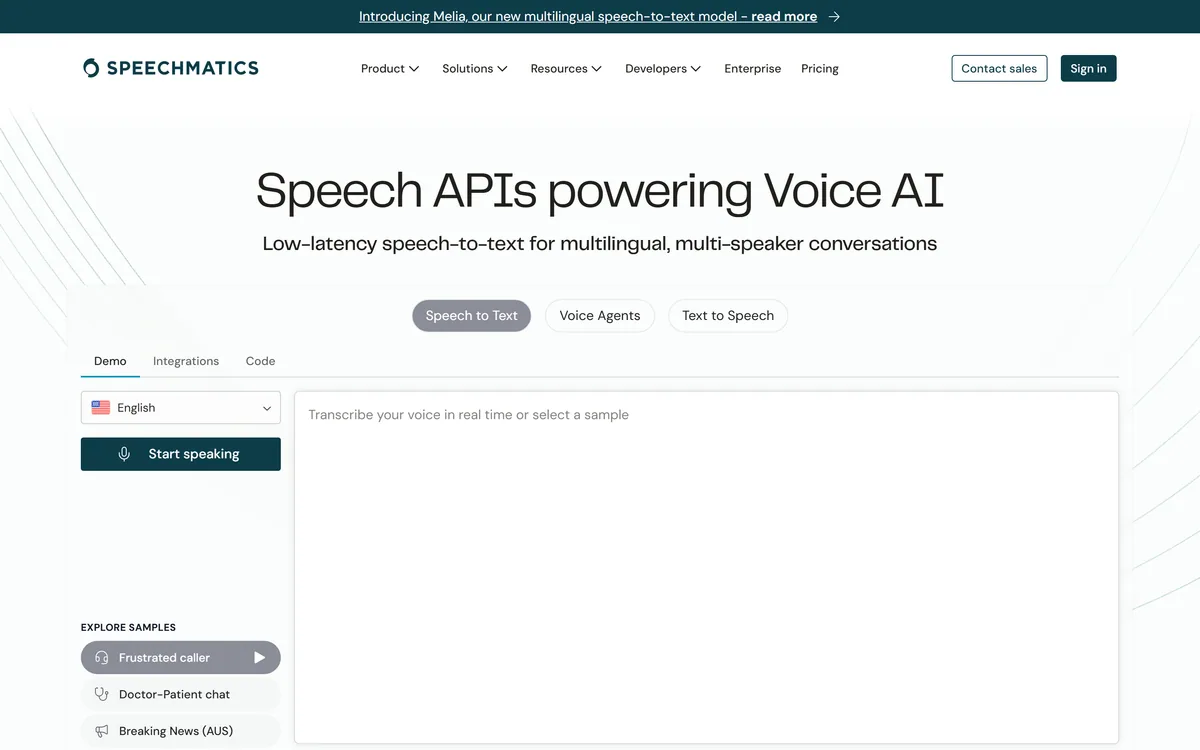
Last checked . Read from speechmatics.com during this check, with the screenshot above captured at the same time.
The 1.07% pooled word error rate and lowest-of-twelve placement are attributed on the site to independent Pipecat testing dated August 2026, benchmarked against services including Deepgram, AWS and Azure
Support for 55+ languages, speaker diarization and custom vocabulary
Code-switching described as handling speakers moving between languages mid-sentence
Deployment options given as on-device, on-premises and cloud, with data non-logging as standard
Certifications listed as ISO 27001:2022, GDPR, HIPAA and SOC 2 Type II
Named customers Adobe, LiveKit, Ubisoft and Stenograph
Sector use cases across healthcare, legal, media, contact centres and meeting platforms
Company, product, documentation and legal pages present in the site footer
No plan prices published here, in line with this site's pricing policy
The benchmark figure is reported by Speechmatics as coming from a third party; we have not read the Pipecat test ourselves. Commentary on how word error rate behaves across domains describes the metric generally rather than this engine specifically.
Editor's Verdict
4.6/5
Speechmatics has an AInexfinder Editor Score of 4.6/5.
Speechmatics pricing
AInexfinder does not list plan prices or billing details. For current pricing, plans, and trials, visit the official Speechmatics website.
Vendor pricing, credits, and billing policies change over time. Always confirm on the official site before you buy.
Frequently asked questions
Is the accuracy claim independent?
Speechmatics attributes it to Pipecat testing from August 2026 — a 1.07% pooled word error rate, lowest of twelve services benchmarked against names including Deepgram, AWS and Azure. Third-party attribution is unusual in this category, where most accuracy claims are self-reported.
Will it be that accurate on my audio?
Not necessarily. 'Pooled' means averaged across a test set, and word error rate moves substantially with domain — medical terms, product names, jargon and background noise all hurt. Run twenty minutes of your worst audio through it before believing any published figure.
What is code-switching and why does it matter?
A speaker changing language mid-sentence. It is ordinary conversation across much of the world, and single-language engines transcribe half of it as nonsense. If your users are outside a monolingual market, test this specifically — it is invisible in an English-only demo.
Can I run it without sending audio to the cloud?
Yes — on-device and on-premises deployment are both offered, with data non-logging as standard. For healthcare and legal work that is usually the deciding factor, because no accuracy figure overcomes a rule against sending the audio out.
Does it give me meeting summaries?
No. This is a transcription API, not a notes product. If you want summaries, action items and a searchable archive without building them, something like Otter fits better. Choosing an API when you wanted an app is the usual mistake here.
How do I stop it mangling our product names?
Custom vocabulary — supply the domain terms in advance. This matters more than the headline accuracy number, because the words a general model gets wrong most are exactly the ones specific to your business.
How does it compare with Deepgram?
Both are transcription APIs, and both appeared in the same Pipecat benchmark where Speechmatics placed first. The honest answer is to run your own worst audio through both free tiers and score the errors by importance rather than by count.
Daniel reviews AI tools the slow way — by actually using them on real projects. His reviews cover what works, what breaks, and who each tool is genuinely a good fit for.
Daniel and the AInexfinder editorial team research Speechmatics using public product information, listing evidence, and (when available) hands-on checks. Scores reflect listing completeness and transparency — not paid placement.
Listings may include affiliate or sponsored placements, which are labeled when present. Editorial scores and cons are not sold. See our affiliate disclosure and review methodology.
Rev has repositioned from transcription into an investigative intelligence platform for legal teams, combining AI evidence analysis with human-verified transcription guaranteed 99%+ accurate in 12 hours, plus court reporting, deposition summaries and a speech-to-text API.
Cockatoo transcribes audio and video across 100+ languages with a stated accuracy of up to 99.8%, exports to SRT, DOCX, PDF and TXT, imports from Dropbox and YouTube, and offers three free transcripts daily with no card required.
AssemblyAI sells voice AI infrastructure: production APIs for pre-recorded and real-time speech-to-text on its Universal models, a Speech Understanding API that turns transcripts into structured insight, a Voice Agent API over a single WebSocket, and guardrails including PII redaction and content moderation.
Deepgram provides speech-to-text and text-to-speech through its Flux models, plus a Voice Agent API that combines transcription, speech synthesis and LLM orchestration into a single interface. Everything runs in real time or batch, in the cloud or self-hosted, with text-to-speech latency stated as low as 80ms.
The workspace at www-flux3.com generates 5–20 second AI videos with native audio from text or a starting image, routing across FLUX 3, MiniMax H3, Seedance, Wan 3.0 and Kling 3.0 Pro, at 720p or 1080p with video extension.