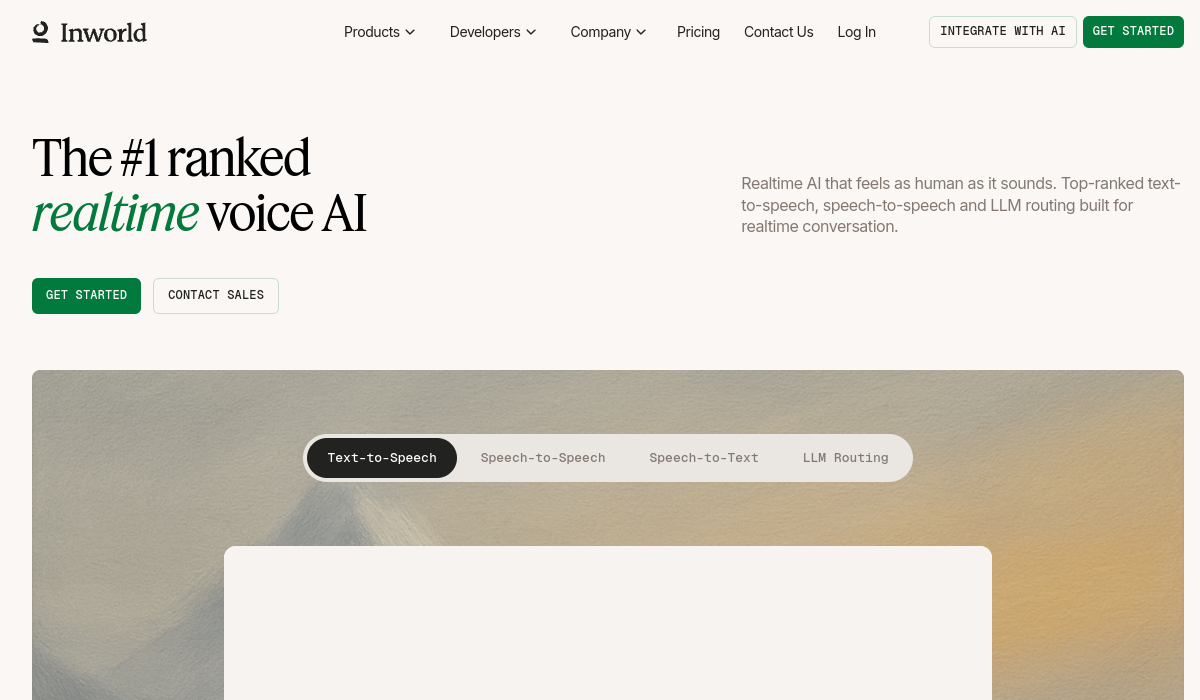
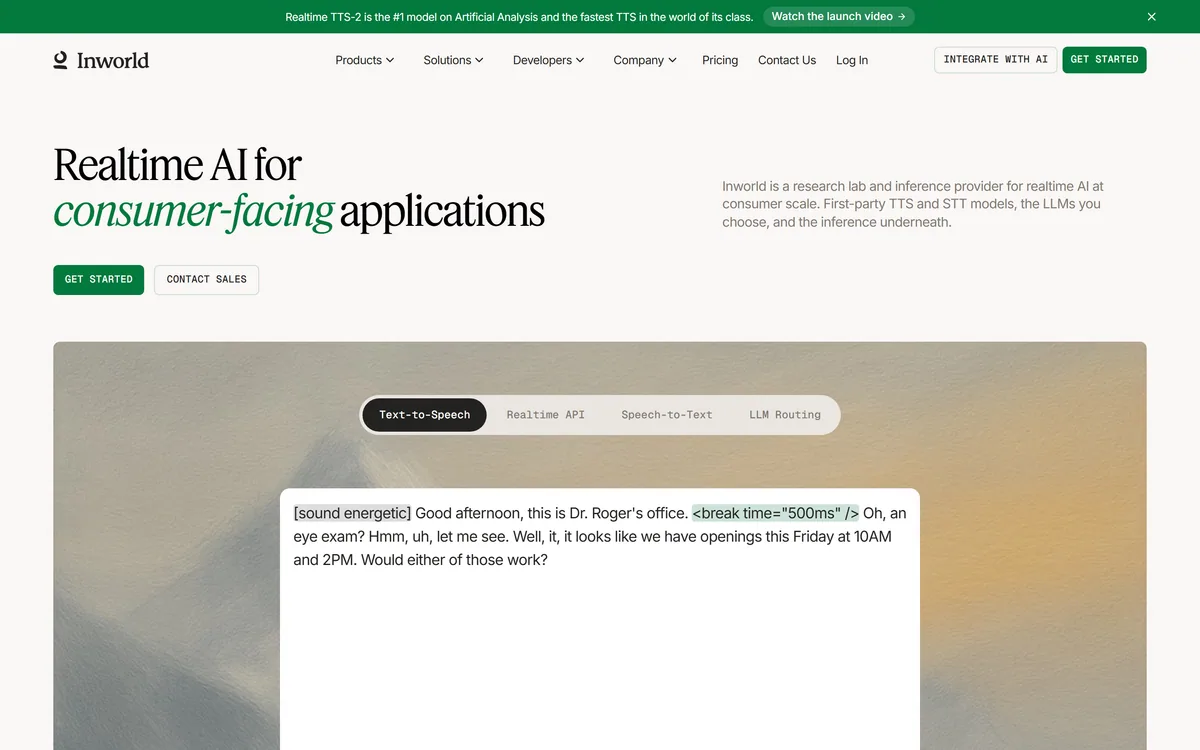
Inworld AI is a research lab and inference provider supplying realtime voice infrastructure. Its products cover text-to-speech, speech-to-text, a realtime API, its own inference, a router across 220+ language models, and compute — used to build voice agents, companions and interactive media.
inworld-tts-2 in research preview, and inworld-tts-2-flash for lowest latency
TTS language coverage
200+ languages, with cross-lingual voice identity
Stated TTS latency
100ms P90 time-to-first-byte for TTS-2; 20ms P90 for TTS-2 Flash, both server-side
STT models available
inworld-stt-1, plus Whisper large v3 via Groq, AssemblyAI Universal-3 and Soniox real-time models
Model router
220+ language models across third-party and first-party inference tracks
Named customers
Wishroll/Status, Bible Chat, Talkpal
Stated customer result
Wishroll/Status cited as reaching 1 million users in 19 days
Sectors served
Companions, social apps, games, customer support voice agents, sales agents, phone agents, language learning, interactive media
Enterprise deployment
VPC deployments available
Charging model
Usage-based; no prices published here
Voice Infrastructure, Summarised
Inworld AI is an inference provider selling realtime voice infrastructure — text-to-speech, speech-to-text, model routing and compute — as building blocks rather than as a finished product.
Latency is the headline claim: inworld-tts-2 at 100ms P90 time-to-first-byte, and the flash variant at 20ms, both measured server-side.
TTS covers 200+ languages with cross-lingual voice identity, so one voice can speak across languages.
A router gives access to 220+ language models, spanning external providers and Inworld's own inference, from one integration.
Charging is usage-based, with enterprise VPC deployment available — you pay for what you generate, not for seats.
Latency Terms That Decide Everything Here
Four terms you need in order to read any voice infrastructure claim properly.
Time to first byte
How long before the first audio arrives after a request. In voice, this matters far more than total generation time, because playback starts as soon as the stream does.
P90 and P99
The 90th and 99th percentile. P90 latency means one call in ten is slower than the stated figure — and the tail is what users actually notice in a long conversation.
Turn-taking
Detecting when a speaker has finished so the agent can respond. Getting this wrong makes an agent interrupt or leave dead air, both of which read as broken.
Cross-lingual voice identity
The same synthetic voice speaking different languages while remaining recognisably the same person. Hard, and valuable for multilingual products.
From Game Characters To Voice Plumbing
Inworld built its early reputation on AI characters for games — non-player characters you could actually talk to, with personalities, memories and goals. That was the story, and it attracted a great deal of coverage in games media.
The company now describes itself as a research lab and inference provider, and its product list is infrastructure: TTS, STT, an API, inference, a router, compute. No game engine integrations appear in the current material.
That is a significant change and it is worth understanding rather than glossing. The character-platform pitch asked developers to build inside someone else's framework. The infrastructure pitch sells components that go into whatever you are already building.
The strategic logic is sound. A character platform competes with every game studio's own preference for building its own systems, and it is a narrow market. Realtime voice infrastructure serves companions, support agents, phone systems, language learning and games alike — a much larger surface with a clearer buyer.
It also plays to what was genuinely hard about the original problem. Making a character feel alive was always mostly a latency problem, and latency engineering transfers to every voice application.
The practical implication: if you arrived here from an article about AI NPCs, evaluate this as a voice infrastructure vendor. The building blocks are there; the framework around them is now yours to write.
Making a game character feel alive was always a latency problem wearing a costume. Selling the latency directly reaches a far bigger market.
Why 20 Milliseconds Is The Whole Product
The latency figures are the centre of the offering and they deserve to be understood rather than admired.
Human conversation runs on roughly 200 milliseconds between turns. That gap is remarkably consistent across languages and cultures, and we are exquisitely sensitive to deviation from it. A pause noticeably longer than that reads as hesitation, confusion, or a bad line — before a single word arrives.
That 200ms is the entire budget for a voice agent, and it has to cover everything: detecting that the user stopped speaking, transcribing, sending to a language model, generating a response, synthesising speech, and network round trips in both directions.
Voice quality itself is largely solved — ElevenLabs settled that argument years ago. Time-to-first-byte for speech synthesis is one slice of that budget. At 20ms P90, the flash model consumes a tenth of it, which leaves genuine room for the model call — which is where the unavoidable time actually goes.
That is why an infrastructure company optimising this specific number matters. Every millisecond saved in synthesis is a millisecond available for thinking, and thinking is what makes the answer good.
Two caveats on reading these numbers honestly. They are server-side, so your users' network latency sits on top and can dwarf them. And P90 means one call in ten is slower — in a conversation of thirty turns, that is three noticeable pauses. Ask about P99 if you are building something that must feel consistently natural.
The Router Is A Bet Against Model Lock-In
Realtime Router — access to 220+ models across third-party providers and Inworld's own inference — is the most strategically interesting product in the set.
The premise is that model choice should not be an architectural commitment. Models are released constantly, prices move, and the best option for a given task changes on a timescale much shorter than the life of an application.
Routing through one integration means switching is a configuration change rather than a rewrite. It also enables the pattern that actually saves money in production: sending routine turns to a cheap fast model and difficult ones to an expensive capable one, rather than paying frontier rates for every hello.
The first-party and third-party split is worth noticing. Offering both its own inference and external providers means Inworld is positioning as a neutral layer rather than only selling its own capacity — which is more credible than it would be otherwise.
The dependency to think about is the ordinary one for any abstraction layer: you are adding a hop between your application and the model provider, which introduces both a latency cost and a point of failure. In a product where latency is the selling point, that trade-off deserves measuring rather than assuming.
A specialist recogniser like Speechmatics is the alternative if transcription is your only need. Offering established third-party STT models alongside its own — Whisper via Groq, AssemblyAI, Soniox — follows the same neutral-layer logic and is a reasonable signal of confidence.
Measure end-to-end latency from a real user's network, not server-side figures.
Ask for P99 as well as P90 — the tail is what users remember from a conversation.
Test the router's added hop against calling a provider directly, and quantify the difference.
Try cross-lingual voice identity on your actual target languages before believing the count.
Run a full thirty-turn conversation rather than judging on single utterances.
Metered By Usage
This site does not publish plan prices. Inworld's structure is usage-based, which is the correct model for infrastructure and has consequences worth planning for.
You pay for what you generate — audio synthesised, audio transcribed, tokens routed — rather than for seats or a subscription. That means cost scales directly with success, which is either reassuring or alarming depending on your product.
The specific risk in voice applications is that usage is not proportional to value. A companion app user who talks for three hours generates the same synthesis cost whether they subscribed or are on a free tier. Consumer voice products can be structurally difficult to make profitable for exactly this reason, and modelling cost per active user is more important here than in most categories.
Two things worth establishing early. First, whether the flash and standard TTS models are priced differently, since the latency premium usually is. Second, how the router prices — whether there is a margin over the underlying provider's rate, and whether first-party inference is cheaper than routing out.
VPC deployment is offered for enterprise, which changes the economics and the data posture together. For anyone in a regulated environment, or handling voice data with residency requirements, that is the conversation to start with rather than the public API.
One point specific to voice: recorded speech is biometric data under several privacy regimes, and the obligations that attach to it are stricter than for text. Settle where audio is processed and how long it is retained before you build on any voice API.
The Boundary Of What You Are Buying
Being clear about the boundary saves the wrong buyer a wasted week.
A deployed agent such as Phonely is what a finished product looks like at this layer. It is not a finished product. There is no interface to log into and configure an agent. These are APIs and models, and you need engineers to assemble them into something. If you want a working phone agent rather than the parts of one, this is the wrong layer.
It is not a game character platform any more, whatever the historical coverage says. No engine integrations appear in the current material, and building an NPC on this means writing the character logic yourself on top of the voice layer.
It is not the reasoning. The router gives access to models; the quality of what your agent actually says is a function of the model you choose and the prompting you write, not of the infrastructure.
What it genuinely is: a specialised, latency-obsessed voice layer for people building conversational products, with the neutrality to avoid tying you to one model provider. For that buyer it is a strong offering, and the named customers — a companion app, a religious chat product, a language learning tool — fit that shape precisely.
APIs and models, not an interface you configure an agent in
No game engine integrations in the current product set
Voice quality and latency, not the reasoning your agent performs
Requires engineering to become anything a user can touch
Best suited to teams already building a conversational product
Key features of Inworld AI
Realtime text-to-speech with 200+ language coverage
Cross-lingual voice identity across languages
Low-latency flash TTS variant
Realtime speech-to-text with first-party and third-party model options
You are building a conversational voice product and have engineers to do it
Latency is a product requirement rather than a nice-to-have
You want to avoid committing architecturally to one model provider
You need many languages with a consistent voice identity across them
Enterprise VPC deployment and data residency are requirements
Overbuilt For You If
You want a working voice agent rather than the components of one
You arrived looking for game NPC tooling, which is not the current product
You need voiceover for video, where a finished product is far quicker
You have no engineering capacity to assemble infrastructure
Your usage economics cannot absorb cost that scales with conversation length
Other Layers Of The Voice Stack
Voice products are assembled from several of these, and knowing which layer you need is most of the decision.
ElevenLabs — the voice quality benchmark, with products as well as an API
Phonely AI — a finished phone agent if you do not want to build one
Speechmatics — specialist speech recognition across accents and languages
Murf — voiceover as a product rather than as infrastructure
ACE Studio — the singing end of voice synthesis, an entirely different problem
Product And Latency Claims Checked
Last checked . Read from inworld.ai during this check, with the screenshot above captured at the same time.
Company described on site as a research lab and inference provider delivering realtime AI infrastructure
Six products named: Realtime TTS, Realtime STT, Realtime API, Realtime Inference, Realtime Router and Compute
TTS models named as inworld-tts-2, in research preview, and inworld-tts-2-flash
TTS language coverage stated as 200+ with cross-lingual voice identity
Latency stated as 100ms P90 time-to-first-byte for TTS-2 and 20ms P90 for TTS-2 Flash, both server-side
STT options listed including inworld-stt-1, Whisper large v3 via Groq, AssemblyAI Universal-3 models and a Soniox real-time model
Router stated as providing access to 220+ language models across third-party and first-party tracks
Named customers on site: Wishroll/Status, Bible Chat and Talkpal, with Wishroll/Status cited as reaching 1 million users in 19 days
Sectors listed including companions, social apps, games, customer support, sales, phone agents, language learning and interactive media
Enterprise VPC deployments referenced
Charging described as usage-based with rates on the vendor's pricing page; no prices published here, in line with this site's pricing policy
No game engine integrations appear in the current product material, and funding and headquarters were not stated on the pages reviewed
Latency figures are the vendor's own, measured server-side, so end-user network latency sits on top of them. P90 means one request in ten is slower than the stated figure — ask for P99 before designing around these numbers. Recorded speech is treated as biometric data under several privacy regimes, with stricter obligations than text, so settle processing location and retention before building on any voice API.
Editor's Verdict
4.3/5
Inworld AI has an AInexfinder Editor Score of 4.3/5.
Inworld AI pricing
AInexfinder does not list plan prices or billing details. For current pricing, plans, and trials, visit the official Inworld AI website.
Vendor pricing, credits, and billing policies change over time. Always confirm on the official site before you buy.
Frequently asked questions
What does Inworld AI do now?
It supplies realtime voice infrastructure — text-to-speech, speech-to-text, a realtime API, its own inference, a router across 220+ models, and compute. It describes itself as a research lab and inference provider rather than a finished-product company.
Is Inworld AI still for game characters?
Not in its current product set. Inworld was known for AI NPCs, and no game engine integrations appear in the present material. Games are still listed as a served sector, but you would be building the character logic yourself on top of the voice layer.
How fast is Inworld's text-to-speech?
The vendor states 100ms P90 time-to-first-byte for TTS-2 and 20ms for the flash variant, measured server-side. Your users' network latency sits on top of those figures, and P90 means one request in ten is slower.
Why does latency matter so much for voice AI?
Human conversation leaves roughly 200 milliseconds between turns and we are highly sensitive to deviation. That 200ms is the entire budget for transcription, model call, synthesis and network — so every millisecond saved in synthesis is one available for thinking.
How does Inworld AI charge?
Usage-based — you pay for audio synthesised, audio transcribed and tokens routed, rather than for seats. Model cost per active user is worth modelling carefully, because voice usage is not proportional to what a user pays you.
What is a model router and why would I want one?
It gives access to many models through one integration, so switching is a configuration change rather than a rewrite. It also lets you send routine turns to a cheap fast model and hard ones to an expensive model, which is what actually controls cost in production.
Is voice data subject to special privacy rules?
Often, yes. Recorded speech is treated as biometric data under several privacy regimes, with stricter obligations than text. Establish where audio is processed and how long it is retained before building on any voice API, and take your own advice for your jurisdiction.
Daniel reviews AI tools the slow way — by actually using them on real projects. His reviews cover what works, what breaks, and who each tool is genuinely a good fit for.
Daniel and the AInexfinder editorial team research Inworld AI using public product information, listing evidence, and (when available) hands-on checks. Scores reflect listing completeness and transparency — not paid placement.
Listings may include affiliate or sponsored placements, which are labeled when present. Editorial scores and cons are not sold. See our affiliate disclosure and review methodology.
Layer AI is a creative platform for teams that learns your brand and style, then generates image, video, 3D and audio across 300+ models with an agent, LoRA training and editing, plus IP-safety, auditability and enterprise controls.
Seele AI's SeeleAgent is a game-focused multimodal AI agent that generates game prototypes, 2D and 3D, alongside images, video, 3D assets and code from prompts, using a skills library and Seele's own multimodal and world models. It is an early, ambitious tool best treated as a prototyping aid.
Friends & Fables runs tabletop roleplaying campaigns with an AI game master called Franz, combining world building tools, tactical turn-based combat on the 5.1 System Reference Document, maps, image generation, narration and multiplayer parties of up to six across desktop, tablet and mobile.
Promethean AI is a world-building assistant for digital art teams that indexes a studio's existing assets as metadata without moving or storing the files, sits on top of Unreal and other 3D editors rather than replacing them, and states over 10,000 users including PlayStation Studios.
Rodin (Hyper3D) is an AI 3D model generator that turns text prompts or a single image into detailed 3D assets, with 21 styles, generation controls, plugins for Blender, Unity and Unreal, an API and MCP, aimed at game, print, product and avatar creators.
Skybox AI by Blockade Labs generates 360-degree equirectangular panoramas and skyboxes with stated generation times as fast as 15 seconds, 32-bit HDRI export for scene lighting, a Unity plugin, MCP support and direct export to Blender and Unreal.