Promethean AI is a world-building assistant for digital art teams that indexes a studio's existing assets as metadata without moving or storing the files, sits on top of Unreal and other 3D editors rather than replacing them, and states over 10,000 users including PlayStation Studios.
prometheanai.com7 viewsAdded March 2, 20264K visitors
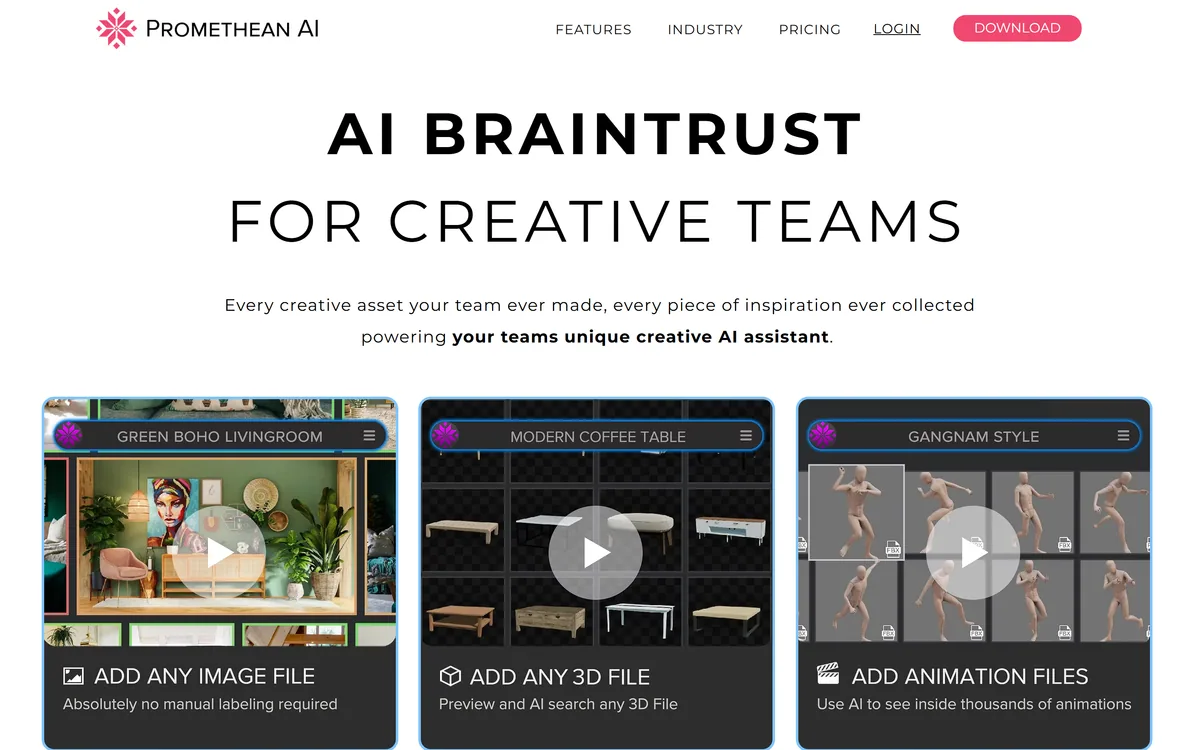
Promethean AI's homepage, captured 9 September 2026, showing its AI braintrust positioning.
Promethean AI: An Assistant For World Builders
The framing is unusual for this category: an AI braintrust for creative teams, built from every creative asset your team ever made and every piece of inspiration ever collected.
Braintrust is the operative word, and it describes something quite different from a generator.
A generative image tool produces something new from a prompt. What Promethean describes is an engine that understands your existing assets — images, videos, 3D models, animations, PDFs, presentations — reasons about them, and configures them in novel combinations when you ask in natural language.
The distinction matters enormously to a professional studio. A game or film production does not need more images; it has thousands already, scattered across drives, named inconsistently, and known only to whoever made them.
The stated problem is put plainly: over two decades digital art production has become a hundred times more complex, and the product manufactures time by handling the mundane so teams can focus on beauty and story. Dressing a room with the right existing props is mundane work that consumes days, and it is exactly the kind of task where retrieval beats generation.
Whether the complexity multiple or the tenfold speed claim is precise matters less than the direction, which anyone who has assembled an environment will recognise.
A studio does not need more images. It has thousands already — on scattered drives, inconsistently named, and known only to whoever made them.
Learning A Studio's Own Taste
The suggested starting point is instructive: put reference and inspiration files into Inspiration mode and consult it for design questions, then drag a folder of 3D assets into Source File mode and sync it.
Syncing means the library updates whenever anyone changes that folder, which is what makes the index survive contact with a real production.
The second half of the idea is the more interesting one. A studio's aesthetic is not written down anywhere. It lives in accumulated decisions — which references got pinned, which props kept being chosen, how a lead art director resolved the same question forty times.
New hires absorb it over months by asking colleagues and getting things sent back. Nothing captures it, and when a senior artist leaves, a genuine amount of it leaves too.
An engine that has indexed every asset and every reference the team collected is, in effect, a queryable version of that institutional memory. That is a real proposition rather than a marketing one, and it explains why the pitch is aimed at teams rather than individuals — a solo artist already holds their own taste in their head. Character and behaviour systems like Inworld AI address a different layer of the same production, and the two do not overlap.
What Does Never Uploading Your Assets Mean?
Two claims sit on the homepage as headline commitments: no uploading your assets required, and no changing your editor required. The FAQ is more specific, stating the team is never exposed to asset files, does not upload, store or train on them in any way, and that privacy is built into its technical DNA.
The architecture behind that is described directly: Promethean keeps assets exactly where they are and creates a metadata library around them.
This is the most consequential design decision in the product, and it solves three separate problems at once.
The first is legal. A studio under NDA on an unannounced title frequently cannot send asset files to a third party at all, and no feature set overcomes that. A tool that never receives the files is approvable where an uploading one is not.
The second is practical. Production asset libraries are measured in terabytes, and uploading them is a project in itself. The third is trust: not training on customer assets removes the fear that this year's work becomes next year's competitor capability.
Sharing follows the same logic — the metadata library travels via a shared folder, or a MySQL server or S3 storage for a more professional setup, with the vendor stating it is never exposed to either the assets or the metadata. Optional managed storage is offered on request, which is the honest way to present the exception.
Confirm the metadata-only architecture with your own legal team.
Check your editor version against the published plugin support.
Index inspiration first — it is the cheapest way to test the retrieval.
Point the sync at a folder that changes, not an archive.
Plan where the metadata library lives before a second person needs it.
Built By An Artist, For Artists
The FAQ answers the question this category usually avoids — whether it is taking artists' jobs — with specifics rather than reassurance.
It states the company was founded by a veteran game artist and former art director at a major studio, with more than a decade spent empowering and educating artists, and that it was the technical advisor for artists in the class action brought against the largest text-to-image companies.
Whatever one's view of that litigation, advising the artist side of it is a costly and legible position for a company selling AI tools to take. It is not a claim that can be quietly adopted for marketing purposes.
The product design follows the same line. The FAQ states the tools require artist input and touch at every step, and describes itself as not for prompt artists but for professional artists who want the best of AI without feeling taken advantage of.
That is a coherent stance rather than a hedge, and it is reflected in what the tool actually does: it retrieves, arranges and configures work artists already made, instead of generating replacements for it. Studios evaluating this alongside general asset generators such as PixelLab are choosing between two genuinely different philosophies, not two feature sets.
Fitting Into A Pipeline You Already Have
The integration promise is that you do not have to change your pipeline: the product is built to meet artists where they are, going on top of every part of the workflow rather than replacing any of it.
The supported surface is stated precisely enough to plan around, which is more than most vendors offer.
The primary integration is Unreal Engine, with open source plugins provided for Unreal, Unity, 3ds Max, Maya and Blender — and an explicit caveat that not all versions of the other editors have been tested and may not be compatible, with plugin code downloadable and customisable if yours is unsupported.
Publishing that caveat is the right call. Pipeline software that overstates compatibility costs a technical artist a fortnight discovering the truth, and a studio's tolerance for that is low.
The enterprise story is consistent: data security, SSO, an API and workflow customisation, with proprietary pipelines accommodated through a bit of Python. Extendable and tech-art friendly is the correct description, and it also tells you who this needs — a studio with a technical artist. Adoption is stated as over 10,000 users including PlayStation Studios, with support from the Disney Accelerator, which are checkable affiliations rather than anonymous logos. Studios that need animation rather than arrangement look to tools like Krikey AI, which generate instead of retrieving.
Adding AI To A Studio Workflow
The way this fails is by being introduced as a mandate rather than as a tool artists choose to keep.
This order gets it adopted rather than resented.
Have legal confirm the metadata-only architecture before anything is installed.
Check your exact editor versions against the published plugin support.
Index inspiration and reference material first, and query it before syncing assets.
Sync one live project folder rather than the whole archive.
Let one artist use it on real work for a fortnight and report back honestly.
Decide where the shared metadata library lives before the team scales onto it.
Promethean AI: What It Builds
A metadata library, not a cloud upload — assets stay where they are and are never sent to the vendor.
No editor change required; it sits on top of the pipeline you already run.
Retrieval and arrangement of your own work rather than generation of new images.
Artist-founded, and stated as technical advisor for artists in the text-to-image class action.
10,000-plus users including PlayStation Studios, with Disney Accelerator support.
Key features of Promethean AI
Natural language querying of a studio's own asset library
Metadata indexing that leaves files in place
Inspiration mode for reference and design questions
Source File mode with folder syncing
Reasoning across images, video, 3D models, animation, PDFs and presentations
Open source plugins for major 3D editors
Enterprise SSO, API and Python workflow customisation
Shared metadata libraries over folder, MySQL or S3
Pros & cons
Pros
7
Assets are never uploaded, stored or trained on, which makes NDA work approvable
Layers onto an existing pipeline instead of demanding migration
Retrieval of owned work sidesteps the provenance questions generation raises
The artist-first position is backed by a costly and checkable action
Plugin compatibility limits are published rather than glossed over
Plugin source is open, so unsupported versions can be adapted
Captures institutional taste that otherwise leaves when senior artists do
Cons
7
The tenfold and hundredfold claims carry no source
Only Unreal is a primary integration; other editors carry version caveats
Deployment realistically needs a technical artist
Value scales with library size, so small teams gain little
It arranges existing assets rather than producing new ones
The footer copyright reads two years behind our capture date
Managed asset storage exists as an exception and must be requested directly
Best For
Game studios with large accumulated asset libraries
Film and animation teams under strict NDA conditions
Last checked . Read from prometheanai.com in a browser session on the date above, with the screenshot captured at the same time.
Positioned as an AI braintrust for creative teams, built from their own assets and inspiration
Headline commitments of no uploading assets required and no changing your editor required
FAQ stating the team is never exposed to asset files and does not upload, store or train on them
Architecture described as keeping assets in place and creating a metadata library around them
Sharing described via shared folder, MySQL server or S3 storage, with optional managed storage on request
Founder described as a veteran game artist and former studio art director
Stated as technical advisor for artists in the class action brought against major text-to-image companies
Tools described as requiring artist input at every step, and as not being for prompt artists
Primary integration stated as Unreal Engine, with open source plugins for Unity, 3ds Max, Maya and Blender
An explicit caveat that not all versions of other editors have been tested or may be compatible
Enterprise features listed as data security, SSO, API and Python-based workflow customisation
Adoption stated as over 10,000 users including PlayStation Studios, with Disney Accelerator support; footer copyright shown as 2024
What we could not confirm: how the 10,000-user figure is counted; the basis for the tenfold speed and hundredfold complexity claims, which carry no source; which editor versions are actually tested; what the PlayStation Studios and Disney Accelerator relationships involve in practice; and pricing. The footer copyright reads 2024, which we noted but cannot interpret. We did not install a plugin or index a library.
Editor's Verdict
4.3/5
Promethean AI is the rare creative AI product whose commercial design and stated ethics point the same direction. It never takes possession of your art — it builds a metadata layer around files that stay where they are — which is simultaneously a privacy position, an intellectual property position and the reason a studio's legal team can approve it. Its founder's background and its stated role advising artists in the class action against text-to-image companies give the artist-first framing more substance than a slogan. The footer copyright still reads 2024, which is worth noticing when assessing momentum. AInexfinder Editor Score: 4.3/5.
Promethean AI pricing
AInexfinder does not list plan prices or billing details. For current pricing, plans, and trials, visit the official Promethean AI website.
Vendor pricing, credits, and billing policies change over time. Always confirm on the official site before you buy.
Frequently asked questions
What is Promethean AI?
An engine that indexes a team's creative assets — images, video, 3D models, animation, documents — reasons about them, and configures them in new combinations on request. It retrieves and arranges rather than generating.
Do I have to upload my assets?
No. The FAQ states files are never uploaded, stored or trained on, and that the team is never exposed to them. A metadata library is built around assets that stay in your own storage.
Why does that architecture matter?
It solves three problems at once: studios under NDA often cannot send files anywhere, production libraries are too large to upload practically, and not training on customer work removes the fear of it becoming someone else's capability.
Do I have to change my 3D editor?
No. It is described as sitting on top of every part of an existing workflow. Unreal Engine is the primary integration, with open source plugins for Unity, 3ds Max, Maya and Blender.
Will every version of my editor work?
Not necessarily, and the site says so. It states that not all versions of the other editors have been tested and may not be compatible, with plugin code available to customise if yours is unsupported.
Is it taking artists' jobs?
The company addresses this directly, citing an artist founder and a former studio art director role, and stating it acted as technical advisor for artists in the class action brought against major text-to-image companies.
What does braintrust mean here?
A queryable version of institutional taste. A studio's aesthetic lives in accumulated decisions nobody wrote down, and an index of every asset and reference the team collected makes that memory searchable.
How do teams share a library?
Through a shared folder, or a MySQL server or S3 storage for a more professional setup. The vendor states it is never exposed to the assets or the metadata library itself.
What is the easiest way to start?
Add reference and inspiration files to Inspiration mode and query them, then drag a folder of 3D assets into Source File mode and sync it so the library updates as the folder changes.
Who is it not for?
A solo artist who already knows every asset they own gains little, and any team without a technical artist to handle plugin deployment should account for that before committing.
Daniel reviews AI tools the slow way — by actually using them on real projects. His reviews cover what works, what breaks, and who each tool is genuinely a good fit for.
Daniel and the AInexfinder editorial team research Promethean AI using public product information, listing evidence, and (when available) hands-on checks. Scores reflect listing completeness and transparency — not paid placement.
Listings may include affiliate or sponsored placements, which are labeled when present. Editorial scores and cons are not sold. See our affiliate disclosure and review methodology.
Layer AI is a creative platform for teams that learns your brand and style, then generates image, video, 3D and audio across 300+ models with an agent, LoRA training and editing, plus IP-safety, auditability and enterprise controls.
Inworld AI is a research lab and inference provider supplying realtime voice infrastructure. Its products cover text-to-speech, speech-to-text, a realtime API, its own inference, a router across 220+ language models, and compute — used to build voice agents, companions and interactive media.
Friends & Fables runs tabletop roleplaying campaigns with an AI game master called Franz, combining world building tools, tactical turn-based combat on the 5.1 System Reference Document, maps, image generation, narration and multiplayer parties of up to six across desktop, tablet and mobile.
Seele AI's SeeleAgent is a game-focused multimodal AI agent that generates game prototypes, 2D and 3D, alongside images, video, 3D assets and code from prompts, using a skills library and Seele's own multimodal and world models. It is an early, ambitious tool best treated as a prototyping aid.
Rodin (Hyper3D) is an AI 3D model generator that turns text prompts or a single image into detailed 3D assets, with 21 styles, generation controls, plugins for Blender, Unity and Unreal, an API and MCP, aimed at game, print, product and avatar creators.