PixelLab generates pixel art game assets including character animations, 4 and 8 directional rotations, tilesets, environments and UI elements. It offers skeleton-based animation, true inpainting that understands the original image, and states it does not store generated or input images.
The reason most indie games are never finished is not code. It is art — specifically the realisation that a playable game needs a character in eight directions, walking, running, attacking and idle, plus enemies, tiles, items and interface elements.
Pixel art looks like the affordable option and is not. Every pixel is a deliberate choice, consistency across hundreds of sprites is exacting, and animation multiplies everything by the number of frames.
PixelLab addresses that specific bottleneck, and the thing that makes it credible is which problems it chose to solve.
PixelLab: Pixel Art Assets For Games
Built for what games need — rotations, animations, tilesets and UI, not just individual sprites.
4 and 8 directional views from a single character, with isometric support.
Skeleton-based animation alongside text prompts and an automatic character creator.
True inpainting that sees and understands your original image while editing, so style matches.
It states it stores no images, generated or input, and runs on cloud GPUs so you need no graphics card.
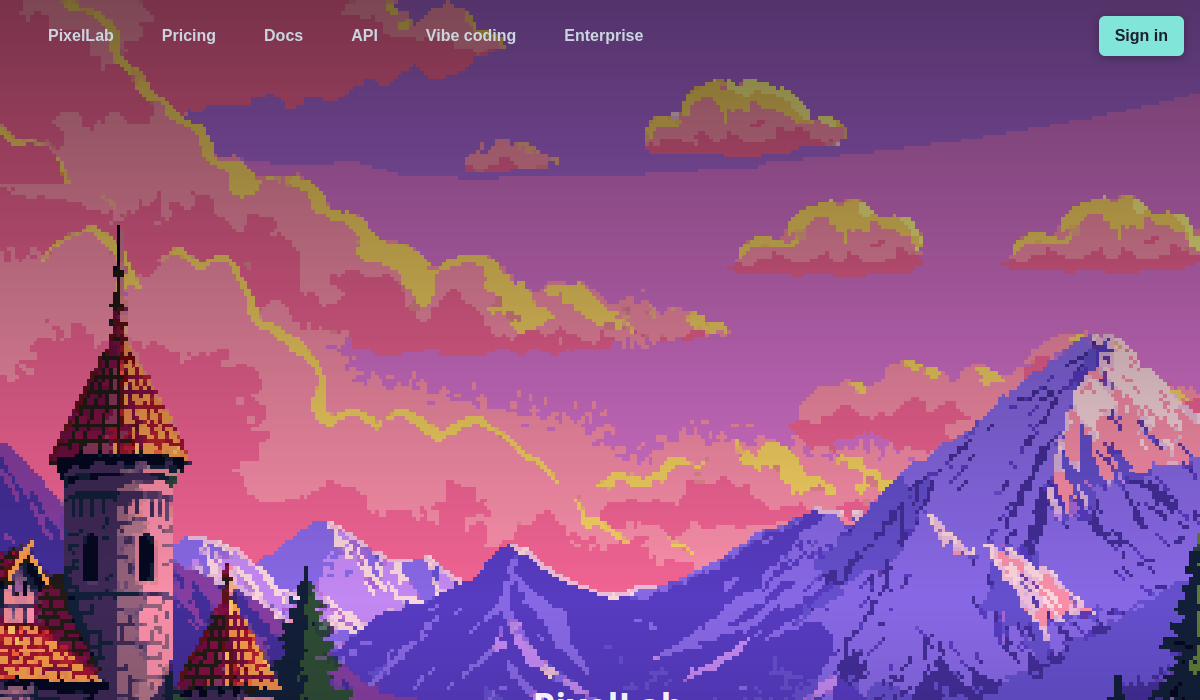
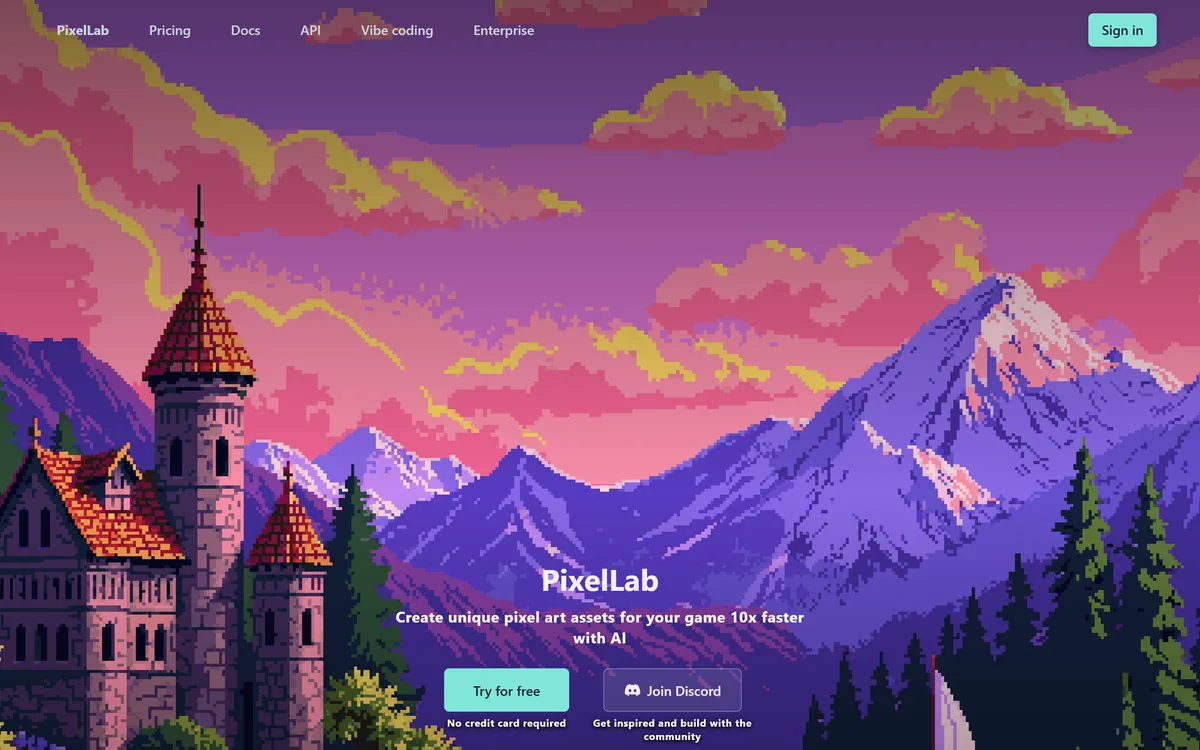
PixelLab's homepage, captured 9 September 2026, showing the pixel art game asset tools.
Why Is Pixel Art Harder To Generate Than It Looks?
PixelLab positions itself as creating unique pixel art assets 10x faster with AI, for indie game developers.
The technical difficulty here is counterintuitive, because pixel art seems simple compared with photorealism.
The problem is precision at low resolution. A 32-pixel-tall character has no room for error — every pixel carries meaning, an anti-aliased edge that would be invisible at high resolution ruins the aesthetic entirely, and the constraint is the art form rather than a limitation of it.
General image models are trained to produce smooth, detailed output and then downscaled, which produces something that resembles pixel art without obeying its rules: inconsistent pixel grids, unintended colours, and edges that are almost but not quite aligned.
Getting it right requires generating in the constraint rather than reducing to it, which is why a dedicated tool exists at all. It is the same reason format-specific generators outperform general ones elsewhere — a specialist can make assumptions, as tools like BeatViz do in a completely different medium.
A 32-pixel-tall character has no room for error. The constraint is the art form, not a limitation of it.
Rotations, Skeletons And True Inpainting
Three capabilities do most of the practical work here, and each addresses something a game specifically requires.
Rotations — 4 and 8 directional views with isometric support — solve the requirement that kills side projects. A character that only faces one way is not a game character, and drawing the same figure convincingly from eight angles is genuinely skilled work.
Skeleton-based animation is the more sophisticated inclusion. Text-prompted animation is fine for simple motion; a skeleton gives you actual control over poses, which is how animation has always been directed.
True inpainting is described as seeing and understanding your original image while making edits, unlike other models. That matters because the usual failure of generative editing on pixel art is that the edited region does not match the surrounding style — different palette, different pixel density, visibly patched.
Together they cover generation, variation and correction, which is the full loop. A tool that generates well but cannot edit what it produced leaves you regenerating until something is acceptable, which is slower than it sounds.
Style Consistency Across A Whole Game
PixelLab states its tools adapt to your reference images to maintain visual consistency across all your sprites, creating characters and objects that match your game's style.
Consistency is the actual problem in game art and it is chronically underestimated by people who have not shipped a game.
A single beautiful sprite is easy. Two hundred sprites that look like they belong in the same world — same palette discipline, same outline treatment, same light direction, same level of detail — is the hard part, and it is what separates a game that looks made from one that looks assembled.
Reference-driven generation is the right mechanism because style is far easier to demonstrate than to describe. Nobody can articulate their palette rules; everybody can supply four sprites that follow them.
The realistic caveat is that consistency degrades across many generations, and drift is gradual enough to miss. Reviewing the whole set together periodically rather than judging each sprite as it arrives is the discipline that keeps a project coherent.
Establish your style with reference sprites before generating at volume.
Review the whole set together periodically — drift is invisible one sprite at a time.
Use skeletons for anything where pose matters, prompts for simple motion.
Generate rotations early, since a one-directional character is not a game character.
Check the licence for commercial release before building a game on the assets.
Storage Policy And Cloud GPUs
PixelLab's FAQ states that it does not store any images generated or used as input for generation, unless clearly stated otherwise in the tool or documentation, and that it runs on cloud GPUs so you do not need a strong graphics card yourself.
The storage statement is unusual and worth crediting, because most generation services retain output by default and say so only in terms nobody reads.
For game developers this matters more than it might elsewhere. Unreleased character designs and art direction are commercially sensitive, and a studio would reasonably hesitate before uploading them to a service that keeps them.
The cloud GPU point is the practical counterpart. Running generation models locally requires hardware many indie developers do not have, and moving that to a server removes a real barrier — at the cost of needing connectivity and of your images travelling, which the storage policy is designed to address.
The caveat in the wording is worth noting honestly: unless clearly stated otherwise in the tool or documentation. That is a sensible carve-out for features that require retention, and it means the policy is a default rather than an absolute.
What Generated Assets Cannot Give A Game
Removing the art bottleneck does not remove the reasons games fail, and it is worth being clear about that.
Art direction is the first thing generation cannot supply. A coherent visual identity is a set of decisions about what the game looks like and why, and reference-driven generation reproduces a style rather than deciding one.
Animation feel is the second. Game animation communicates weight and responsiveness through frame timing, and a technically correct walk cycle that feels wrong is a common and hard-to-diagnose problem.
Integration is the third and most practical. Sprite sheets have to match your engine's expectations for dimensions, pivot points, padding and naming, and assets that need reformatting before import erode the time saved.
And it cannot make the game good. Art is the most visible constraint and rarely the binding one — the same reason a code generator like Lovable makes scaffolding free without making the product worth using.
The comparison with 3D asset generation is instructive. Tools like Krikey AI remove rigging for 3D characters, which is the same bottleneck in a different dimension — and both face the same limit, that removing the production barrier does not supply the direction.
Building A Sprite Set With PixelLab
The way generated game art goes wrong is a folder of five hundred sprites that do not belong to the same game.
This sequence establishes the style first and treats consistency as the thing being managed.
Define the style with four or five reference sprites before generating anything else.
Generate one full character in all directions and check it holds together.
Build the animation set for that character before starting a second one.
Import into your engine early, so dimension and pivot problems surface now.
Review the whole sprite set together every few sessions to catch drift.
Confirm commercial licensing before the game has any assets you cannot replace.
PixelLab: Tools And Storage Policy
Product type
AI pixel art generator for game assets
Positioning
Create unique pixel art assets for your game 10x faster with AI
Users
3,000+ indie game developers stated
Animation
One-click animations, skeleton-based animation, animate with text
Rotation
4 and 8 directional views, with isometric support
Editing
True inpainting that sees and understands the original image
Style
Style-consistent generation adapting to your reference images
Environments
Scene generation, textures and tilesets
UI elements
Menu items, buttons and health bars
Infrastructure
Cloud GPUs, so no local graphics card required
Storage
States it does not store generated or input images, unless clearly stated otherwise in the tool or documentation
Access
Free trial with no credit card, plus docs, an API, vibe coding and enterprise pages
What we could not confirm: pricing and how generation is metered; the commercial licensing terms for generated assets, which is the question that decides whether a game can ship with them; which models underlie generation; what output formats and sprite sheet layouts are supported, which determines engine compatibility; how consistent style remains across hundreds of generations; and what the enterprise tier adds. We did not generate any assets.
Is PixelLab Right For Your Game?
Generate sprites when
Art is the bottleneck stopping your game from being playable.
You need a character in four or eight directions and cannot draw one.
Consistency across many sprites is beyond what you can maintain by hand.
You need tilesets and UI elements as well as characters.
You have no graphics card capable of running generation locally.
Hire a pixel artist when
Your game's visual identity is its differentiator and must be original.
Animation feel is central to the game and needs frame-level authorship.
You cannot resolve commercial licensing before shipping.
Your engine needs sprite sheet formats the tool does not produce.
The project's real constraint is design rather than art.
More Game And Image Tools
Adjacent generators for characters, images and design assets.
Pikzels — images built for a specific display constraint
Photoroom — generated imagery with commercial rules
Khroma — building the palette a pixel art style depends on
Refabric — design generation against production specifications
Editor's Verdict
4.2/5
Pixel art is a deceptively hard generation target, because every pixel is a deliberate decision and the eye notices when one is wrong. What makes PixelLab credible is that it addresses the things a game actually needs rather than producing pretty single sprites: four and eight directional rotations, skeleton-based animation, tilesets, and inpainting that sees the original image so edits match the existing style. The stated policy of not storing generated or input images is unusual and welcome. For a solo developer, this removes the asset bottleneck that kills most projects. AInexfinder Editor Score: 4.2/5.
PixelLab pricing
AInexfinder does not list plan prices or billing details. For current pricing, plans, and trials, visit the official PixelLab website.
Vendor pricing, credits, and billing policies change over time. Always confirm on the official site before you buy.
Frequently asked questions
What is PixelLab?
PixelLab generates pixel art game assets — sprites, character animations, 4 and 8 directional rotations, tilesets, environments and UI elements. It offers skeleton-based animation and true inpainting, runs on cloud GPUs, and states it does not store generated or input images.
Why is pixel art hard to generate?
Precision at low resolution. A 32-pixel-tall character has no room for error, and an anti-aliased edge invisible at high resolution ruins the aesthetic entirely. General models produce smooth output then downscale, which resembles pixel art without obeying its rules.
Why do rotations matter so much?
Because a character that only faces one way is not a game character. Four or eight directional views are what a playable game requires, and drawing the same figure convincingly from eight angles is genuinely skilled work — which is why it kills so many side projects.
What is true inpainting?
Editing that sees and understands the original image, so the edited region matches the surrounding style. The usual failure of generative editing on pixel art is a patch with a different palette or pixel density — visibly repaired rather than integrated.
How does style consistency work?
Through reference images, which is the right mechanism because style is far easier to demonstrate than describe. Nobody can articulate their palette rules; everybody can supply four sprites that follow them.
What is the risk with consistency?
Drift. It degrades gradually across many generations and is invisible one sprite at a time. Reviewing the whole set together every few sessions is the discipline that keeps a project looking like one game rather than an assembled folder.
Does PixelLab store my images?
Its FAQ states it does not store any images generated or used as input, unless clearly stated otherwise in the tool or documentation. That carve-out means it is a default rather than an absolute, but the statement is more than most generation services offer.
Do I need a good graphics card?
No — generation runs on cloud GPUs. That removes a real barrier for indie developers, at the cost of requiring connectivity and of your images travelling to a server, which the storage policy is designed to address.
What can generated art not give a game?
Art direction and animation feel. A coherent visual identity is a set of decisions about what the game looks like and why; generation reproduces a style rather than deciding one. And a technically correct walk cycle that feels wrong is a common, hard-to-diagnose problem.
Can I ship a commercial game with these assets?
That depends on licensing terms not stated on the pages we read, and it is the question to settle before your game contains assets you cannot replace. Also check sprite sheet formats against your engine early, since reformatting erodes the time saved.
Daniel reviews AI tools the slow way — by actually using them on real projects. His reviews cover what works, what breaks, and who each tool is genuinely a good fit for.
Daniel and the AInexfinder editorial team research PixelLab using public product information, listing evidence, and (when available) hands-on checks. Scores reflect listing completeness and transparency — not paid placement.
Listings may include affiliate or sponsored placements, which are labeled when present. Editorial scores and cons are not sold. See our affiliate disclosure and review methodology.
Patternaly is an AI pattern generator that turns a text prompt into seamless, tileable patterns for print-on-demand, textiles, packaging and wallpaper, with 19 artistic styles, a seamless checker, product mockups and HD export, and commercial rights on paid plans.
Pet Pic Portraits turns a pet photo into styled artwork — Royal King, Pop Art, Watercolour, Viking, Wizard and more — with an instant preview before ordering. Output is a digital download, a canvas print or framed wall art, and it includes a pet memorial option.
krea2.org is a browser image-generation workspace that runs several third-party models side by side, including Krea 2 tiers, FLUX.2, GPT Image 2, Nano Banana and Seedream 5.0, with reference uploads, six aspect ratios and live model switching.
Canva AI is the Magic Studio suite built into Canva — Magic Write for copy, Dream Lab for images, Magic Edit, Expand and Eraser for photos, Magic Switch for reformatting, Magic Charts for data, and Canva Code for interactive widgets.
Pixlr is a browser-based photo editor from Pixlr Pte Ltd with two editors and a generative AI layer — Generative Fill, Expand and Transform, background and object removal, Super Scale upscaling, face swap, plus image, video, and audio generation.