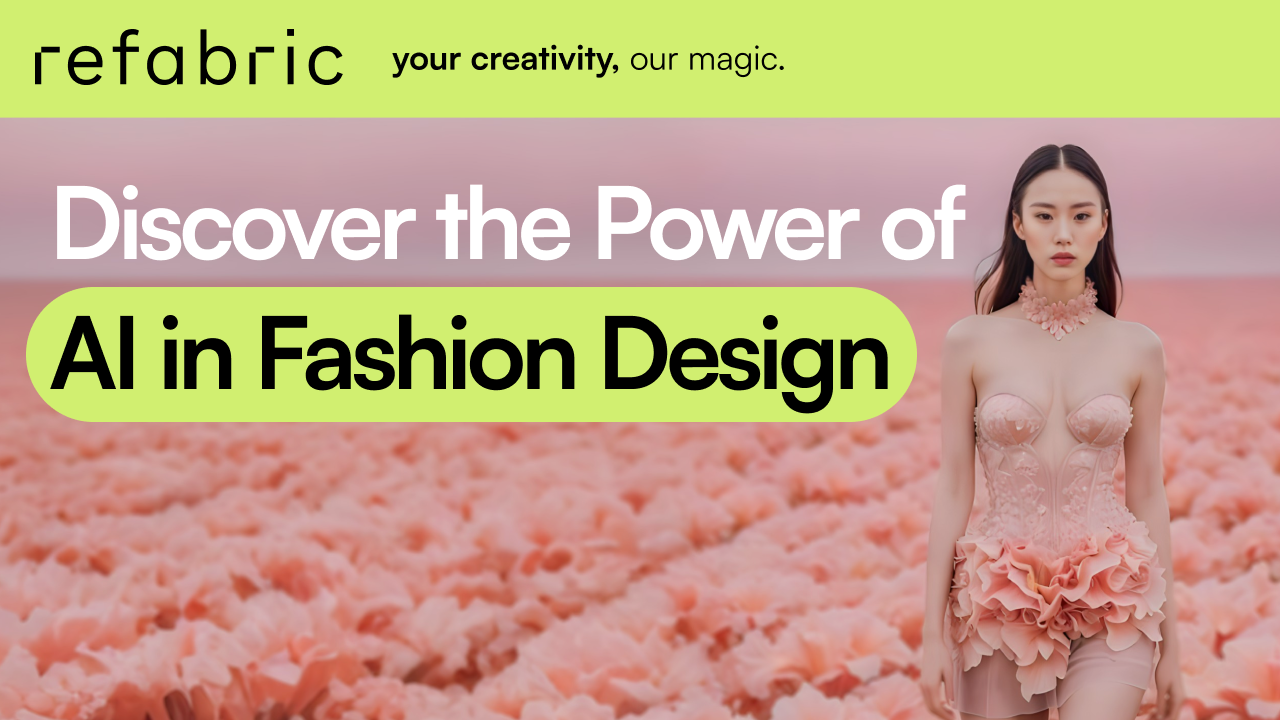
Refabric is an AI fashion platform covering design, tech packs and photoshoots. Its Design Canvas combines real-time trends with a brand's own archives, it generates production-ready tech packs from a product image, and it produces ecommerce visuals without samples or models. It is part of the LVMH Startup Acceleration Program.
refabric.com9 viewsAdded January 12, 202610K visitors
Fashion design has a gap between the idea and the thing, and it is much wider than people outside the industry assume. A beautiful sketch is not a garment; it becomes one only through a specification document detailing every measurement, seam, fabric and finish.
That document is the tech pack, and producing it is skilled, tedious work that stands between a design and a factory being able to make it.
Refabric covers the visible half — design and photography — and also this one, which is the part that makes it more than a picture generator.
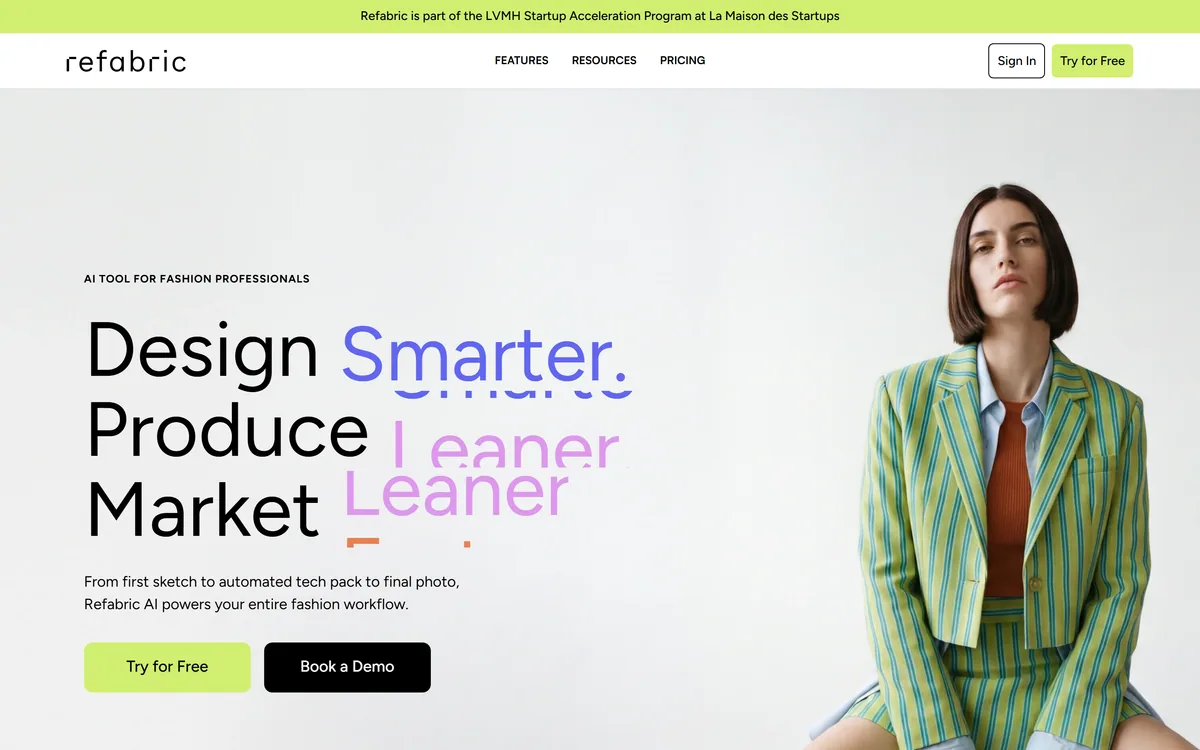
Refabric's homepage, captured 9 September 2026, showing the Design Canvas and fabric library.
Refabric: Fashion Design From Sketch To Tech Pack
Three stages covered: AI design, AI tech packs and AI photoshoots — sketch through to ecommerce visual.
Tech packs generated from a product image, which is the step where design becomes manufacturable.
Design Canvas combines live trends with your own brand archives, so output is on-trend and on-brand.
A fabric library with real compositions — silk-cotton blends, denim with elastane, linen-viscose — rather than generic textures.
Part of the LVMH Startup Acceleration Program at La Maison des Startups, with entities in the USA and France.
What Is A Tech Pack And Why Automate It?
Refabric states that you upload a product image and receive a production-ready tech pack in minutes.
For anyone outside apparel, the tech pack is worth explaining because it is where the actual work lives.
It is the complete specification a manufacturer works from: measurements at every point and every size, construction details, seam types, stitch counts, fabric composition, trims, labels, packaging and tolerances. It is dense, technical and unambiguous by necessity.
Producing one is slow and it is where errors become expensive. An ambiguous measurement produces a sample that is wrong, and each iteration costs weeks of calendar time and shipping between continents.
Automating a first draft therefore attacks the right target. The work is structured, conventional and repetitive — which is exactly the shape software should absorb — and it leaves the judgement about tolerances and construction choices where it belongs, with a technical designer reviewing rather than typing.
A beautiful sketch is not a garment. It becomes one through a tech pack, and that document is where the real work has always been.
Design Canvas, Trends And Brand DNA
Refabric describes a Design Canvas unifying real-time trends with your own brand archives, so designs are both on-trend and on-brand, with Brand DNA, moodboards, fabrics and assets as inputs.
That combination is the correct architecture for fashion specifically, and the reason is commercial.
Trend data alone produces designs that look like everyone else's, because everyone reads the same signals. A brand whose collection is indistinguishable from its competitors' has lost the thing customers were paying for.
Archive data alone produces designs that look like last season, which is the opposite failure and equally fatal in a business built on newness.
Holding both is the actual design brief — recognisably this brand, recognisably now — and encoding it as inputs rather than relying on a designer to hold it in their head is genuinely useful. The same tension between consistency and freshness runs through brand video tools such as Hypernatural.
AI Photoshoots Without Samples Or Models
Refabric states that its AI Photoshoot creates ecommerce-ready visuals without a studio, samples or models.
The economics here are the strongest part of the case, and they are worth spelling out.
A fashion ecommerce shoot means samples manufactured and shipped, models booked, a studio, a photographer, a stylist and a retouching pass — for every colourway of every style, every season. It is one of the largest recurring costs in the business.
Removing the sample requirement is the biggest single saving, because samples take weeks and cost money before a single unit is sold. Being able to photograph a garment that does not physically exist changes when you can start selling.
The caution is the same one that applies across ecommerce generation: a customer buying a garment they saw in a generated image and receiving something that drapes differently is a returns problem, and apparel already has the highest return rate in retail. Fabric behaviour is the specific risk — how a material actually falls is difficult to render and immediately obvious in the hand.
The general ecommerce equivalent is instructive here. Platforms such as Photoroom solve product imagery across every category and enforce brand consistency at scale, but they have no view of fabric behaviour — which is precisely the property apparel lives or dies on.
The parallel with other specification-driven generation is closer than it looks. Game asset tools like PixelLab generate inside a format's rules rather than approximating them, and fashion has the same requirement: output that a production process can actually accept.
Treat the generated tech pack as a first draft for a technical designer to review.
Feed both trend data and your own archive, or output drifts generic.
Verify fabric drape against a real sample before selling from generated imagery.
Check that generated colour matches dyed fabric, not just the screen.
Keep measurement tolerances a human decision — that is where cost lives.
A Fabric Library With Real Compositions
The Design Canvas shows a fabric library with specific entries: printed 72% silk and 28% cotton, twill in 100% cotton, denim at 98% cotton and 2% elastane, woven in 55% linen and 45% viscose, jacquard at 80% cotton and 20% silk.
Those are real compositions rather than decorative labels, and their presence indicates something about the product's seriousness.
Fabric composition determines almost everything about a garment: how it drapes, how it takes dye, how it wears, how it must be washed, what it costs and how it behaves on a production line.
A design tool that treats fabric as a texture is producing pictures. One that treats it as a specification with a composition and a behaviour is producing something a manufacturer can act on.
The question worth asking is how accurately the visualisation reflects those compositions — whether a 55% linen blend actually renders with linen's characteristic drape and creasing, or whether the label is metadata attached to a generic render.
The LVMH Programme And What It Signals
A banner across the top of the site states that Refabric is part of the LVMH Startup Acceleration Program at La Maison des Startups.
That is a specific and checkable claim rather than a vague partnership badge, and it carries real information.
LVMH is one of the largest luxury groups in the world, and its acceleration programme is selective in a domain where fashion technology claims are abundant and industry credibility is scarce.
Selection implies the product has been examined by people who understand apparel production, which is a different and higher bar than a general startup accelerator applies.
The corresponding caution is the ordinary one about accelerator placement: it indicates a relationship at a point in time rather than an endorsement, a commercial arrangement or evidence that any brand in the group uses the product. It is a signal worth weighing rather than a conclusion.
Designing A Collection With Refabric
The failure mode with AI fashion tools is generating hundreds of beautiful garments and manufacturing none of them, because nothing was ever specified properly.
This sequence keeps the production path attached to the design work.
Load your brand archive first, so output is recognisably yours rather than generic.
Design against a real fabric composition, not a generic texture.
Generate the tech pack early and have a technical designer review it, not approve it.
Verify measurements and tolerances by hand — that is where sampling costs come from.
Sample the fabric physically before selling from generated photography.
Check generated colour against dyed fabric rather than against a screen.
Fashion Production Terms
The vocabulary of apparel production, and why each step exists.
undefined
undefined
undefined
undefined
undefined
undefined
Key features of Refabric
AI design generation from prompts and references
Design Canvas combining trends with brand archives
A fabric library with real compositions
Brand DNA training on your own archive
Tech pack generation from a product image
AI photoshoots without samples or models
Moodboard and asset management
Trend analysis
Pros & cons
Pros
7
Covers the tech pack, which is where design actually becomes manufacturable
Combining trend data with brand archives is the correct architecture for fashion
A fabric library with real compositions rather than generic textures
Removing the sample requirement changes when you can start selling
Photography savings scale with colourways, which is where the cost is
Selection into the LVMH acceleration programme is a checkable industry signal
Named legal entities in two jurisdictions
Cons
7
How accurately visuals reflect stated fabric compositions is unverified
Fabric drape is the hardest thing to render and the most obvious in the hand
Apparel already has the highest return rate in retail, and imagery mismatch worsens it
A generated tech pack needs a technical designer's review, not approval
Accelerator placement is a relationship, not an endorsement or a customer
The 92% designer figure has no stated basis
Brand archive handling and retention are not described
Best For
Small and mid-sized fashion labels without in-house technical design capacity
Brands whose photography costs scale badly with colourways
Design teams wanting output anchored to their own archive
Businesses trying to sell before samples arrive
Labels producing many variations of established styles
Refabric Against Other Design Platforms
Design tools differ by whether they produce images or production specifications.
Entries with real compositions including silk-cotton, twill, denim with elastane, linen-viscose and jacquard
Tech packs
Generated from a product image in minutes, described as production-ready
Photoshoot
Ecommerce-ready visuals without a studio, samples or models
Accelerator
Part of the LVMH Startup Acceleration Program at La Maison des Startups
Languages
English and Turkish site versions
Entities
Mintgrams Technologies, Inc. in Fairfield, New Jersey, and an address in Paris
Stated figure
92% of designers say Refabric has become part of their workflow, per the site
Refabric: Verified From The Fashion Platform
Last checked . Read from refabric.com in a browser session on the date above, with the screenshot captured alongside.
Positioned as an AI fashion design and photoshoot platform for fashion professionals
Stated as powering the entire fashion workflow from first sketch to automated tech pack to final photo
Design Canvas described as unifying real-time trends with your own brand archives
Inputs shown including trend agent, moodboards, trends, brand DNAs, assets and fabrics
A fabric library shown with specific compositions including 72% silk and 28% cotton, 98% cotton and 2% elastane, and 55% linen and 45% viscose
AI Design, AI Photoshoot and AI Tech Packs listed as the three feature areas
AI Tech Packs described as uploading a product image and receiving a production-ready tech pack in minutes
AI Photoshoot described as creating ecommerce-ready visuals without a studio, samples or models
A banner stating Refabric is part of the LVMH Startup Acceleration Program at La Maison des Startups
English and Turkish site versions offered
Footer names Mintgrams Technologies, Inc. at an address in Fairfield, New Jersey, and an address in Paris
What we could not confirm: pricing and how generation is metered; how accurately generated visuals reflect the stated fabric compositions, which is the question deciding whether the fabric library is specification or decoration; what a production-ready tech pack actually contains and whether manufacturers accept it without rework; how brand archive training works and what happens to uploaded archives; the basis for the 92% figure; and which brands use it. We did not use the platform.
Is Refabric Built For Your Label?
Design with it when
Tech pack production is a bottleneck between design and manufacturing.
Photography costs scale with colourways faster than your margins do.
You want designs anchored to your archive rather than to generic trends.
You need to start selling before samples arrive.
Your team has a technical designer who can review a generated tech pack.
Shoot samples when
Fabric drape and hand-feel are central to what you sell.
Your customers would return garments that differ from the imagery.
You have no technical designer to review generated specifications.
Your brand's value is in craft that generative design would flatten.
Colour accuracy against dyed fabric cannot be verified before selling.
Editor's Verdict
4.0/5
Most AI fashion tools generate pretty garment images and stop, which is the easy half and the half that produces nothing manufacturable. Refabric's more interesting claim is the tech pack — the specification document a factory actually works from — generated from a product image. That is where design becomes production, and automating it addresses real work rather than the visible part. Training on a brand's own archives alongside trend data is the right architecture for consistency. Placement in the LVMH acceleration programme is a meaningful signal about who takes it seriously. AInexfinder Editor Score: 4.0/5.
Refabric pricing
AInexfinder does not list plan prices or billing details. For current pricing, plans, and trials, visit the official Refabric website.
Vendor pricing, credits, and billing policies change over time. Always confirm on the official site before you buy.
Frequently asked questions
What is Refabric?
Refabric is an AI fashion platform covering design, tech packs and photoshoots. Its Design Canvas combines real-time trends with a brand's own archives, it generates production-ready tech packs from a product image, and it produces ecommerce visuals without samples or models.
What is a tech pack?
The complete specification a manufacturer works from — measurements at every point and size, construction details, seam types, fabric composition, trims, labels and tolerances. It is where a design becomes manufacturable, and producing one is slow, skilled work.
Why is automating tech packs the interesting part?
Because it attacks the work rather than the visible half. Generating pretty garment images is easy and produces nothing manufacturable. Tech pack production is structured, conventional and repetitive — exactly the shape software should absorb.
Can I send a generated tech pack straight to a factory?
Treat it as a first draft for a technical designer to review rather than approve. An ambiguous measurement produces a wrong sample, and each iteration costs weeks of calendar time and shipping between continents — so the review is where the value is preserved.
Why combine trends with brand archives?
Because either alone fails. Trend data produces designs indistinguishable from competitors', since everyone reads the same signals. Archive data alone produces last season. The actual brief is recognisably this brand and recognisably now, which needs both.
How much does AI photography save?
Substantially, because the cost scales with colourways. A traditional shoot means samples manufactured and shipped, models, a studio, a photographer, a stylist and retouching — for every colour of every style, every season. Removing the sample requirement is the largest single saving.
What is the risk with generated fashion imagery?
Returns. Apparel already has the highest return rate in retail, and a customer receiving a garment that drapes differently from the image compounds it. Fabric behaviour is the specific risk — how a material falls is hard to render and immediately obvious in the hand.
Does the fabric library actually mean anything?
The compositions listed are real ones — 98% cotton with 2% elastane, 55% linen with 45% viscose — which suggests fabric is treated as specification rather than texture. The question worth asking is whether the visualisation reflects those properties or attaches them as metadata.
What does the LVMH programme placement mean?
That the product was selected into a programme run by a major luxury group, which implies examination by people who understand apparel production. It indicates a relationship at a point in time rather than an endorsement or evidence that any brand in the group uses it.
Who should not use it?
Labels whose value is in craft that generative design would flatten, businesses without a technical designer to review specifications, and anyone selling garments where drape and hand-feel are central — since those are precisely what generated imagery represents least reliably.
Daniel reviews AI tools the slow way — by actually using them on real projects. His reviews cover what works, what breaks, and who each tool is genuinely a good fit for.
Daniel and the AInexfinder editorial team research Refabric using public product information, listing evidence, and (when available) hands-on checks. Scores reflect listing completeness and transparency — not paid placement.
Listings may include affiliate or sponsored placements, which are labeled when present. Editorial scores and cons are not sold. See our affiliate disclosure and review methodology.
krea2.org is a browser image-generation workspace that runs several third-party models side by side, including Krea 2 tiers, FLUX.2, GPT Image 2, Nano Banana and Seedream 5.0, with reference uploads, six aspect ratios and live model switching.
GenApe is an all-in-one AI platform covering writing, chat, image and video generation, image editing, product photography, translation, and research — with 145 free credits on signup and commercial rights granted to paid users.
Adobe Firefly generates images, video, and audio from models trained on licensed Adobe Stock and public domain content, with Content Credentials on every output, Firefly Boards for ideation, Custom Models for brand style, and third-party partner models alongside Adobe's own.
GPT Image 2 launched on 21 April 2026 as ChatGPT Images 2.0 and as the gpt-image-2 API model. Its distinguishing capabilities are dense, accurate text rendering, layout fidelity for infographics and packaging, up to 3840px output, prompt-guided masking, and reasoning applied to image structure before generation.
Stockimg AI offers separate generators for logos, stock photos, illustrations, wallpapers, product photos and social posts, then schedules the output to Instagram, TikTok, LinkedIn, YouTube and X, with an API for programmatic use.
OpenArt is an all-in-one AI creation platform covering image, video, voice and audio in one place, built around a Director that lets you lay out a storyboard and shape each shot through conversation, alongside persistent characters and worlds for consistency across a project.