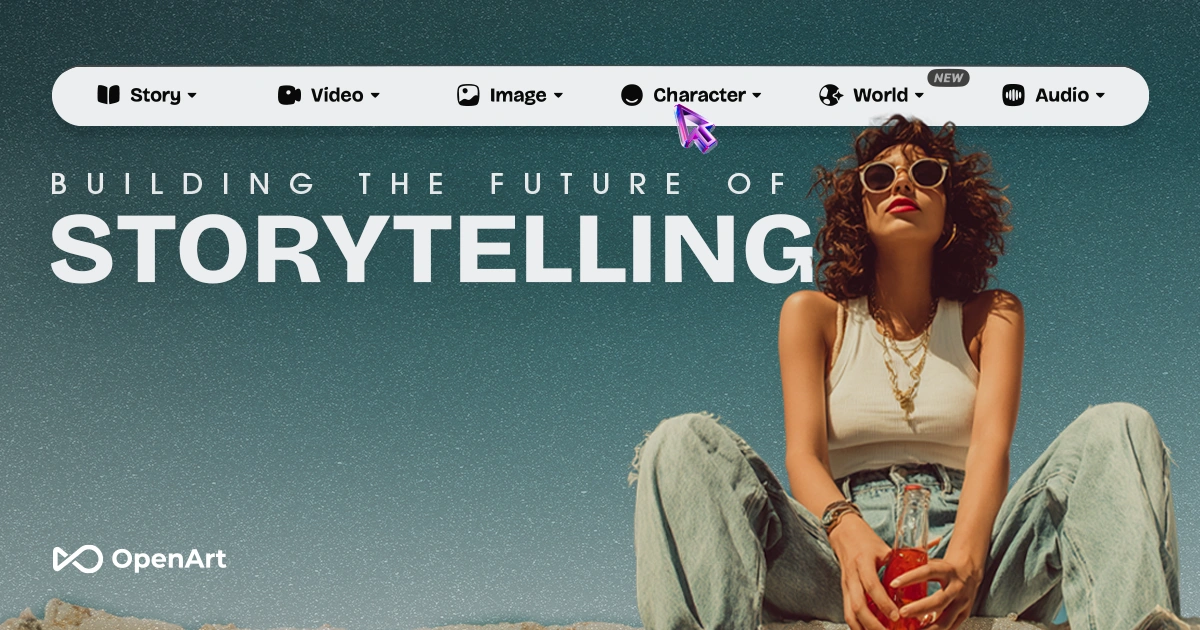
OpenArt is an all-in-one AI creation platform covering image, video, voice and audio in one place, built around a Director that lets you lay out a storyboard and shape each shot through conversation, alongside persistent characters and worlds for consistency across a project.
openart.ai11 viewsAdded August 12, 2025870K visitors
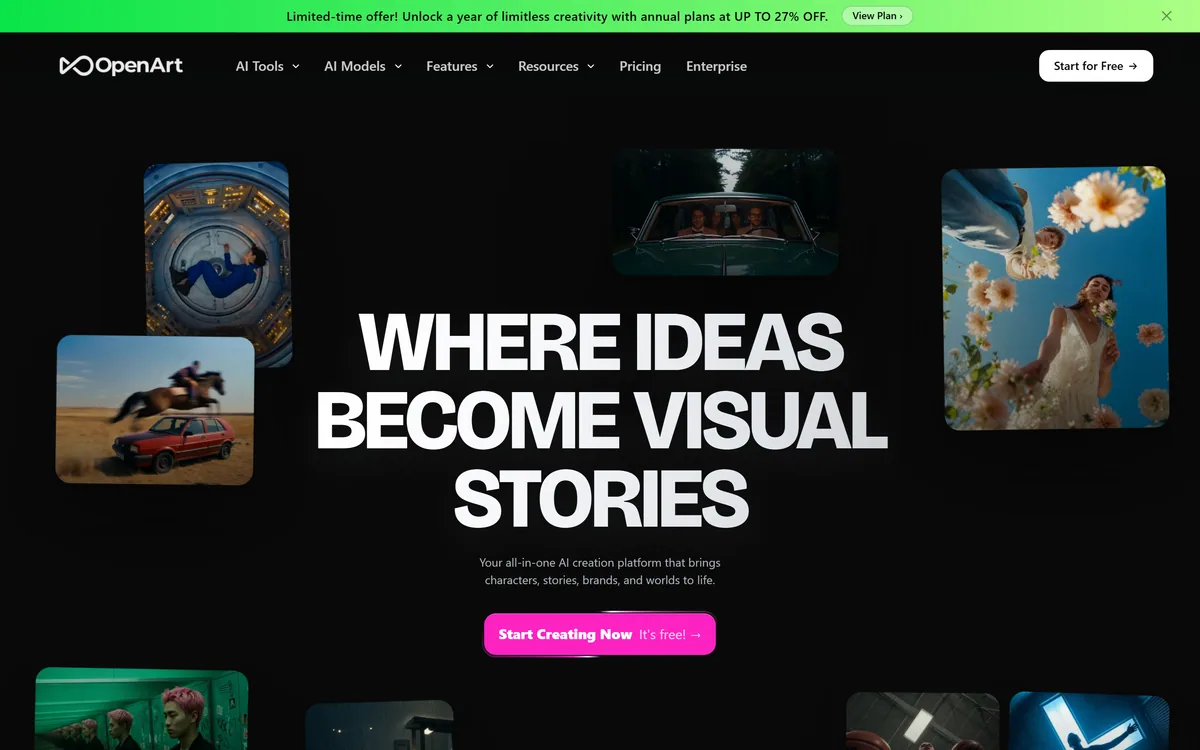
OpenArt's homepage, captured 9 September 2026.
OpenArt: Director, Characters And Worlds
A Director that storyboards — lay out the sequence, then shape each shot by conversation rather than reprompting.
Characters and worlds as persistent objects, which is what makes a sequence read as one story.
Image, video, voice and audio in one place, generated, edited and stitched without leaving the platform.
Ten named output formats, from short film and music video to UGC ads and micro drama.
10 million-plus creators claimed, with an enterprise tier alongside the free start.
What Does A Model Marketplace Change?
OpenArt presents itself as an all-in-one AI creation platform bringing characters, stories, brands and worlds to life, with AI tools and AI models as separate navigation categories.
Exposing models as a browsable category rather than hiding them behind one generator is a meaningful choice, and its consequences run in two directions.
The benefit is fit. Generative models have visibly different characters — one renders illustration well, another photorealism, another handles motion coherently — and being able to choose means matching the model to the job rather than fighting whichever one the platform picked.
It also means the platform improves without rebuilding. New models arrive, the interface stays, and users inherit capability.
The cost is reproducibility and choice paralysis in equal measure. A result you liked may have come from a model that gets retired, and a newcomer faced with a model list has a decision they lack the information to make. The sensible pattern is to ignore the list until something disappoints, then treat the model as the variable — which is the same discipline any multi-model platform requires.
Every shot is generated independently, so the same character has a different face in shot three. That is why sequences never become stories.
Directing A Video By Conversation
The Director is described as offering control from loose creative direction to precise granular edits — laying out the storyboard, shaping each shot by natural chat, and refining the final sequence.
The storyboard part is what makes this different from a prompt box, and it reflects how filmed work is actually made.
Prompting a video generator produces a shot. Producing a film requires deciding what the shots are, what order they go in, and how each relates to the one before — and that planning is where the piece is actually made, long before anything is rendered.
A tool that starts from a storyboard treats the sequence as the object being worked on. Changing shot four then means changing shot four, rather than regenerating everything and hoping the rest still matches.
Conversation as the editing interface is the sensible complement. Film direction has always been verbal — closer, warmer, hold it longer — and describing an adjustment is faster than reconstructing a prompt that produces it, which is the same insight behind MolyPix.AI keeping designs editable rather than regenerable.
Character Consistency Across Images
Character and World appear as first-class modules alongside Image, Video and Audio, with the platform positioned around bringing characters, stories, brands and worlds to life.
Treating a character as a persistent object rather than a prompt is the most important design decision on this platform.
The reason is a structural property of generation. Each image or shot is produced independently, so describing the same woman in a red coat five times produces five different women in red coats. They are all plausible and none of them is the same person.
For a single image that does not matter. For anything with a narrative it is fatal, because a viewer tracks people — and a face that changes between shots reads as a different character, which destroys the sequence.
Persisting the character as an asset means shot four references the same thing shot one did. Worlds do the same job for places, so the street outside the café looks like itself in scene six. Both are infrastructure rather than features, and they are what separate a platform for stories from a generator for images.
Build the character before generating any shots.
Test consistency across ten shots before committing to a project.
Storyboard the sequence rather than prompting shot by shot.
Note which model produced anything you need to match later.
Check commercial rights before anything runs as an advertisement.
One Platform For Image, Video And Audio
The platform states that image, video, voice and audio are all generated, edited and stitched together without leaving it, across ten named output formats from short film and music video to UGC ads, explainers and micro drama.
Keeping audio inside the same platform is the underrated part of that.
A generated video without sound is a moving image, not a piece of content. Voice, music and effects are what make it watchable, and the conventional workflow means exporting video, importing to an editor, sourcing audio elsewhere, and reassembling — with a quality loss at every hop.
Doing it in one place removes those hops, and more importantly it lets the audio inform the edit. A cut that lands on a beat is a decision made with both in front of you.
The named format list is doing similar work to a template. A music video and an explainer have completely different pacing, shot length and structural conventions, and a platform that knows which you are making can apply those assumptions rather than requiring you to describe them.
Where Generated Video Still Falls Short
Ten output formats is a broad claim, and the honest reading is that generative video serves some of them far better than others.
UGC ads, social content and micro drama are the strongest fits. All three tolerate imperfection as a stylistic property — handheld framing, uneven continuity and slightly strange physics read as native to the format rather than as failure.
Product ads and explainers sit in the middle. They work when the product is generic and fail when it must appear exactly as it is, because a generated object that is nearly your product is worse than no footage at all.
Short films and film trailers are the hardest, and not because of image quality. A film requires performance — a specific expression at a specific moment, a pause that means something — and generation produces plausible acting rather than intended acting.
The realistic position is that this makes a certain kind of work possible for people who could not previously make anything, which is genuinely significant, and that it does not yet make the kind of film that would have been made anyway. For fixed-format assets a constrained generator like PixelLab is more reliable, and garment visuals are Refabric's specialism.
Building A Consistent Visual Series
Generative video projects fail at shot twelve, when the character no longer looks like themselves and the whole sequence has to be redone.
This sequence establishes consistency before any of it is expensive.
Create the character as a persistent asset first.
Generate ten unrelated shots of them and check whether it holds.
Build the world before the scenes that use it.
Storyboard the whole sequence before rendering anything.
Direct adjustments by conversation rather than rewriting prompts.
Add audio inside the platform so the edit can respond to it.
Key features of OpenArt
Director with storyboard layout and conversational shot editing
Persistent characters reused across shots
Persistent worlds for consistent settings
Image, video, voice and audio generation in one place
Ten named output format workflows
Browsable model selection
Sequence assembly and refinement
Free tier with paid and enterprise options
Pros & cons
Pros
7
Identifies consistency, not image quality, as the real bottleneck
Characters and worlds as persistent assets is the structurally right answer
Storyboarding treats the sequence as the object rather than the shot
Conversation is how film direction has always worked
Audio in the same platform lets the edit respond to the sound
Named formats carry pacing assumptions a prompt box cannot
Model choice exposed rather than hidden behind one generator
Cons
7
Whether consistency holds across a full short film is unproven from the site
Model availability and routing are not documented
Commercial rights for generated output are not addressed on the pages we read
Ten formats means some are served far better than others
Short films need intended performance, which generation does not produce
Products that must appear exactly as they are remain a weak spot
Our capture found no footer, so company and terms went unread
Best For
Creators making narrative work across many shots
Micro drama and vertical serial producers
Social teams producing at volume in named formats
Anyone whose projects need the same character repeatedly
Storyboard-first thinkers rather than prompt-first ones
OpenArt Against Other Art Platforms
Creative platforms differ by whether they produce assets or sequences.
Hypernatural — branded video with a persistent brand kit
MolyPix.AI — editable design output rather than sequences
OpenArt: Read From The Creation Pages
Last checked . Read from openart.ai in a browser session on the date above, with the screenshot captured at the same time.
Positioned as an all-in-one AI creation platform for characters, stories, brands and worlds
Six modules displayed: Director, Video, Image, Character, World and Audio
Director described as offering loose creative direction through to precise granular edits
Storyboard layout and shot shaping by natural chat both described
Image, video, voice and audio stated as generated, edited and stitched without leaving the platform
Ten output formats named, including short film, music video, UGC ads, micro drama and podcast
AI models presented as a browsable navigation category alongside AI tools
Characters and worlds presented as first-class modules rather than prompt techniques
10 million-plus creators, brands and studios claimed
A free start offered, with paid annual plans and an enterprise route
A limited-time annual discount displayed in a banner
AI-assisted refinement of the final sequence described as part of the Director workflow
What we could not confirm: our capture did not reach the site footer, so we make no claim about what is published there, including the operating company or terms. We also could not confirm which models are available or how routing works; how well character consistency actually holds across a long sequence, which is the claim that matters most and which a demo cannot establish; what commercial rights apply to generated output; what the creator count measures; and pricing. We did not generate or direct anything.
Editor's Verdict
4.1/5
OpenArt has identified the actual bottleneck in generative video, and it is not image quality. It is that every shot arrives as an independent event, so the same character has a different face in shot three and the sequence never becomes a story. Persistent characters and worlds, plus a director that treats a project as a storyboard rather than a series of prompts, is the structurally right answer. Whether the consistency holds across a genuine short film is the question a demo cannot settle, and it is the one to test first. AInexfinder Editor Score: 4.1/5.
OpenArt pricing
AInexfinder does not list plan prices or billing details. For current pricing, plans, and trials, visit the official OpenArt website.
Vendor pricing, credits, and billing policies change over time. Always confirm on the official site before you buy.
Frequently asked questions
What is OpenArt?
An all-in-one AI creation platform covering image, video, voice and audio, built around a Director that lays out a storyboard and shapes each shot by conversation, with characters and worlds persisting across a project.
Why is character consistency the hard problem?
Because every generation is independent. Describing the same woman in a red coat five times produces five different women in red coats — all plausible, none the same person. For anything with a narrative, that is fatal.
How do persistent characters fix it?
By making the character an asset rather than a description. Shot four references the same object shot one did, so the face is the same by construction rather than by hoping the prompt lands identically twice.
What do worlds do?
The same thing for places. A persistent world means the street outside the café looks like itself in scene six, which is what stops a sequence feeling like unrelated clips assembled in an order.
Why storyboard rather than prompt?
Because prompting produces a shot and a film is made of relationships between shots. Starting from a storyboard means changing shot four changes shot four — rather than regenerating everything and hoping the rest still matches.
Why direct by conversation?
Because film direction has always been verbal — closer, warmer, hold it longer. Describing an adjustment is faster and more natural than reconstructing a prompt that happens to produce it.
Which formats does it actually serve well?
UGC ads, social content and micro drama, because those tolerate imperfection as a stylistic property. Product ads work when the product is generic. Short films are hardest, because they need intended performance rather than plausible performance.
Why does audio in the same platform matter?
Because a generated video without sound is a moving image rather than content, and the conventional workflow loses quality at every export and import. Having both in one place also lets the edit respond to the audio.
Should I pick a model myself?
Ignore the list until something disappoints, then treat the model as the variable. Models differ visibly — illustration, photorealism, motion coherence — but a newcomer faced with a list lacks the information to choose usefully.
How should I test it?
Build one character, generate ten unrelated shots of them, and see whether it holds. Consistency across a real sequence is the claim that decides whether this works, and it is the one a demo reel cannot establish.
Daniel reviews AI tools the slow way — by actually using them on real projects. His reviews cover what works, what breaks, and who each tool is genuinely a good fit for.
Daniel and the AInexfinder editorial team research OpenArt using public product information, listing evidence, and (when available) hands-on checks. Scores reflect listing completeness and transparency — not paid placement.
Listings may include affiliate or sponsored placements, which are labeled when present. Editorial scores and cons are not sold. See our affiliate disclosure and review methodology.
krea2.org is a browser image-generation workspace that runs several third-party models side by side, including Krea 2 tiers, FLUX.2, GPT Image 2, Nano Banana and Seedream 5.0, with reference uploads, six aspect ratios and live model switching.
GenApe is an all-in-one AI platform covering writing, chat, image and video generation, image editing, product photography, translation, and research — with 145 free credits on signup and commercial rights granted to paid users.
Adobe Firefly generates images, video, and audio from models trained on licensed Adobe Stock and public domain content, with Content Credentials on every output, Firefly Boards for ideation, Custom Models for brand style, and third-party partner models alongside Adobe's own.
GPT Image 2 launched on 21 April 2026 as ChatGPT Images 2.0 and as the gpt-image-2 API model. Its distinguishing capabilities are dense, accurate text rendering, layout fidelity for infographics and packaging, up to 3840px output, prompt-guided masking, and reasoning applied to image structure before generation.
Stockimg AI offers separate generators for logos, stock photos, illustrations, wallpapers, product photos and social posts, then schedules the output to Instagram, TikTok, LinkedIn, YouTube and X, with an API for programmatic use.
Thumbmagic generates YouTube, Shorts, Instagram and TikTok thumbnails from a video, link or script, using creator-proven layout frameworks, face and expression detection, and 4K platform-ready exports built for A/B testing.