Friends & Fables runs tabletop roleplaying campaigns with an AI game master called Franz, combining world building tools, tactical turn-based combat on the 5.1 System Reference Document, maps, image generation, narration and multiplayer parties of up to six across desktop, tablet and mobile.
Ask anyone who has run a tabletop campaign why it ended and the answer is almost never the story. It is that six adults could not find a Tuesday.
Friends & Fables removes the scheduling constraint entirely. The game master is always available, the party can play asynchronously, and a session can be twenty minutes at midnight.
What sits underneath is more than a chat game — a rules engine, a virtual tabletop and a world building toolkit that the AI reads and uses.
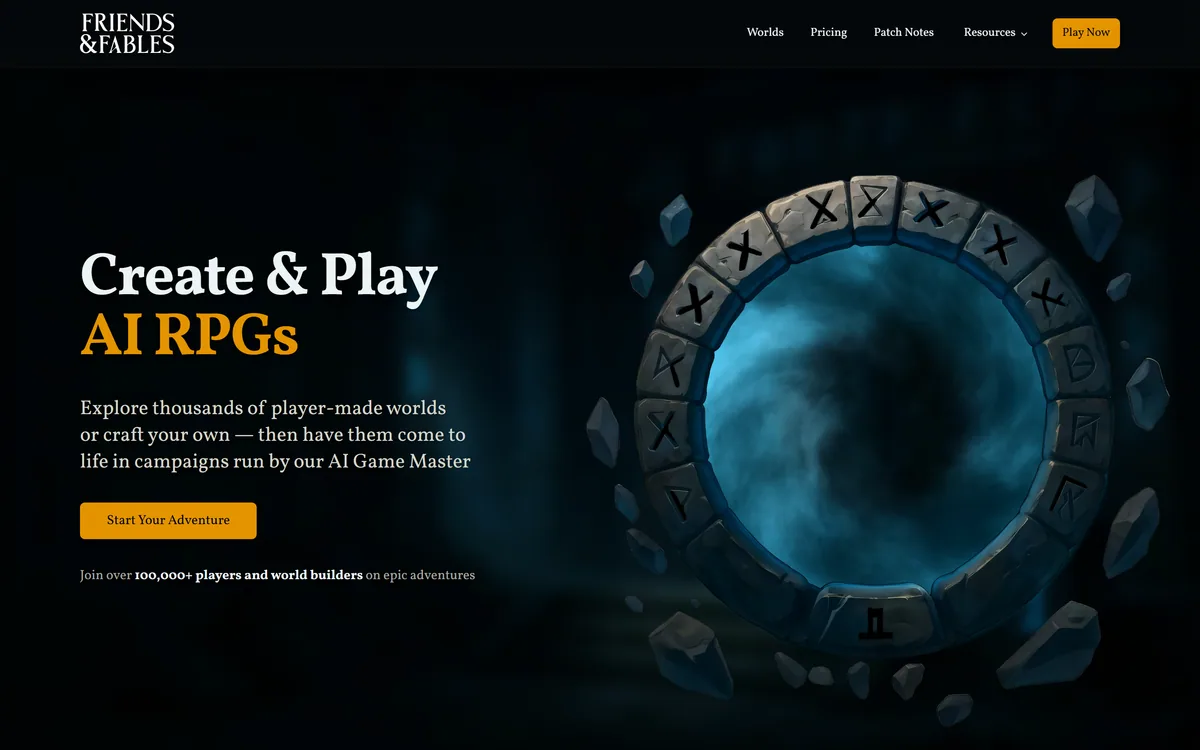
Friends & Fables' homepage, captured 9 September 2026.
Friends & Fables: An AI Game Master
Franz, an AI game master who narrates, adjudicates rules and reacts to the world you built, with stated memory and customisation.
Tactical turn-based combat on the 5.1 System Reference Document, with battlemaps, spells, abilities and monsters.
Full world building — maps, lore, quests, NPCs and a travel system, with the AI learning what you write.
Multiplayer up to six, playable together or asynchronously, across desktop, tablet and mobile.
Free world building and 50 free turns, with no card required, and 100,000-plus players claimed.
Can An AI Run A Tabletop Campaign?
Franz is described as adapting to your choices and creating dynamic storylines, with advanced memory and customisation, narrating and adjudicating rules while reacting to your world in real time.
Splitting a game master's job into its parts explains what an AI does well and where the gap remains.
Rules adjudication is the easiest part and the one AI handles most reliably. Which modifier applies, whether the roll succeeds, what a spell does at this level — this is lookup and arithmetic, and a machine does it faster than a person leafing through a book.
Narration and description are next, and genuinely well suited. Describing a tavern, voicing a merchant, improvising a name for a village nobody planned — models are good at this, and always available for it.
The hard part is dramatic judgement: knowing that the party is bored, that this fight has gone on too long, that the quiet player has not spoken in an hour, and that the story would be better if the villain escaped. Great game masters read the room, and the room is precisely what an AI cannot see. A video agent like Tavus can at least watch a face, which is a different bet on the same limitation.
Rules adjudication is arithmetic. Narration is describable. Knowing the table is bored is the part a game master is actually for.
Why Lore And Memory Decide Everything
Two features carry more weight than the rest of the list: dumping your favourite lore into a world so the AI instantly learns and weaves it in, and Franz's stated advanced memory.
Memory is the constraint that has limited every AI storytelling attempt so far.
A campaign is a long-running structure. The innkeeper you were rude to in session two should remember in session fifteen; the sword you left behind should still be where you left it; the faction you angered should act on it. Continuity is not a nice extra in roleplaying, it is most of what makes a campaign feel like a world rather than a sequence of scenes.
Models forget, and the failure is jarring in a specific way — an NPC greeting you as a stranger after a session of shared history breaks immersion more thoroughly than a bad description ever could.
Which is why the world building tools matter as infrastructure rather than as content creation. Lore written down is lore that can be retrieved rather than remembered, and structuring a world properly is the single most effective thing a player can do to make the game master good.
Franz, Memory And Why Lore Matters
The world building toolkit covers interactive map making, character generators, lore writing, quest design with branching paths, NPCs and a travel system, with published worlds shared to a library others can play.
That library is the more interesting half of the product, and it changes what the platform is.
A solo AI roleplaying app is a toy for one person. A platform where thousands of players build worlds and other people play them is closer to a creative community with an engine attached — and the incentive structure is unusually healthy, because building a world costs you time and gives other people something.
It also solves the cold start problem that kills most creative tools. A new player faced with an empty world builder usually leaves; a new player faced with thousands of playable worlds starts playing.
The travel system and top-down map maker are the details that suggest the team has actually played these games. Journeys between places, rather than teleporting from plot point to plot point, is what makes a world feel large — and it is exactly the thing a text-only AI game would skip. Animated characters to populate those worlds are a separate craft, and Krikey AI's.
Play someone else's published world before building your own.
Write lore down rather than relying on the AI to remember it.
Use the customisation settings to set tone before session one.
Try a one-shot before committing to a campaign.
Expect to direct the game master more than a human one.
Tactical Combat On The SRD Licence
Combat is described as tactical and turn-based, based on fifth edition rules, with battlemaps, spells, abilities and monsters — and the footer states plainly that the work includes material from the System Reference Document 5.1 by Wizards of the Coast, licensed under Creative Commons Attribution 4.0, with no affiliation to Dungeons & Dragons or Wizards of the Coast.
That attribution is worth pausing on, because it is done properly.
The SRD is the open subset of the fifth edition rules, released under a licence that explicitly permits this use. Building on it is legitimate, and the correct behaviour is exactly what is on this page: name the document, name the licence, name the rights holder, and disclaim affiliation.
Plenty of products in this space are vaguer, using phrases like inspired by popular tabletop systems while avoiding the specifics. Naming the licence is both more honest and more useful, because it tells a player precisely which rules they are getting.
Practically it means the mechanics are familiar to anyone who has played fifth edition, and that the content is the open subset rather than published adventures or setting material — which is what you would expect and worth knowing before you look for a specific monster.
Playing Alone, Together, Or Neither
The platform supports parties of up to six, playing together in real time or asynchronously at each person's own pace, across desktop, tablet and mobile.
Asynchronous play is the feature that makes this different from a video call with dice, and it deserves more attention than it gets.
A conventional campaign requires simultaneity — everyone present, for hours, repeatedly. Removing that requirement changes who can play at all: parents, shift workers, people across time zones, anyone whose evenings are not reliably their own.
It also changes the texture of the game. Asynchronous play is slower and more considered, closer to correspondence chess than to a live table, and some of what makes tabletop fun — interruption, overlapping jokes, collective panic — does not survive the format.
Solo play is the third mode and the one the AI serves best, since there is nobody to wait for and the game master's full attention is yours. It is a genuinely different hobby from group tabletop, and worth approaching as one rather than as a substitute. For unwinding rather than engaging, something like RelaxFrens is the opposite prescription.
Starting A Campaign That Keeps Going
AI campaigns fail the way conventional ones do — enthusiasm in session one, drift by session four — with one added failure mode of expecting the game master to supply everything.
This sequence sets up a campaign that survives its own beginning.
Play a published one-shot first to learn how Franz behaves.
Set custom context and instructions for tone before starting.
Write your world's core lore down rather than improvising it.
Keep the party at four or fewer for a first asynchronous campaign.
Take an active hand in directing scenes rather than waiting to be entertained.
Use the travel system — journeys are what make a world feel large.
Key features of Friends & Fables
AI game master with narration and rules adjudication
Tactical turn-based combat on battlemaps
World building with maps, lore, NPCs and quests
Published world library from other players
Quests and one-shots with branching outcomes
Multiplayer parties of up to six, sync or async
Text to speech narration with character voices
Image generation for characters, locations and items
Pros & cons
Pros
7
Removes the scheduling problem that ends most tabletop campaigns
Asynchronous play opens the hobby to people who cannot commit evenings
World building tools double as memory infrastructure for the AI
A published world library solves the cold start problem elegantly
SRD attribution and the affiliation disclaimer are handled properly
A travel system suggests people who have actually played these games
Free world building and 50 turns with no card is a real trial
Cons
7
An AI cannot read the room, which is most of a game master's craft
Memory reach across a long campaign is the open question and unstated
Asynchronous play loses the interruption and overlapping energy of a table
Content is the open SRD subset, not published adventures or settings
Underlying models are not named
Turn consumption after the free allowance is not explained
Requires you to drive scenes rather than be entertained
Best For
Tabletop players whose campaigns died to scheduling
Solo players, who conventional tabletop cannot serve at all
Groups spread across time zones
World builders who enjoy creating as much as playing
Newcomers learning fifth edition rules without holding up a table
Friends & Fables Against Other Story Games
AI creative tools differ by whether you play, watch or build.
Vector Witch — map and emblem artwork you can print
Friends & Fables: Read From The Worlds Pages
Last checked . Read from fables.gg in a browser session on the date above, including the full footer. The screenshot was captured at the same time.
Positioned as an AI RPG platform with player-made worlds run by an AI game master
Franz named as the AI game master, described with advanced memory and customisation
Tactical turn-based combat stated as based on fifth edition rules, with battlemaps, spells and monsters
World building tools listed including map makers, character generators, lore, quests and a travel system
Lore described as learned by the AI and woven into campaigns
Multiplayer stated at up to six players, synchronous or asynchronous
Cross-platform support stated across desktop, tablet and mobile
Text to speech narration with character voices, and image generation for characters and locations
Free world building and 50 free turns stated, with no credit card required
100,000-plus players and world builders claimed
Footer includes patch notes, documentation, an SRD library, a press kit and a community link
Footer acknowledgement credits SRD 5.1 by Wizards of the Coast under CC BY 4.0, and disclaims affiliation with D&D or Wizards of the Coast
What we could not confirm: how far Franz's memory actually reaches across a long campaign, which is the question that decides whether this works; which underlying models run the game master and image generation; how turns are counted and consumed after the free 50; how moderation handles published worlds shared to the library; and pricing, which sits on a separate page we did not reproduce. We did not play a session.
Editor's Verdict
4.1/5
The scheduling problem is what actually kills tabletop campaigns, and Friends & Fables attacks it directly: play when you want, alone or asynchronously, with a game master who is always available. Franz narrating, adjudicating and reacting to a world you built is a genuinely good use of the technology, and combining it with a virtual tabletop and world building tools makes this more than a chat game. The licence attribution is exemplary — the SRD credited properly and the disclaimer stated plainly. What an AI cannot yet do is surprise you the way a person does. AInexfinder Editor Score: 4.1/5.
Friends & Fables pricing
AInexfinder does not list plan prices or billing details. For current pricing, plans, and trials, visit the official Friends & Fables website.
Vendor pricing, credits, and billing policies change over time. Always confirm on the official site before you buy.
Frequently asked questions
What is Friends & Fables?
An AI roleplaying platform where an AI game master called Franz runs campaigns in worlds you or other players build. It combines narration, rules adjudication, tactical combat on battlemaps, maps, image generation and multiplayer up to six.
Can an AI actually run a game?
The parts split unevenly. Rules adjudication is arithmetic and it does that well. Narration and improvised description suit it. Reading that the table is bored, or that a fight has gone on too long, is the part it cannot see.
Does it remember what happened earlier?
Memory is stated as advanced, and it is the question that decides whether a campaign works. An innkeeper greeting you as a stranger after shared history breaks immersion more thoroughly than any bad description — write lore down rather than relying on recall.
Is it legal to use fifth edition rules?
Yes, and the site handles it correctly. The footer credits the System Reference Document 5.1 by Wizards of the Coast under Creative Commons Attribution 4.0 and states plainly that it is not affiliated with Dungeons & Dragons or Wizards of the Coast.
What is asynchronous play like?
Slower and more considered — closer to correspondence chess than a live table. It removes the scheduling problem entirely, at the cost of interruption, overlapping jokes and the collective panic that makes group tabletop fun.
Can I play alone?
Yes, and it is the mode the AI serves best — nobody to wait for, and the game master's full attention. Treat it as a genuinely different hobby from group tabletop rather than as a substitute for one.
Do I need to build a world first?
No, and you should not. Thousands of published player-made worlds are browsable, and playing one first teaches you how Franz behaves before you spend an evening on a map maker.
How much does world building matter?
More than it looks. Lore written into the world is lore the AI can retrieve rather than remember, so structuring a world properly is the single most effective thing you can do to make the game master good.
Is there a free version?
World building is free and you get 50 free turns with no credit card required. How turns are counted and consumed beyond that is not explained on the pages we read, so check before planning a long campaign.
Who should stick with a human game master?
Anyone for whom the people at the table are the reason to play. The improvised chaos between players, and a game master who notices the quiet one has not spoken in an hour, are things no AI currently replaces.
Daniel reviews AI tools the slow way — by actually using them on real projects. His reviews cover what works, what breaks, and who each tool is genuinely a good fit for.
Daniel and the AInexfinder editorial team research Friends & Fables using public product information, listing evidence, and (when available) hands-on checks. Scores reflect listing completeness and transparency — not paid placement.
Listings may include affiliate or sponsored placements, which are labeled when present. Editorial scores and cons are not sold. See our affiliate disclosure and review methodology.
Inworld AI is a research lab and inference provider supplying realtime voice infrastructure. Its products cover text-to-speech, speech-to-text, a realtime API, its own inference, a router across 220+ language models, and compute — used to build voice agents, companions and interactive media.
Layer AI is a creative platform for teams that learns your brand and style, then generates image, video, 3D and audio across 300+ models with an agent, LoRA training and editing, plus IP-safety, auditability and enterprise controls.
Seele AI's SeeleAgent is a game-focused multimodal AI agent that generates game prototypes, 2D and 3D, alongside images, video, 3D assets and code from prompts, using a skills library and Seele's own multimodal and world models. It is an early, ambitious tool best treated as a prototyping aid.
Promethean AI is a world-building assistant for digital art teams that indexes a studio's existing assets as metadata without moving or storing the files, sits on top of Unreal and other 3D editors rather than replacing them, and states over 10,000 users including PlayStation Studios.
Rodin (Hyper3D) is an AI 3D model generator that turns text prompts or a single image into detailed 3D assets, with 21 styles, generation controls, plugins for Blender, Unity and Unreal, an API and MCP, aimed at game, print, product and avatar creators.
Skybox AI by Blockade Labs generates 360-degree equirectangular panoramas and skyboxes with stated generation times as fast as 15 seconds, 32-bit HDRI export for scene lighting, a Unity plugin, MCP support and direct export to Blender and Unreal.