Treblo generates complete songs from a text prompt in any style, with a browsable style library, an Explore feed of what others have made, iOS and Android apps, and a developer section for building on it.
FreemiumVideo & Audio
ACE Studio is an AI music production platform built around singing voice synthesis. You give it MIDI and lyrics and it returns an expressive vocal performance, with 140+ voices across 8 languages, voice cloning, AI instruments, stem splitting and a DAW plugin that brings the whole thing into your session.
There are two completely different products hiding under the phrase AI music, and confusing them wastes a lot of time. One takes a text prompt and hands back a finished song — that is Suno's territory, and you take what you are given.
The other treats the machine as an instrument. You write the melody, you write the words, and the software performs them. Nothing is decided for you, which is both the appeal and the work.
ACE Studio is firmly the second kind, and it is descended from a tradition — Vocaloid, UTAU, Synthesizer V — that predates the current wave by fifteen years. This review covers what MIDI-and-lyrics input actually buys you, why the DAW plugin decides whether anyone keeps using it, how the voice cloning consent question sits, and where a human singer is still the only answer.
The input format is the whole argument. A prompt-driven generator asks you to describe what you want and hope; ACE Studio asks you to specify it.
You give it notes — actual pitches, actual durations — and the syllables that sit on them. The model's job is not to invent a melody but to sing the one you wrote, convincingly, with vibrato and phrasing and breath in roughly the places a human would put them.
That distinction matters enormously to anyone actually making music. A generated song that is 80% right is unusable, because you cannot open it up and fix the 20%. A generated vocal on a MIDI track that is 80% right is a starting point, because every note is still a note you can drag.
It also means the tool cannot save you from a weak melody. Everything downstream of the notes is yours, and the synthesiser will perform a bad tune as diligently as a good one.
The features that surround this follow the same logic. Vocal-to-MIDI converts an existing sung take into editable notes and lyrics — the opposite direction from a speech tool like ElevenLabs, which starts from text. Stem splitting pulls a mix apart into components. These are not generation features — they are conversion features, turning audio into something you can manipulate.
A generated song that is eighty percent right is unusable. A generated vocal on a MIDI track that is eighty percent right is a Tuesday afternoon.
A VST3, AU and AAX plugin with ARA link mode for tempo sync. This is a dry line on a feature list and it is the single most consequential thing about the product.
Music production happens in a digital audio workstation. Not near one — inside one. A session has a tempo map, a time signature, automation, a mix, and forty other tracks that all have to line up. Anything living outside that session generates a bouncing-and-importing ritual that nobody sustains for long.
Rendering a vocal in a web app, downloading a WAV, dragging it into Logic, discovering the timing drifted, and going back to change one syllable is a workflow people abandon by the third song.
ARA support is the specific detail worth noticing. It lets the plugin see the host's timeline rather than just receiving audio, which is how tools like Melodyne stay in sync. Without it, a tempo change in your session silently breaks the vocal.
AAX in particular signals intent. It is the Pro Tools format, and supporting it means the developers are targeting studios rather than only bedroom producers.
Upload samples, train a model, sing anything in that voice. It is the feature most likely to sell the product and the one that most needs a moment's thought.
The legitimate uses are genuinely good. A songwriter cloning their own voice can demo in their own timbre without warming up at midnight. A producer with a signed vocalist can, with a proper agreement, sketch parts between sessions rather than booking studio time to try an idea.
The illegitimate use is obvious and it is somebody else's voice. A recorded voice is a person's likeness, and in several jurisdictions it carries protection independent of copyright — publicity and personality rights in parts of the United States, image rights elsewhere, with new legislation arriving specifically to address synthetic voices.
The practical rule is unglamorous and worth stating plainly: clone your own voice, or clone a voice you have written permission to clone, in writing, for the use you actually intend. A verbal yes from a session singer three years ago is not consent for a model trained on their voice today.
This is not a criticism of ACE Studio, which is a tool like any other. It is the obligation that comes with using it, and the platform's terms are where you should confirm what it permits before you release anything.
This site does not publish plan prices, because they change faster than any review can track. The structure is more stable and more useful, and here it is straightforward.
ACE Studio runs a freemium model. There is a free entry point that lets you generate vocals and hear the voices, with paid tiers above it unlocking heavier use and the fuller feature set.
The meter that matters in this category is synthesis time or render volume rather than seats — you are paying for the model to sing, and a producer working through a dozen takes of a chorus consumes far more than the song count suggests.
Two things to establish before committing. First, whether voice cloning sits on the tier you are considering, since it is usually the feature that pushes people up a level. Second, what the commercial-use terms are on each tier — free tiers in music tools frequently exclude release, and discovering that after a track is finished is expensive.
Because the free tier lets you hear the actual voices, the evaluation is unusually honest here. Take your own melody through it before paying for anything.
Being specific about this is more useful than another list of features.
Interpretation. A good vocalist does not perform the notes, they perform the meaning — pushing behind the beat on a heavy line, thinning the tone where the lyric turns. Synthesis produces an excellent read of the melody, and a read is not an interpretation.
Texture at the edges. Rasp, cracks, the catch in a held note. These are the imperfections listeners register as emotion and they remain the hardest thing to synthesise convincingly.
The room. A voice recorded in a space carries that space with it, in a way a clean synthetic take does not until you put considerable work into pretending it does.
Cleanup tools like Cleanvoice AI exist precisely because recorded takes need rescuing. Where synthesis wins is equally concrete: demos, songwriting drafts, backing stacks, harmony parts, guide vocals, unlimited revision at three in the morning, and any language you do not sing yourself. That is a lot of genuinely useful work, and it is not the lead vocal on the record.
| Category | AI singing voice synthesis and music production |
|---|---|
| Core input | MIDI notes plus lyrics |
| Voice library | 140+ AI singing voices across 8 languages |
| Voice cloning | Train a custom voice model from uploaded samples |
| Named vocal features | Vocal Synth, Choir Mode, Voice Changer, Vocal to MIDI |
| AI instruments | Natural-Play and Auto-Expressive instruments, plus Ensemble Mode |
| String sections | Recorded with the Budapest Art Orchestra, described by the vendor as the first AI string sections |
| Audio tools | Stem Splitter, audio-to-MIDI conversion |
| Video tool | Video Composer, with scene analysis and generated music and sound effects |
| DAW plugin | ACE Bridge, in VST3, AU and AAX formats, with ARA link mode for tempo sync |
| Style templates | Includes Pop and R&B, Cinematic, Opera, Rap and Kids Choir |
| Charging model | Freemium — free entry point with paid tiers above it; no prices published here |
Singing voice synthesis from MIDI notes and lyrics
More than 140 AI singing voices across 8 languages
Custom voice cloning from uploaded samples
Choir Mode for stacking multiple voices
Voice Changer for transforming an existing vocal
Vocal to MIDI conversion, returning notes and lyrics
Stem Splitter for isolating parts of a mix
AI instruments with Natural-Play and Auto-Expressive behaviour
AI string sections recorded with the Budapest Art Orchestra
Generative Kits driven by text descriptions
Video Composer with scene analysis and generated score
ACE Bridge plugin in VST3, AU and AAX with ARA tempo sync
The dividing line is whether you write the music or the model does, and it separates these more sharply than any feature.
| Tool | What you supply | What you get back | Editable after |
|---|---|---|---|
| ACE Studio | MIDI and lyrics | A sung vocal performance | Yes — every note stays a note |
| Suno | A text prompt | A finished song | Barely — you regenerate instead |
| Soundraw | Mood, genre and length | An instrumental track | Section-level rearranging |
| Murf | Text | Spoken voiceover, not singing | Text and delivery controls |
| ElevenLabs | Text or an audio sample | Spoken voice and cloning | Text and delivery controls |
These split cleanly between generating whole songs, generating speech, and cleaning up what you recorded.
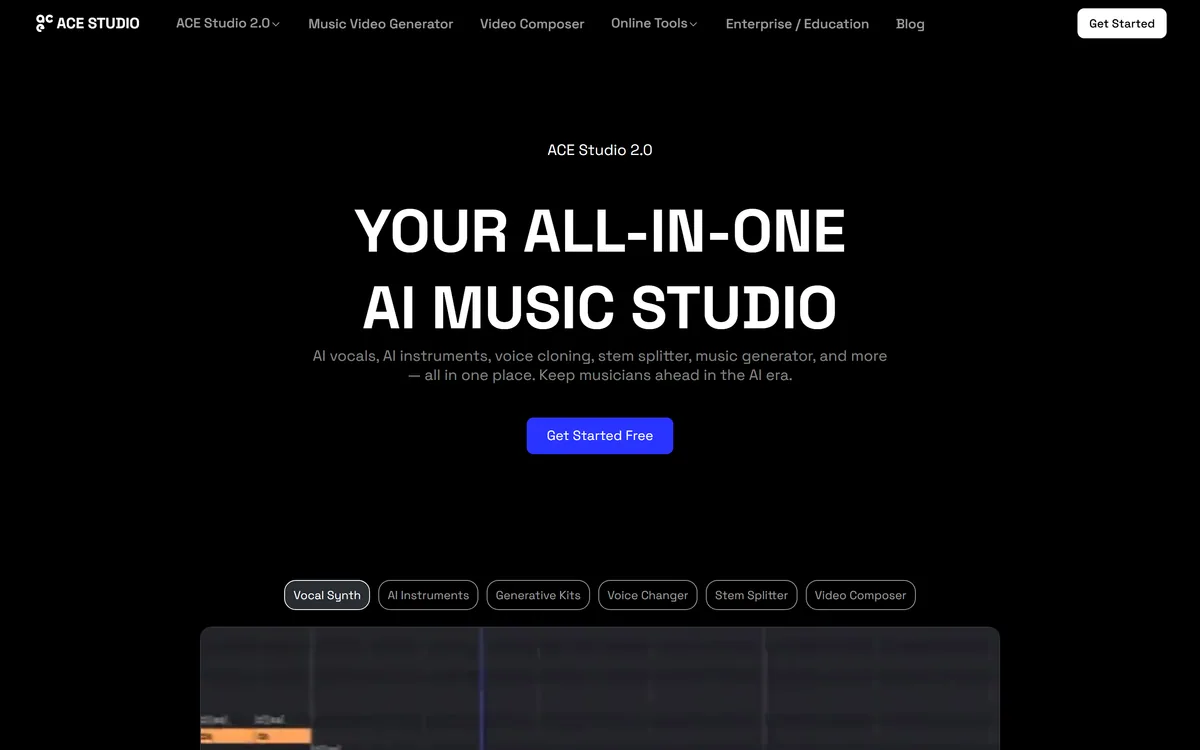
Last checked . Read from acestudio.ai during this check, with the screenshot above captured at the same time.
Voice counts, language coverage and the orchestral recording claim are the vendor's own and were not independently verified. Cloning a voice that is not your own raises likeness and publicity rights that vary by jurisdiction and are separate from copyright — get written permission for the specific use, and read the platform's own terms on commercial release before publishing anything.
ACE Studio has an AInexfinder Editor Score of 4.2/5.
AInexfinder does not list plan prices or billing details. For current pricing, plans, and trials, visit the official ACE Studio website.
Visit official website for pricingVendor pricing, credits, and billing policies change over time. Always confirm on the official site before you buy.
Log in to write a review.
No reviews yet. Be the first to share your experience with ACE Studio.
Assigned reviewer
Daniel ReedSenior AI Tools Reviewer
Daniel reviews AI tools the slow way — by actually using them on real projects. His reviews cover what works, what breaks, and who each tool is genuinely a good fit for.
Daniel and the AInexfinder editorial team research ACE Studio using public product information, listing evidence, and (when available) hands-on checks. Scores reflect listing completeness and transparency — not paid placement.
Treblo generates complete songs from a text prompt in any style, with a browsable style library, an Explore feed of what others have made, iOS and Android apps, and a developer section for building on it.
Loudly is a Berlin-built AI music platform spanning generation across four proprietary models and one partner model, a remix engine for songs you own, genre-aware mastering, stem splitting, and distribution to more than 50 platforms — with output stated as rights-cleared at generation.
MusicCreator AI generates tracks up to eight minutes from text, photos or genre prompts, and surrounds that with eighteen further tools including stem splitting, vocal removal, audio-to-MIDI conversion, a MIDI editor, mastering, key and BPM detection and a singing voice generator, across eleven interface languages.
Boomy is a generative music platform from Boomy Corporation in Berkeley, California. It creates original songs in seconds, states that artists receive full commercial rights, and publishes a running total of songs made — 22,123,440 at the time we checked.
MakeSong turns a text description or your own lyrics into a complete track with vocals across a wide genre range, exports to MP3 and WAV, and includes a fuller-than-usual set of editing tools — stem splitting, vocal removal, section replacement, song extension and video generation.

The workspace at www-flux3.com generates 5–20 second AI videos with native audio from text or a starting image, routing across FLUX 3, MiniMax H3, Seedance, Wan 3.0 and Kling 3.0 Pro, at 720p or 1080p with video extension.