Treblo generates complete songs from a text prompt in any style, with a browsable style library, an Explore feed of what others have made, iOS and Android apps, and a developer section for building on it.
FreemiumVideo & Audio
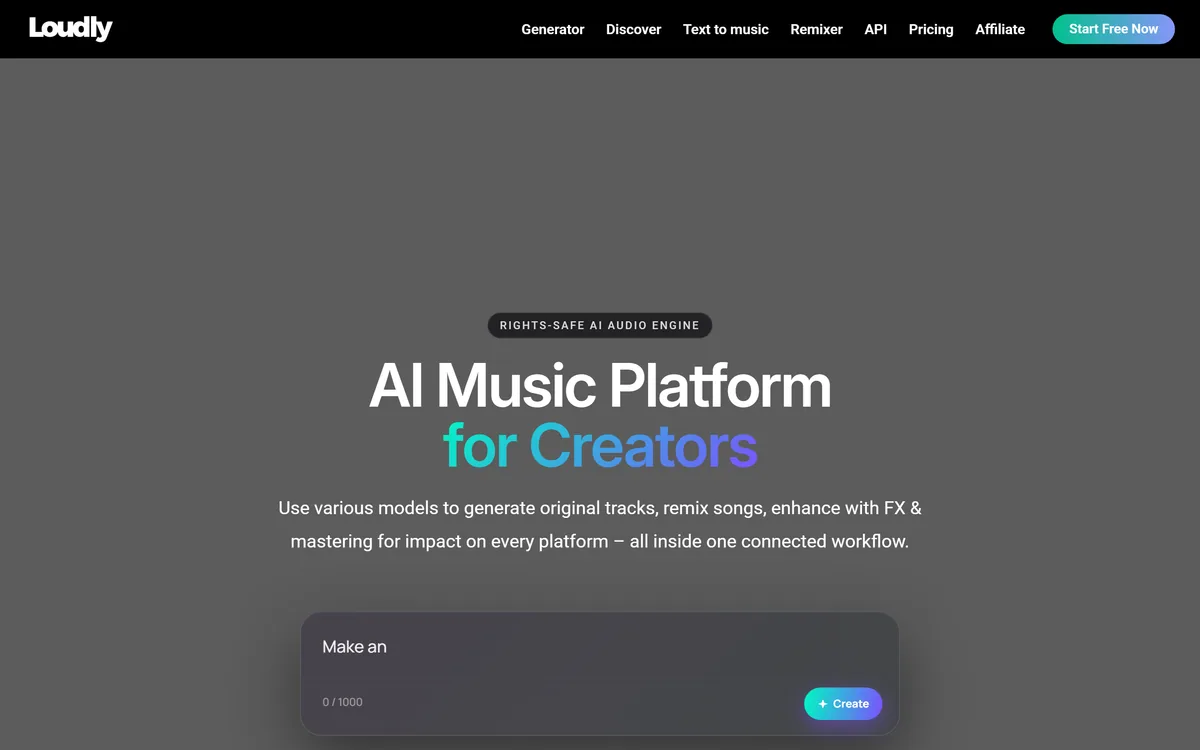
Loudly is a Berlin-built AI music platform spanning generation across four proprietary models and one partner model, a remix engine for songs you own, genre-aware mastering, stem splitting, and distribution to more than 50 platforms — with output stated as rights-cleared at generation.
Generated music has a problem that generated images mostly escaped: the industry it borrows from litigates. Anyone putting a track behind a commercial video is exposed to a question about where the model learnt to make it.
Loudly's answer is architectural rather than reassuring. Its proprietary models are described as rights-cleared by construction, with output cleared when it is generated rather than licensed afterwards.
Around that sit five named models, a track-analysis system called SongDNA, mastering, stem splitting and distribution — a full pipeline rather than a generator.
The claim is unusually specific: all Loudly-proprietary models are rights-cleared by architecture, output is cleared at the point of generation, and there is no retroactive licensing and no litigation surface. Partner models are described as integrated under commercial agreements.
Unpacking that matters, because most of this category makes a vaguer version of the same promise.
The common formulation is that output is royalty-free, which describes what you may do with it and says nothing about where the model learnt. If the training corpus contained material the company had no right to use, a royalty-free licence from that company protects you only as far as that company can be pursued.
Cleared at the point of generation is a claim about the upstream position instead. It says the rights question was settled before the model existed, so nothing arrives later to be licensed.
The distinction between proprietary and partner models is the honest part. Loudly makes its architectural claim only for its own models and describes the partner model as covered by commercial agreement, which is a different assurance — and knowing which model produced a track therefore matters commercially, not just sonically.
Royalty-free describes what you may do with the output. It says nothing about where the model learnt to make it.
SongDNA is described as analysing audio, lyrics, structure, mood, tempo, key, hooks and your own inputs into a reusable fingerprint of a track — and the site states plainly that without it there is no intelligent agency.
That is the most interesting engineering idea on the page, and it addresses a specific failure in music generation.
A model asked to remix or extend a track without structural understanding produces something that sounds adjacent and behaves wrongly — a change at the wrong bar, a key that drifts, an arrangement decision that ignores where the chorus is. It is musically incoherent in ways a listener notices without being able to name.
A structured fingerprint — key, tempo, chord movement, section boundaries, genre proportions — gives every subsequent operation something concrete to reason against. Agent decisions become grounded rather than plausible.
The outputs built on it are the commercially useful part: a generation prompt derived from the track, a formatted playlist pitch, captions matched to the mood, and a hook-first short-form edit. Those are the jobs a musician actually has to do after the music is finished.
The model stack is laid out plainly. VEGA 1 is low-latency and raw, described as ideal for scratch tracks and rapid iteration. VEGA 2 applies production techniques at generation, aimed at professional background music and sync licensing. VEGA 3 adds agentic arrangement, mixing and effects for production-ready instrumentals. MANTA 1 is the only model producing full songs with vocals and lyrics. A partner model handles sample generation.
Publishing that breakdown is rarer than it should be, and it changes how you use the platform.
Most generators present one quality dial and let you discover the trade by wasting credits. Naming the intended use per model — demos, sync licensing, catalogue-quality, full songs, sound design — lets you pick correctly the first time.
The speed and cost dimension is the practical one. Iterating on a brief with a fast raw model and then producing the final version with the highest-capability one is obviously the right workflow, and it is only possible when the tiers are visible.
That instrumentals and vocals come from different models is also worth knowing up front. Only one model in the stack produces vocal tracks, so a project that needs sung lyrics has exactly one path through the platform — which is a constraint MusicCreator AI and others in the category handle differently.
Loudly's own positioning is honest about where generated music belongs: professional background music, sync licensing, platform audio, catalogue tracks and client deliverables.
That is the right list, and the omission is instructive — nothing on it is music anyone listens to on purpose.
Background scoring is a genuine market with genuine requirements: fits the mood, does not distract, clears legally, and costs less than a library licence. Generated music meets all four, which is why this category found commercial traction faster than most.
What it does not do is carry a record. Music people choose to hear is doing something a model is structurally poor at — expressing a specific person's particular experience, which is the entire point of the art form.
The remix engine's own framing acknowledges an adjacent line, stating it does not create soundalike covers and works only on songs you own with rights staying with the holder. That is a deliberate refusal of the most legally dangerous thing this technology can do, and it is worth crediting.
Beyond generation sit three services that make this a pipeline rather than a generator: genre-aware mastering guided by platform loudness targets with no per-download fees and no AI training on uploaded audio, a stem splitter producing DAW-ready WAV or MP3 across vocals, drums, bass, guitar, synth and strings, and distribution to more than 50 platforms with 100 percent of royalties retained.
Mastering is the most quietly valuable of the three.
It is the step independent musicians most often skip or get wrong, and streaming platforms normalise loudness — so a track mastered without regard to those targets sounds quieter and thinner than everything around it, which listeners experience as lower quality without knowing why.
The stated no-training-on-uploads policy matters here specifically. You are uploading finished music you own to a company that also trains music models, and a company that says it does not use it is answering the obvious question rather than leaving it hanging.
Distribution built into the pipeline rather than bolted on is a real convenience, and keeping all royalties is the standard modern distributor position rather than a differentiator — the thing to check is what the platform costs instead. Lyrics are the one part of a song this does not write, which is LyricLab's territory, while Boomy approaches the whole problem from the release end.
The commonest use of generated music is scoring something else, and the commonest mistake is generating first and fitting afterwards.
This sequence produces a track that works with the edit rather than against it.
| Company | Loudly GmbH, Berlin, Germany |
|---|---|
| Positioning | A rights-safe AI audio engine and music platform |
| Proprietary models | VEGA 1 low latency, VEGA 2 production quality, VEGA 3 agentic, MANTA 1 for vocals and lyrics |
| Partner model | A third-party sample generation model, integrated under commercial agreement |
| Rights position | Proprietary model output stated as cleared at the point of generation |
| SongDNA | Analyses audio, lyrics, structure, mood, tempo, key and hooks into a reusable fingerprint |
| SongDNA outputs | Style prompt, playlist pitch, social captions and a hook-first short-form edit |
| Remixer | Works on songs you own; states it does not create soundalike covers |
| Mastering | Genre-aware, guided by platform loudness targets, with no AI training on uploads |
| Stem splitting | Vocals, drums, bass, guitar, synth and strings in WAV or MP3 |
| Distribution | To 50-plus platforms with 100 percent of royalties retained |
| Infrastructure | An API-first offering for platforms embedding audio generation |
Four proprietary generation models with stated use cases
Full song generation with vocals and lyrics
Partner model for sample-level generation
SongDNA track analysis and fingerprinting
Remix engine for songs you own
Genre-aware mastering to platform loudness targets
Stem splitting into six instrument groups
Distribution to 50-plus platforms via an API-first engine
Music tools differ by rights position and by how far past generation they go.
| Tool | Rights position | Beyond generation | Best for |
|---|---|---|---|
| Loudly | Cleared at generation, models named | Mastering, stems and distribution | Commercial background and sync music |
| MusicCreator AI | Stated in its own terms | Generation focused | Quick tracks from a description |
| Boomy | Release-oriented | Distribution | Making and releasing songs quickly |
| LyricLab | Lyrics only | None | The words rather than the music |
| Voicemaker | Speech, not music | Effects and cloning | Narration alongside a score |
Other tools across generation, lyrics and voice.
Last checked . Read from loudly.com in a browser session on the date above, including the full footer. The screenshot was captured at the same time.
What we could not confirm: what rights-cleared by architecture means in terms of the actual training corpus, since no source or licence detail is published; which company supplies the partner sample model's clearance in practice; how the no-litigation-surface claim would operate as a contractual protection; how SongDNA's genre proportions are derived; whether the footer copyright year indicates the site was last updated before the current year; and pricing. We did not generate, master or distribute a track.
Loudly has built its entire architecture around the question the rest of this category avoids: where the training data came from and whether you can safely release the output. Rights-cleared at the point of generation, with no retroactive licensing, is a specific claim rather than a reassuring adjective. Naming five models and telling you what each is actually for is the other unusual thing here. SongDNA is the genuinely novel idea — a structured fingerprint of a track that grounds every subsequent agent action, which is a better answer to musical coherence than more parameters. AInexfinder Editor Score: 4.3/5.
AInexfinder does not list plan prices or billing details. For current pricing, plans, and trials, visit the official Loudly website.
Visit official website for pricingVendor pricing, credits, and billing policies change over time. Always confirm on the official site before you buy.
Log in to write a review.
No reviews yet. Be the first to share your experience with Loudly.
Assigned reviewer
Daniel ReedSenior AI Tools Reviewer
Daniel reviews AI tools the slow way — by actually using them on real projects. His reviews cover what works, what breaks, and who each tool is genuinely a good fit for.
Daniel and the AInexfinder editorial team research Loudly using public product information, listing evidence, and (when available) hands-on checks. Scores reflect listing completeness and transparency — not paid placement.
Treblo generates complete songs from a text prompt in any style, with a browsable style library, an Explore feed of what others have made, iOS and Android apps, and a developer section for building on it.
ACE Studio is an AI music production platform built around singing voice synthesis. You give it MIDI and lyrics and it returns an expressive vocal performance, with 140+ voices across 8 languages, voice cloning, AI instruments, stem splitting and a DAW plugin that brings the whole thing into your session.
MusicCreator AI generates tracks up to eight minutes from text, photos or genre prompts, and surrounds that with eighteen further tools including stem splitting, vocal removal, audio-to-MIDI conversion, a MIDI editor, mastering, key and BPM detection and a singing voice generator, across eleven interface languages.
Boomy is a generative music platform from Boomy Corporation in Berkeley, California. It creates original songs in seconds, states that artists receive full commercial rights, and publishes a running total of songs made — 22,123,440 at the time we checked.
MakeSong turns a text description or your own lyrics into a complete track with vocals across a wide genre range, exports to MP3 and WAV, and includes a fuller-than-usual set of editing tools — stem splitting, vocal removal, section replacement, song extension and video generation.

The workspace at www-flux3.com generates 5–20 second AI videos with native audio from text or a starting image, routing across FLUX 3, MiniMax H3, Seedance, Wan 3.0 and Kling 3.0 Pro, at 720p or 1080p with video extension.