
Treblo generates complete songs from a text prompt in any style, with a browsable style library, an Explore feed of what others have made, iOS and Android apps, and a developer section for building on it.
FreemiumVideo & Audio
Boomy is a generative music platform from Boomy Corporation in Berkeley, California. It creates original songs in seconds, states that artists receive full commercial rights, and publishes a running total of songs made — 22,123,440 at the time we checked.
Most people who need music do not need a song. They need something that sits under a video, fills a room, or occupies ninety seconds of a podcast without anybody thinking about it.
That demand used to be met by stock libraries with licensing terms complicated enough to make lawyers useful. Generative music replaces the library with a generator, and the interesting part is what rights come with the output.
Boomy's answer is direct: you create the song, you get full commercial rights. Combined with a published company address and a public song count, that makes it easier to evaluate than most of its competitors.
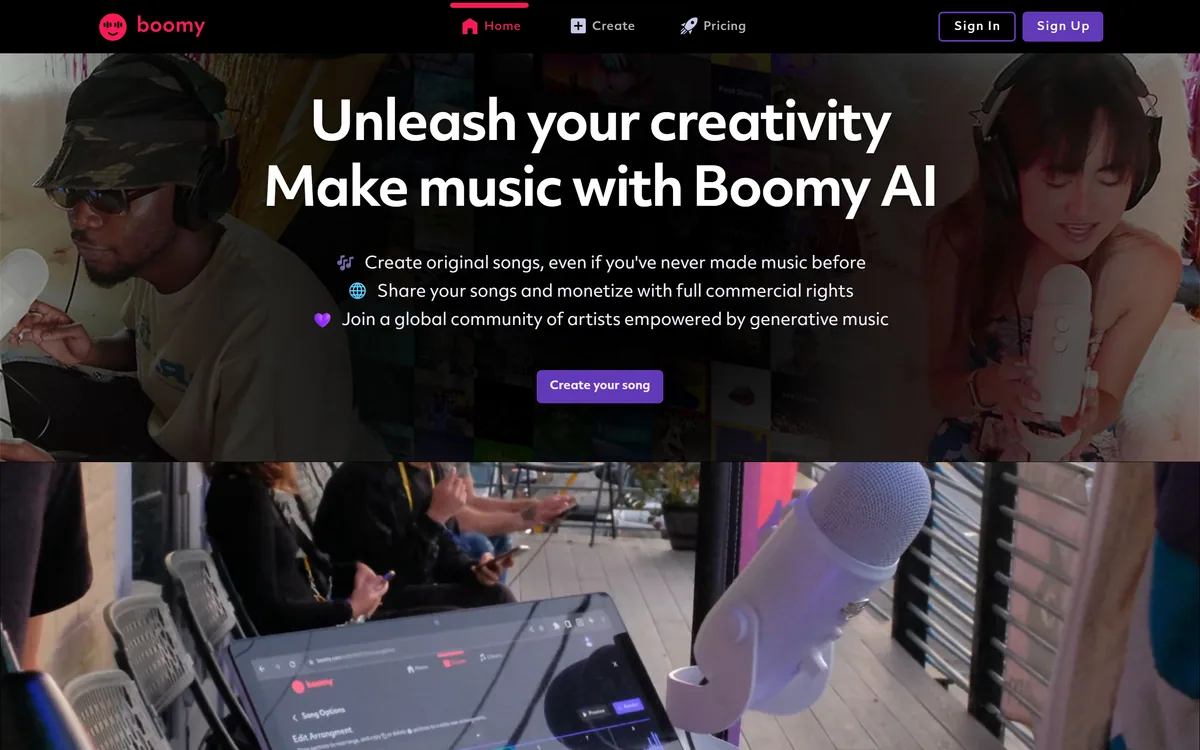
Boomy states that artists receive full commercial rights to the songs they create, which is the single most important claim on the site.
The reason it matters is that rights, not audio quality, are what makes generated music usable. A track you cannot legally put behind a client's advertisement is worthless regardless of how it sounds, and stock libraries have historically made this deliberately confusing with tiered licences and per-use restrictions.
A plain statement of full commercial rights removes that friction, and stating it on the marketing page rather than only in terms of service is a meaningful difference in posture. It is the claim the product is built around.
What you should still do is read the actual terms before anything commercially significant depends on it. Rights language on a homepage is a summary; the enforceable version lives in the terms of service, and the two are worth comparing on any platform.
The related question — whether generated music can be copyrighted at all, and by whom — is unsettled in several jurisdictions and is not something any vendor can resolve for you. Boomy's grant covers what Boomy can grant, which is its own permission, not a guarantee about how a registry or a court will treat the output.
Rights, not audio quality, are what makes generated music usable. A track you cannot legally put behind a client's advertisement is worthless regardless of how it sounds.
Generative music has got good at the things that are measurable and stayed weak at the things that are not.
Structure, key, tempo consistency and mix balance are essentially solved. A generated track will not go out of tune, will not lose the beat, and will have a beginning, a middle and an end in roughly the right places.
What it does not have is a reason to exist. Songs people return to have a specific idea in them — a melodic phrase, a lyrical turn, a production choice that is slightly wrong on purpose — and generation optimises towards the average of what it learned, which is the opposite of specific.
That is not a criticism so much as a description of the fit. For background music, averageness is a feature: you want the track to be unobtrusive and inoffensive, and generated audio is reliably both.
For anything where the music is the point, it fails, and no amount of prompting fixes it. If you want to shape audio you already care about, an audio editor such as RipX DAW is a different and more appropriate class of tool.
Boomy publishes a running total of songs created by its users, reading 22,123,440 when we checked the site.
Publishing a specific number is a choice worth respecting. Most platforms round, or say millions, or say nothing at all, and a precise figure invites the kind of scrutiny vague claims avoid.
The number tells you the platform has real scale and a large body of accumulated output. It also tells you something less comfortable, which is that most of those songs will never be heard by anyone, because generation capacity has outrun listener attention by an enormous margin.
That matters practically if your plan involves distributing generated music to streaming services and earning from it. Volume is not a strategy in a market where twenty-two million competing tracks exist within one platform alone, and streaming services have become progressively less hospitable to bulk uploads.
The realistic use of a tool like this is production rather than release: music you need for something else you are making. That is a smaller ambition than becoming an artist, and it is the one that actually works.
Boomy's footer names Boomy Corporation at 2991 Sacramento St Unit #207, Berkeley, CA 94702, with a copyright notice reading 2019 to 2023.
Publishing a real street address is more unusual than it should be. A large share of AI tools name no company and no jurisdiction, which leaves you with no idea who you are contracting with or where a dispute would be heard.
A named corporation with a physical address in California means you know the answer to both, and it means the rights statement is being made by an identifiable entity. That is worth more than any feature on the page.
The copyright range ending in 2023 is a detail worth noting rather than over-reading. Footer years are often simply not updated, and a stale one is not evidence of an abandoned product — but combined with the absence of recent announcements it is a reasonable prompt to check when the product last changed before you build a workflow on it.
The straightforward way to resolve it is to look at what the product does today rather than what the footer says. Generate something, check whether the interface reflects current model capability, and decide from there.
Boomy generates finished songs, and everything that word implies is also everything it excludes.
It does not edit. If you have audio that exists and needs work — a stem separated, a part retuned, an arrangement changed — that is a different discipline handled by an editor such as RipX DAW. Generation makes new audio; editing changes audio you already care about, and neither substitutes for the other.
It does not repair. Noise, room tone, clipping and the hundred small faults of a real recording are a restoration problem, and restoration tools such as iZotope RX exist because fixing a flawed take is harder than producing a clean synthetic one. A generator has nothing to repair, which is both its advantage and its ceiling.
It does not speak. Narration is a separate model class with separate concerns — pronunciation, pacing, emphasis — and a voice product like Narakeet handles it. If your video needs a voice over the music, that is two tools, not one.
And it does not put pictures to the result. Turning a finished track into something watchable is its own job, addressed by tools such as BeatViz that understand a cut has to relate to the beat. Boomy gives you the audio; the release around it is still yours to assemble.
The failure pattern with generative music is generating fifty tracks and using none of them, because none was made against a real requirement.
This sequence starts from the use rather than from the generator.
| Operating company | Boomy Corporation |
|---|---|
| Address | 2991 Sacramento St Unit #207, Berkeley, CA 94702 |
| Product type | Generative music creation |
| Core promise | Create original songs in seconds, with no experience required |
| Rights | Full commercial rights to created songs, per the site |
| Songs created | 22,123,440 by Boomy artists at the time we checked |
| Footer copyright | 2019 to 2023 as displayed |
| Audience | Anyone making music without training, and creators needing production audio |
Original song generation in seconds
No musical training or instrument required
Full commercial rights to created songs per the site
A public running total of songs created
A named operating company with a published address
Style-based creation aimed at non-musicians
Audio tools split by whether they make the music, shape it, or put pictures to it.
| Tool | What it does | Rights position | Best for |
|---|---|---|---|
| Boomy | Generates original songs from nothing | Full commercial rights stated on the site | Production audio you own and can release |
| RipX DAW | Separates and edits existing audio | You bring your own material | Shaping music that already exists |
| iZotope RX | Repairs and restores recordings | Your own recordings | Fixing audio problems, not creating audio |
| BeatViz | Turns a finished track into a video | Terms not stated on the site | The visual half of a release |
| Narakeet | Generates narration rather than music | Commercial use per its own terms | Voice over video, not soundtrack |
Last checked . Read from boomy.com in a browser session on the date above, with the screenshot captured alongside.
What we could not confirm: pricing and plan structure, which we did not read; the exact wording of the rights grant in the terms of service, which is the enforceable version of the homepage claim and should be read before anything commercial depends on it; which models generate the audio; whether distribution to streaming services is handled by Boomy or by you; output formats and stem availability; and when the product last shipped a change, which the footer year raises as a question rather than answers. We did not generate any music, so nothing here reflects tested audio quality.
Boomy is one of the few generative music tools that puts the commercial question front and centre rather than burying it in terms nobody reads. It states that artists get full commercial rights to what they create, publishes a corporate address in Berkeley, and shows a running count of songs made — which is the kind of specificity that makes a claim checkable. The music itself is what you would expect from generative audio: structurally competent, tonally pleasant, and rarely the reason anyone listens twice. As a source of releasable, ownable background music it does its job. As songwriting it does not, and the site does not really claim otherwise. AInexfinder Editor Score: 3.7/5.
AInexfinder does not list plan prices or billing details. For current pricing, plans, and trials, visit the official Boomy website.
Visit official website for pricingVendor pricing, credits, and billing policies change over time. Always confirm on the official site before you buy.
Log in to write a review.
No reviews yet. Be the first to share your experience with Boomy.
Assigned reviewer
Daniel ReedSenior AI Tools Reviewer
Daniel reviews AI tools the slow way — by actually using them on real projects. His reviews cover what works, what breaks, and who each tool is genuinely a good fit for.
Daniel and the AInexfinder editorial team research Boomy using public product information, listing evidence, and (when available) hands-on checks. Scores reflect listing completeness and transparency — not paid placement.
Treblo generates complete songs from a text prompt in any style, with a browsable style library, an Explore feed of what others have made, iOS and Android apps, and a developer section for building on it.
ACE Studio is an AI music production platform built around singing voice synthesis. You give it MIDI and lyrics and it returns an expressive vocal performance, with 140+ voices across 8 languages, voice cloning, AI instruments, stem splitting and a DAW plugin that brings the whole thing into your session.
Loudly is a Berlin-built AI music platform spanning generation across four proprietary models and one partner model, a remix engine for songs you own, genre-aware mastering, stem splitting, and distribution to more than 50 platforms — with output stated as rights-cleared at generation.
MusicCreator AI generates tracks up to eight minutes from text, photos or genre prompts, and surrounds that with eighteen further tools including stem splitting, vocal removal, audio-to-MIDI conversion, a MIDI editor, mastering, key and BPM detection and a singing voice generator, across eleven interface languages.
MakeSong turns a text description or your own lyrics into a complete track with vocals across a wide genre range, exports to MP3 and WAV, and includes a fuller-than-usual set of editing tools — stem splitting, vocal removal, section replacement, song extension and video generation.

The workspace at www-flux3.com generates 5–20 second AI videos with native audio from text or a starting image, routing across FLUX 3, MiniMax H3, Seedance, Wan 3.0 and Kling 3.0 Pro, at 720p or 1080p with video extension.