
Treblo generates complete songs from a text prompt in any style, with a browsable style library, an Explore feed of what others have made, iOS and Android apps, and a developer section for building on it.
FreemiumVideo & Audio
RipX DAW from Hit'n'Mix Ltd. separates a mixed recording into six or more stems and then into individual notes, which can be retuned, moved, replaced or deleted. It converts audio to MIDI, detects key and scale, and stores work in its own Rip format.
A finished stereo mix is normally a one-way door. Everything has been summed together, and the individual decisions inside it — this note, that instrument, this take — are no longer separable by any conventional means.
Stem separation opened that door part way. Splitting a mix into vocals, drums, bass and other is now widely available and genuinely useful, and it stops there: you get four fixed recordings instead of one.
RipX goes a step further, and it is the step that matters. It separates into notes, which means a wrong note in a guitar part inside a finished master is something you can select, retune, or remove.
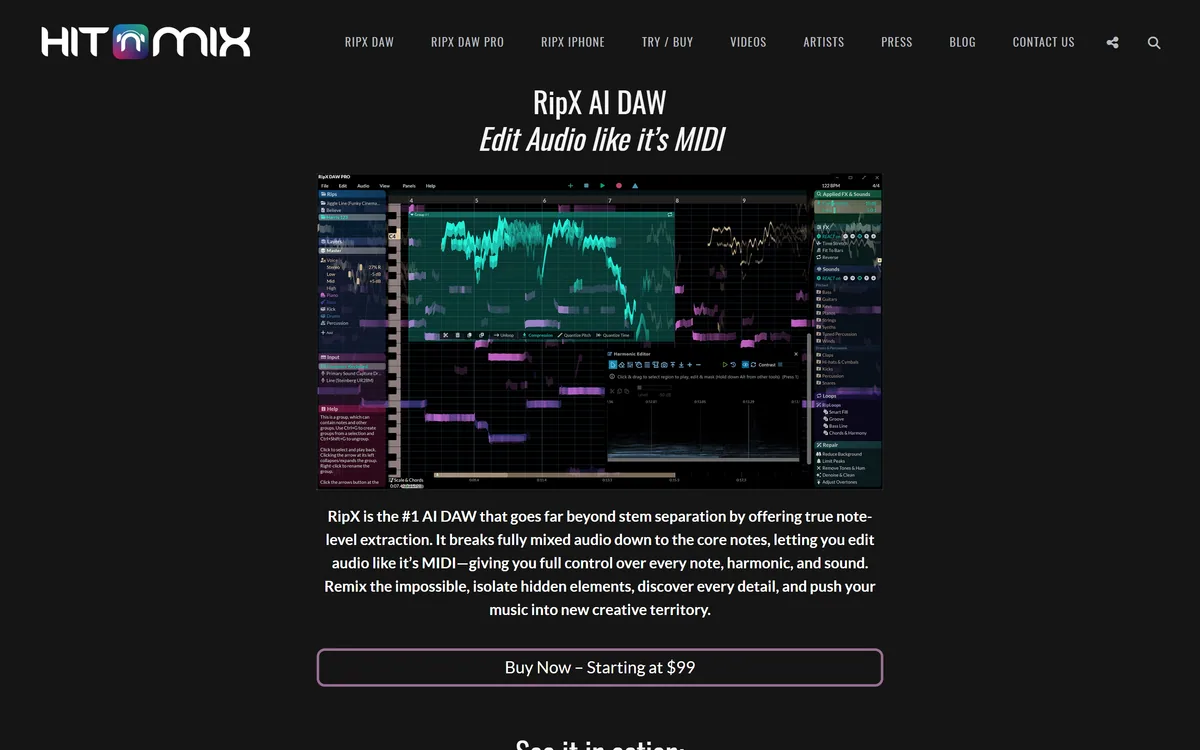
RipX separates a mixed recording into six or more stems and then decomposes those into individual notes, each of which can be retuned, moved, replaced or deleted.
The conceptual jump is worth stating plainly. Conventional audio editing works on regions of time — you can cut a passage, fade it, filter it. Note-level editing works on musical events, so the unit you manipulate is the note rather than the second.
That changes what is possible rather than what is convenient. Fixing a single flat note in the third chorus of a mastered track is not a difficult edit in conventional tools; it is an impossible one, because the note exists mixed with everything else happening at the same moment.
The obvious uses follow: correcting a performance nobody can re-record, removing an instrument from a mix, transposing a part without transposing the whole track, and extracting a melody accurately enough to use elsewhere.
The less obvious use is educational, and it may be the strongest. Being able to isolate and examine what each instrument in a recording is actually playing, note by note, is a way of learning music that has never previously existed outside of transcription by ear.
That is a different ambition from repair. iZotope RX separates dialogue and rebalances a mix to fix how a recording sounds; this changes what it plays.
Fixing one flat note in a mastered track is not a hard edit in conventional tools. It is an impossible one, because the note exists mixed with everything happening at that moment.
RipX stores work in its own Rip format rather than in conventional audio files, and understanding why explains both a benefit and a constraint.
A WAV file is a sequence of samples. It has no concept of a note, an instrument or a musical event, which is precisely why editing inside one is so limited — there is nothing structured to edit.
The Rip format holds the decomposed representation: which notes exist, which stem each belongs to, their pitch, timing and character. That structure is what makes note-level editing possible at all, and no standard format carries it.
The constraint is portability. Work saved in a proprietary format is readable by the software that made it, and a project you built over weeks is not something you can hand to a collaborator using anything else.
The practical discipline is therefore to export at milestones rather than only at the end. Rendered audio and MIDI both leave the container, and having those means a project remains usable even if your relationship with the software changes.
Separation quality varies enormously with the material, and knowing the pattern saves a great deal of wasted effort.
What separates well is anything the model has strong priors for and that occupies distinct space. A lead vocal over a clear arrangement, a bass line in its own register, drums with their characteristic transients — these come apart convincingly because they are distinguishable in the first place.
What separates badly is anything overlapping. Two guitars playing similar parts in the same register, a vocal doubled with harmonies, a dense mix where everything occupies the middle. The model must guess which energy belongs to which source, and when the sources are similar it guesses wrong.
Heavily processed material is the other hard case. Reverb, distortion and heavy compression blur the boundaries the separation depends on, which is why a modern loudness-maximised master separates worse than an older, more dynamic recording of the same music.
Artefacts are the tell. Isolated stems that sound acceptable under a full mix reveal watery smearing and phasing the moment they are heard alone — which is why auditioning a separated stem in isolation, before building anything on it, is the single most useful habit with this class of tool.
The same caution applies to every separation product, including the Music Rebalance module in a post suite and one-pass cleaners such as AudioCleaner AI: judge the result alone, not under a mix.
The workflow that gets the most from RipX starts by choosing material it can actually separate.
Attempting a dense modern master as a first project is how people conclude the technology does not work.
RipX serves several audiences whose needs look similar and are not, and the edition choice follows from which one you are.
Remixers and producers use it to extract usable parts from finished recordings — a vocal, a drum break, a bass line — which is the most common use and the one most affected by separation quality.
Post-production and restoration use is narrower and higher-stakes: removing an instrument that cannot be re-recorded, fixing a performance in an archive recording, or salvaging material where the multitrack is lost.
Musicians and teachers use it differently again, as a transcription and analysis tool. Audio-to-MIDI conversion combined with key and scale detection turns a recording into something readable, which is a genuinely new way to study a piece of music.
The rights question applies across all three and is worth stating plainly rather than as a footnote. Separating a commercial recording produces stems you have no licence to use, and the technical ability to isolate a vocal has no bearing on whether you may release it. Clear that before, not after.
For spoken material none of this is the right shape, and a transcript-driven editor like Descript gets to the same edits far faster.
Separation of a mixed recording into six or more stems
Note-level editing — retune, move, replace or delete individual notes
Sound replacement inside a finished mix
Audio-to-MIDI conversion of performances
Musical key and scale detection with Auto Pitch To Scale
Built-in effects including Formant Shift, Harmony, Vibrato and Delay
Automatic tempo matching when copying between tracks
Three editions including a desktop PRO tier and an iPhone version
Audio tools divide by the unit they let you edit: a region, a spectrogram, or a note.
| Tool | Editing unit | Separation | Best for |
|---|---|---|---|
| RipX DAW | Individual notes | Six or more stems, then notes | Changing what a recording plays |
| iZotope RX | Regions of the spectrogram | Dialogue and music rebalance | Repairing damaged recordings |
| Descript | Words in a transcript | Speech isolation | Dialogue-led editing |
| Async | A described edit | Voice cleanup | Coarse edits without a timeline |
| AudioCleaner AI | The whole file | Automated cleanup | One-pass tidying rather than editing |
| Operating company | Hit'n'Mix Ltd. |
|---|---|
| Product type | AI digital audio workstation with note-level editing |
| Editions | RipX DAW, RipX DAW PRO, RipX iPhone |
| Stem separation | Six or more stems from a mixed recording |
| Note editing | Retune, move, replace or delete individual notes inside mixed audio |
| Key detection | Musical scale and key detection, with Auto Pitch To Scale |
| Built-in effects | Reverse, Delay, Vibrato, Harmony, Formant Shift, Low Pass, High Pass |
| MIDI | Audio-to-MIDI conversion |
| Timing and pitch | Tempo and pitch adjustment, with automatic tempo matching on paste |
| Stereo | Panning, including for mono tracks |
| File format | Proprietary Rip format |
| Audio interface | ASIO compatible |
| Footer | Company Info, Terms Of Use, Contact Us, Privacy Policy |
Last checked . Read from the RipX DAW product page on hitnmix.com, with the screenshot above captured in the same session.
What we could not confirm: pricing, or what separates RipX DAW from RipX DAW PRO in features; system requirements and supported operating systems; plugin format support such as VST or AU; which models perform the separation; any measured separation quality benchmark; how the iPhone edition relates to the desktop one; and export format options out of the Rip container. We did not use the software, so nothing here reflects tested separation quality.
RipX does something genuinely unusual rather than doing a familiar thing well. Stem separation is now widely available; separating further into individual notes, so that a wrong note inside a finished stereo mix can be retuned or deleted, is a different capability and one that almost nothing else offers. For remixing, sampling, restoration and education, that turns a fixed recording back into editable material. It scores highly and not perfectly because separation quality varies enormously with the source, and because the Rip format means your work lives in a proprietary container. AInexfinder Editor Score: 4.3/5.
AInexfinder does not list plan prices or billing details. For current pricing, plans, and trials, visit the official RipX DAW website.
Visit official website for pricingVendor pricing, credits, and billing policies change over time. Always confirm on the official site before you buy.
Log in to write a review.
No reviews yet. Be the first to share your experience with RipX DAW.
Assigned reviewer
Daniel ReedSenior AI Tools Reviewer
Daniel reviews AI tools the slow way — by actually using them on real projects. His reviews cover what works, what breaks, and who each tool is genuinely a good fit for.
Daniel and the AInexfinder editorial team research RipX DAW using public product information, listing evidence, and (when available) hands-on checks. Scores reflect listing completeness and transparency — not paid placement.
Treblo generates complete songs from a text prompt in any style, with a browsable style library, an Explore feed of what others have made, iOS and Android apps, and a developer section for building on it.
ACE Studio is an AI music production platform built around singing voice synthesis. You give it MIDI and lyrics and it returns an expressive vocal performance, with 140+ voices across 8 languages, voice cloning, AI instruments, stem splitting and a DAW plugin that brings the whole thing into your session.
Loudly is a Berlin-built AI music platform spanning generation across four proprietary models and one partner model, a remix engine for songs you own, genre-aware mastering, stem splitting, and distribution to more than 50 platforms — with output stated as rights-cleared at generation.
MusicCreator AI generates tracks up to eight minutes from text, photos or genre prompts, and surrounds that with eighteen further tools including stem splitting, vocal removal, audio-to-MIDI conversion, a MIDI editor, mastering, key and BPM detection and a singing voice generator, across eleven interface languages.
Boomy is a generative music platform from Boomy Corporation in Berkeley, California. It creates original songs in seconds, states that artists receive full commercial rights, and publishes a running total of songs made — 22,123,440 at the time we checked.
MakeSong turns a text description or your own lyrics into a complete track with vocals across a wide genre range, exports to MP3 and WAV, and includes a fuller-than-usual set of editing tools — stem splitting, vocal removal, section replacement, song extension and video generation.