Async is the platform formerly known as Podcastle, rebranded in January 2026. It edits video and audio through conversational prompts: removing filler and bad takes, cleaning audio with Magic Dust, generating B-roll, dubbing, lipsync and voice cloning, across Async Studio and Async API.
In January 2026, Podcastle stopped being a podcasting company. It rebranded as Async and repositioned around a much broader claim: one platform where a creator edits video, a marketing team localises content, and a developer builds a voice agent, all on the same models.
That is a substantial change of scope, and it is worth understanding before evaluating anything the product does today. Anyone arriving from a bookmark, an old tutorial or a two-year-old recommendation is looking for a tool that no longer exists under that name.
The underlying technology did not change. What changed is who it is sold to and what the interface asks you to do — which is now, primarily, to describe the edit rather than perform it.
Async, Formerly Podcastle
Podcastle rebranded as Async in January 2026, moving from a podcasting tool to a broader AI media platform.
Existing accounts, projects, pricing tiers and billing carried across unchanged, per the company's own announcement.
Two divisions: Async Studio for creators, Async API for developers building on the same models.
Editing happens through conversation — fix rough cuts, cut to the beat, clean audio, generate B-roll, add captions.
Magic Dust is the audio cleanup, alongside dubbing, lipsync, voice cloning, eye contact correction and background blur.
What Did The Podcastle Rebrand Change?
The company announced the rebrand in January 2026, framing it as a shift from a dedicated podcasting tool to a unified AI media platform, with the CEO's stated position that the next generation of creators want to direct rather than edit.
Practically, three things changed. The name and domain moved to async.com. The scope widened from audio-led podcast production to video as the primary surface. And the business split into two: Async Studio for people making content, Async API for developers embedding the same capabilities.
What did not change matters as much. The announcement states that accounts, projects, pricing tiers and billing structures all remain the same, and that users keep access to their existing workflows. That is the right way to handle a rebrand, and it is not always how they are handled.
The company reports $23.5M in total funding, with backers including Andrew Ng's AI Fund, Mosaic Ventures, RTP Global, Point Nine and Sierra Ventures. That is relevant mainly as a signal about durability — a rebrand this broad is usually a bet funded by someone.
The honest question for an existing Podcastle user is whether a broader product serves them better. A podcaster who wanted a podcast tool now has a video platform with podcasting inside it, and breadth frequently means the original use case stops getting the attention it did.
Renames are more common in this category than they should be, and each one quietly breaks documentation. A tool such as quso.ai went through the same thing, and so did Gemini Notebook.
The announcement is explicit that accounts, projects, pricing and billing carried across unchanged. That is the right way to handle a rebrand, and not how they are usually handled.
Studio And API Are Two Businesses
Async operates through Async Studio and Async API, serving distinct users on the same models, and that structure explains most of the product decisions.
Studio is the creator-facing application: record, edit, clean, caption, clip, publish. It is judged on whether the interface makes a finished video faster.
API is infrastructure: the same speech synthesis, recognition and voice models, called from someone else's software. It is judged on latency, reliability and cost per unit, and its customers never open the Studio.
Running both from one model stack is efficient and creates a genuine tension. The features an API customer wants — determinism, parameters, predictable output — are frequently the opposite of what a Studio user wants, which is a good default and no decisions.
For a buyer, the useful read is which side you are on. If you are choosing between Async and a creator tool, compare Studio and ignore the API entirely; if you are building a product, compare the API against speech infrastructure vendors, where the competition is quite different.
Chat-Driven Editing Is Faster And Coarser
Async's central interaction is conversational: you describe the edit — remove the filler, cut to the beat, clean the audio, generate B-roll — rather than performing it on a timeline.
For coarse work this is genuinely faster, and the reason is that describing an intention takes seconds while executing it takes minutes. "Remove every pause longer than a second" is one sentence and a hundred manual edits.
It is also better for people who cannot edit. A timeline is an expert interface, and a large number of people who need video produced have no intention of learning one — which is exactly the market a chat interface opens.
For precise work it is worse, and predictably so. Any edit where the exact frame matters, where the decision is aesthetic rather than describable, or where you would know it when you see it, is a job for a timeline. You cannot describe a cut you have not yet chosen.
The workable pattern is therefore chat for the pass that removes obvious problems, and a timeline for anything the result still gets wrong. Treating conversational editing as a first pass rather than as the whole workflow is what keeps it useful.
The nearest philosophical neighbour is Descript, which edits the transcript rather than the conversation — both are attempts to escape the timeline, from different directions.
Use conversational editing for the coarse pass — filler, pauses, bad takes, levels.
Move to a timeline for anything where the exact frame matters.
Check dubbed output with a native speaker before publishing to that market.
Get written consent for any cloned voice that is not your own.
Compare Studio if you are a creator, and the API separately if you are building.
Magic Dust And The Audio Half
Magic Dust is Async's audio cleanup — noise removal and voice clarity — and audio remains where the platform's heritage shows.
That heritage is an advantage. Podcastle spent years on speech, and speech is the hardest part of most video: viewers forgive poor footage far more readily than poor sound, and bad audio is the most common reason an otherwise decent video is unwatchable.
The cleanup tools are also the ones with the clearest limits. Noise reduction attenuates what an algorithm believes is noise, and pushing it hard produces the watery quality that identifies over-processed speech instantly. The right target is not distracting rather than clean.
Voice cloning, dubbing and lipsync sit alongside, and these carry an obligation rather than a limitation. Cloning a voice that is not yours, or dubbing a guest into another language in their own voice, requires that person's explicit written consent for that specific use — a release for recording an interview does not cover synthesising new speech from it.
Eye contact correction is the one to use most sparingly. It works by altering where someone appears to be looking, which is a small change with a strange effect: viewers frequently sense that something is off without being able to identify what.
For audio that needs rescuing rather than cleaning, none of this is enough, and a spectral repair suite like iZotope RX is the tool that actually recovers a damaged take.
Moving A Podcast Workflow Onto Async
For an existing Podcastle user, the practical question is whether the same workflow still runs. For a new user, it is whether a video-led platform suits an audio-led job.
Either way, test on an episode you have already published, where you know what the finished version should sound like.
Take a published episode and run the raw recording through the conversational cleanup pass.
Compare the result against the version you actually shipped, listening on laptop speakers rather than headphones.
Check specifically what the automatic filler removal took out that you would have kept — pauses carry meaning in interviews.
Test one dubbed language with a native speaker before assuming localisation is solved.
Verify that your existing projects and settings carried across the rebrand as stated.
Decide separately whether the video features are useful to you, or whether you now pay for a platform you use a quarter of.
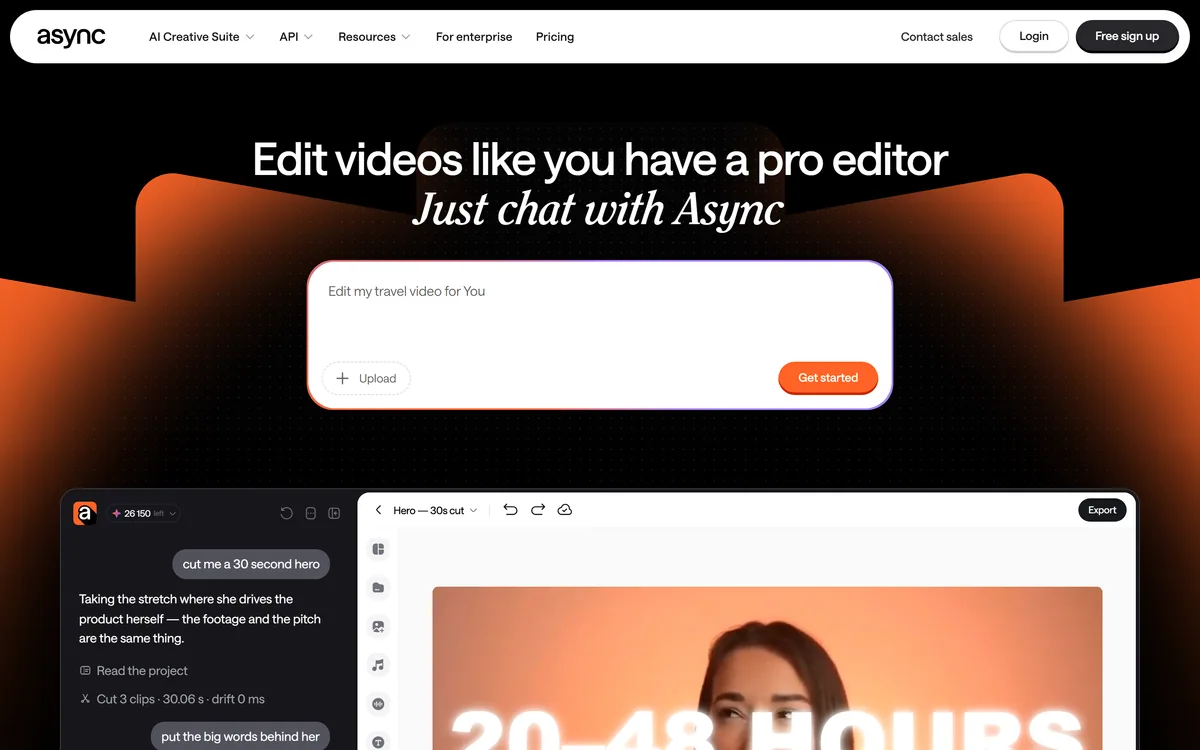
Async's homepage, captured 9 September 2026, showing the platform under its post-rebrand identity.
Async: Rebrand And Backing
Current name
Async
Former name
Podcastle
Rebrand date
January 2026
Current domain
async.com, with podcastle.ai redirecting
Divisions
Async Studio for creators, Async API for developers
CEO and founder
Arto Yeritsyan
Funding
$23.5M total, per the company's announcement
Backers named
Andrew Ng's AI Fund, Mosaic Ventures, RTP Global, Point Nine, Sierra Ventures
Editing
Conversational — fix rough cuts, remove filler and bad takes, cut to the beat
Audio
Magic Dust for noise removal and voice clarity
Generation
B-roll, visuals, scenes and music
Localisation
AI dubbing, lipsync and multilingual AI voices
Other features
Captions and subtitles, social clips, voice cloning, eye contact correction, background blur
Continuity
Accounts, projects, pricing tiers and billing stated as unchanged through the rebrand
Key features of Async
Conversational editing that removes filler, pauses, repeats and bad takes
Cut to the beat, syncing edits to music and mood
Magic Dust for noise removal and voice clarity
Generation of B-roll, visuals, scenes and music
Captions, subtitles and social-format clip generation
AI dubbing with lipsync and multilingual AI voices
Voice cloning, eye contact correction and background blur
Async API for developers building on the same models
Pros & cons
Pros
6
The rebrand preserved accounts, projects, pricing and billing rather than breaking them
Conversational editing is genuinely faster for coarse work and open to non-editors
Years of speech heritage show in the audio tooling, which is where most video fails
Studio and API let the same models serve creators and developers
Named CEO, stated funding and named backers rather than an anonymous vendor
Dubbing and lipsync in the same tool as editing removes a handoff
Cons
6
Anyone arriving from an old bookmark or tutorial is looking for a product that no longer exists by that name
Chat is the wrong interface for frame-accurate or aesthetic edits
A podcaster who wanted a podcast tool now owns a broader platform
Automatic filler removal takes out pauses that carried meaning in interviews
Voice cloning and dubbing carry consent obligations the marketing does not foreground
Underlying models, dubbing language count and retention policy are all undisclosed
Best For
Creators producing video alongside audio who wanted one tool
People who need video edited and will never learn a timeline
Teams localising content into several languages
Developers wanting speech models through an API
Existing Podcastle users whose workflow carried across
Async Beside Other Video Editors
Editing tools differ on what you manipulate: a timeline, a transcript, or a conversation.
iZotope RX — when audio needs rescuing rather than cleaning
Vmaker AI — recording and repurposing in one platform
ElevenLabs — if the voice models themselves are what you are buying
Confirming The Podcastle Rebrand
Last checked . Read from async.com and the company's own rebrand announcement, with the screenshot above captured in the same session.
podcastle.ai returns a 308 permanent redirect to async.com
The site presents the product as Async, described in its markup as an AI video editor
Rebrand from Podcastle to Async confirmed by the company's own announcement, dated January 2026
Two divisions confirmed as Async Studio and Async API
CEO and founder named in the announcement as Arto Yeritsyan
Total funding stated as $23.5M
Backers named as Andrew Ng's AI Fund, Mosaic Ventures, RTP Global, Point Nine and Sierra Ventures
Announcement states accounts, projects, pricing tiers and billing structures remain unchanged
Conversational editing confirmed for fixing rough cuts, removing filler, pauses, repeats and bad takes
Magic Dust confirmed for noise removal and voice clarity
Generation confirmed for B-roll, visuals, scenes and music
Captions and subtitles, social clips, AI dubbing, lipsync, voice cloning, eye contact correction, background blur and multilingual AI voices all confirmed as listed features
What we could not confirm: which underlying models power the editing, dubbing or voice cloning; pricing tiers and how they map to the old Podcastle plans; API rate limits, latency figures or pricing; how many languages dubbing supports; retention and deletion policy for cloned voices and uploaded recordings; and whether any Podcastle feature was removed rather than carried across. We did not use the product, so nothing here reflects tested output.
Editor's Verdict
4.0/5
The rebrand is the story here, and it is a genuine repositioning rather than a new logo. Podcastle was a podcasting tool; Async is a chat-driven creative suite covering video, dubbing, lipsync and voice, split into a Studio for creators and an API for developers. That is a coherent bet on the same underlying speech technology serving two customers, and existing accounts, projects and billing carried across unchanged. It scores where it does because chat-driven editing is genuinely faster for coarse work and genuinely worse for precise work, and because a podcaster who liked Podcastle now owns a broader tool they did not ask for. AInexfinder Editor Score: 4.0/5.
Async pricing
AInexfinder does not list plan prices or billing details. For current pricing, plans, and trials, visit the official Async website.
Vendor pricing, credits, and billing policies change over time. Always confirm on the official site before you buy.
Frequently asked questions
What happened to Podcastle?
It rebranded as Async in January 2026, moving from a dedicated podcasting tool to a unified AI media platform covering video, dubbing, lipsync and voice. podcastle.ai now redirects to async.com. The company's announcement states that accounts, projects, pricing tiers and billing structures all remain unchanged.
What is Async?
A chat-driven AI creative suite for video and audio. You describe the edit — remove the filler, cut to the beat, clean the audio, generate B-roll — rather than performing it on a timeline. It runs as Async Studio for creators and Async API for developers building on the same underlying models.
Did my Podcastle projects survive the rebrand?
The company's announcement states that all accounts, projects, pricing tiers and billing structures remain unchanged and that users retain access to existing workflows. That is the correct way to handle a rebrand — but verify your own projects rather than assuming, since we could not test it.
Is conversational editing actually better?
For coarse work, yes — describing an intention takes seconds where executing it takes minutes, and "remove every pause longer than a second" is one sentence and a hundred manual edits. For precise work it is worse, because you cannot describe a cut you have not yet chosen. Use chat for the first pass, a timeline for the rest.
What is Magic Dust?
Async's audio cleanup — noise removal and voice clarity. Audio is where the platform's Podcastle heritage shows, and it matters because viewers forgive poor footage far more readily than poor sound. The usual caution applies: push noise reduction hard and speech acquires that watery, over-processed quality.
Do I need consent to clone or dub a voice?
Yes, for any voice that is not your own. Dubbing a guest into another language in their own voice means synthesising speech they never gave, and a release covering the original recording does not automatically cover that. Get explicit written permission for the specific use before enabling it.
What is the Async API for?
Developers embedding the same speech synthesis, recognition and voice models into their own software — voice agents, for instance. It is judged on latency, reliability and cost, and its customers never open Studio. If you are building rather than creating, compare it against speech infrastructure vendors instead of against editing apps.
Should I still use Async if I only make audio podcasts?
Possibly, but with eyes open. The product's centre of gravity has moved to video, and breadth usually means the original use case stops getting the attention it once did. If you liked Podcastle for exactly what it was, the honest question is whether you now pay for a platform you use a quarter of.
How good is the automatic filler removal?
Fast, and worth checking rather than trusting. The specific thing to review is what it removed that you would have kept — in interviews, a pause frequently carries meaning, and a version with every silence stripped can sound relentless in a way the original did not.
Who backs Async?
The rebrand announcement states $23.5M in total funding, with backers including Andrew Ng's AI Fund, Mosaic Ventures, RTP Global, Point Nine and Sierra Ventures. That matters mainly as a durability signal: a repositioning this broad is a funded bet rather than a change of logo.
Daniel reviews AI tools the slow way — by actually using them on real projects. His reviews cover what works, what breaks, and who each tool is genuinely a good fit for.
Daniel and the AInexfinder editorial team research Async using public product information, listing evidence, and (when available) hands-on checks. Scores reflect listing completeness and transparency — not paid placement.
Listings may include affiliate or sponsored placements, which are labeled when present. Editorial scores and cons are not sold. See our affiliate disclosure and review methodology.
Cleanvoice AI cleans podcast and video audio automatically: filler words, background noise, mouth sounds, breaths, stutters and dead air. It exports an editable timeline back to Audition, Reaper, DaVinci Resolve and Audacity rather than locking you into its own editor.
The workspace at www-flux3.com generates 5–20 second AI videos with native audio from text or a starting image, routing across FLUX 3, MiniMax H3, Seedance, Wan 3.0 and Kling 3.0 Pro, at 720p or 1080p with video extension.
Runway is an AI video platform built around generative world models — Gen-4.5, Aleph 2.0, and Act-Two for performance capture — split across Runway Creative for filmmakers, Runway Dev for builders, and Runway Robotics.
Descript is a video and audio editor that works by editing a transcript — delete a sentence and the footage goes with it — plus Studio Sound, Eye Contact, filler-word removal, AI voices, avatars, and the Underlord assistant.
Treblo generates complete songs from a text prompt in any style, with a browsable style library, an Explore feed of what others have made, iOS and Android apps, and a developer section for building on it.
kling3ai.co is an independent interface offering video generation through Kling 3.0 and Seedance models, with multi-shot storyboarding, motion control and 4K output. It is not Kuaishou's official Kling service, which runs at kling.ai.