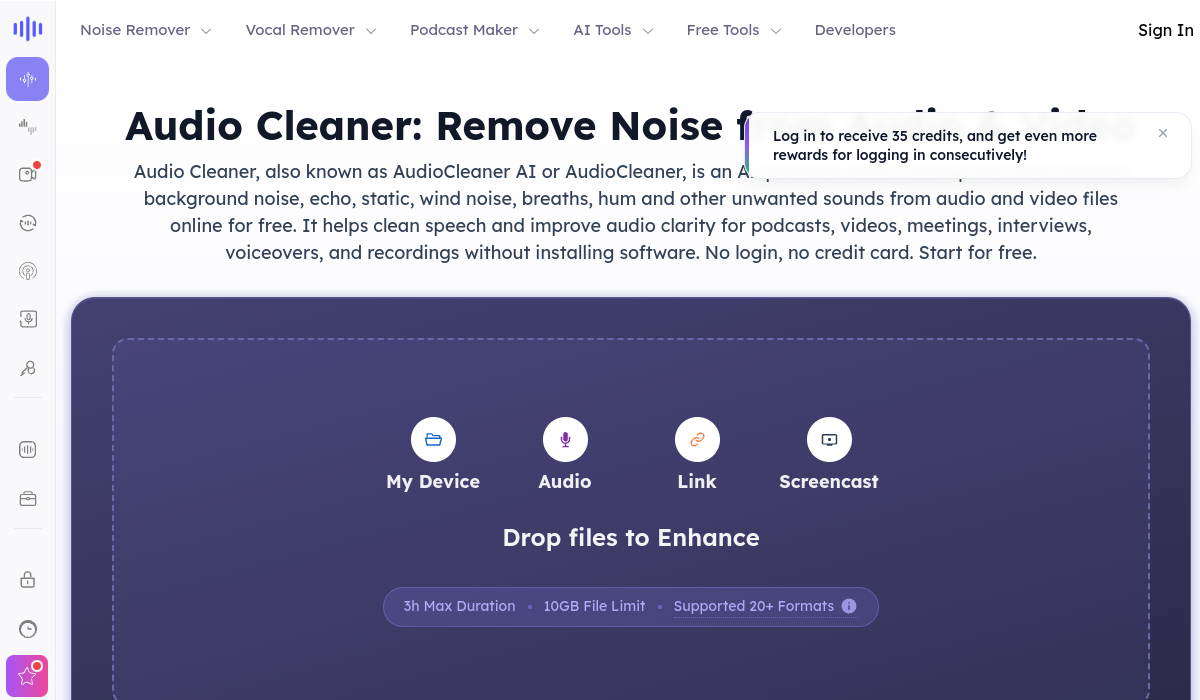
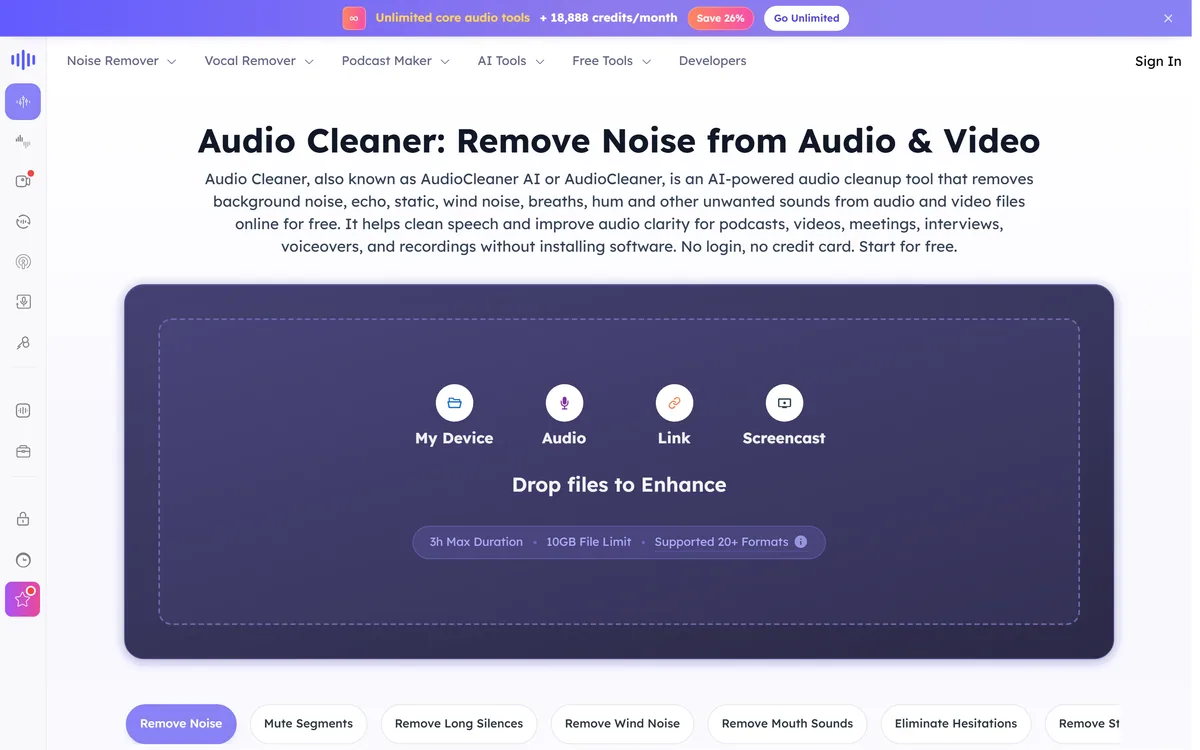
AudioCleaner AI removes background noise, echo, static, wind, breaths, hum and reverb from audio and video, and separates mixes into stems — vocals, drums, guitar, bass and piano. It handles 20+ formats up to 3 hours and 10GB, and states that uploaded and edited files are deleted after one day.
audiocleaner.ai7 viewsAdded November 22, 2025113K visitors
Bad audio ruins more recordings than bad video does, and it is far less forgiving. Viewers will tolerate a soft picture for an hour and will abandon a clear one with hum on the voice inside a minute.
The recordings this matters for are usually the ones that cannot be redone, which is why podcast-specific tools such as Cleanvoice AI exist alongside general cleaners. An interview that will not happen again, a lecture recorded once, a call where the important thing was said over a bad line.
AudioCleaner AI addresses that, and it does something slightly unusual for a browser tool: it publishes its limits on the homepage rather than burying them in a plan comparison. Three hours, ten gigabytes, twenty-plus formats. That transparency is the right instinct, and it makes the tool easy to assess before uploading anything.
What Does AudioCleaner AI Fix?
Two different jobs: removing unwanted sound — noise, echo, static, wind, breaths, hum, reverb — and separating a mix into individual stems.
Generous limits for a browser tool: 3 hours maximum duration and a 10GB file limit, across 20+ formats including MP3, MP4, WAV, MOV, WMA and AAC.
Files are deleted after one day — both originals and edited versions — which is a specific, checkable commitment.
Free credits on registration, plus 10 more every 24 hours up to three times, so it can be tested properly before paying.
Video is handled too, not just audio, which matters because most bad audio arrives attached to a video file.
AudioCleaner AI's homepage, captured 9 September 2026. The limits — three hours, ten gigabytes, twenty-plus formats — are stated on the page rather than hidden in a plan comparison.
Freemium with paid subscription plans; amounts not disclosed
Noise Removal And Stem Splitting Are Different Problems
The site covers both, and they are worth separating because one is far more reliable than the other.
Noise removal is subtractive. Hum, hiss, air conditioning and wind occupy identifiable parts of the frequency spectrum, and a model trained to recognise them can attenuate them while leaving speech intact. When the noise is steady and distinct from the voice, results are frequently excellent.
Stem splitting is separative, and much harder. Pulling vocals, drums, bass and guitar out of a finished mix means undoing a sum — the instruments were combined into two channels and the information distinguishing them is genuinely entangled. Modern separation is remarkably good and it always leaves artefacts, usually audible as a watery quality on the isolated vocal.
The practical implication is about expectation rather than quality. Cleaned dialogue can be broadcast. Separated stems are excellent for practice, for a remix, for karaoke or for reference — and rarely good enough to present as a clean original recording.
Transcript editors such as Descript bundle some of this. Echo and reverb removal sits between the two and is the hardest of the common tasks, because reverb is the room repeating the voice rather than a separate sound. Expect improvement rather than elimination.
Noise removal takes away something that was added. Stem splitting tries to undo a sum — and something is always lost in the arithmetic.
What Cleanup Cannot Repair
It is worth being direct about the limits, because they are physical rather than a matter of model quality.
Clipping is unrecoverable. When a recording was too loud, the peaks were flattened at the point of capture and that waveform information no longer exists. Software can smooth the distortion; it cannot restore what was never recorded.
Speech buried under louder speech is close to unrecoverable too, because separation depends on the target being distinguishable, and a competing voice occupies the same frequencies as the one you want.
Very heavy compression from a bad phone line or a low-bitrate export has already discarded audio data permanently, and no cleanup restores it.
The one intervention that dwarfs all of these is prevention: a cheap external microphone placed close to the speaker beats any amount of post-processing on a laptop microphone across a room. Cleanup is for the recording you already have, not a substitute for making a better one.
Should You Remove Every Breath?
AudioCleaner AI lists breath removal alongside noise and hum, and this deserves a note because it is the setting most often overdone.
Speech contains breath. Removing it entirely produces audio that is technically cleaner and subtly wrong — listeners register the result as processed without being able to say why, and long-form content becomes oddly tiring to listen to.
The same applies to aggressive silence trimming. Natural pauses carry meaning, and a voice with every gap closed sounds rushed regardless of the actual speaking speed.
The judgement depends on format, and on whether a publishing tool such as Rebel Audio is already processing the file. For a short advertisement or a tightly cut explainer, heavy processing is fine and expected. For a long interview or a podcast, restraint is better — the goal is audio that sounds like a good recording rather than audio that sounds edited.
The reliable test is to process one minute at your chosen settings and listen to it uninterrupted before applying anything to a full recording. Problems that are inaudible in a ten-second sample become obvious across sixty seconds.
Process one minute and listen to it fully before applying settings to an entire recording.
Use lighter breath removal on long-form content than on short-form.
Preserve natural pauses; closing every gap makes a voice sound rushed.
Do noise removal before any loudness normalisation, or you amplify the noise first.
Keep the original file, since every cleanup is a lossy decision you may want to revisit.
One-Day Deletion Is A Real Commitment
The site states plainly that it stores both your original and edited files for one day, after which they are permanently removed.
That is a specific, time-bound and checkable statement, and it is meaningfully better than the vague reassurance most file-processing tools offer. A retention policy with a number attached is one a company can be held to.
It matters here more than in many categories, because audio uploads are frequently confidential: recorded interviews with named sources, client calls, medical or legal discussions, and lectures with attendees who never agreed to anything.
There is a practical consequence to plan around as well as a privacy benefit. One day means download promptly — a file you leave until the weekend is gone. For a batch project, work in sessions rather than uploading everything and processing gradually.
The caveat is the usual one: a stated policy is a promise rather than an audited control, and no third-party attestation accompanies it. For genuinely sensitive material — privileged legal recordings, unpublished journalism with confidential sources — local processing on your own machine remains the more defensible choice regardless of what any cloud tool promises.
Testing It On Your Worst Recording
The free credits make this genuinely testable, and the right test uses your hardest file rather than a clean sample.
The bar is step three. A tool that cannot rescue your typical bad recording is not one you will reach for when it matters.
Register for the free credits and pick the worst recording you actually need fixed, not a demonstration file.
Process a one-minute excerpt first rather than the whole thing, so you spend one credit learning the settings rather than several.
Listen to that minute on the device your audience will use — phone speakers and headphones expose completely different artefacts.
Try one setting at a time. Noise removal, then echo, then breath, so you can hear which one caused any degradation.
If stem splitting is what you need, test on a mix you know well and listen specifically for the watery quality on the isolated vocal.
Download everything before the day is out, since files are deleted after 24 hours.
The Credit Model And What Is Missing
New users receive 35 free credits on registration plus 10 more every 24 hours, up to three times, with paid subscription plans above that; amounts are not disclosed on the pages we read.
That free allocation is generous enough to be a real evaluation rather than a teaser, and the daily top-up structure is well judged — it lets someone with one occasional recording use the tool indefinitely without paying, which builds the habit that eventually converts.
What is not published is more concerning than the pricing. No company name or legal entity appears on the pages we read, and no underlying AI model or provider is named. For a tool processing confidential audio, knowing who operates it is a reasonable thing to want.
The tool list is also very broad — noise removal, vocal removal, podcast generation, audio translation, transcription, voice changing, cover generation and editing. Breadth like that usually means depth in one or two and thin coverage elsewhere.
The sensible approach is to use it for the cleanup it does well and to evaluate any adjacent tool separately rather than assuming the whole suite is equally good.
Key features of AudioCleaner AI
Removal of background noise, static, wind, hum and mouth sounds
Echo and reverb reduction on recordings made in poor rooms
Breath removal and silence handling for speech content
Vocal isolation and removal from finished mixes
Stem splitting into vocals, drums, guitar, bass and piano
Support for 20+ audio and video formats up to 3 hours and 10GB
Free credits on registration with a daily top-up allowance
Adjacent tools for transcription, translation, voice changing and podcast generation
Pros & cons
Pros
6
Three-hour and ten-gigabyte limits are unusually generous for a browser-based tool
Limits and formats are published on the homepage rather than hidden in a plan comparison
A specific one-day deletion policy, which is a commitment a company can be held to
Free credits plus a daily top-up allow genuine evaluation and occasional use without paying
Video files accepted directly, which matters since most bad audio arrives attached to video
Covers both cleanup and separation, which are usually two different tools
Cons
6
No company name or legal entity is published, despite the tool processing confidential audio
No underlying AI model or provider is named
Whether processing happens locally or on a server is not stated, which is the privacy question that matters
The very broad tool list suggests wide coverage rather than depth in the core cleanup
One-day retention means you must download promptly, which is awkward for batch projects
Stem separation always leaves artefacts, which limits output to reference and practice rather than release
Best For
One-off recordings that cannot be made again
Long files that exceed other browser tools' duration limits
Bad audio attached to video footage
Occasional users covered by the daily free credit allowance
Musicians wanting stems for practice or remixing
AudioCleaner Versus The Other Options
Audio tools split between cleanup, editing and generation. Buying the wrong one means paying for capability you will never open.
Tool
Primary job
Where it runs
Best for
AudioCleaner AI
Noise removal and stem separation
Browser, with 3-hour and 10GB limits
One-off cleanup of a recording that cannot be redone
A recording that cannot be redone — an interview, a lecture, a one-off call with hum or hiss on it.
Long files, where three-hour and ten-gigabyte limits beat most browser tools comfortably.
Bad audio attached to a video file, since video formats are accepted directly.
Occasional use, where the daily free credit top-up covers your needs without a subscription.
Stem separation for practice, remixing or reference rather than for release.
Use something else for
Clipped or heavily compressed audio, where the information was destroyed at capture and cannot be restored.
Confidential material such as privileged legal recordings, where local processing is more defensible than any cloud promise.
Regular podcast production, where a workflow-integrated tool saves more time than a standalone cleaner.
Editing as well as cleaning, which needs a transcript-based editor rather than a processor.
Stems intended for release, where separation artefacts will be audible to a listener.
Other Audio Tools Worth Comparing
Cleanup, editing and production are three different purchases that all involve audio.
Cleanvoice AI — podcast-specific cleanup integrated into a production workflow
Descript — editing by transcript with cleanup included, if you need to cut as well as clean
Rebel Audio — the whole podcast pipeline through to publishing
Speechmatics — transcription, which cleaner audio makes considerably more accurate
MakeSong — generating music with stems, rather than separating existing tracks
Confirming AudioCleaner's Limits
Last checked . Read from audiocleaner.ai, including the footer, with the screenshot above captured in the same session.
Noise removal confirmed as covering background noise, echo, static, wind noise, breaths, hum, mouth sounds and reverb
Separation confirmed as vocal isolation and stem splitting across vocals, drums, guitar, bass and piano
Format support stated on the site as 20+ formats including MP3, MP4, WAV, MOV, WMA and AAC
Limits stated on the site as 3 hours maximum duration and a 10GB file limit
Video file support confirmed alongside audio
Retention policy quoted from the site: original and edited files stored for 1 day, then permanently removed
Free allocation confirmed as 35 credits on registration plus 10 additional credits every 24 hours, up to three times
Paid subscription plans confirmed as available, with amounts not listed on the page we read
Footer read directly and confirmed to carry an extensive list of tool links covering noise removal, vocal removal, podcast generation, audio translation, transcription, voice changing, cover generation and audio editing
What we could not confirm: no company name or legal entity appears on the pages we read, which for a tool processing confidential audio is a reasonable thing to want; no underlying AI model or provider is named; whether processing happens in the browser or on a server is not stated explicitly, which matters for the privacy question; no pricing amounts or per-credit consumption rates are published; the retention commitment is stated rather than independently attested; and we did not process audio, so nothing here reflects tested output quality.
Editor's Verdict
3.7/5
AudioCleaner AI scores fairly because it is generous where it counts and clear about the things that usually go unstated: three-hour duration and ten-gigabyte file limits are unusually permissive for a browser tool, twenty-plus formats covers what people actually have, and a one-day deletion policy is a specific commitment rather than vague reassurance. Free credits on registration plus a daily top-up make it genuinely testable. It loses ground because no company name or legal entity is published, no underlying model or provider is named, and the breadth of adjacent tools suggests a wide surface rather than depth in the core cleanup. AInexfinder Editor Score: 3.7/5.
AudioCleaner AI pricing
AInexfinder does not list plan prices or billing details. For current pricing, plans, and trials, visit the official AudioCleaner AI website.
Vendor pricing, credits, and billing policies change over time. Always confirm on the official site before you buy.
Frequently asked questions
What does AudioCleaner AI do?
It does two things: removes unwanted sound from recordings — background noise, echo, static, wind, breaths, hum, mouth sounds and reverb — and separates finished mixes into stems such as vocals, drums, guitar, bass and piano. It accepts 20+ audio and video formats up to 3 hours and 10GB.
How long are my files kept?
One day. The site states that both original and edited files are stored for 1 day and then permanently removed. That is a specific, checkable commitment and better than most file-processing tools offer — but it also means you should download your results promptly, because a file left until the weekend will be gone.
Is AudioCleaner AI free?
There is a genuinely usable free allocation: 35 credits on registration plus 10 more every 24 hours, up to three times, with paid subscription plans above that. Amounts are not disclosed. The daily top-up means someone with one occasional recording can use it indefinitely without paying.
Can AudioCleaner AI fix any bad recording?
No, and the limits are physical rather than a matter of quality. Clipping is unrecoverable, because loud peaks were flattened at capture and that waveform data no longer exists. Speech buried under louder speech and heavily compressed phone audio are similarly beyond repair. Cleanup helps with added noise, not with information that was never recorded.
How good is the stem splitting?
Good enough for practice, remixing, karaoke and reference — and rarely good enough to present as a clean original recording. Separation tries to undo a sum, and something is always lost in the arithmetic, usually audible as a watery quality on the isolated vocal. Test on a mix you know well and listen for it specifically.
Should I remove all the breaths from my recording?
Probably not. Speech contains breath, and removing it entirely produces audio that is technically cleaner and subtly wrong — listeners register it as processed without knowing why, and long-form content becomes tiring. Use lighter settings on interviews and podcasts, heavier ones on short advertisements where processed audio is expected.
Is it safe to upload confidential recordings?
The one-day deletion policy is a good sign and a stated promise rather than an audited control, with no third-party attestation. The site also does not publish a company name or say whether processing happens locally or on a server. For genuinely sensitive material — privileged legal recordings, journalism with confidential sources — local processing on your own machine remains more defensible.
Can it clean audio in a video file?
Yes. Video formats including MP4, MOV and others are accepted alongside audio formats, which matters because most bad audio arrives attached to video rather than as a standalone file. That saves the step of extracting the audio track, cleaning it, and recombining it yourself.
What are the file limits?
Three hours maximum duration and a 10GB file limit, across more than twenty formats. Both are unusually generous for a browser-based tool, and the fact that they are published on the homepage rather than buried in a plan comparison makes the tool easy to assess before uploading anything.
How does it compare with Cleanvoice or Descript?
Cleanvoice is built specifically for podcast workflows and integrates into them, which saves more time if you publish regularly. Descript cleans and edits by transcript, which you want if you need to cut as well as clean. AudioCleaner is the better fit for one-off cleanup of a recording that cannot be redone, particularly a long one.
Daniel reviews AI tools the slow way — by actually using them on real projects. His reviews cover what works, what breaks, and who each tool is genuinely a good fit for.
Daniel and the AInexfinder editorial team research AudioCleaner AI using public product information, listing evidence, and (when available) hands-on checks. Scores reflect listing completeness and transparency — not paid placement.
Listings may include affiliate or sponsored placements, which are labeled when present. Editorial scores and cons are not sold. See our affiliate disclosure and review methodology.
Cleanvoice AI cleans podcast and video audio automatically: filler words, background noise, mouth sounds, breaths, stutters and dead air. It exports an editable timeline back to Audition, Reaper, DaVinci Resolve and Audacity rather than locking you into its own editor.
The workspace at www-flux3.com generates 5–20 second AI videos with native audio from text or a starting image, routing across FLUX 3, MiniMax H3, Seedance, Wan 3.0 and Kling 3.0 Pro, at 720p or 1080p with video extension.
Runway is an AI video platform built around generative world models — Gen-4.5, Aleph 2.0, and Act-Two for performance capture — split across Runway Creative for filmmakers, Runway Dev for builders, and Runway Robotics.
Descript is a video and audio editor that works by editing a transcript — delete a sentence and the footage goes with it — plus Studio Sound, Eye Contact, filler-word removal, AI voices, avatars, and the Underlord assistant.
Treblo generates complete songs from a text prompt in any style, with a browsable style library, an Explore feed of what others have made, iOS and Android apps, and a developer section for building on it.
kling3ai.co is an independent interface offering video generation through Kling 3.0 and Seedance models, with multi-shot storyboarding, motion control and 4K output. It is not Kuaishou's official Kling service, which runs at kling.ai.