TTSReader turns text, PDFs, and EPUB files into speech in the browser, with voice and language selection, speed control, text highlighting, and MP3 export — the free tier runs on browser voices with no usage cap.
FreemiumVideo & Audio
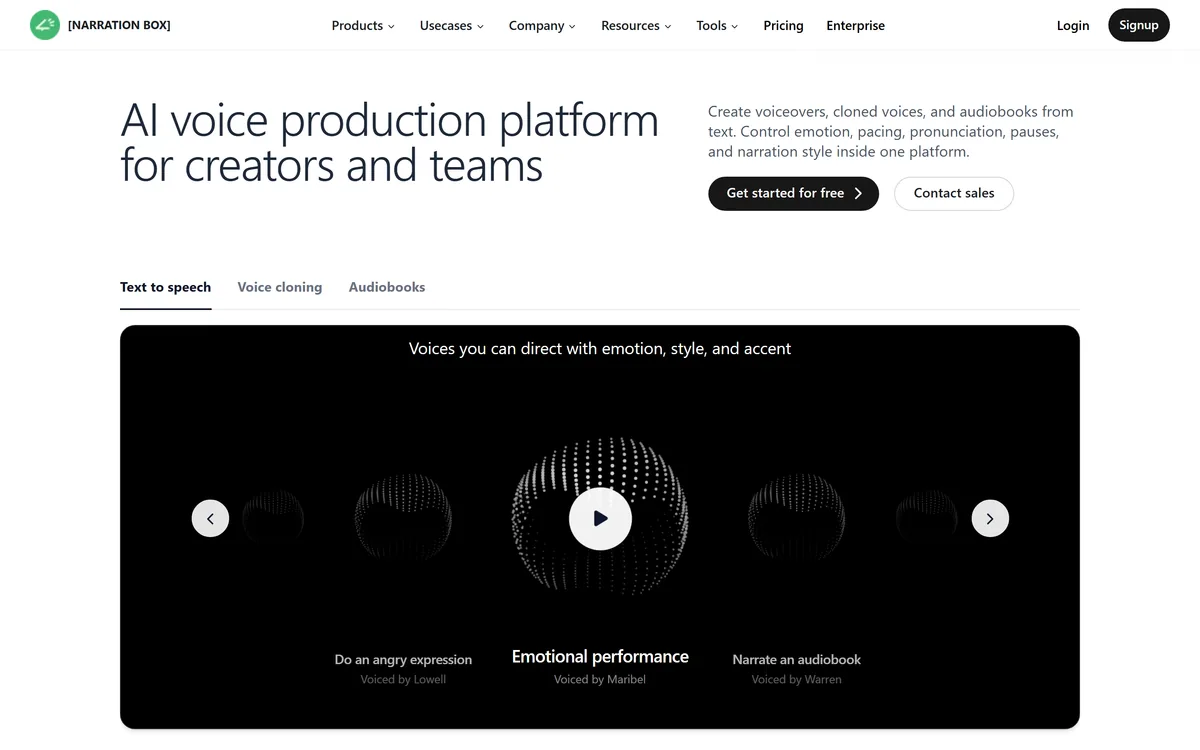
Narration Box is a voice production platform for creators and teams, covering text to speech across 1,500-plus narrators and 80-plus languages, voice cloning from 30 seconds, and an audiobook creator that parses EPUB, PDF and DOCX files into chapters with per-narrator assignment and per-passage regeneration.
| Positioning | An AI voice production platform for creators and teams |
|---|---|
| Narrators | 1,500-plus AI voices |
| Languages | 80-plus languages and accents |
| Voice models | Two named generations, with the newer described as multilingual |
| Cloning | From 30 seconds of audio |
| Studio | Block-based, splitting scripts, chapters and documents into editable sections |
| Direction controls | Emotion, accent, language, speed, pauses and delivery style |
| Expression tags | Short inline tags marking where the performance should change |
| Audiobook input | EPUB, PDF and DOCX, parsed into chapters |
| Audiobook workflow | Edit paragraphs, assign narrators, regenerate passages and download chapter audio |
| Use cases published | Audiobooks, YouTube voiceover, ad voiceover and corporate training |
| Tiers | A free start, with enterprise and sales contact routes |
Narration Box describes a block-based studio splitting scripts, chapters and documents into editable blocks that can be generated, previewed, revised and exported individually.
That architecture exists because long-form audio breaks every assumption a short-clip tool makes.
A thirty-second advertisement is generated once. If it is wrong you regenerate it, and the cost is thirty seconds. A ten-hour audiobook is not one generation — it is thousands, and something will be wrong in some of them.
Without block-level control, correcting a mispronounced name on page ninety means regenerating that entire chapter, which changes the audio everywhere else too. Prosody varies between generations, so the fixed chapter no longer matches the one before it.
Blocks make the edit local. Fix a paragraph, regenerate that paragraph, and the rest of the chapter is untouched — which is the difference between an audiobook you can actually produce and one you abandon in the third round of corrections.
Fixing a mispronounced name on page ninety should not change the audio on page one. That is what block-level generation buys you.
The platform describes directing the overall delivery and then adding short inline expression tags where the performance should change, alongside controls for emotion, accent, language, speed and pauses.
That two-level structure is the right model for long-form, and it differs from how most tools work.
A single emotion setting applied to a whole book produces exactly what listeners complain about: a narrator who reads a murder and a breakfast in identical tones. A tag-only approach has the opposite problem, requiring annotation of every paragraph across ten hours.
Setting a base delivery and marking exceptions is how a human narrator actually works. They have a voice for the book, and they depart from it at specific moments.
The practical benefit is effort proportionate to importance. Most of a chapter needs no annotation at all; the paragraph where something changes gets a tag, and that is perhaps thirty marks in a chapter rather than three hundred.
The audiobook creator accepts EPUB, PDF and DOCX uploads, parses them into chapters, and lets you edit paragraphs, assign narrators, regenerate passages after edits and download chapter audio for a publishing workflow.
Automatic chapter parsing sounds administrative and removes a genuinely large amount of work.
An author with a finished manuscript has a file, not a script. Turning it into narration conventionally means copying text out, splitting it manually, tracking which section corresponds to which chapter, and reassembling the audio in the right order — hours of clerical work before a word is spoken.
Parsing the structure directly means the book's own chapters become the production units, and the output is chapter audio files, which is the format distribution platforms expect.
Per-narrator assignment is the feature that makes fiction viable. A book with a framing narrator and a first-person section, or a non-fiction title with quoted passages, benefits from voices that differ — and assigning them per section is how an audio drama gets made rather than a single reading.
The library is stated at 1,500-plus narrators across 80-plus languages and accents, with a newer voice generation described as multilingual.
The multilingual point matters more than the count, and for a reason specific to long-form.
A multilingual voice is the same voice speaking several languages. That is what makes a translated edition sound like the same book rather than a different production — the narrator's identity carries across, which is exactly what a series or a branded channel needs.
The alternative, picking a separate voice per language, means each edition has a different narrator and no continuity at all.
Fifteen hundred voices is a very large library, and the honest caution is that browsing it is not feasible. The practical approach is to filter hard by language and intended use, audition perhaps five, and stop — because for a ten-hour recording the difference between the best voice and the fourth-best matters far less than committing to one and getting the pronunciation work right, which is where Voicemaker's persistent lexicon earns its place too.
The published use cases run from audiobooks — fiction, non-fiction and educational — through YouTube and advertisement voiceover to corporate training, with voice cloning for audiobooks listed separately.
Audiobooks carry rights considerations the other use cases do not, and they are worth settling before production rather than after.
The first is whether you hold audio rights at all. Publishing contracts frequently separate print, ebook and audio, and an author who has licensed a book to a publisher may not be free to produce their own narration of it.
The second concerns distribution. Some audiobook platforms have policies on synthetic narration — requiring disclosure, restricting it, or treating it differently in their catalogue — and those policies change. Producing ten hours of audio before checking where it can be sold is an expensive sequence.
The third is voice cloning specifically. Cloning your own voice for your own book is straightforward; cloning anyone else's requires written permission covering this use, and a thirty-second sample makes obtaining that trivially skippable rather than genuinely difficult. Character-driven work with emotional direction is Noiz AI's strength, and localising finished video Dubbing AI's.
Generated audiobook production fails in the corrections rather than the first pass, which is exactly what the block architecture is for.
This sequence front-loads the work that prevents rework.
Text to speech across 1,500-plus narrators
80-plus languages and accents
Voice cloning from 30 seconds
Block-based script and chapter editing
Per-block generation and regeneration
Inline expression tags over a base delivery
EPUB, PDF and DOCX parsing into chapters
Per-section narrator assignment
Voice tools differ by whether they are built for clips or for hours.
| Tool | Built for | Editing unit | Best for |
|---|---|---|---|
| Narration Box | Long-form audio | Blocks and chapters | Audiobooks and course narration |
| Voicemaker | Narration and voiceover | Projects and tracks | Volume production with pronunciation control |
| Noiz AI | Expressive character work | Passages with emotion tags | Drama and character voices |
| Dubbing AI | Localising video | Whole files | Translating finished media |
| Hume AI | Evaluating voice quality | Samples | Judging rather than producing |
Other voice tools across production, expression and localisation.
Last checked . Read from narrationbox.com in a browser session on the date above, with the screenshot captured at the same time.
What we could not confirm: our capture did not reach the site footer, so we make no claim about what is published there, including the operating company. We also could not confirm whether cloning requires any consent verification; whether a pronunciation lexicon persists across a project, which matters enormously for a book full of names; how the two voice generations differ technically; export formats and audio specifications for publishing; and pricing, including the annual discount promoted on the page. We did not produce audio.
Long-form narration has a specific problem that short-clip tools never encounter: you fix one sentence in chapter four and the entire chapter has to be regenerated. Narration Box's block-based studio is the direct answer — split the script, regenerate the block, keep everything else — and it is the reason this belongs in a different category from general text-to-speech. Parsing EPUB, PDF and DOCX into chapters with per-narrator assignment is real audiobook production tooling. Inline expression tags on top make the delivery directable rather than uniform. AInexfinder Editor Score: 4.1/5.
AInexfinder does not list plan prices or billing details. For current pricing, plans, and trials, visit the official Narration Box website.
Visit official website for pricingVendor pricing, credits, and billing policies change over time. Always confirm on the official site before you buy.
Log in to write a review.
No reviews yet. Be the first to share your experience with Narration Box.
Assigned reviewer
Daniel ReedSenior AI Tools Reviewer
Daniel reviews AI tools the slow way — by actually using them on real projects. His reviews cover what works, what breaks, and who each tool is genuinely a good fit for.
Daniel and the AInexfinder editorial team research Narration Box using public product information, listing evidence, and (when available) hands-on checks. Scores reflect listing completeness and transparency — not paid placement.
TTSReader turns text, PDFs, and EPUB files into speech in the browser, with voice and language selection, speed control, text highlighting, and MP3 export — the free tier runs on browser voices with no usage cap.
VMEG from PixRipple translates and dubs video into 170+ languages using 17,000+ voices, with voice cloning, lip-sync, subtitle generation, batch processing, and API and MCP access for automated localisation.
Respeecher is an enterprise voice cloning and text-to-speech platform used in film, television and games. Its credits include young Luke Skywalker in The Mandalorian and Viktor Vektor in Cyberpunk 2077, and it requires documented performer consent before a voice is used.

ElevenLabs is an AI audio platform covering text to speech, voice cloning, speech recognition, dubbing, music, and conversational voice agents, with a library of 5,000+ voices across more than 70 languages and an API behind every model.

The workspace at www-flux3.com generates 5–20 second AI videos with native audio from text or a starting image, routing across FLUX 3, MiniMax H3, Seedance, Wan 3.0 and Kling 3.0 Pro, at 720p or 1080p with video extension.

Runway is an AI video platform built around generative world models — Gen-4.5, Aleph 2.0, and Act-Two for performance capture — split across Runway Creative for filmmakers, Runway Dev for builders, and Runway Robotics.