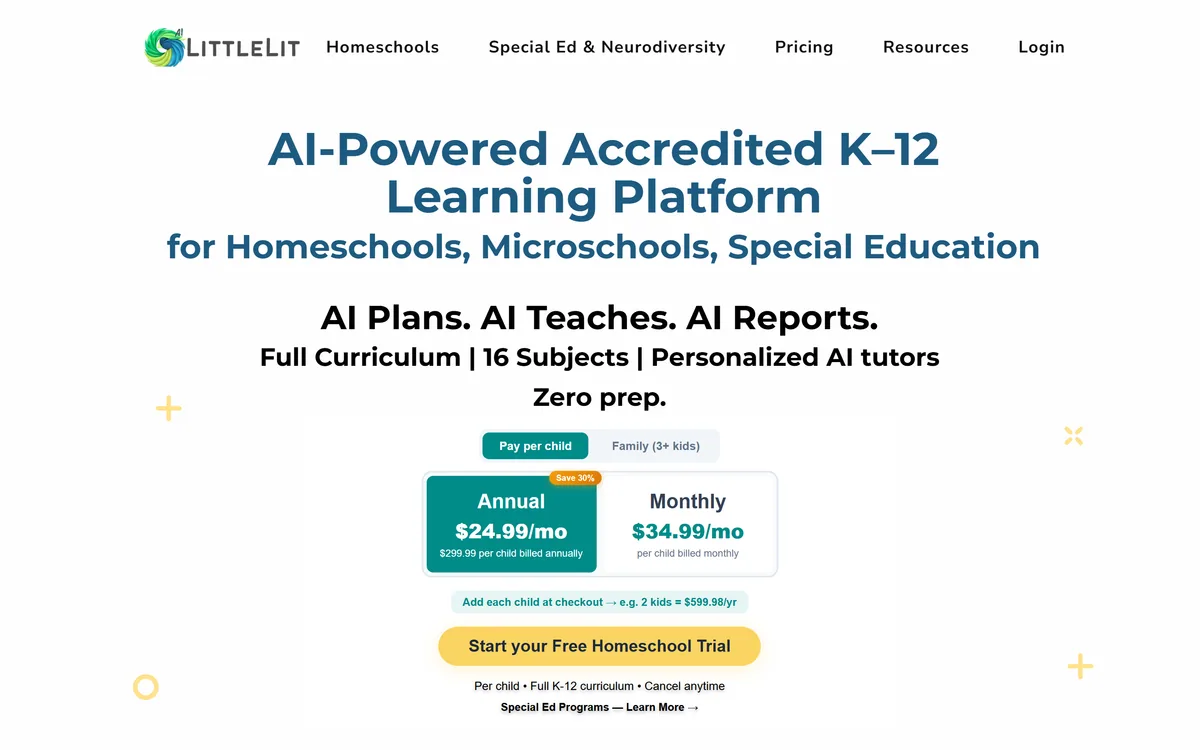
LittleLit AI is an accredited K-12 homeschool platform covering 16 subjects with personalised AI tutors, an automatically built year calendar, on-demand report cards with real grades, and AI-generated gap lessons. It also serves microschools, learning pods and special education programmes.
littlelit.ai8 viewsAdded January 9, 20268K visitors
LittleLit AI's homepage, captured 9 September 2026.
What Does WASC Accreditation Actually Mean?
LittleLit states that it is now a fully accredited K-12 curriculum by WASC, and it is the single most consequential claim on the page.
Accreditation in schooling is not a quality prize. It is an institutional recognition, and its practical value shows up years later.
A homeschooled student applying to college needs a transcript that an admissions office will accept. Without accreditation, a family-produced record is treated with more scrutiny, may need supplementary testing, and in some cases is not accepted at all. Some scholarship programmes and state funding schemes have the same requirement.
An accreditor reviews governance, curriculum, assessment practice and record-keeping against published standards, on a cycle. It says the school meets those standards — not that any particular child will learn well.
The specific thing to verify is scope. Accreditation covers defined programmes and grade ranges, and a company accredited for its curriculum is not automatically covering every product it sells. The right question for any family is whether the accreditation covers the exact programme their child would be enrolled in.
Accreditation is not a quality prize. It is what makes a transcript acceptable to a college admissions office years later.
AI Tutors For Neurodiverse Learners
Special education and neurodiversity is a top-level navigation item, and the site's FAQ specifically addresses whether the platform helps children with ADHD, dyslexia or autism.
There is a real argument for AI tutoring here, and it is worth stating precisely rather than enthusiastically.
What an AI tutor genuinely provides is infinite patience and no social cost. A child who needs the same concept explained eleven times gets it explained eleven times, identically willingly, with no sigh on the eighth and no classmates noticing. For a child who has learnt that asking again is embarrassing, that changes what they are willing to attempt.
Pacing follows the same logic. A tutor that waits is worth a great deal to a learner who processes slowly, and one that skips ahead is worth as much to a child who is bored.
What it does not replace is assessment and intervention. Dyslexia is diagnosed, and dyslexia is remediated with specific structured programmes delivered by trained people. A patient tutor is a genuine support alongside that and is not a substitute for it, and no family should read a curriculum's accessibility features as a therapeutic plan.
Sixteen Subjects And An Automatic Calendar
The platform covers 16 subjects across core, electives and enrichment in one subscription, and states that AI builds the full year calendar automatically.
The calendar is the feature homeschooling parents will recognise as the real one.
The exhausting part of homeschooling is not teaching. It is the planning — sequencing a year across subjects, keeping pace, deciding what comes next, and doing it again every Sunday evening. The site names that directly, and it is the reason families burn out rather than the teaching itself.
Automating the sequence is genuinely valuable because sequencing is a solved problem with published standards behind it. Where multiplication sits relative to division is not a matter of parental judgement.
The all-in-one framing addresses the second complaint the site names: patchwork. Families typically assemble four or five apps and subscriptions, none of which knows about the others, and nobody can answer whether the child is actually on track — which is the same fragmentation argument that makes consolidated platforms win in every category, education included. Single-subject help sits outside that, which is where MathGPT operates.
Confirm the accreditation covers your child's exact programme and grades.
Check whether your state's ESA scheme lists it as an approved vendor.
Use the report cards to find gaps, not to reassure yourself.
Stay in the room — adaptive tutoring is not unsupervised teaching.
Treat neurodiversity support as help alongside assessment, not instead of it.
Reports, Gap Lessons And What They Reveal
The platform offers on-demand report cards with real grades and gap lessons powered by AI, alongside progress tracking.
The gap lesson is the more useful half, and it is the part that justifies AI rather than a static curriculum.
A conventional programme moves at a fixed pace regardless of what was absorbed. A child who half-understood fractions in October carries that into every subsequent topic that depends on them, and the failure surfaces months later as being bad at maths rather than as a specific missing idea.
Detecting that a foundation is weak and inserting a targeted lesson is exactly what an adaptive system should do, and it is close to impossible for one adult teaching several children across sixteen subjects.
Report cards with real grades serve a different purpose again — the record. Homeschooling families need documentation that stands up later, and generating it continuously rather than reconstructing it at year end is a genuine administrative relief. Worth using them to find problems rather than to feel reassured, which is the temptation when the report is about your own child. At the other end of school, ESAI handles the applications that record eventually supports.
Where The Parent Still Has To Be
The site's framing is AI plans, AI teaches, AI reports, with zero prep — and its own FAQ asks whether LittleLit replaces the homeschool parent.
Asking that question openly is to its credit, and the honest answer deserves stating plainly.
What AI does well here is the mechanical work: sequencing, explaining, drilling, assessing against a standard, and generating records. All of that is real and all of it is the part that exhausts parents.
What it cannot do is notice. A child who is quietly anxious about maths, who is coasting on subjects they find easy, who has stopped asking questions, or who is going through something that has nothing to do with school — none of that appears in a progress report, and all of it determines how the year actually goes.
The strongest version of this product is a parent freed from lesson planning and therefore present for the part that needs a person. The weakest is a parent who reads zero prep as zero involvement, and the difference is not something software can control. Conversational practice tools like Praktika carry the same dependency on someone noticing whether it is landing.
Running A Homeschool Year On One Platform
Homeschool programmes fail in the same place every time: enthusiastic September, drift by November, and a scramble to reconstruct records in June.
This sequence uses what the platform automates and keeps the parent where they matter.
Verify the accreditation scope against your child's grade before enrolling.
Check your state's ESA or funding scheme lists it.
Let it build the full year calendar rather than planning term by term.
Sit in on early tutor sessions to see how your child responds.
Read the reports monthly, looking for gaps rather than reassurance.
Keep the conversations, the read-alouds and the noticing for yourself.
LittleLit AI: An Accredited Homeschool Curriculum
Fully accredited K-12 by WASC, which is what makes transcripts and records recognisable to institutions.
Sixteen subjects covering core, electives and enrichment in one subscription, with an automatically built year calendar.
Personalised AI tutors that adapt to how a child learns, with on-demand report cards and AI-generated gap lessons.
Special education and neurodiversity addressed as a named audience alongside homeschools and microschools.
An approved ESA vendor, with published comparison pages against five named alternatives.
LittleLit AI: Scope And Accreditation
Accreditation
Stated as a fully accredited K-12 curriculum by WASC
Coverage
16 subjects across core, electives and enrichment in one subscription
Grades
K-12, with elementary, middle and high school curricula
Planning
AI builds the full year calendar automatically
Teaching
Personalised AI tutors that adapt to the individual learner
Assessment
On-demand report cards with real grades, plus AI-generated gap lessons
Audiences
Homeschools, microschools, learning pods, private schools and special education
Special education
ADHD, autism, dyslexia and gifted curricula each addressed separately
AI literacy
100-plus K-12 AI skills covering safety, responsible use, LLMs and machine learning
Funding
Described as fully covered by ESA funds as an approved vendor
Claimed adoption
10,000-plus homeschool families and 8,000-plus daily AI tutor sessions
Comparisons published
Against Time4Learning, Miacademy, Power Homeschool, Khanmigo and ChatGPT
Key features of LittleLit AI
Accredited K-12 curriculum across 16 subjects
Automatically generated year calendar
Personalised AI tutors per subject
On-demand report cards with real grades
AI-generated gap lessons
AI literacy curriculum across 100-plus skills
Special education and neurodiversity programmes
Interactive projects and hands-on activities
Pros & cons
Pros
7
Accreditation is what makes homeschool records acceptable later
The automatic calendar removes what actually exhausts homeschooling parents
Gap lessons catch weak foundations before they compound into a subject
One subscription replaces a patchwork of apps that do not share progress
Infinite patience genuinely helps children who dread asking again
Continuous record generation beats reconstructing a transcript in June
Its own FAQ asks openly whether it replaces the parent
Cons
7
Accreditation scope is not published and must be verified per programme
Zero prep invites reading as zero involvement, which is the failure mode
Neurodiversity support is not a substitute for assessment or intervention
No qualification stated behind the special education curricula
The underlying models and their safeguards are not described
ESA coverage varies by state and is not enumerated
Social learning is outside what any curriculum platform provides
Best For
Homeschooling families exhausted by planning
Parents who need transcripts that colleges will accept
Microschools and learning pods without a full teaching staff
Families whose child needs an individual pace
Households in states with ESA funding to allocate
LittleLit AI Against Other Homeschool Programs
Learning tools differ by whether they teach a curriculum or support one.
Last checked . Read from littlelit.ai in a browser session on the date above, including the full footer. The screenshot was captured at the same time.
Positioned as an AI-powered accredited K-12 learning platform for homeschools, microschools and special education
Stated as a fully accredited K-12 curriculum by WASC
16 subjects stated across core, electives and enrichment in one subscription
AI stated to build the full year calendar automatically
Personalised AI tutors described as adapting to how a child learns
On-demand report cards with real grades and AI-powered gap lessons stated
Special education, ADHD, autism, dyslexia and gifted curricula each addressed separately
100-plus K-12 AI literacy skills stated, covering safety, responsible use, LLMs and machine learning
Described as fully covered by ESA funds as an approved vendor
10,000-plus homeschool families and 8,000-plus daily AI tutor sessions displayed
Its own FAQ asks whether LittleLit replaces the homeschool parent
Footer confirms state-specific curriculum pages, comparison pages against five named alternatives, free resources and a funding calculator
What we could not confirm: the scope of the WASC accreditation, which covers defined programmes and grade ranges rather than a whole company, and which any family should verify against their child's specific enrolment; which ESA schemes list it and in which states; how the AI tutors are built or what models they use; what the 500,000-plus project figure counts; whether any qualified special education professionals were involved in the neurodiversity curricula; and pricing, which we did not reproduce. We did not enrol a student.
Editor's Verdict
4.0/5
Accreditation is what separates this from every other AI learning app, and it is the thing to understand before anything else — a WASC-accredited curriculum produces transcripts and records that institutions recognise, which matters enormously when a homeschooled student applies to college. The automatic year calendar removes the single most exhausting part of homeschooling. Where we would push back is the framing of zero prep: an AI tutor that adapts to how a child learns is genuinely useful and it does not replace the adult noticing that something is wrong. AInexfinder Editor Score: 4.0/5.
LittleLit AI pricing
AInexfinder does not list plan prices or billing details. For current pricing, plans, and trials, visit the official LittleLit AI website.
Vendor pricing, credits, and billing policies change over time. Always confirm on the official site before you buy.
Frequently asked questions
What is LittleLit AI?
An accredited K-12 homeschool platform covering 16 subjects with personalised AI tutors, an automatically built year calendar, on-demand report cards with real grades and AI-generated gap lessons, also serving microschools and special education.
Why does accreditation matter?
Because it makes records acceptable later. A homeschooled student applying to college needs a transcript an admissions office will accept — without accreditation, a family-produced record faces more scrutiny and is sometimes not accepted at all.
What should I verify about it?
Scope. Accreditation covers defined programmes and grade ranges, and a company accredited for its curriculum is not automatically covered for every product. Ask whether it covers the exact programme your child would be enrolled in.
What does the automatic calendar actually solve?
The part that exhausts people. Homeschooling burnout comes from planning — sequencing a year across subjects, keeping pace, deciding what is next every Sunday — rather than from teaching, and sequencing is a solved problem with published standards behind it.
What is a gap lesson?
A targeted lesson inserted when the system detects a weak foundation. A child who half-understood fractions carries that into everything built on them, and it surfaces months later as being bad at maths rather than as one missing idea.
Does it help children with ADHD or dyslexia?
An AI tutor offers infinite patience and no social cost, which genuinely matters to a child who has learnt that asking again is embarrassing. It is support alongside assessment and structured intervention, not a substitute for either.
Does it replace the homeschool parent?
No, and the site asks that question itself. AI handles sequencing, explaining, drilling and record-keeping. It cannot notice that a child is quietly anxious, coasting, or has stopped asking questions — and that is what determines how a year goes.
Is zero prep accurate?
For planning, largely. The risk is reading it as zero involvement. The strongest version of this is a parent freed from lesson planning and therefore present for the part that needs a person, and software cannot enforce that distinction.
Can ESA funds pay for it?
The site states it is fully covered as an approved ESA vendor. Which schemes and which states is not enumerated, so check your own programme's approved vendor list directly rather than assuming coverage.
How is it different from using ChatGPT with a child?
It publishes a comparison page on exactly that. The substantive differences are accreditation, a sequenced curriculum with assessment and records, and child-safety design — none of which a general assistant provides.
Daniel reviews AI tools the slow way — by actually using them on real projects. His reviews cover what works, what breaks, and who each tool is genuinely a good fit for.
Daniel and the AInexfinder editorial team research LittleLit AI using public product information, listing evidence, and (when available) hands-on checks. Scores reflect listing completeness and transparency — not paid placement.
Listings may include affiliate or sponsored placements, which are labeled when present. Editorial scores and cons are not sold. See our affiliate disclosure and review methodology.
Playground IEP is caseload management software for special education, positioned deliberately between a district's SIS and its IEP writing system. It supplies IEP snapshots, meeting scheduling, progress monitoring and AI drafting tools with all 50 state standards integrated, and states support for over 12,000 teachers.
Twee is an AI platform for language teachers that generates CEFR-aligned texts, dialogues, exercises, questions and writing prompts from a topic, link or word list in 10 languages, exports or shares them, assesses student answers with AI and manages classes.
Free browser-based worksheet maker for teachers, tutors, and homeschool families to create printable math worksheets, writing practice pages, graph paper, lined paper, and answer keys without sign-in.
LUCA is a K-12 reading intervention platform that analyses student reading at the phoneme level rather than the word level, identifying skill gaps in real time. It reports a 17.4 words-per-minute average fluency gain and 763,000+ grapheme-phoneme mappings, delivered through SoundScout, StoryGen and Assessment Intelligence.