
LittleLit AI is an accredited K-12 homeschool platform covering 16 subjects with personalised AI tutors, an automatically built year calendar, on-demand report cards with real grades, and AI-generated gap lessons. It also serves microschools, learning pods and special education programmes.
Playground IEP
Verified
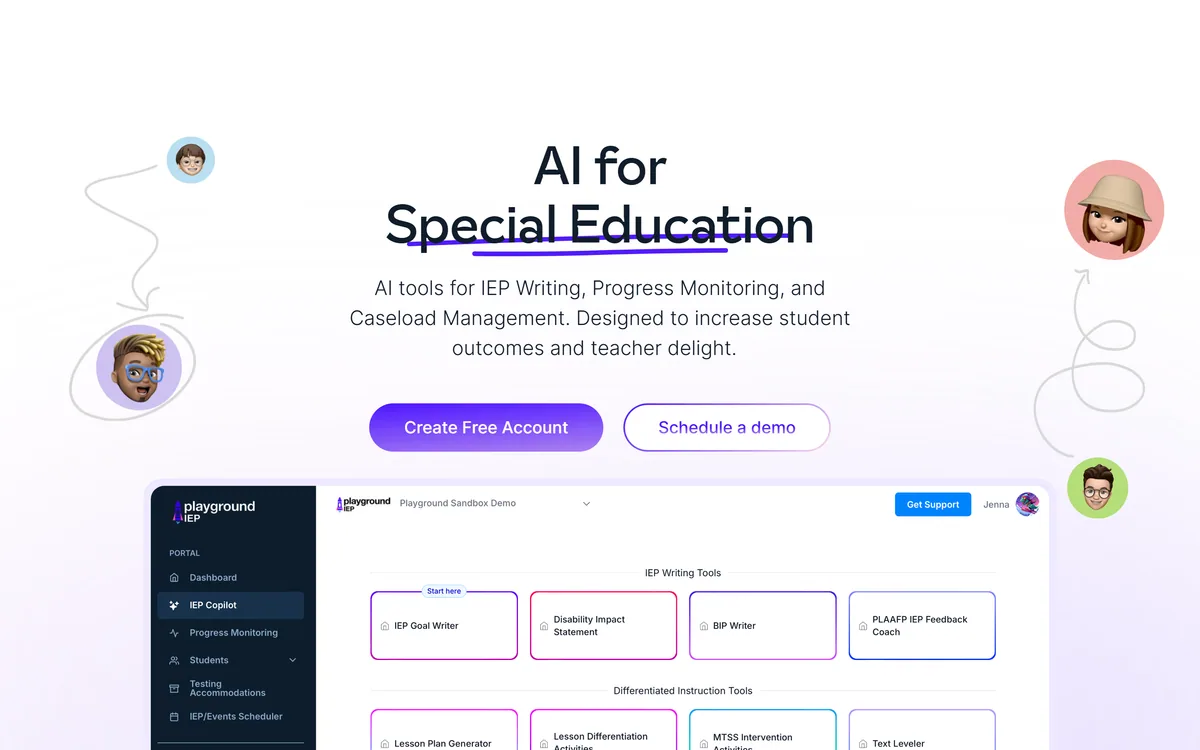
Playground IEP is caseload management software for special education, positioned deliberately between a district's SIS and its IEP writing system. It supplies IEP snapshots, meeting scheduling, progress monitoring and AI drafting tools with all 50 state standards integrated, and states support for over 12,000 teachers.
4.4Editor Score
playgroundiep.com9 viewsAdded April 23, 202515K visitors
Playground IEP: What Teachers Get
- A layer between systems — it complements the SIS and IEP software rather than replacing either.
- Caseload organisation that replaces the spreadsheet every department builds by hand.
- IEP CoPilot for goals, PLAAFP feedback, impact statements, BIP drafting and text levelling.
- All 50 state standards integrated for standards-aligned, measurable goal writing.
- Published PII commitments and a signable Data Protection Agreement referencing FERPA.
Playground IEP: Between The SIS And The IEP System
The FAQ states the position more precisely than the homepage does: Playground IEP sits between the SIS and IEP software, eliminating the need to manually create spreadsheets to manage the caseload.
That single sentence is the product, and it identifies a gap most education software vendors have simply not noticed.
Districts already own two systems. The student information system holds enrolment, demographics, schedules and grades. The IEP writing system holds the legal documents. Both are usually mandated, often old, and neither was designed to answer a case manager's daily questions.
Those questions are operational: which of my students have annual reviews due this month, which teachers need to know about which accommodations, whose progress data is missing before Friday.
So somebody builds a spreadsheet. Every special education department in the country has one, maintained by whoever is best at Excel, containing confidential student information, emailed as an attachment, and lost when that person leaves. That is the actual incumbent this product replaces.
The real incumbent is not another vendor. It is a spreadsheet full of confidential student data, maintained by whoever is best at Excel, and lost when they leave.
Progress Monitoring Without Extra Forms
Progress monitoring appears twice on the site: as a caseload tool and as an AI-generated assessment. The distinction matters more than it first appears.
Monitoring is the requirement special education teams most often fall behind on, and the reason is arithmetic rather than diligence.
An IEP goal must be measurable, and measurable means data collected on a schedule. A case manager with twenty students and four goals each is tracking eighty data streams, each with its own frequency, each needing a report at review time. The teaching is not the bottleneck; the recording is.
Generating the assessment instrument itself is the useful half here, because building a probe that actually measures a specific goal takes real time and rarely gets it. A tool that produces one aligned to the goal removes a step nobody enjoys.
What no software can do is make the collected data true. A generated assessment administered inconsistently produces a tidy chart of nothing, and the chart will look exactly as convincing as a real one. The discipline stays with the human, which is why teacher training features in the vendor's own onboarding emphasis. General classroom AI tools such as Edcafe AI help with the instruction side but do not touch the compliance record.
Why Is Caseload Management The Real Problem?
The published answer is blunt: caseload management is regulatorily complex and mostly manual, with few tools designed to manage and communicate it, vital student information generally disorganised and not secure, and administrators holding little insight into compliance.
Every clause there describes something a school leader would recognise immediately.
The compliance dimension is what raises the stakes above ordinary inconvenience. An IEP is a legal document with statutory deadlines, and missing a reevaluation date is not an administrative slip — it is a compliance failure with consequences for the district and, more importantly, a delay in services for a child.
The communication dimension is the one most often ignored. A general education teacher must know a student's accommodations to deliver them, but that information sits inside a document written for a legal purpose and stored in a system they cannot access.
The result across most schools is that accommodations are communicated verbally, in corridors, and forgotten. The IEP snapshot — a short, readable extract for a teacher who needs to act — addresses that gap directly, and one of the site's own testimonials from a vice principal describes exactly that improvement in information sharing.
- Find the department spreadsheet first — it defines what the tool must replace.
- Fix meeting and reevaluation scheduling before anything else.
- Give general education teachers a snapshot they will actually read.
- Decide who sees what before importing a single student record.
- Review every generated goal against the child, not the standard.
Writing Goals Against Fifty State Standards
The IEP Goal Writer is described as generating SMART, standards-aligned goals with scaffolded objectives and measurable benchmarks, with all 50 state standards integrated so goals can be crafted in a fraction of the time.
Standards integration is the part that separates this from a general writing assistant, and it is worth being precise about why.
A goal must reference the standards of the state the child is educated in, and those standards differ by state, subject and grade. A general model asked to write an IEP goal produces something that reads correctly and cites a framework that may not apply, which is worse than useless in a document that will be reviewed by a compliance officer.
Working from an integrated standards set is the difference between a plausible sentence and a usable one.
The wider CoPilot set — a PLAAFP feedback coach, a disability impact statement writer, a behaviour intervention plan writer, MTSS interventions and a text leveller — targets the components teachers find hardest to phrase. The impact statement in particular is the section that must describe how a disability affects access to the general curriculum without drifting into deficit language, and it is genuinely difficult to write well. Drafting help is real help, provided the educator remains the author. Instructional assistants such as Khanmigo work on the teaching itself and touch none of the compliance record this product exists to hold.
Student Data And A Published Commitment
Under a heading of data privacy by design, the site publishes a Data Protection Agreement referencing FERPA and, separately, an explicit two-column statement of how student personally identifiable information is handled.
The will-always column commits to using PII only for authorised purposes, disclosing collection transparently, providing access and correction, maintaining a security programme and requiring vendors to follow the same commitments.
The will-never column is the more unusual half: never collect or share PII beyond purpose, never sell student PII, never use PII for behavioural ad targeting, never build unauthorised personal profiles, and never retain PII longer than necessary.
Publishing that as a plain list rather than burying it in a policy is a meaningful choice. These are exactly the commitments a district's counsel has to establish before procurement, and offering a DPA for review and signature before contact is a further step most vendors do not take.
None of this removes the district's own obligations. FERPA compliance is a shared responsibility, generated content still enters a legal record, and the child's IEP team remains accountable for what it says. But a vendor handling children's disability data should be judged first on what it publishes about that data, and this is a strong showing — stronger, in our reading, than anything comparable in the education tools we have reviewed, including curriculum products like LittleLit AI that handle far less sensitive information.
Managing A Caseload Without Spreadsheets
The transition that fails is the one that adds a system without removing the spreadsheet, leaving staff maintaining both.
This order retires the spreadsheet rather than duplicating it.
- Locate every informal tracker in use and list what each one is actually for.
- Have counsel review the DPA before any student data moves.
- Export from the SIS and IEP system, and check the cleaned data against the source.
- Set confidentiality permissions before granting general education access.
- Move scheduling and snapshots first — the two with immediate visible payoff.
- Delete the spreadsheets once the same questions are answerable in the tool.
Playground IEP: Tools And Safeguards
| Category | Special education caseload and inclusion management |
|---|---|
| Position | Between the student information system and the IEP writing software |
| Adoption | Stated as supporting over 12,000 teachers |
| AI tools | IEP goal writer, PLAAFP feedback coach, disability impact statement, BIP writer |
| Additional AI | MTSS interventions, text leveller, progress monitoring assessments, differentiated lesson plans |
| Standards | All 50 state standards stated as integrated for goal alignment |
| Caseload tools | Organisation, IEP snapshots, meeting scheduling, progress monitoring, custom confidentiality |
| Integration | Works from data exported by any IEP system or SIS, with a built-in cleaning process |
| Privacy | A signable Data Protection Agreement referencing FERPA and other privacy laws |
| PII stance | Published will-always and will-never commitments, including never selling student PII |
| Onboarding | In-person onboarding prioritised for both special and general education staff |
| Audiences | SPED teachers, directors, school leadership, general education teachers, service providers |
Key features of Playground IEP
Caseload organisation replacing manual spreadsheets
IEP snapshots for general education staff
Automated IEP meeting and reevaluation scheduling
AI goal writing aligned to state standards
PLAAFP feedback and disability impact statement drafting
Behaviour intervention plan and MTSS intervention drafting
Text levelling and differentiated lesson planning
Custom confidentiality settings per role
Pros & cons
Pros
7- Occupies a genuine gap rather than competing with mandated systems
- Publishes explicit will-always and will-never commitments on student PII
- Offers a DPA for review and signature before any contact
- Standards integration makes generated goals usable rather than merely plausible
- IEP snapshots close the accommodation communication gap directly
- Scheduling automation targets the most consequential compliance risk
- In-person onboarding is prioritised, including for general education staff
Cons
7- Adds a third system to districts already running two
- Depends on clean exports from systems it does not control
- Generated goals still require full educator review before they enter a legal record
- No software can make inconsistently collected progress data meaningful
- How current the integrated state standards are kept is not published
- Testimonials are vendor-selected and use first names only
- Success depends on onboarding general education staff, which is the hardest part
Best For
- Special education departments managing caseloads on spreadsheets
- Case managers tracking deadlines across many students
- Directors needing visibility into compliance status
- Schools where accommodations are communicated informally
- Districts that will run structured in-person onboarding
Playground IEP Beside Other Education Software
Education tools differ by which part of a school's work they touch.
| Tool | Handles | Sits with | Best for |
|---|---|---|---|
| Playground IEP | Caseload operations and compliance | Between the SIS and IEP system | Special education departments |
| Edcafe AI | Classroom materials and activities | Alongside teaching | Individual teacher preparation |
| Khanmigo | Student tutoring and teacher support | In the lesson | Instruction rather than administration |
| LittleLit AI | A full accredited curriculum | Instead of a school | Home education |
| A department spreadsheet | Everything, badly | On one person's laptop | Nothing, once anything else exists |
More Special Education Tools
Other software supporting teachers and students in and out of the classroom.
- Edcafe AI — classroom materials generated for teachers
- Khanmigo — tutoring and teacher assistance in the lesson
- LittleLit AI — an accredited K-12 curriculum for home education
- LearnFast AI — adaptive practice for individual students
- MentoMind — another approach to structured student support
Does Your District Need Caseload Software?
Adopt the caseload tool when
- Your department maintains a spreadsheet holding confidential student data.
- Meeting and reevaluation deadlines are tracked manually.
- General education teachers do not reliably know student accommodations.
- Administrators have no view of compliance status across the school.
- Your counsel will review and sign a vendor DPA.
Keep the spreadsheet when
- Your IEP system already answers daily caseload questions well.
- The caseload is small enough for one person to hold in mind.
- District policy blocks a third system touching student records.
- Nobody is available to run in-person onboarding for staff.
- You cannot export usable data from your existing systems.
Playground IEP: Verified On The Privacy Pages
Last checked . Read from playgroundiep.com in a browser session on the date above, with the screenshot captured at the same time.
- Positioned as AI tools for IEP writing, progress monitoring and caseload management
- Support stated for over 12,000 teachers
- FAQ stating it sits between the SIS and IEP software, eliminating manual spreadsheets
- Explicitly described as complementary to, not a replacement for, existing IEP writing software
- IEP CoPilot listing a goal writer, PLAAFP feedback coach, disability impact statement and BIP writer
- Further tools listed for MTSS interventions, text levelling, progress assessments and differentiation
- All 50 state standards stated as integrated for standards-aligned goal generation
- Caseload tools listed as organisation, snapshots, meeting scheduling, progress monitoring and custom confidentiality
- A built-in data cleaning process described for exports from any IEP system or SIS
- A Data Protection Agreement offered for review and signature, referencing FERPA
- A published two-column statement of will-always and will-never commitments on student PII, including never selling it
- Footer showing a 2026 copyright, privacy policy, terms of use and the DPA, alongside named educator testimonials
What we could not confirm: how the 12,000-teacher figure is counted; which specific state standards sets are integrated and how currently they are maintained; how generated goals perform under district compliance review; where student data is processed and by which sub-processors; and how the confidentiality settings are administered. Testimonials on the site are vendor-selected. We did not create an account, import data or review the DPA text.
Editor's Verdict
4.4/5Playground IEP is unusually clear about what it is not, and that clarity is the reason it works. It does not replace IEP writing software or the student information system; it occupies the gap between them, which is where every district's improvised spreadsheet currently lives. The published data commitments — an explicit will-always and will-never list on student personally identifiable information, alongside a signable DPA — are the most substantive we have read from an education vendor, and they matter more here than any feature, because the subject is children with disabilities. AInexfinder Editor Score: 4.4/5.
Playground IEP pricing
AInexfinder does not list plan prices or billing details. For current pricing, plans, and trials, visit the official Playground IEP website.
Visit official website for pricingVendor pricing, credits, and billing policies change over time. Always confirm on the official site before you buy.
Frequently asked questions
What is Playground IEP?
Special education caseload management software. Its FAQ states it sits between the student information system and the IEP writing software, replacing the manual spreadsheets departments build to track deadlines, data and communication.
Does it replace our IEP writing system?
No, and it says so explicitly. It is described as complementary — a new class of inclusion and caseload management software rather than another IEP writing tool, working from data exported by whatever systems you already run.
Why is caseload management the actual problem?
Because it is regulatorily complex, mostly manual, and unsupported by either mandated system. Deadlines are statutory, accommodations must reach classroom teachers, and administrators typically have no view of compliance status at all.
How does it handle student data?
It publishes a signable Data Protection Agreement referencing FERPA and a plain two-column list of commitments — including never selling student PII, never using it for behavioural ad targeting, and never building unauthorised profiles.
Can AI write an IEP goal?
It can draft one. The goal writer works from all 50 state standards, which is what makes output usable rather than merely plausible. The educator remains the author of a legal document and must review every word.
What is a PLAAFP and why does it need a coach?
It is the present-levels narrative every goal is measured from. It is the hardest section to write precisely, and a vague one undermines every goal built on it — which is why drafting feedback is genuinely useful there.
What is an IEP snapshot for?
Giving a general education teacher the accommodations and information they need to act on, extracted from a document written for legal purposes and stored in a system they usually cannot access.
Will it fix our progress monitoring?
It can generate aligned assessments and organise the tracking, which removes real work. It cannot make inconsistently collected data meaningful — a generated probe administered irregularly produces a chart that looks exactly as convincing as a real one.
How does onboarding work?
The site states in-person onboarding is prioritised for both special education teams and general education staff. The second group is the harder and more important one, since the inclusion benefit depends on classroom teachers using it.
What should we do before adopting it?
Find every informal tracker in use, have counsel review the DPA before any student data moves, and set confidentiality permissions before granting access. Then retire the spreadsheets rather than maintaining both.
Reviews
Log in to write a review.
User Reviews
No reviews yet. Be the first to share your experience with Playground IEP.
Reviewed by Daniel Reed
Assigned reviewer
Daniel ReedSenior AI Tools Reviewer
Daniel reviews AI tools the slow way — by actually using them on real projects. His reviews cover what works, what breaks, and who each tool is genuinely a good fit for.
Hands-on reviewsProduct testingAI software
Daniel and the AInexfinder editorial team research Playground IEP using public product information, listing evidence, and (when available) hands-on checks. Scores reflect listing completeness and transparency — not paid placement.
- Last verified
- Methodology
- How we review AI tools
- Sources used
- playgroundiep.com
- AInexfinder listing fields (features, pros/cons, description)
- Public vendor pages when available
- Editorial policy
- Listings may include affiliate or sponsored placements, which are labeled when present. Editorial scores and cons are not sold. See our affiliate disclosure and review methodology.
Related tools
Twee is an AI platform for language teachers that generates CEFR-aligned texts, dialogues, exercises, questions and writing prompts from a topic, link or word list in 10 languages, exports or shares them, assesses student answers with AI and manages classes.
FreemiumEducation & Research

Free browser-based worksheet maker for teachers, tutors, and homeschool families to create printable math worksheets, writing practice pages, graph paper, lined paper, and answer keys without sign-in.
AI lesson planning and resource creation for teachers Category: Education & Research.
FreemiumEducation & Research
AI-generated interactive lessons with live student polls Category: Education & Research.
FreemiumEducation & Research
AI tutoring platform purpose-built for K-12 schools Category: Education & Research.
FreemiumEducation & Research
Compare:Playground IEP vs LittleLit AIPlayground IEP vs TweePlayground IEP vs Printable Worksheet MakerPlayground IEP vs Monsha
Playground IEP alternatives Explore More
Embed this listing on your site
Featured on AInexfinder