Wispr Flow is a voice-to-text tool that types polished writing wherever your cursor is, across Mac, Windows, iPhone and Android, and now bundles an AI meeting notetaker into the same subscription.
FreemiumProductivity & Automation
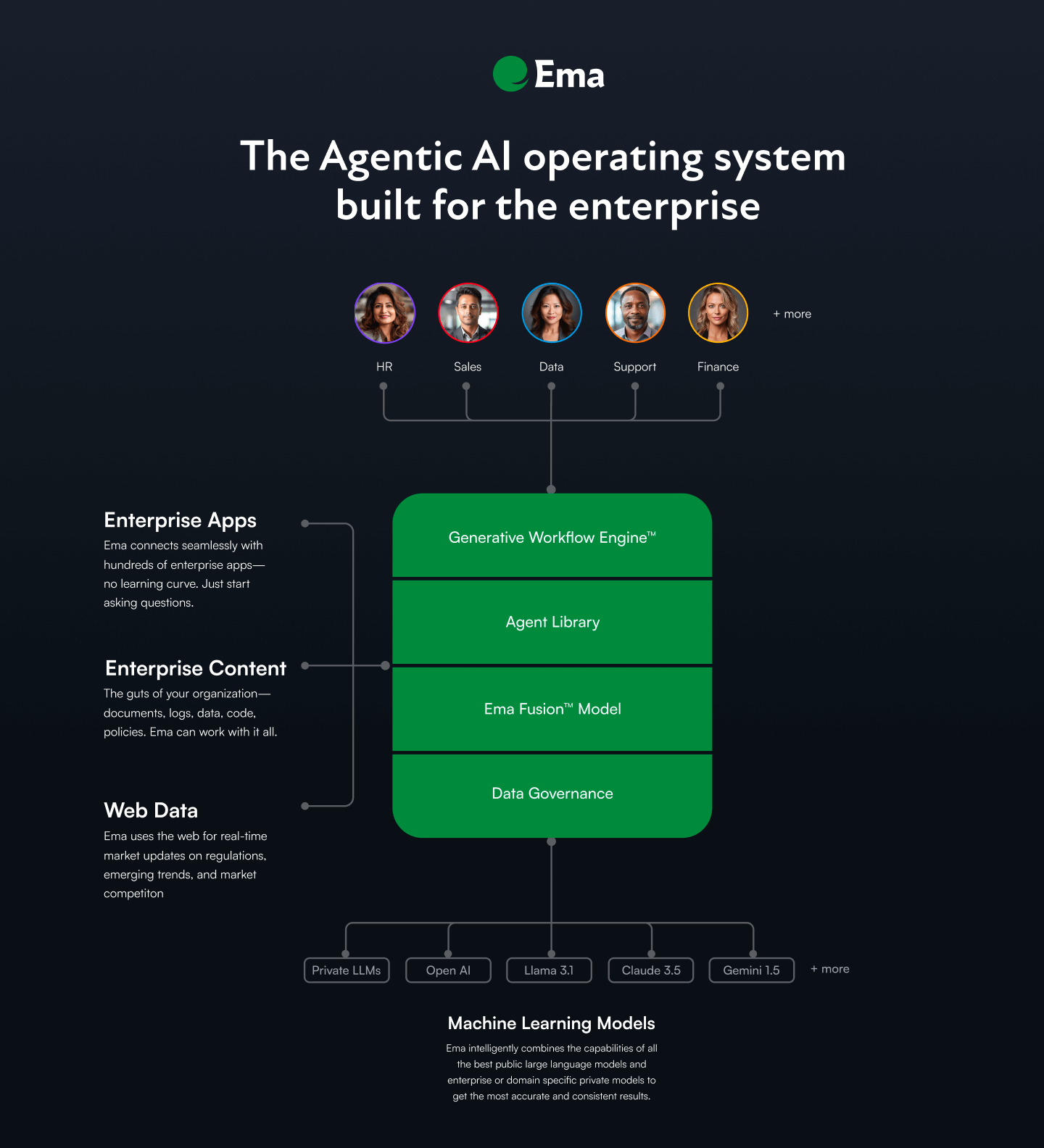
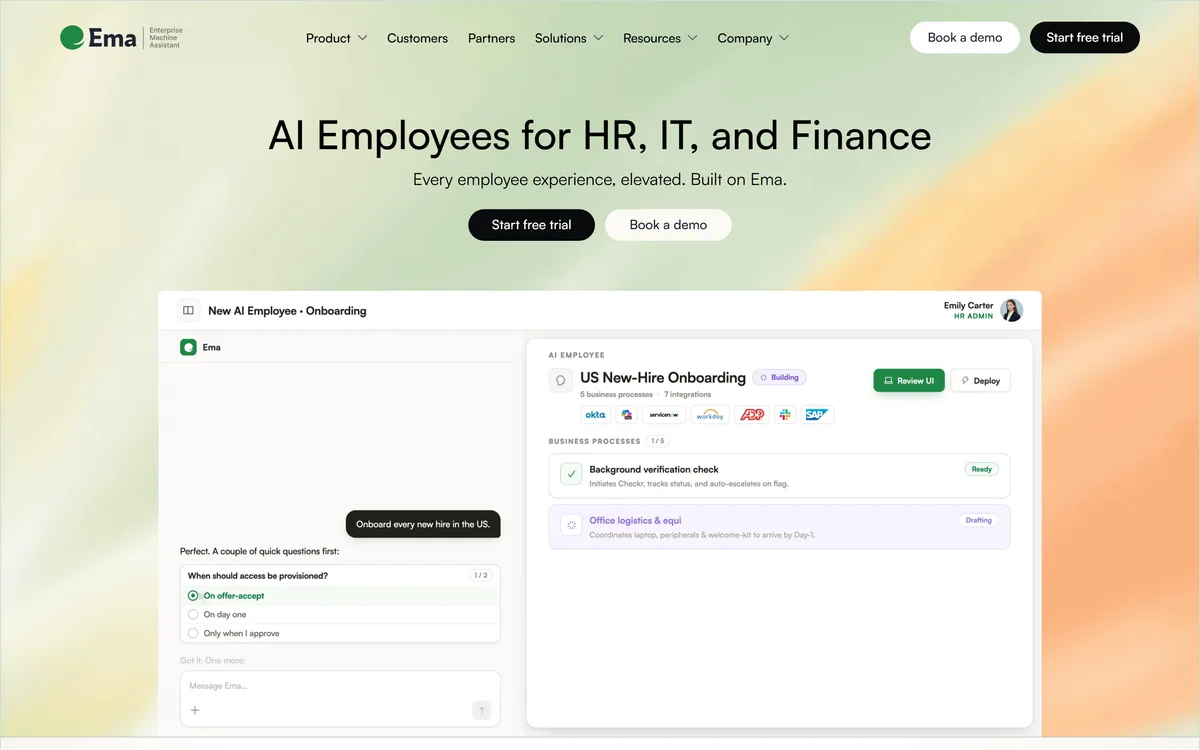
Ema builds what it calls Universal AI Employees for HR, IT and finance, covering recruiting, onboarding, benefits and performance. EmaFusion combines 100+ models with automatic failover, 1,000+ prebuilt connectors reach existing systems, and the compliance list runs to eight certifications including ISO 42001.
Internal support is where large organisations lose an extraordinary amount of time to questions that already have answers. How much leave do I have. Why was my expense rejected. Who approves this. When does the new policy apply.
Those questions are answered by people who could be doing something else, and the answer is almost always sitting in a system the asker cannot navigate or does not know exists.
Ema addresses that, and the thing that separates it from the dozens of companies with the same idea is not the agents. It is what surrounds them — because an agent that reads HR records and acts on them is a governance problem before it is a productivity one, and Ema has clearly worked that out.
Ema states SOC 2 Type II, ISO 42001, ISO 27001, ISO 27017, ISO 27701, EU AI Act alignment, GDPR and CSA STAR, alongside on-premise and air-gapped deployment, RBAC and ABAC governance, immutable audit trails and human-in-the-loop approval chains.
That is a longer list than most enterprise software carries, and in this category it is the differentiator rather than a hygiene factor. An agent operating in HR touches salary, performance reviews, medical accommodations and disciplinary records — the most sensitive data an employer holds, regulated separately in most jurisdictions.
Two of the certifications are worth singling out. ISO 42001 is the AI management systems standard, which is specifically about how an organisation governs AI rather than how it secures data — exactly the question a board now asks and which SOC 2 does not answer. ISO 27701 covers privacy information management, which matters when the data is about employees.
EU AI Act alignment is the forward-looking one. HR use cases including recruitment and performance evaluation are classified as high risk under that regulation, with obligations around transparency, human oversight and documentation. A vendor that has thought about this before customers ask is ahead of most.
Air-gapped deployment closes the remaining case for defence, government and heavily regulated buyers where nothing leaves the network at all.
Certifications are also what separate this tier from lighter agent tools. A support-focused platform such as Forethought solves a narrower problem without having to clear a security review of this depth.
An agent that reads performance reviews and medical accommodations is a governance problem before it is a productivity one.
Ema states approval chains with human-in-the-loop and immutable audit trails, and for HR agents specifically this is the mechanism that makes deployment defensible.
The reason is that decisions about employment have legal consequences. A recruitment agent that screens candidates is making a decision with discrimination exposure attached. A benefits agent that determines eligibility is affecting someone's healthcare.
Under the EU AI Act and comparable emerging rules, high-risk uses require meaningful human oversight — not a rubber stamp, but a person with the authority and information to override.
Immutable audit trails are the evidentiary half. When someone challenges a decision, you need to show what the system did, on what basis, and who reviewed it. A log that could have been edited is not evidence.
The practical implication for a buyer is to design the approval chains before deployment rather than after. Which decisions may an agent take alone? Which require review? Who has authority to override, and do they have the information to do it meaningfully? The technology supports all of this; the operating model is yours to write.
EmaFusion is claimed to combine 100+ models in real time, beat the best single model at up to 20 times lower cost, and fail over automatically if a model has an outage.
The failover claim is the one to take most seriously and it is rarely discussed. Model providers do have outages, and an enterprise support agent that stops working because a single vendor is degraded is a production incident affecting every employee. Automatic failover across providers is genuine operational resilience, and single-model architectures simply do not have it.
The cost argument is also structurally sound. Most enterprise questions are easy — checking a leave balance does not need a frontier model — and routing simple queries to cheap models while reserving expensive ones for hard cases is exactly how you would design this if cost mattered.
The 20 times figure is where scepticism belongs. No methodology, baseline or task mix is published, and a cost multiple depends entirely on what proportion of your queries are simple. A workload of trivial lookups would show an enormous multiple; a workload of complex reasoning would show almost none.
Read it as directional rather than as a specification. The architecture is right; the number is marketing, and your own query mix decides what you would actually see.
The multi-model argument is not unique to Ema — coding agents like Zencoder make a version of it too — but it remains far easier to claim than to demonstrate.
Ema states 1,000+ prebuilt connectors and 250+ prebuilt integrations, reached through Teams, Slack or voice as one digital front door.
Connector count is the least glamorous and most decisive number here. An HR agent is useless without access to the HR information system; a finance agent needs the expense platform and the ERP. Every one of those integrations is unglamorous engineering against a system with its own permissions model and its own quirks.
That work is also why enterprise agent projects fail. A pilot with three connected systems demonstrates well; production needs thirty, and the twenty-seven remaining are where the timeline goes.
The front-door framing matters just as much. Employees will not adopt another portal — they are already in Teams or Slack all day, and an agent that lives there is used while one behind another login is not.
The questions to press are about depth rather than count. Which specific systems in your stack are covered, does a connector read or also write, and how are permissions inherited? An agent that can see everything in your HR system regardless of who is asking is a data breach waiting for a curious employee.
Connector depth is exactly why incumbents are hard to displace. A platform already holding your CRM data, such as HubSpot AI, starts every one of these conversations several steps ahead.
Ema states outcome-based pricing, with no unused modules and no tokenmaxxing. That is a deliberate positioning against two real problems in enterprise AI purchasing.
Module bundling is the first: buying a suite where you use two of nine components and pay for all nine. Token-based pricing is the second, where cost scales with how verbose the system is rather than with what it achieved, and the vendor has no incentive to make it concise.
Charging for outcomes aligns those incentives properly, and it is the right instinct. The complication is definitional and it is where a buyer should spend their attention.
What counts as an outcome? A resolved ticket, where resolution is judged by whom? An onboarding completed, measured how? An agent that closes a request the employee then re-opens has produced an outcome by one definition and not by another.
This is not a criticism so much as the central term of the contract. Get the definition, the measurement method and the dispute process in writing before signing, because with outcome pricing that definition is the price. Everything else in the negotiation matters less.
Enterprise agent pilots go wrong by proving the technology works rather than testing whether it works in your systems with your governance.
The bar is step three. Permission inheritance is where agent deployments produce their most serious failures, and it is invisible in a demo.
AI agents for HR, IT and finance covering recruiting, onboarding, benefits and performance
EmaFusion routing across 100+ models with automatic failover on provider outages
1,000+ prebuilt connectors and 250+ integrations into existing enterprise systems
Access through Microsoft Teams, Slack and voice rather than a separate portal
RBAC and ABAC access governance
Immutable audit trails for every agent action
Human-in-the-loop approval chains for decisions requiring oversight
On-premise and air-gapped deployment options
Enterprise agent platforms differ most on governance and integration depth, not on what their agents can say.
| Tool | Domain | Governance posture | Deployment |
|---|---|---|---|
| Ema | HR, IT and finance internal operations | Eight certifications including ISO 42001, RBAC/ABAC, immutable audit | Cloud, on-premise or air-gapped |
| Forethought | Customer support rather than internal | Standard enterprise posture | Cloud |
| Zencoder | Engineering work and code | SOC 2, ISO 27001, ISO 42001 | Cloud, on-premise or hybrid |
| HubSpot AI | Customer-facing sales and marketing | Standard SaaS posture | Cloud |
| Notion AI | Knowledge and documents | Standard SaaS posture | Cloud |
| Product type | Enterprise AI agents, described as Universal AI Employees |
|---|---|
| Functions covered | HR, IT and finance, including recruiting, onboarding, benefits and performance |
| Model architecture | EmaFusion, stated as combining 100+ models in real time with automatic failover |
| Stated cost claim | Beats the best single model at up to 20x lower cost |
| Connectors | 1,000+ prebuilt connectors and 250+ prebuilt integrations |
| Access surfaces | Microsoft Teams, Slack, voice and others |
| Certifications | SOC 2 Type II, ISO 42001, ISO 27001, ISO 27017, ISO 27701, EU AI Act, GDPR, CSA STAR |
| Deployment | On-premise and air-gapped options available |
| Governance | RBAC and ABAC controls, immutable audit trails, human-in-the-loop approval chains |
| Pricing model | Outcome-based, with no unused modules and no token-based charging |
| Legal entity | Ema Unlimited, Inc. |
| Headquarters | 321 Castro St, Mountain View, California |
| Published links | Privacy Policy, Data Processing Addendum, Cookie Settings, Privacy Center, solutions, resources and company pages |
Last checked . Read from ema.ai, including the footer, with the screenshot above captured in the same session.
What we could not confirm: the 20x cost claim carries no methodology, baseline or task mix, and any such multiple depends entirely on how simple your query mix is; the 100+ models in EmaFusion are not enumerated, so you cannot check whether any are excluded on governance grounds; the definition of an outcome under outcome-based pricing is not stated, which is the central commercial term; the named individuals quoted are executives rather than clearly identified customer organisations; no funding detail is disclosed; and we did not deploy the platform.
Compare on who the agent serves — employees, customers or engineers — since that decides the governance burden.
Ema scores well because it takes the governance side of enterprise agents more seriously than almost anyone: SOC 2 Type II, ISO 42001, ISO 27001, ISO 27017, ISO 27701, EU AI Act, GDPR and CSA STAR, with air-gapped deployment, RBAC and ABAC controls, immutable audit trails and human-in-the-loop approval chains. For agents acting on employee data, that list is the product. EmaFusion routing across 100+ models with automatic failover is a sound architecture. It loses ground because the AI employee framing overstates what an agent is, because the 20x cost claim has no methodology, and because outcome-based pricing is harder to evaluate than it sounds. AInexfinder Editor Score: 4.1/5.
AInexfinder does not list plan prices or billing details. For current pricing, plans, and trials, visit the official Ema website.
Visit official website for pricingVendor pricing, credits, and billing policies change over time. Always confirm on the official site before you buy.
Log in to write a review.
No reviews yet. Be the first to share your experience with Ema.
Assigned reviewer
Daniel ReedSenior AI Tools Reviewer
Daniel reviews AI tools the slow way — by actually using them on real projects. His reviews cover what works, what breaks, and who each tool is genuinely a good fit for.
Daniel and the AInexfinder editorial team research Ema using public product information, listing evidence, and (when available) hands-on checks. Scores reflect listing completeness and transparency — not paid placement.
Wispr Flow is a voice-to-text tool that types polished writing wherever your cursor is, across Mac, Windows, iPhone and Android, and now bundles an AI meeting notetaker into the same subscription.
Saner.AI is an AI personal assistant that consolidates notes, tasks, emails and documents into one workspace. Its Skai assistant turns emails and brain dumps into scheduled tasks, and it is explicitly designed around ADHD, with a co-founder who has it.
Simular Inc. builds Sai, an AI agent that operates a private cloud-based virtual desktop — clicking, typing and using interfaces the way a person does, while also able to call APIs, use a terminal and write code. Its research line is the Agent S series.
AI-powered CRM for relationship-driven teams Category: Productivity & Automation.

axess is a free AI job-search tool that scans LinkedIn, Indeed and Glassdoor daily, scores each role against your profile on both relevance and likelihood, researches the employer, and prepares a tailored CV and cover letter for the matches worth pursuing.

Otter.ai transcribes meetings live, writes summaries and action items, and organises everything into searchable Channels — with OtterPilot joining Zoom, Teams, and Google Meet, plus role-specific agents for sales, recruiting, and SDR work.