TTSReader turns text, PDFs, and EPUB files into speech in the browser, with voice and language selection, speed control, text highlighting, and MP3 export — the free tier runs on browser voices with no usage cap.
FreemiumVideo & Audio
Vogent is a platform for building voice agents, using its own conversational models trained on phone calls rather than only off-the-shelf LLMs. It states 200ms average response latency, includes IVR navigation models, counterfactual testing against past calls, and HIPAA-compliant workspaces.
Voice agents fail on rhythm long before they fail on intelligence. A pause half a second too long, an interruption at the wrong moment, a response that arrives after you have already started repeating yourself.
That is a training problem as much as an engineering one. A model trained overwhelmingly on written text has learned how writing works, and phone conversation is a different thing entirely — full of overlap, hesitation, false starts and repair.
Vogent's distinguishing decision is to train its own conversational models on phone calls specifically, which is a more expensive answer than assembling a stack and a more likely one to sound right.
Vogent states 200ms average response latency using its own models and voices, and it is worth understanding what that figure is measuring and why the number is significant.
Human conversational turn-taking runs on gaps of roughly 200 milliseconds. That is not a coincidence or a convention — it is a consistent finding across languages, and it means anything slower registers as hesitation rather than as thought.
Most voice agents sit well above it, because four things have to happen in that window: detect that speaking stopped, transcribe, decide, synthesise. Each is fast and they compound, which is why so many agents feel like a satellite call.
Owning the models is what makes the number credible. A platform assembling third-party speech recognition, a general LLM and third-party synthesis inherits three network hops and three queues; one running its own has fewer places for time to go.
The caveat is the word average. A 200ms average across a call is compatible with occasional multi-second stalls, and it is the stalls that people remember. The test worth running is not measuring latency but listening to twenty real calls and counting the awkward moments.
Contrast that with an orchestrating platform. OpenMic.ai names ElevenLabs and Deepgram as its voice providers, which gives you switchability and adds a network hop to every turn.
Human turn-taking runs on gaps of about 200 milliseconds. That is a finding across languages, not a convention — which is why anything slower reads as hesitation.
Vogent lists advanced IVR detection and navigation models, and this is the feature that reveals what the platform is actually built for.
An IVR is the automated phone menu on the other end — press one for sales, please hold, say the reason for your call. Any outbound agent calling a business rather than a consumer will meet one within seconds, and most voice agents have no idea what to do with it.
Handling it is genuinely difficult. The agent must recognise that it is talking to a machine rather than a person, understand a spoken menu, choose an option, wait through hold music of unpredictable length, and then start the actual conversation with whoever answers.
That is a specific engineering problem with no general solution, and building models for it says the company expects real outbound use rather than demonstrations. Almost nothing in the marketing of voice platforms addresses it.
It also implies use cases worth knowing about. Agents that navigate IVRs are agents calling businesses — verification, scheduling, records requests, follow-ups — which is a different market from the inbound receptionist most voice platforms sell.
Vogent lists Counterfactual Analysis, described as testing agents on past calls, and this is the most interesting item on the feature list.
The problem it solves is that voice agents are almost impossible to test. Every call is different, the other party is unpredictable, and a change that improves one conversation can break another in a way no unit test detects.
Testing against calls that already happened changes that. You have the real audio, the real questions, the real interruptions and the real edge cases, and you can run a modified agent against them and see whether it does better or worse than the version that actually took the call.
That is closer to how machine learning systems are properly evaluated than to how software is usually tested, and it is the right frame — a voice agent is a model in production, not a program with branches.
The limitation is that a replayed call is not a real one. The other party's next utterance was a response to what the old agent said, so a modified agent taking a different turn quickly diverges into a conversation that never happened. Counterfactual testing catches regressions well and cannot prove an improvement.
This is a more rigorous position than most of the category takes. Developer platforms like Vapi hand you the assembly and leave evaluation entirely to you.
Vogent hosts agents on live phone numbers selectable by area code, with call transfers, knowledge bases and post-call automations around them.
The number itself matters more than it appears. A local area code is answered measurably more often than an unfamiliar one, which is why the feature exists — and it is also why the practice sits close to a line worth thinking about, since a local number implying local presence is a small deception if there is none.
Call transfer is the feature to configure first rather than last. An agent that cannot escalate is worse than a hold queue, because a hold queue at least implies a person is coming, and the caller who cannot reach one remembers it.
Knowledge Bases give the agent documents to look up, and Functions and Tools give it live API and database access. The distinction matters: a knowledge base answers what the policy says, while a function answers what this customer's balance is, and confusing the two produces confidently wrong answers about live data.
Post-call automations close the loop, turning the outcome into a record somewhere rather than a transcript nobody reads. That is the part that makes a deployment measurable, and it is usually configured last and regretted.
Anyone wanting to own the layer beneath all of this rather than rent a platform should look at Deepgram, where self-hosting is a first-class option.
The reputational cost of a bad voice call is higher than for any other channel, because people repeat the story.
Start narrow, on calls where failure costs little, and configure the exit before the conversation.
| Product type | Platform for building voice agents |
|---|---|
| Positioning | All-in-one platform for humanlike, intelligent and effective voice agents |
| Latency | 200ms average response latency, stated with Vogent's own models and voices |
| Models | Custom conversational models trained on phone calls, plus off-the-shelf models such as GPT |
| Custom models | Bring-your-own-model support and fine-tuning services offered |
| Flow Builder | Drag-and-drop agent creation |
| IVR | Advanced IVR detection and navigation models |
| Testing | Counterfactual Analysis against past calls |
| Knowledge | Knowledge Bases for document lookup |
| Live data | Functions and Tools for API and database access |
| Telephony | Live phone numbers selectable by area code |
| Handoff | Call transfers to a human |
| Analytics | Call history with recordings and transcripts, plus post-call automations |
| Compliance | HIPAA-compliant voices and workspaces; SOC 2 Type II audit stated as pending |
| Footer | Privacy Policy, Terms and Conditions, Subprocessors, plus LinkedIn, X and Discord |
Custom conversational models trained on phone calls rather than written text
200ms average response latency stated with those models
IVR detection and navigation for calling businesses
Counterfactual Analysis testing agents against past calls
Flow Builder for drag-and-drop agent creation
Knowledge Bases for documents and Functions for live data
Live phone numbers by area code, with human call transfer
Fine-tuning services and bring-your-own-model support
Voice platforms differ on whether they own the models or orchestrate somebody else's.
| Tool | Model position | Distinctive capability | Best for |
|---|---|---|---|
| Vogent | Own models trained on phone calls | IVR navigation and counterfactual testing | Outbound agents that call businesses |
| OpenMic.ai | Orchestrates third-party voice providers | Vertical templates across thirteen industries | Deploying quickly to a named use case |
| Vapi | Developer-first orchestration | Assembly and control | Building a voice product yourself |
| Retell AI | Orchestration with operations tooling | Running a fleet of live agents | Managing agents after launch |
| Deepgram | The speech layer itself | Self-hosting and transcription | Owning the stack rather than renting it |
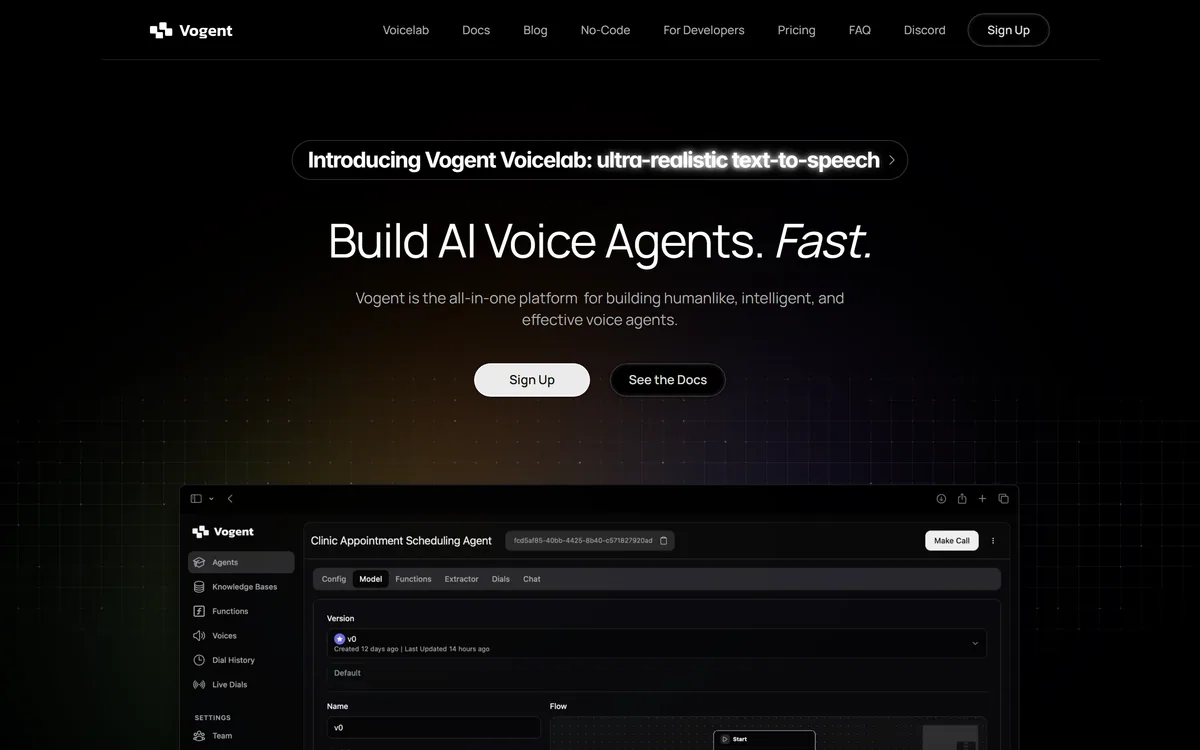
Last checked . Read from vogent.ai and its footer navigation, with the screenshot above captured in the same session.
What we could not confirm: the operating company's legal name or location; pricing or how calls are metered; which off-the-shelf models are used and where; the conditions under which the 200ms figure was measured; how many languages are supported, since none are stated; any named customer or case study; the current status of the SOC 2 audit beyond pending; and how call recordings are retained. We did not place a call, so nothing here reflects tested agent behaviour.
Two things separate Vogent from the general run of voice agent platforms. It trains its own conversational models on phone calls rather than assembling a stack from general-purpose parts, which is why a 200ms latency figure is plausible rather than aspirational — phone conversation has a rhythm that a model trained on written text does not have. And Counterfactual Analysis, testing an agent against calls that already happened, is the only honest way to evaluate a change before it reaches customers. It scores below the top because the SOC 2 audit is pending rather than complete, and no customer is named. AInexfinder Editor Score: 4.1/5.
AInexfinder does not list plan prices or billing details. For current pricing, plans, and trials, visit the official Vogent website.
Visit official website for pricingVendor pricing, credits, and billing policies change over time. Always confirm on the official site before you buy.
Log in to write a review.
No reviews yet. Be the first to share your experience with Vogent.
Assigned reviewer
Daniel ReedSenior AI Tools Reviewer
Daniel reviews AI tools the slow way — by actually using them on real projects. His reviews cover what works, what breaks, and who each tool is genuinely a good fit for.
Daniel and the AInexfinder editorial team research Vogent using public product information, listing evidence, and (when available) hands-on checks. Scores reflect listing completeness and transparency — not paid placement.
TTSReader turns text, PDFs, and EPUB files into speech in the browser, with voice and language selection, speed control, text highlighting, and MP3 export — the free tier runs on browser voices with no usage cap.
VMEG from PixRipple translates and dubs video into 170+ languages using 17,000+ voices, with voice cloning, lip-sync, subtitle generation, batch processing, and API and MCP access for automated localisation.
Respeecher is an enterprise voice cloning and text-to-speech platform used in film, television and games. Its credits include young Luke Skywalker in The Mandalorian and Viktor Vektor in Cyberpunk 2077, and it requires documented performer consent before a voice is used.

ElevenLabs is an AI audio platform covering text to speech, voice cloning, speech recognition, dubbing, music, and conversational voice agents, with a library of 5,000+ voices across more than 70 languages and an API behind every model.

The workspace at www-flux3.com generates 5–20 second AI videos with native audio from text or a starting image, routing across FLUX 3, MiniMax H3, Seedance, Wan 3.0 and Kling 3.0 Pro, at 720p or 1080p with video extension.

Runway is an AI video platform built around generative world models — Gen-4.5, Aleph 2.0, and Act-Two for performance capture — split across Runway Creative for filmmakers, Runway Dev for builders, and Runway Robotics.