
TTSReader turns text, PDFs, and EPUB files into speech in the browser, with voice and language selection, speed control, text highlighting, and MP3 export — the free tier runs on browser voices with no usage cap.
FreemiumVideo & Audio
Vocode is an open-source Python library for building voice agents on top of LLMs, with conversation abstractions, endpointing, emotion tracking and integrations across speech-to-text and text-to-speech providers. A hosted service runs inbound and outbound calls via API alongside it.
Voice agents look simple from the outside and are not. The model is the easy part; the hard part is knowing when a person has stopped speaking, handling a barge-in, and stitching together three providers without adding a second of latency.
Vocode exists to give you that layer. It is an open-source library providing conversation abstractions, endpointing and provider integrations, with a hosted service on top for anyone who would rather not run telephony.
One thing to know before evaluating: vocode.dev redirects to the GitHub organisation now, so the documentation is where the product is described.
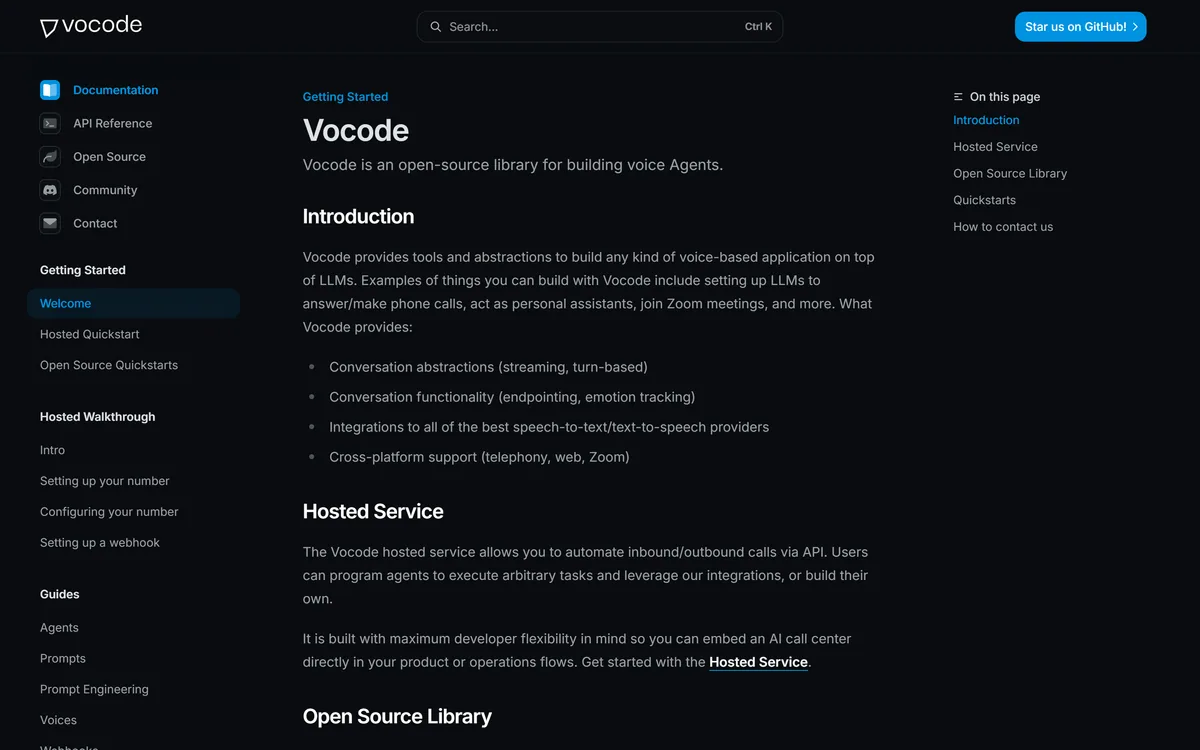
The library provides conversation abstractions for both streaming and turn-based interaction, conversation functionality including endpointing and emotion tracking, integrations across speech-to-text and text-to-speech providers, and cross-platform support spanning telephony, web and Zoom.
Read that list again and notice what is absent: no model, no voice, no opinion about what the agent should say.
That is the point. Vocode is plumbing, and plumbing is exactly what teams underestimate when they decide to build a voice agent themselves.
The realistic alternative to a framework is writing your own audio pipeline, discovering that endpointing is a research problem rather than a threshold, and spending a quarter on the part of the product nobody will ever notice working.
Emotion tracking is the outlier on the list — a harder claim than the rest and one whose accuracy depends entirely on the underlying provider, so treat it as available rather than as solved. Platforms like Voiceflow abstract all of this away, at the cost of exactly the control you came here for.
The model is the easy part of a voice agent. Endpointing is the part that decides whether anyone stays on the call.
Vocode documents its beta features openly rather than describing them in the present tense alongside shipped ones: external actions, warm transfer, multilingual bots, injecting context, IVR navigation, vector databases and HIPAA compliance.
That list is more informative than a feature grid, because it tells you which direction the project is being pushed by real deployments.
Warm transfer and IVR navigation are call-centre requirements. Vector databases and injecting context are retrieval requirements. HIPAA compliance is a healthcare requirement.
Together they describe a product being pulled toward regulated, high-volume telephony rather than toward consumer voice assistants — which is where the money in voice agents currently is.
The caveat is what beta means for anything compliance-related. HIPAA in beta is not HIPAA, and any team with that requirement needs the executed agreement rather than the documentation page.
The hosted service automates inbound and outbound calls via API, described as built for maximum developer flexibility so an AI call centre can be embedded in a product or an operations flow.
This is the more consequential half for most teams, because self-hosting a voice agent means running telephony, and telephony is a specialised operational burden.
The documentation walks through setting up a number, configuring it, and setting up a webhook, which is the realistic sequence for anyone starting from nothing.
Enterprise options include bringing your own telephony and your own OpenAI API keys. The second matters more than it sounds: it means model spend sits on your account with your rate limits and your data agreement rather than being resold.
The trade against a fully managed platform is the usual one. You get flexibility and pay for it in the parts you now have to think about — prompt design, action definitions, failure handling and the escalation path when the agent cannot help. That last piece is where contact-centre products such as Aloware have a decade's head start.
vocode.dev issues a redirect to the GitHub organisation, so there is no marketing homepage. The documentation at docs.vocode.dev is live, hosted on Mintlify, and describes both the library and the hosted service.
This is worth reporting neutrally, because a retired marketing site can mean several very different things and the redirect itself does not distinguish between them.
It can mean a company has stopped selling to a self-serve audience and moved to direct enterprise sales, where a homepage does little work. It can mean the project has become primarily an open-source effort. It can also mean less than that.
What can be checked directly is more useful than speculation: repository commit activity, release cadence, open issue response, and whether the hosted service still provisions numbers and accepts API keys.
For an open-source library this matters less than it would for a closed platform. The code is on GitHub and stays usable regardless of what the company does, which is precisely the argument for choosing an open framework in the first place.
Choosing open source for a voice agent is a real decision with real costs, and they are not the ones people expect.
The obvious worry — that the project stops being maintained — is the least serious. Code that works keeps working, and a frozen library is a snapshot you can fork rather than a service that switches off.
The genuine exposure is upstream. A voice agent depends on a speech-to-text provider, a text-to-speech provider, a model and a carrier, and any of those four can change pricing, deprecate a version or alter latency without warning.
A framework insulates you from having to rewrite everything when that happens, which is its actual value. It does not insulate you from the change itself, and nothing does.
The second exposure is support. When a call drops at three in the morning there is no vendor to escalate to, and the answer to that is not to avoid open source but to know before you commit which of those four dependencies you would be debugging. A managed platform like Tavus owns all four and hands you none of them.
Voice agent projects fail on the boring details rather than the interesting ones, and they fail late — usually the week after a demo that went well.
This sequence front-loads the things that actually decide whether the agent survives contact with real callers.
Open-source library for voice agents on LLMs
Streaming and turn-based conversation abstractions
Endpointing and emotion tracking
Speech-to-text and text-to-speech provider integrations
Telephony, web and Zoom support
Hosted inbound and outbound calling via API
Answering machine and do-not-call detection
Bring your own telephony and OpenAI keys for enterprise
Voice agent tooling splits by how much you want to build versus buy.
| Tool | Model | You control | Best for |
|---|---|---|---|
| Vocode | Open library plus hosted service | Pipeline, providers, prompts | Engineers embedding calling in a product |
| Voiceflow | Visual agent design platform | Flow, content, integrations | CX teams without engineering capacity |
| Tavus | Video conversational agents | Persona and behaviour | Face-to-face rather than phone |
| Hyperbound | Voice roleplay for sales training | Scenario and scoring | Practice rather than production calls |
| Aloware | Contact centre dialler | Campaigns and compliance | Human agents at volume |
| What it is | Open-source library for building voice agents on LLMs |
|---|---|
| Hosted service | Inbound and outbound call automation via API |
| Domain status | vocode.dev redirects to the GitHub organisation; docs.vocode.dev is live |
| Conversation abstractions | Streaming and turn-based |
| Conversation features | Endpointing and emotion tracking |
| Providers | Integrations across speech-to-text and text-to-speech services |
| Platforms | Telephony, web and Zoom |
| Call features documented | Actions, action triggers, conversational dials, retrieve call data, answering machine detection, do-not-call detection |
| Enterprise options | Bring your own telephony; bring your own OpenAI API keys |
| Beta features | External actions, warm transfer, multilingual bots, injecting context, IVR navigation, vector databases, HIPAA compliance |
| Docs platform | Mintlify, with an llms.txt documentation index |
| Community | GitHub, Discord and Twitter |
Other routes to conversational agents, from visual builders to video.
Last checked . Read from docs.vocode.dev in a browser session on the date above, after confirming that vocode.dev redirects to the GitHub organisation. The screenshot was captured at the same time.
What we could not confirm: the operating company behind the hosted service, since the documentation footer names none; why vocode.dev redirects to GitHub, which the redirect alone does not explain; current repository activity, release cadence or maintenance status, which should be checked directly before adoption; whether the hosted service is still provisioning numbers; the licence terms of the open-source repositories; and pricing, which the documentation does not state on the pages we read.
Vocode is two things sharing a name: an open-source library that gives you the unglamorous parts of a voice agent — endpointing, streaming, provider integrations — and a hosted service that runs phone calls via API. Both are documented properly, including the enterprise and beta features most projects leave undocumented. The complication for anyone evaluating it is that vocode.dev now redirects to GitHub rather than a marketing site, so the documentation is the only thing left describing the product, and you should read commitment signals from the repository rather than from a homepage that no longer exists. AInexfinder Editor Score: 3.7/5.
AInexfinder does not list plan prices or billing details. For current pricing, plans, and trials, visit the official Vocode website.
Visit official website for pricingVendor pricing, credits, and billing policies change over time. Always confirm on the official site before you buy.
Log in to write a review.
No reviews yet. Be the first to share your experience with Vocode.
Assigned reviewer
Daniel ReedSenior AI Tools Reviewer
Daniel reviews AI tools the slow way — by actually using them on real projects. His reviews cover what works, what breaks, and who each tool is genuinely a good fit for.
Daniel and the AInexfinder editorial team research Vocode using public product information, listing evidence, and (when available) hands-on checks. Scores reflect listing completeness and transparency — not paid placement.
TTSReader turns text, PDFs, and EPUB files into speech in the browser, with voice and language selection, speed control, text highlighting, and MP3 export — the free tier runs on browser voices with no usage cap.
VMEG from PixRipple translates and dubs video into 170+ languages using 17,000+ voices, with voice cloning, lip-sync, subtitle generation, batch processing, and API and MCP access for automated localisation.
Respeecher is an enterprise voice cloning and text-to-speech platform used in film, television and games. Its credits include young Luke Skywalker in The Mandalorian and Viktor Vektor in Cyberpunk 2077, and it requires documented performer consent before a voice is used.

ElevenLabs is an AI audio platform covering text to speech, voice cloning, speech recognition, dubbing, music, and conversational voice agents, with a library of 5,000+ voices across more than 70 languages and an API behind every model.

The workspace at www-flux3.com generates 5–20 second AI videos with native audio from text or a starting image, routing across FLUX 3, MiniMax H3, Seedance, Wan 3.0 and Kling 3.0 Pro, at 720p or 1080p with video extension.

Runway is an AI video platform built around generative world models — Gen-4.5, Aleph 2.0, and Act-Two for performance capture — split across Runway Creative for filmmakers, Runway Dev for builders, and Runway Robotics.