Chatling deploys AI support agents across five channels — web, WhatsApp, Instagram, Telegram and Messenger — into one unified inbox. It auto-syncs your website, docs and help centre, replies in 80+ languages, and hands off to your team with full context.
The last decade of support chatbots taught customers one thing: the box in the corner exists to stop you reaching a person. Type a question, get a link to an article you already read, try again.
Chatling opens by naming that directly. Its positioning is resolution rather than deflection, which is a claim about what success means rather than a claim about the technology.
The distinction is measurable. A deflection bot succeeds when the ticket does not get created; a resolution bot succeeds when the customer's problem goes away. Those two things look identical on a dashboard and completely different to the person typing.
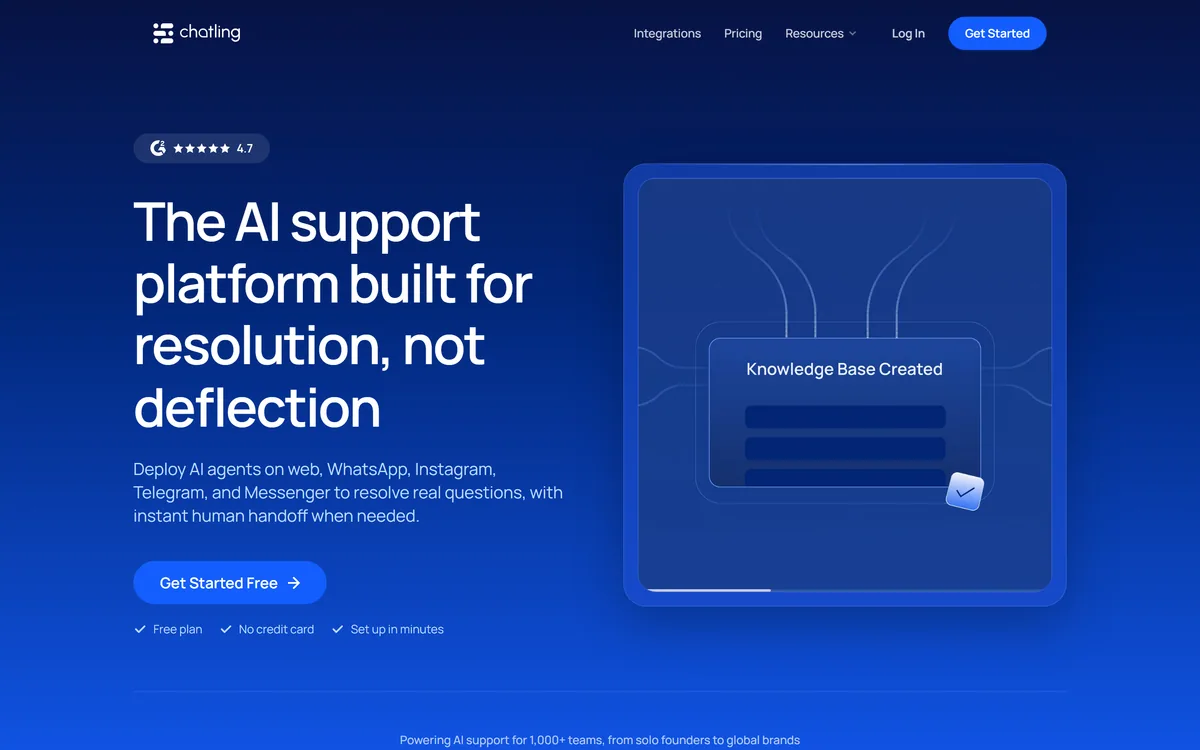
Chatling's homepage, captured 9 September 2026, showing the multi-channel support positioning.
Chatling: Support Agents Across Five Channels
Resolution, not deflection — the stated design goal, and the correct thing to measure a support bot on.
Five channels, one inbox: website, WhatsApp, Instagram, Telegram and Messenger.
Instant human handoff with full conversation context when the agent cannot resolve something.
Auto-syncing knowledge from your website, docs and help centre, so answers do not silently go stale.
80+ languages, plus displayed scores of 4.7 on G2 and 4.3 on Trustpilot, and 1,000+ teams claimed.
What Does Resolution Over Deflection Mean?
Chatling states it is built for resolution, not deflection, and deploys agents that resolve real questions with instant human handoff when needed.
Deflection is a support metric that counts tickets that never got created. It sounds like efficiency and it measures something closer to friction: every customer who gave up, every person who found the bot useless and left, counts as a success.
Resolution counts a different thing — whether the person got what they came for. It is harder to hit and impossible to fake, because a customer whose problem is unsolved comes back or leaves.
The reason this framing matters when you evaluate is that it tells you which number the vendor expects you to watch. A tool optimised for deflection will look excellent on volume and terrible on satisfaction; the reverse is more useful and less flattering.
The practical test during a trial is simple and slightly uncomfortable: read fifty transcripts where the bot did not hand off, and count how many actually ended with the customer's problem solved. That number is the product.
Deflection counts every customer who gave up as a success. Resolution counts whether the person got what they came for. Those look identical on a dashboard.
Where Human Handoff Actually Matters
Chatling states that when the AI cannot resolve an issue, conversations are handed to your team instantly with full context.
Two words in that sentence carry the weight. Instantly matters because the failure mode customers hate most is not a bot that cannot help — it is a bot that will not let go, cycling through suggestions while the person types agent five times.
Full context matters because the alternative is asking the customer to repeat everything they just typed, which converts a mild annoyance into a genuine one. A handoff that loses the conversation is worse than no bot at all.
The thing to test is what triggers a handoff. If it only fires when the customer explicitly asks, the bot will keep people trapped a few turns too long, and those turns are where goodwill is spent.
Voice-based handling has the same problem in a harder form, because a caller cannot scroll back. Products like Vogent and Aloware face it on the phone, where the transfer has to happen in seconds or the caller hangs up.
Five Channels, One Inbox
Chatling deploys to website, WhatsApp, Instagram, Telegram and Messenger, and states that every conversation lands in one unified inbox.
The breadth is more useful than it sounds, because customers do not choose a channel rationally. They message wherever they already are, which for large parts of the world means WhatsApp and Instagram rather than a form on your site.
The unified inbox is the part that actually saves time. Five channels without it means five places to check, five sets of notifications and five conversations you did not know were happening.
What breadth does not solve is that channels have different conventions. A WhatsApp message expects a reply in minutes; an Instagram DM sits alongside comments and mentions; a website widget catches people mid-purchase with a specific question. The same agent serves all five, and it will be better suited to some than others.
The practical advice is to start with the channel where your volume actually is, get resolution right there, and add the rest once the agent is answering well. Turning on five channels at once multiplies your unanswered questions by five.
Measure resolution, not deflection — read transcripts, not volume charts.
Test what triggers handoff before you trust the bot with real customers.
Start on one channel and expand once resolution is good.
Fix your documentation first; the agent can only be as accurate as its source.
Check how quickly the knowledge sync picks up a changed help article.
Keeping An AI Agent's Knowledge Current
Chatling states that it auto-syncs your website, docs and help centre so the agent always responds with the latest information, with no manual updates needed.
This addresses the quiet failure mode of every support bot: it does not break, it just gets old. A policy changes, a price changes, a feature is retired, and the bot keeps confidently answering with last year's facts.
Manual retraining does not solve it, because retraining is a task that competes with everything else and always loses. Auto-sync solves it structurally by making the documentation the single source rather than a copy.
The consequence is that your help centre becomes load-bearing. If your docs are thin, contradictory or out of date, the agent will be all three, and you will have made a documentation problem into a customer-facing one.
That is the real prerequisite for a tool like this, and it is the same prerequisite as any retrieval-based product. Teams that maintain internal knowledge well — the discipline that tools such as GitBook and Dosu exist to support — get far more out of an AI agent than teams that do not.
What Chatling Does Not Cover
Messaging is one surface of support, and a tool that covers five messaging channels well still leaves the other surfaces where they were.
Voice is the obvious gap. A caller cannot scroll back, cannot see suggested articles, and will not wait through three failed attempts, so telephone support is a different engineering problem handled by phone platforms such as CloudTalk rather than by a chat agent with a microphone bolted on.
Email is the second. Support email arrives asynchronously, often with attachments and long history, and the reply is expected to be composed rather than conversational — closer to what assistants like WriteMail.ai address than to a chat thread.
Internal support is the third and least obvious. The questions employees ask about payroll, access and policy look like support questions but sit behind different systems and different permissions, which is the space products such as Ema occupy.
None of that is a criticism of the scope. It is the reason to be precise about which queue you are actually trying to shorten, because buying a messaging agent to fix a phone queue is a common and expensive mistake.
Rolling Out Chatling Without Annoying Customers
The fastest way to damage a support experience is to put an unprepared agent in front of paying customers and find out in public.
This sequence tests against real questions before anyone external sees it, and expands only once resolution is holding.
Audit your help centre first and fix anything wrong, since the agent inherits every error.
Connect one channel only — whichever carries most of your current volume.
Feed it your last hundred real support questions and read every answer.
Set handoff to trigger early rather than late while you are still learning.
Read fifty non-handoff transcripts and count actual resolutions, not conversation ends.
Add the remaining channels one at a time, checking each against its own conventions.
Chatling: Channels And Numbers
Product type
AI customer support agents
Positioning
Built for resolution, not deflection
Channels
Website, WhatsApp, Instagram, Telegram, Messenger
Inbox
One unified inbox across all channels
Handoff
Instant transfer to your team with full context
Knowledge
Auto-syncs website, docs and help centre
Languages
80+ supported
Displayed ratings
4.7 on G2 and 4.3 on Trustpilot, per the site
Scale claim
1,000+ teams, from solo founders to global brands
Models
Switchable between leading models to balance accuracy, speed and cost
Contact
support@chatling.ai
Key features of Chatling
AI support agents across five messaging channels
One unified inbox for every conversation
Instant human handoff with full context
Auto-syncing knowledge from website, docs and help centre
Replies in more than 80 languages
Live chat for jumping into conversations directly
Switchable underlying models
Lead capture and prospect qualification
Pros & cons
Pros
7
Names deflection as the wrong metric, which is the honest argument in this category
Instant handoff with full context avoids the worst customer-facing failure mode
Auto-syncing knowledge prevents the slow drift that kills most support bots
Five channels in one inbox genuinely reduces where a small team has to look
80+ languages opens support to customers you could not otherwise serve
Switchable models let you trade accuracy against cost deliberately
A published DPA and EU data protection page for teams that need them
Cons
6
Only as accurate as the documentation it syncs from, which is your problem to fix
No operating company or jurisdiction named in the footer
Which models are available under switchable models is not stated
Five channels have different conventions that one agent will serve unevenly
Displayed review scores are read from the vendor's page, not verified at source
Pricing is not covered on the pages we read
Best For
Small support teams fielding the same questions repeatedly
Businesses whose customers message on WhatsApp or Instagram
Companies with a maintained, accurate help centre
Teams supporting customers in languages they do not speak
Founders handling support alongside everything else
Chatling Against Other Support Tools
Support automation differs by channel, by whether a human is in the loop, and by what it treats as success.
Tool
Channels
Human handoff
Best for
Chatling
Web, WhatsApp, Instagram, Telegram, Messenger
Instant, with full context
Small teams whose customers message from everywhere
Customers reach you across several messaging apps and you are checking each one.
Your help centre is accurate and maintained, so an agent can answer from it.
The same twenty questions arrive every week and eat your team's day.
You support customers in languages nobody on the team speaks.
You have capacity to read transcripts and tune the agent for a few weeks.
Keep humans on it when
Your documentation is thin or out of date, which the agent will simply broadcast.
Your support questions are genuinely novel each time rather than repetitive.
A wrong answer in your field carries regulatory or safety consequences.
Most of your volume is voice rather than messaging.
You cannot commit to reviewing transcripts, in which case nobody will notice it drifting.
More Support And Chat Tools
Neighbouring products that handle a different part of the same conversation.
CloudTalk — the phone side of the same support function
OpenMic AI — voice agents for calls rather than chat
GitBook — the documentation an agent has to answer from
Ema — internal employee support rather than customer-facing
Aloware — outbound and inbound calling for the same teams
Chatling: What The Site States On The Day
Last checked . Read from chatling.ai in a browser session on the date above, with the screenshot captured alongside.
Positioned as the AI support platform built for resolution, not deflection
Website, WhatsApp, Instagram, Telegram and Messenger all named as channels
A unified inbox across channels stated
Instant human handoff with full context stated
Auto-sync of website, docs and help centre stated, with no manual updates needed
80+ languages stated
Displayed as 4.7 / 5 on G2 and 4.3 / 5 on Trustpilot
1,000+ teams claimed, from solo founders to global brands
Switchable models offered to balance accuracy, speed and cost
Footer confirms DPA, Cookie Policy, Privacy Policy, Terms of Service, EU Data Protection and support@chatling.ai
What we could not confirm: the operating company or its jurisdiction, which the footer does not name; pricing and plan structure; which specific models are offered under the switchable-models feature; how quickly the knowledge sync detects a changed help article; what triggers a handoff by default; and whether the displayed G2 and Trustpilot scores reflect current review counts, since we read them as printed on the vendor's own page rather than at source. We did not deploy an agent, so nothing here reflects tested resolution quality.
Editor's Verdict
4.1/5
Chatling's positioning line — built for resolution, not deflection — is a direct shot at the entire previous generation of support bots, and it is the right thing to be arguing about. A bot that reduces ticket volume by making people give up is not doing support. The two design choices that back the claim are instant handoff with full context, and knowledge that auto-syncs from your existing docs so answers do not silently go stale. Five channels in one inbox is genuinely useful for small teams. It falls short of a top score because the whole thing rests on how good your documentation already is, and that is a problem no vendor can fix for you. AInexfinder Editor Score: 4.1/5.
Chatling pricing
AInexfinder does not list plan prices or billing details. For current pricing, plans, and trials, visit the official Chatling website.
Vendor pricing, credits, and billing policies change over time. Always confirm on the official site before you buy.
Frequently asked questions
What is Chatling?
Chatling is an AI customer support platform that deploys agents to your website, WhatsApp, Instagram, Telegram and Messenger, routing every conversation into one unified inbox. It hands off to your team with full context when the agent cannot resolve something, and syncs its knowledge from your existing docs.
What does resolution, not deflection mean?
Deflection counts tickets that never got created, which means every customer who gave up counts as a success. Resolution counts whether the person's problem was actually solved. The two look identical on a dashboard and completely different to the customer, which is why the framing matters.
How do I test whether it is really resolving?
Read fifty transcripts where the agent did not hand off, and count how many ended with the customer's problem solved rather than the conversation simply ending. That number is the product. Volume charts will not tell you, because a conversation ending looks the same either way.
How does human handoff work?
The site states that when the AI cannot resolve an issue, conversations are handed to your team instantly with full context. Both words matter: instantly, because a bot that will not let go is the failure customers hate most, and full context, because making someone repeat themselves undoes any goodwill.
How does Chatling stay up to date?
It auto-syncs from your website, docs and help centre, with no manual updates needed. This addresses the quiet failure of support bots — they do not break, they just get old, confidently answering with last year's policy long after it changed.
What if our documentation is bad?
Then the agent will be bad, publicly. Auto-sync makes your help centre load-bearing: thin, contradictory or stale docs become customer-facing rather than merely internal. Fixing the documentation is the real prerequisite, and it is work no vendor can do for you.
Should I turn on all five channels at once?
No. Start where your volume actually is, get resolution right there, then expand. Channels have different conventions — WhatsApp expects a reply in minutes, a website widget catches people mid-purchase — and enabling everything at once multiplies unanswered questions by five.
Which languages does Chatling support?
The site states 80+ languages, with the agent understanding and replying in the customer's language. For businesses selling internationally that is often the single strongest reason to automate first-line support, since it covers customers you could not otherwise serve at all.
Which AI models does Chatling use?
The site says you can switch between leading models to balance accuracy, speed and cost, but does not name them on the pages we read. Worth asking before committing, since the trade-off only means something if you know what you are choosing between.
Is Chatling suitable for regulated support?
Be careful. Where a wrong answer carries regulatory or safety consequences, an agent answering from synced documentation is a risk rather than a saving. The pattern that works there is handoff-first, with automation restricted to genuinely routine questions.
Daniel reviews AI tools the slow way — by actually using them on real projects. His reviews cover what works, what breaks, and who each tool is genuinely a good fit for.
Daniel and the AInexfinder editorial team research Chatling using public product information, listing evidence, and (when available) hands-on checks. Scores reflect listing completeness and transparency — not paid placement.
Listings may include affiliate or sponsored placements, which are labeled when present. Editorial scores and cons are not sold. See our affiliate disclosure and review methodology.
Voiceflow is an enterprise conversational AI platform where CX teams design agent workflows visually, prototype them in place, and deploy one agent across web, app, WhatsApp, SMS and voice. It states 500-millisecond voice latency, 300,000 messages per minute and more than 10,000 live agents in production.
Wonderchat is a platform for building AI customer-service and sales agents from your own content and data. Agents answer with citations from approved sources, hand off to sales and capture leads in the conversation, while a QA agent flags weak answers for fixing.
Spur is a multi-channel AI agent for commerce marketing and support, unifying WhatsApp, Instagram, Facebook and website chat in one inbox, automating comment-to-DM flows and bulk campaigns, and integrating with external systems to update orders and book meetings.