Dosu captures knowledge automatically from coding agent sessions, keeps documentation updated when source code changes, and connects GitHub, Confluence, Notion and Slack into one source of context. It states 50% fewer tokens burned, 2x faster agent performance and 200k+ engineers using it.
Documentation has always lost to features, and the reason is not laziness. Writing it is work that benefits somebody else later, which is the least motivating shape a task can have.
Coding agents have changed the arithmetic. An agent with good context is fast and accurate; an agent without it reads half the repository to answer a simple question, gets it wrong, and costs you tokens doing so.
Dosu's proposition is that documentation should be captured rather than written — extracted from the work as it happens, and updated when the code it describes changes.
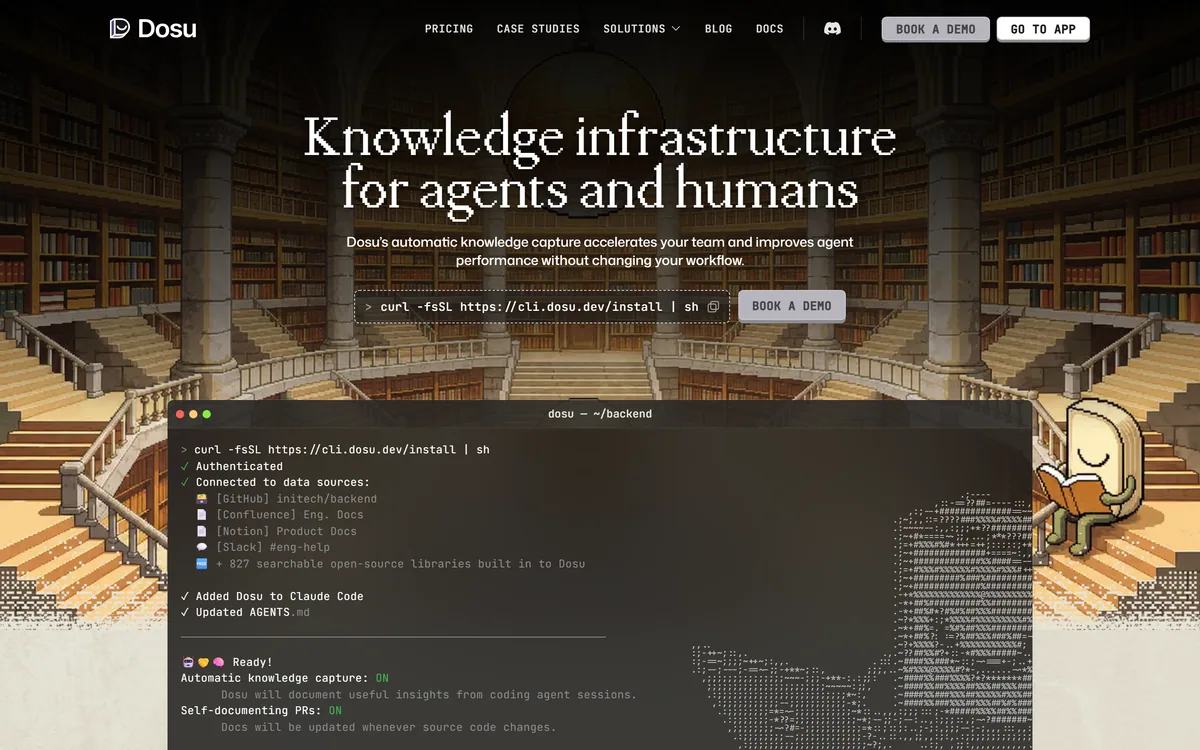
Dosu's homepage, captured 9 September 2026, showing the CLI install and connected data sources.
Dosu: Documentation That Writes Itself
Automatic knowledge capture from coding agent sessions, so documentation is a by-product rather than a task.
One source instead of many MCP servers, consolidating GitHub, Confluence, Notion and Slack.
827 open-source libraries searchable out of the box, plus your own repositories.
50% fewer tokens and 2x faster agents claimed, with 200k+ engineers and SOC 2 Type II certification.
Why Do Coding Agents Need Better Docs?
Dosu positions itself as knowledge infrastructure for agents and humans, stating that automatic knowledge capture accelerates your team and improves agent performance without changing your workflow.
The mechanism is worth spelling out because it explains the token figures. An agent answering a question must first find the relevant context, and if there is no documentation it does that by reading code.
Reading code is expensive in exactly two ways. It consumes tokens proportional to how much has to be read, and it produces an inferred understanding that may be wrong — because code shows what happens, not why, and the why is where the decisions live.
Good documentation short-circuits both. The agent reads a paragraph instead of four files, and the paragraph contains the reasoning that the code cannot express.
This reframes documentation from a courtesy to infrastructure. It was always valuable and always deferrable; with agents in the loop it has a measurable per-query cost, which is the first time the argument has had a number attached to it — much as CodeScene attached a number to technical debt.
Code shows what happens, not why. The why is where the decisions live, and it is exactly what an agent cannot infer by reading more files.
Capturing Knowledge From Agent Sessions
Dosu's terminal output describes automatic knowledge capture as on, documenting useful insights from coding agent sessions.
This is the cleverest idea in the product. When an agent works through a problem, it necessarily reconstructs an understanding of the relevant part of the system — and that understanding is normally discarded when the session ends.
Capturing it converts a by-product into an asset. The expensive part of documentation, which is working out how something actually functions, has already been paid for; writing it down is the cheap part that never happens.
It also aligns the incentive correctly. Nobody has to remember to document anything, and the documentation that gets created is about the parts of the system people are actually working on, which is where it is most needed.
The caveat is that an agent's understanding can be wrong, and captured wrongness is worse than absence because it will be trusted by the next agent and the next person. Any system doing this needs a review path, and that is the thing to check before switching it on across a repository.
Self-Documenting Pull Requests
The second capability is docs updating whenever source code changes, described on the site as self-documenting PRs.
This attacks documentation's real failure, which was never that it did not exist. It was that it existed, described the system as of two years ago, and was therefore worse than nothing because people believed it.
Stale documentation is genuinely dangerous with agents in the loop. A human reading an out-of-date page usually notices the mismatch against the code; an agent may confidently act on the description instead.
Tying updates to the change that caused them is the structurally correct fix, because it removes the gap where documentation drifts. The moment the code changes is the only moment anyone knows what changed and why.
The practical question to ask is what happens when the update is wrong. A documentation change generated alongside a code change should be reviewable in the same pull request, which is where products like GitBook and cubic approach the same review surface from different directions.
Treat captured documentation as a draft that needs review, not as truth.
Check that generated doc updates are reviewable in the same pull request.
Consolidate context sources before adding more MCP servers.
Measure your own token usage before and after, rather than trusting a published figure.
Start on one repository where the code is well understood by a human.
One Source Instead Of Many MCP Servers
Dosu makes a pointed argument about replacing a tangle of MCP servers with a single consistent source of knowledge, and lists GitHub, Confluence, Notion and Slack among its connections plus 827 built-in open-source libraries.
The problem it names is real and recent. Connecting an agent to five separate systems means five sets of credentials, five retrieval behaviours, five ways for something to fail, and no coherent notion of what the agent actually knows.
It also means duplication and contradiction. The same fact exists in a Notion page, a Slack thread and a README, in three versions of varying age, and the agent picks whichever it finds first.
A consolidation layer resolves that by deciding what is authoritative, which is a genuinely useful thing to have decided. The trade is that you have added a dependency between your agents and everything they know.
The 827 open-source libraries are the underrated part of the list. Agents routinely get third-party library usage wrong because their training data predates the current version, and a maintained index of library documentation addresses that specific and common failure.
Reading The Published Numbers
Dosu publishes three figures: 50% fewer tokens burned by agents working with accurate documentation, 2x faster agent performance with Dosu-maintained context, and 200k+ engineers already using it.
The first two are vendor benchmarks with no stated methodology on the page, so treat them as directional. The direction, however, is well supported by ordinary reasoning: less reading means fewer tokens, and better context means less trial and error.
What makes them unusually testable is that both are things you can measure yourself. Token usage per task is already visible in your agent tooling, and so is time to a correct answer.
That puts this in a better position than most vendor claims, which rely on effects you cannot isolate. Run twenty representative tasks before and after and you have your own number, on your own codebase, which is the only one that matters.
The 200k+ engineers figure is the vaguest of the three, since it does not distinguish between people who installed it once and teams using it daily — a distinction every developer tool blurs in the same way.
Adding Dosu To An Existing Repository
The risk with automatic documentation is generating a large volume of plausible text about a system nobody has verified, which then becomes the authority.
This sequence starts where a human can check the output and expands only once the captured knowledge has proved accurate.
Start with one repository somebody on the team knows thoroughly.
Measure current token usage and time-to-answer on twenty representative tasks.
Turn on knowledge capture and read the first documents it produces, closely.
Correct anything wrong immediately, before it is trusted by later sessions.
Enable self-documenting PRs once captured knowledge has proved accurate.
Re-run the same twenty tasks and compare against your own baseline.
Agent Knowledge Terms
The vocabulary around agent context, and what each term actually means.
undefined
undefined
undefined
undefined
undefined
undefined
Dosu: Product And Numbers
Product type
Knowledge infrastructure for coding agents and humans
Positioning
Automatic knowledge capture that accelerates teams and improves agent performance
Install
A single CLI command, per the site
Data sources
GitHub, Confluence, Notion, Slack
Built-in index
827 searchable open-source libraries
Agent integration
Adds itself to Claude Code and updates AGENTS.md, per the site
Capture
Documents insights from coding agent sessions automatically
Documentation
Updates whenever source code changes
Token claim
50% fewer tokens burned by agents with accurate documentation
Speed claim
2x faster coding agent performance with Dosu-maintained context
Scale claim
200k+ engineers
Certification
SOC 2 Type II
Location
1841 Market St, San Francisco, CA 94103
Does Your Repository Need Dosu?
Connect it when
Coding agents are a real part of how your team works.
Your documentation is thin, stale, or spread across four systems.
Agents keep rediscovering the same things and costing you tokens for it.
You are running several MCP servers and the tangle has become a maintenance problem.
Onboarding relies on people asking colleagues rather than reading anything.
Write docs yourself when
Your codebase is small enough that context is never the constraint.
You already maintain accurate documentation with real discipline.
You cannot allow a third party to index your source and internal systems.
Nobody will review captured documentation, which makes wrongness durable.
Your problem is code quality rather than code understanding.
Key features of Dosu
Automatic knowledge capture from coding agent sessions
Documentation updated when source code changes
A single CLI install
GitHub, Confluence, Notion and Slack connections
827 open-source libraries searchable out of the box
Automatic AGENTS.md maintenance
Integration with coding assistants including Claude Code
A consolidated alternative to multiple MCP servers
Pros & cons
Pros
7
Inverts documentation economics by capturing rather than requiring writing
Ties doc updates to the change that caused them, which removes drift structurally
Consolidating context sources resolves duplication and contradiction between systems
The built-in library index addresses agents getting third-party APIs wrong
Published claims are unusually testable against your own token usage
SOC 2 Type II certification and a published street address
Installs in one command without changing existing workflow
Cons
7
Captured wrongness is worse than no documentation, since it will be trusted
Whether captured knowledge is reviewable before becoming authoritative is unstated
The 50% and 2x figures carry no published methodology
200k+ engineers does not distinguish installs from active use
Adds a dependency between your agents and everything they know
Requires indexing source and internal systems, which some organisations cannot allow
No registered operating entity named in the footer
Best For
Teams where coding agents do meaningful daily work
Codebases with thin or stale documentation and high onboarding cost
Organisations running several MCP servers that have become unmanageable
Engineering groups measuring and trying to reduce agent token spend
Open-source maintainers whose contributors need context fast
Dosu Against Other Developer Tools
Developer tools split by whether they explain the code, review it, or measure it.
Last checked . Read from dosu.dev in a browser session on the date above, with the screenshot captured alongside.
Positioned as knowledge infrastructure for agents and humans
Stated that automatic knowledge capture accelerates teams and improves agent performance without changing workflow
Install shown as a single CLI command
GitHub, Confluence, Notion and Slack shown as connected data sources
827 searchable open-source libraries stated as built in
Stated as adding itself to Claude Code and updating AGENTS.md
Automatic knowledge capture described as documenting insights from coding agent sessions
Self-documenting PRs described, with docs updated whenever source code changes
Positioned as replacing a tangle of MCP servers with one consistent source of knowledge
Figures displayed for 50% fewer tokens, 2x faster agent performance and 200k+ engineers
SOC 2 Type II certification stated
Address shown as 1841 Market St, San Francisco, CA 94103
What we could not confirm: the methodology behind the 50% token and 2x speed figures, which are presented without a stated basis; whether 200k+ engineers counts installs or active users; pricing, which routes to a separate page we did not read; the registered operating entity, which the footer does not name beyond the product; how source code and internal documents are processed and retained during indexing; and whether captured documentation is reviewable before it becomes authoritative. We did not install Dosu.
Editor's Verdict
4.3/5
Dosu is built on an observation that has become obviously true in the last year: coding agents are only as good as the context they can find, and most codebases have none worth finding. Rather than asking teams to write documentation they were never going to write, it captures knowledge from agent sessions as a by-product and updates docs when source changes. That inverts the economics of documentation entirely. The published numbers — 50% fewer tokens, 2x faster agent performance — are vendor figures, but the mechanism behind them is sound and the problem is real. AInexfinder Editor Score: 4.3/5.
Dosu pricing
AInexfinder does not list plan prices or billing details. For current pricing, plans, and trials, visit the official Dosu website.
Vendor pricing, credits, and billing policies change over time. Always confirm on the official site before you buy.
Frequently asked questions
What is Dosu?
Dosu is knowledge infrastructure for coding agents and humans. It captures documentation automatically from agent sessions, updates docs when source code changes, and consolidates GitHub, Confluence, Notion and Slack plus 827 open-source libraries into one searchable source of context.
Why do agents need documentation?
Because without it they read code to build understanding, which costs tokens proportional to how much they read and produces an inference that may be wrong. Code shows what happens, not why — and the why is where the decisions live.
How does knowledge capture work?
When an agent works through a problem it necessarily reconstructs an understanding of that part of the system, and that understanding is normally discarded when the session ends. Capturing it turns a by-product into an asset — the expensive part of documenting has already been paid for.
What if the captured documentation is wrong?
That is the real risk, because captured wrongness is worse than absence: it will be trusted by the next agent and the next person. Any system doing this needs a review path, and confirming one exists is the thing to check before enabling it across a repository.
What are self-documenting pull requests?
Documentation updates generated alongside the code change that made them necessary. It attacks documentation's real failure, which was never absence but staleness — a page describing the system as of two years ago, believed by people and acted on confidently by agents.
Why replace multiple MCP servers?
Five connected systems mean five credentials, five retrieval behaviours and no coherent notion of what the agent knows. Worse, the same fact exists in a Notion page, a Slack thread and a README in three versions, and the agent uses whichever it finds first.
Why does the built-in library index matter?
Because agents routinely get third-party library usage wrong when their training data predates the current version. A maintained index of 827 open-source libraries addresses that specific failure, which is one of the most common causes of confidently broken generated code.
Should I trust the 50% and 2x figures?
Treat them as directional — no methodology is published. What makes them better than most vendor claims is that you can measure both yourself: token usage per task and time to a correct answer are already visible in your agent tooling.
How do I test it properly?
Measure twenty representative tasks before installing, start on one repository somebody knows thoroughly, read the first captured documents closely and correct anything wrong immediately, then re-run the same twenty tasks against your own baseline.
Who does not need Dosu?
Teams whose codebase is small enough that context is never the constraint, teams that already maintain accurate documentation with real discipline, and organisations that cannot allow a third party to index source code and internal systems.
Daniel reviews AI tools the slow way — by actually using them on real projects. His reviews cover what works, what breaks, and who each tool is genuinely a good fit for.
Daniel and the AInexfinder editorial team research Dosu using public product information, listing evidence, and (when available) hands-on checks. Scores reflect listing completeness and transparency — not paid placement.
Listings may include affiliate or sponsored placements, which are labeled when present. Editorial scores and cons are not sold. See our affiliate disclosure and review methodology.
Theneo is an AI-powered API documentation and developer-portal platform where engineers, writers, PMs and AI agents co-edit API references, guides and changelogs in real time, with generation from any spec, MCP and llms.txt for agents, and private per-customer portals.
Stainless generates idiomatic client libraries in seven languages, documentation that tracks the API, and MCP servers, all derived from an OpenAPI specification. Its homepage announces that the company is joining Anthropic.
GitHub Copilot is an AI coding assistant that spans completion, chat, agent mode, automated code review, and a cloud agent that opens pull requests, working across VS Code, Visual Studio, JetBrains, Xcode, Neovim, Eclipse, the CLI, and github.com.
Replit AI turns a written description into a working application — the Agent writes the code, and Replit supplies the database, authentication, hosting, and monitoring, so a prototype goes live without a local setup or a deployment pipeline.