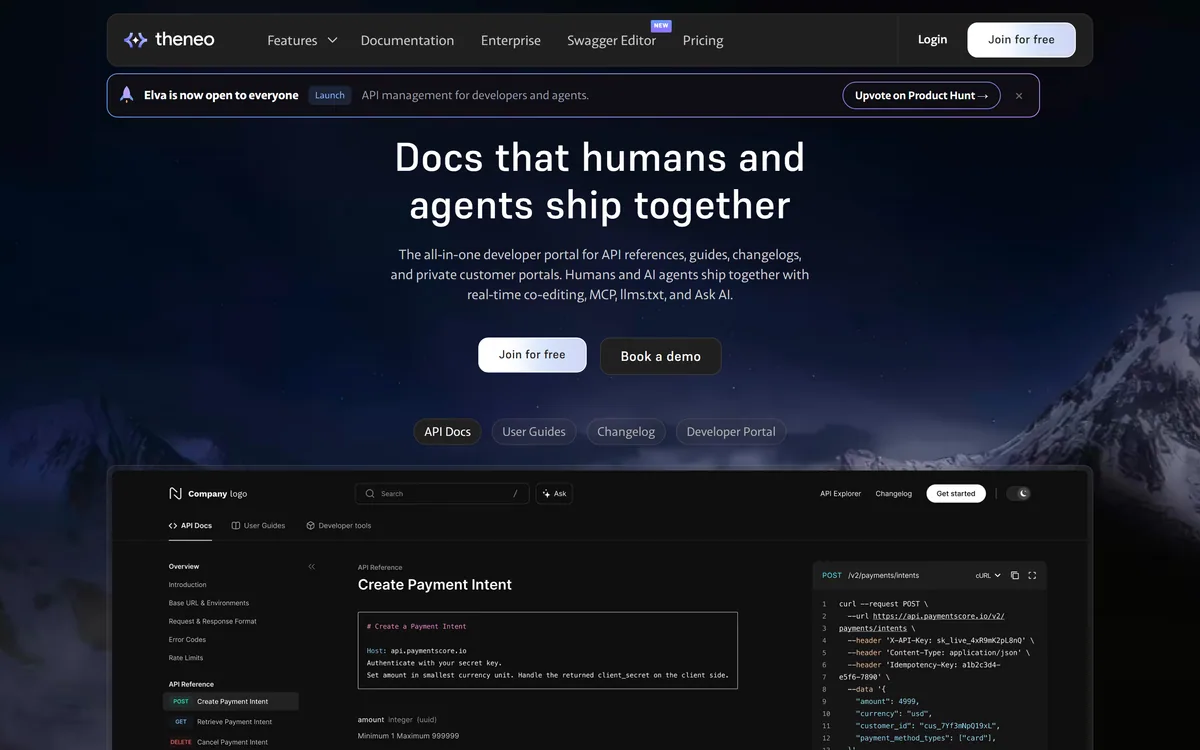
Theneo is an AI-powered API documentation and developer-portal platform where engineers, writers, PMs and AI agents co-edit API references, guides and changelogs in real time, with generation from any spec, MCP and llms.txt for agents, and private per-customer portals.
API documentation is the thing every team knows it should keep current and almost never does, because writing and syncing it is tedious and falls between engineering and writing. Theneo's pitch is to make the docs keep up on their own.
It generates complete docs from any API spec, lets engineers, writers, PMs and AI agents co-edit them in real time, and exposes them to agents through MCP and an llms.txt. For the SDK side of an API, it sits alongside tools like Stainless, while covering the documentation layer specifically.
This review covers how Theneo keeps docs in sync, who it fits among API teams, how its plans work, and who will find it more than they need.
Theneo generates API docs from a spec and keeps humans and agents editing in sync.
Theneo, The Docs Brief
Theneo is an AI-powered API-docs platform: generate docs from a spec and co-edit them in real time.
Humans and agents both edit: engineers in Markdown, others in WYSIWYG, and AI agents via MCP and llms.txt.
It keeps docs in sync: smart changelogs flag breaking changes as the API evolves.
Private portals are a differentiator: authenticated per-customer docs showing each only the APIs they use.
Theneo API-Docs Facts
What it is
An AI-powered API-documentation platform
Generation
Complete docs from any API spec
Editing
Real-time co-editing, Markdown and WYSIWYG
For agents
MCP server and llms.txt
Changelogs
Auto-flag breaking changes
Portals
Private, authenticated per-customer docs
Security
SOC 2 Type II, ISO 27001 & 9001, GDPR (vendor)
Deployment
Cloud or self-hosted, full white-label
API Docs That Humans And Agents Build Together
Theneo's framing, docs that humans and agents ship together, captures what makes it current rather than dated. Engineers can work in Markdown, non-engineers in a WYSIWYG editor, and AI agents can edit too, all in the same document with live collaboration.
That multi-author model is the fix for why docs rot: they usually depend on one overburdened person, and drift the moment the API changes. Letting everyone, including agents, contribute in one place keeps the docs closer to the product.
It generates complete docs from any API spec as the starting point, so you are editing a real draft rather than a blank page, which is most of the activation energy for keeping documentation alive.
Docs rot because they depend on one overburdened person and drift the moment the API changes. Theneo lets everyone, including agents, edit in one place to keep docs close to the product.
How Does Theneo Keep Docs In Sync?
Two capabilities matter most: generation-plus-collaboration, and making the docs machine-consumable.
Generate From A Spec, Edit Together
Import an API spec and Theneo generates reference docs, guides and changelogs; smart changelogs auto-flag breaking changes so consumers are warned, and version rollback and an audit trail keep edits safe. A developer-tool like Replit AI speeds the building of an API; Theneo keeps its docs honest as it changes.
The real-time co-editing with live cursors is what turns documentation from a chore handed to one person into a shared, maintainable asset, which is the difference between docs that stay current and docs that quietly go stale.
MCP, llms.txt And Private Portals
Theneo exposes docs as agent tools via an MCP server and an llms.txt, so an AI agent can consume your API documentation directly, a forward-looking choice as more development happens through agents. It also offers private, authenticated per-customer portals that show each customer only the APIs they pay for, with SSO and per-segment branding.
Those private portals are a genuine differentiator for B2B and regulated API businesses. For a broader internal knowledge base beyond API docs, a tool like Document360 is the wider-net option; Theneo is sharper on APIs specifically.
Who Theneo Fits Among API Teams
Theneo fits API-first companies, startups to large enterprises, where documentation quality directly affects adoption: developer platforms, fintechs, and B2B products whose customers integrate against an API.
It especially suits teams that need per-customer private portals, regulated or partner-ecosystem businesses where different customers should see different APIs, and teams that want docs their own AI agents can consume cleanly.
It fits less well a tiny project with a stable, simple API and few consumers, where a static docs page is enough, or a team that wants general internal wiki/docs rather than API documentation specifically. Theneo's depth is aimed at API as a product.
How Theneo Tiers Its Plans
Theneo is freemium, a join-for-free tier plus a book-a-demo and Enterprise path, with cloud or self-hosted deployment and full white-labelling available. We do not publish prices, which change; check the site.
The value question is whether better, always-current docs measurably improve API adoption and cut support load, which for an API-as-a-product business is a direct commercial lever, not a nice-to-have.
For such a team, the cost usually justifies itself through faster integrations and fewer support tickets; for a hobby API, the free tier is the sensible ceiling.
A Neat Way To Trial Theneo
Because the pitch is docs that stay in sync, trial it on a real API spec and a real change, not a sample.
Import your actual API spec and judge the quality of the docs it generates.
Have an engineer and a non-engineer co-edit the same doc to test the collaboration.
Make a breaking change and confirm the smart changelog flags it correctly.
Connect an AI agent via MCP or llms.txt and check it can consume the docs.
If you serve different customers, set up a private portal and verify the access control.
Pass/fail: Theneo is worth it if docs stay current with less effort and adoption or support improves.
Confirm the SOC 2 and ISO claims meet your requirements before rollout.
Theneo API-Docs Terms
API spec
A machine-readable description of an API (such as OpenAPI/Swagger) that Theneo turns into generated documentation.
llms.txt
A file that makes a site's content, here your docs, readable by AI agents and language models.
MCP server
An interface that lets an AI agent consume Theneo's docs as a tool, not just a human reading a page.
Breaking change
An API change that can break existing integrations; Theneo's smart changelogs auto-flag these.
Is Theneo Right For Your API Docs?
API Teams Theneo Suits
API-first companies where docs affect adoption
Developer platforms, fintechs and B2B integrators
Teams needing private per-customer portals
Groups that want docs their AI agents can consume
Teams where multiple roles should edit the docs
When Theneo Is Unnecessary
A tiny, stable API with few consumers
Teams wanting a general internal wiki, not API docs
Projects where a static docs page is enough
Anyone who will not keep the docs maintained at all
Hobby APIs beyond the free tier's needs
Key features of Theneo
Docs generated from any API spec
Real-time multi-role co-editing
Markdown and WYSIWYG in one doc
Smart changelogs for breaking changes
MCP server and llms.txt for agents
Private per-customer portals
Version rollback and audit
Cloud or self-hosted, white-label
Pros & cons
Pros
5
Generates a real docs draft from a spec
Multi-role editing keeps docs from rotting
Agent-consumable via MCP and llms.txt
Private per-customer portals for B2B
Strong stated security credentials
Cons
5
Overkill for a tiny, stable API
Not a general internal wiki
Customer and speed stats are vendor-stated
Depth aimed at API-as-a-product teams
Certifications need verifying for compliance
Best For
API-first companies
Developer platforms and fintechs
B2B API integrators
Teams needing private portals
Agent-consumable docs
Theneo Against Other Docs Tools
The useful comparison is with other developer-docs and API tooling.
Last checked . Read from theneo.io during this check, with the screenshot above captured at the same time.
An AI-powered API-documentation and developer-portal platform
Generation of complete docs from any API spec
Real-time co-editing in Markdown and WYSIWYG
Smart changelogs that auto-flag breaking changes
An MCP server and llms.txt for AI-agent consumption
Private, authenticated per-customer portals with SSO
SOC 2 Type II, ISO 27001 & 9001 and GDPR stated by the vendor
Cloud or self-hosted deployment with full white-labelling
No plan prices reproduced here, in line with this site's pricing policy
Theneo's customer counts and '57x faster' figure are vendor-stated claims; its certifications should be verified against current documentation for your requirements.
Editor's Verdict
4.2/5
Theneo earns 4.2 for attacking the reason API docs rot, single-owner drift, with a platform that generates docs from a spec, lets engineers, writers, PMs and AI agents co-edit in real time, flags breaking changes, and serves private per-customer portals. Its customer and speed figures are vendor claims, and it is overkill for a tiny stable API, but for an API-as-a-product business it is a strong, well-credentialed fit. AInexfinder Editor Score: 4.2/5.
Theneo pricing
AInexfinder does not list plan prices or billing details. For current pricing, plans, and trials, visit the official Theneo website.
Vendor pricing, credits, and billing policies change over time. Always confirm on the official site before you buy.
Frequently asked questions
What is Theneo?
Theneo is an AI-powered API documentation and developer-portal platform. It generates complete docs from any API spec, lets engineers, writers, PMs and AI agents co-edit them in real time, flags breaking changes, and can serve private, authenticated per-customer portals.
How does Theneo keep API docs current?
It generates docs from your API spec, lets multiple roles, and AI agents, co-edit them live, and uses smart changelogs that auto-flag breaking changes. That multi-author, spec-driven approach fixes the usual cause of stale docs: dependence on one overburdened person who cannot keep up with changes.
Can AI agents use Theneo docs?
Yes. Theneo exposes docs as agent tools through an MCP server and an llms.txt file, so an AI agent can consume your API documentation directly rather than only a human reading a page. That is a forward-looking choice as more development happens through agents.
What are Theneo's private portals?
Private portals are authenticated, per-customer documentation views that show each customer only the APIs they use or pay for, with SSO and per-segment branding. They are a genuine differentiator for B2B and regulated API businesses that cannot expose all their APIs publicly.
Who is Theneo for?
API-first companies where documentation quality affects adoption, developer platforms, fintechs and B2B products whose customers integrate against an API, plus teams needing private per-customer portals or docs their AI agents can consume. Its depth is aimed at treating an API as a product.
How much does Theneo cost?
It is freemium, with a join-for-free tier plus a book-a-demo and Enterprise path, and offers cloud or self-hosted deployment with full white-labelling. We do not publish prices, which change; check the site, and weigh cost against faster integrations and reduced support load.
Is Theneo secure enough for regulated use?
The vendor states SOC 2 Type II, ISO 27001 and 9001, GDPR compliance, EU data residency and a self-hosting option, which targets regulated and enterprise use. As with any such claims, verify the current certifications against your own compliance requirements before rolling it out.
Does Theneo replace an internal wiki?
Not really. Theneo is sharply focused on API documentation and developer portals rather than general internal knowledge. For a broader internal wiki or help centre, a knowledge-base tool is a better fit; many teams use Theneo for API docs and a separate tool for everything else.
Are Theneo's performance claims reliable?
Figures like a large number of companies using it and a '57x faster deployment' claim are vendor-stated, so treat them as marketing rather than independent benchmarks. Judge Theneo on how well it generates and syncs docs for your own API during a trial.
How should I trial Theneo?
Import your real API spec and judge the generated docs, have an engineer and a non-engineer co-edit the same doc, make a breaking change to test the changelog, connect an AI agent via MCP or llms.txt, and if you serve different customers, set up a private portal and verify the access control.
Daniel reviews AI tools the slow way — by actually using them on real projects. His reviews cover what works, what breaks, and who each tool is genuinely a good fit for.
Daniel and the AInexfinder editorial team research Theneo using public product information, listing evidence, and (when available) hands-on checks. Scores reflect listing completeness and transparency — not paid placement.
Listings may include affiliate or sponsored placements, which are labeled when present. Editorial scores and cons are not sold. See our affiliate disclosure and review methodology.
Dosu captures knowledge automatically from coding agent sessions, keeps documentation updated when source code changes, and connects GitHub, Confluence, Notion and Slack into one source of context. It states 50% fewer tokens burned, 2x faster agent performance and 200k+ engineers using it.
Stainless generates idiomatic client libraries in seven languages, documentation that tracks the API, and MCP servers, all derived from an OpenAPI specification. Its homepage announces that the company is joining Anthropic.
GitHub Copilot is an AI coding assistant that spans completion, chat, agent mode, automated code review, and a cloud agent that opens pull requests, working across VS Code, Visual Studio, JetBrains, Xcode, Neovim, Eclipse, the CLI, and github.com.
Replit AI turns a written description into a working application — the Agent writes the code, and Replit supplies the database, authentication, hosting, and monitoring, so a prototype goes live without a local setup or a deployment pipeline.
.avif)