Spur is a multi-channel AI agent for commerce marketing and support, unifying WhatsApp, Instagram, Facebook and website chat in one inbox, automating comment-to-DM flows and bulk campaigns, and integrating with external systems to update orders and book meetings.
spurnow.com8 viewsAdded February 23, 202622K visitors
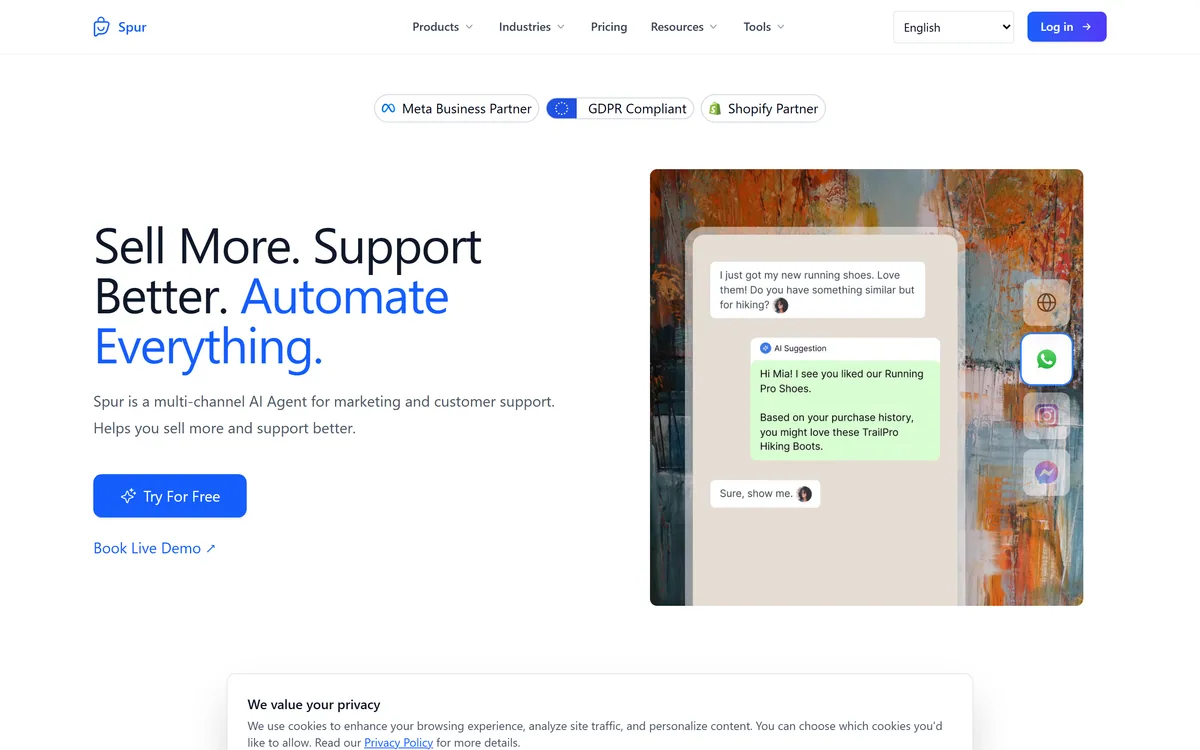
Spur's homepage, captured 9 September 2026, showing its multi-channel automation positioning.
Spur: One Inbox For WhatsApp, Instagram And The Website
The positioning is direct: sell more, support better, automate everything — a multi-channel AI agent for marketing and customer support.
The channel list is the thing to notice, because it describes where commerce conversations actually happen rather than where a software company would prefer them to.
For a very large share of online retail, the buying conversation is a WhatsApp message asking whether something is in stock, an Instagram DM asking about sizing, or a comment under a post. The website chat widget is often the least used of the four.
Those channels have historically been served by separate tools, separate logins and separate people, which is why a customer can get three different answers depending on where they asked.
One inbox with built-in ticketing, custom fields and multi-agent collaboration is the unglamorous fix, and it matters more than the automation layered on top. The site's own before-and-after framing names the real symptom accurately: chained to your inbox day and night, leads slipping away off-hours.
The buying conversation is a WhatsApp message about stock or an Instagram DM about sizing. The website chat widget is often the least used channel of the four.
Comment To DM And Where Leads Leak
Comment To DM is described as automating replies to comments — sending a DM to share a link, qualify a lead, or ask someone to follow if they are not already.
It is a small feature addressing a genuinely large leak.
A post that performs well collects hundreds of comments asking price, availability and where to buy. Every one of those is a person who has raised their hand, and answering them individually is impossible at volume — so most go unanswered, and the interest evaporates within the hour it took to lose it.
Moving the conversation from a public comment into a direct message also changes what is possible: you can send a link, ask a qualifying question and take an order in a DM, none of which works in a comment thread.
The judgement required is about tone. An automated DM that reads as a broadcast performs worse than no reply at all, and asking someone to follow before you have helped them inverts the exchange. The mechanism is sound; the copy decides whether it lands as service or as spam. Website-focused assistants like Chatling solve the same qualification problem on a single channel.
What Does An Actionable Agent Change?
The first listed capability is actionable AI: integrating with external systems to pull real-time data, update orders or book meetings automatically.
That distinction — between an agent that answers and an agent that acts — is the whole difference between deflecting a ticket and resolving one.
A chatbot that can only answer questions handles the easy half of support. Where is my order is a question about live data, and without a systems integration the best possible answer is a link to a tracking page the customer has already checked.
Change my delivery address, cancel this item, apply this discount — these are the requests that actually consume support time, and they all require the agent to do something rather than say something.
The integration list reflects the commerce focus: Shopify and WooCommerce for stores, Razorpay and Stripe for payments, Shiprocket and Return Prime for logistics. That combination is what makes actionable claims credible, because an agent can only update an order in a system it is connected to.
The stated outcomes — 90 percent fewer escalations, ten times faster resolutions, 30 percent higher CSAT — carry no methodology, and should be read as claims rather than benchmarks. Tidio Lyro makes the same argument on website chat, where the agent's actions come from helpdesk integrations rather than commerce ones.
Connect the order and logistics systems first — that is where resolution comes from.
Write automated DM copy that reads as help, not as a broadcast.
Set escalation rules before launch, not after the first complaint.
Check WhatsApp Business API rules for your message types.
Watch what the agent handles badly, weekly, in the shared inbox.
Handover, Escalation And Knowing The Limit
Seamless handover is listed as a headline capability: when complex issues arise, the AI passes conversations to human agents.
This is the feature that determines whether automation improves customer experience or destroys it, and it is worth more scrutiny than it usually gets.
Every customer has been trapped in a loop with a bot that could not help and would not escalate. The damage is not the unanswered question; it is the message the experience sends — that the company would rather not hear from you.
A customer who reaches a person after two exchanges has had a good experience. The same customer after ten has decided something about the brand that no resolution reverses.
The design questions are therefore concrete: what triggers a handover, how quickly, whether the customer can request one at any point, and what happens outside staffed hours. None of that is answered on a marketing page, and all of it should be established in a trial with real conversations rather than a demo.
Getting it right is also what makes the automation defensible internally — support teams resist these tools mainly because they have watched one make their job harder.
A Negative Review Left On The Page
Among the five-star testimonials on Spur's homepage sits a one-star review, published in full: too complicated to set up, could not receive a one-time passcode, and the reviewer states plainly that they did not understand it.
Underneath it is a response inviting anyone facing setup difficulty to get in touch.
We have read several hundred vendor sites for this programme and this is the first time we have seen a company leave a negative review on its own homepage. It deserves saying clearly, because the alternative is universal and unremarkable: curate the wall, show only the fives, and let the buyer discover the friction after purchase.
It is also useful information rather than merely admirable. The complaint names a real and specific onboarding problem — WhatsApp Business API verification involves phone verification, Meta approval and business documentation, and it genuinely does defeat people.
A buyer reading that review learns something true about the product that no feature list would have told them: budget time for setup, and expect the channel connection to be the hard part rather than the automation. Enterprise support platforms such as Forethought face the same onboarding reality with more implementation support attached.
Automating Support Without Losing Customers
Automation goes wrong in one direction only: the customer who needed a person and could not reach one.
This order protects against that.
Budget real time for channel verification — it is the hardest part of setup.
Connect order and logistics systems before switching the agent on.
Load knowledge sources from your actual support history, not your FAQ page.
Define escalation triggers and let customers request a human at any point.
Launch on one channel and one intent, then widen.
Read the conversations the agent handled badly every week.
Spur: What Runs On Which Channel
Four channels, one inbox — WhatsApp, Instagram, Facebook and website chat with shared ticketing.
Actionable agents that pull live data, update orders and book meetings.
Comment To DM, moving public interest into a private conversation automatically.
Campaigns and abandoned cart flows with a stated 80 percent-plus delivery rate.
Meta Business Partner and Shopify Partner, GDPR compliant, with a published DPA.
Spur: Channels And Compliance
Category
Multi-channel AI agent for commerce marketing and support
Channels
WhatsApp, Instagram, Facebook and website chat widget
Agent capability
Pulls real-time data, updates orders and books meetings via integrations
Setup
Described as no-code, with agents running in minutes
Handover
Escalation to human agents for complex issues
Marketing
Bulk campaigns and event-triggered messages including abandoned cart
Comment automation
Comment To DM with link sharing and lead qualification
Inbox
Unified across channels with ticketing, custom fields and multi-agent collaboration
Integrations
Shopify, WooCommerce, Razorpay, Stripe, Shiprocket, Return Prime and others
Partnerships
Meta Business Partner and Shopify Partner badges displayed
Compliance
GDPR compliant with encryption stated, plus a published DPA
Company
Spur Technologies, Inc., a Delaware corporation, with a stated India entity
Key features of Spur
Unified inbox across four messaging channels
AI agents that update orders via integrations
Comment To DM automation
Bulk campaigns and event-triggered messages
Website chat widget with FAQ handling
Ticketing, custom fields and multi-agent collaboration
Escalation from agent to human
Commerce, payment and logistics integrations
Pros & cons
Pros
7
Built for markets where commerce happens in messaging, not on websites
One inbox stops customers getting different answers on different channels
Actionable agents resolve requests rather than only deflecting them
Comment To DM rescues interest that otherwise evaporates within the hour
Commerce, payment and logistics integrations make the action claims credible
Leaves a negative review published on its own testimonial wall
Corporate details, DPA and GDPR pages all published in the footer
Cons
7
Channel verification is a genuine setup barrier, as its own review shows
Published outcome percentages carry no stated methodology
Escalation speed and rules are not described publicly
Automated DMs land as spam when the copy reads as a broadcast
Value depends on integrations you may not be able to connect
Little benefit at low conversation volume
Messaging channel rules are set by platforms and can change
Best For
Direct-to-consumer brands selling through Instagram and WhatsApp
Shopify and WooCommerce stores with high message volume
Businesses whose leads arrive outside working hours
Teams answering the same questions dozens of times daily
Retailers running campaigns to an opted-in messaging list
Spur Against Other Support Automation
Support tools differ by channel focus and by what the agent can do.
Voiceflow — designing conversational flows in detail
Vista Social — the publishing side of the same channels
Spur: Read From The Commerce Pages
Last checked . Read from spurnow.com in a browser session on the date above, with the screenshot captured at the same time.
Positioned as a multi-channel AI agent for marketing and customer support
Channels described as website, Instagram, Facebook and WhatsApp
Actionable AI described as integrating with external systems to update orders and book meetings
No-code setup stated, with agents running in minutes
Seamless handover to human agents described for complex issues
Comment To DM described for link sharing, lead qualification and follow requests
Campaigns described with a stated delivery rate above 80 percent, including abandoned cart flows
A unified inbox with ticketing, custom fields and multi-agent collaboration
Stated results of 90 percent fewer escalations, ten times faster resolutions and 30 percent higher CSAT
Meta Business Partner, Shopify Partner and GDPR Compliant badges displayed at the top of the page
A one-star review published on the testimonial wall alongside positive ones, with a vendor response
Footer showing Spur Technologies, Inc., a Delaware corporation, a named India entity with a registered address, plus privacy policy, terms, GDPR and DPA pages
What we could not confirm: how the escalation, resolution and CSAT percentages were measured; what the 80 percent delivery figure covers; how quickly the agent escalates and whether customers can request a human at any point; what business verification requires in each region; and pricing. We did not connect a channel or run an agent.
Editor's Verdict
4.0/5
Spur is built for a specific reality that Western-headquartered tools often miss: in much of the world commerce happens in WhatsApp and Instagram DMs rather than on a website, and the store that replies within minutes wins the sale. Unifying those channels into one inbox with an agent that can update an order rather than just answer about it is the right shape for that market. What earns it real credit is a detail most vendors would have deleted — a one-star review left visible on the testimonial wall, with a support reply underneath it. AInexfinder Editor Score: 4.0/5.
Spur pricing
AInexfinder does not list plan prices or billing details. For current pricing, plans, and trials, visit the official Spur website.
Vendor pricing, credits, and billing policies change over time. Always confirm on the official site before you buy.
Frequently asked questions
What does Spur do?
It unifies WhatsApp, Instagram, Facebook and website chat into one inbox and runs AI agents across them that can answer questions, qualify leads, update orders and escalate to a person.
Why focus on messaging channels?
Because for a large share of online retail the buying conversation is a WhatsApp message about stock or an Instagram DM about sizing. The website chat widget is often the least used of the four.
What makes an agent actionable?
Being connected to your systems. Where is my order is a live data question, and without integration the best possible answer is a tracking link the customer already checked. Acting is what resolves a ticket.
What is Comment To DM?
Automatically moving a public comment into a private message. A well-performing post collects hundreds of people asking price and availability, and answering them individually is impossible at volume.
How do I stop automated DMs feeling like spam?
Write copy that reads as help rather than broadcast, and do not ask someone to follow you before you have answered their question. The mechanism is sound; the wording decides how it lands.
What matters most about escalation?
Speed. A customer who reaches a person after two exchanges has had a good experience; the same customer after ten has decided something about your brand that no eventual resolution reverses.
Is setup difficult?
Channel verification can be. Spur's own testimonial wall carries a one-star review describing setup difficulty and passcode problems, left published with a response — which is useful, honest information for a buyer.
Why is that negative review worth mentioning?
Because it is unusual, and because it tells you something true: budget time for business verification, and expect connecting the channels to be harder than configuring the automation.
Which systems does it integrate with?
The site names Shopify and WooCommerce for stores, Razorpay and Stripe for payments, and Shiprocket and Return Prime for logistics, among others — the combination that makes order actions possible.
When is it not worth automating?
When your volume is low enough to answer everything personally, when every conversation is bespoke and high value, or when there is no route to a human outside working hours.
Daniel reviews AI tools the slow way — by actually using them on real projects. His reviews cover what works, what breaks, and who each tool is genuinely a good fit for.
Daniel and the AInexfinder editorial team research Spur using public product information, listing evidence, and (when available) hands-on checks. Scores reflect listing completeness and transparency — not paid placement.
Listings may include affiliate or sponsored placements, which are labeled when present. Editorial scores and cons are not sold. See our affiliate disclosure and review methodology.
Voiceflow is an enterprise conversational AI platform where CX teams design agent workflows visually, prototype them in place, and deploy one agent across web, app, WhatsApp, SMS and voice. It states 500-millisecond voice latency, 300,000 messages per minute and more than 10,000 live agents in production.
Wonderchat is a platform for building AI customer-service and sales agents from your own content and data. Agents answer with citations from approved sources, hand off to sales and capture leads in the conversation, while a QA agent flags weak answers for fixing.
Chatling deploys AI support agents across five channels — web, WhatsApp, Instagram, Telegram and Messenger — into one unified inbox. It auto-syncs your website, docs and help centre, replies in 80+ languages, and hands off to your team with full context.