.png)

HubSpot AI is branded Breeze — an assistant plus a set of agents for prospecting, content, customer service, campaigns, nurture, and revenue, all running on live CRM data, with an Agent Builder for custom ones.
FreemiumBusiness & Marketing
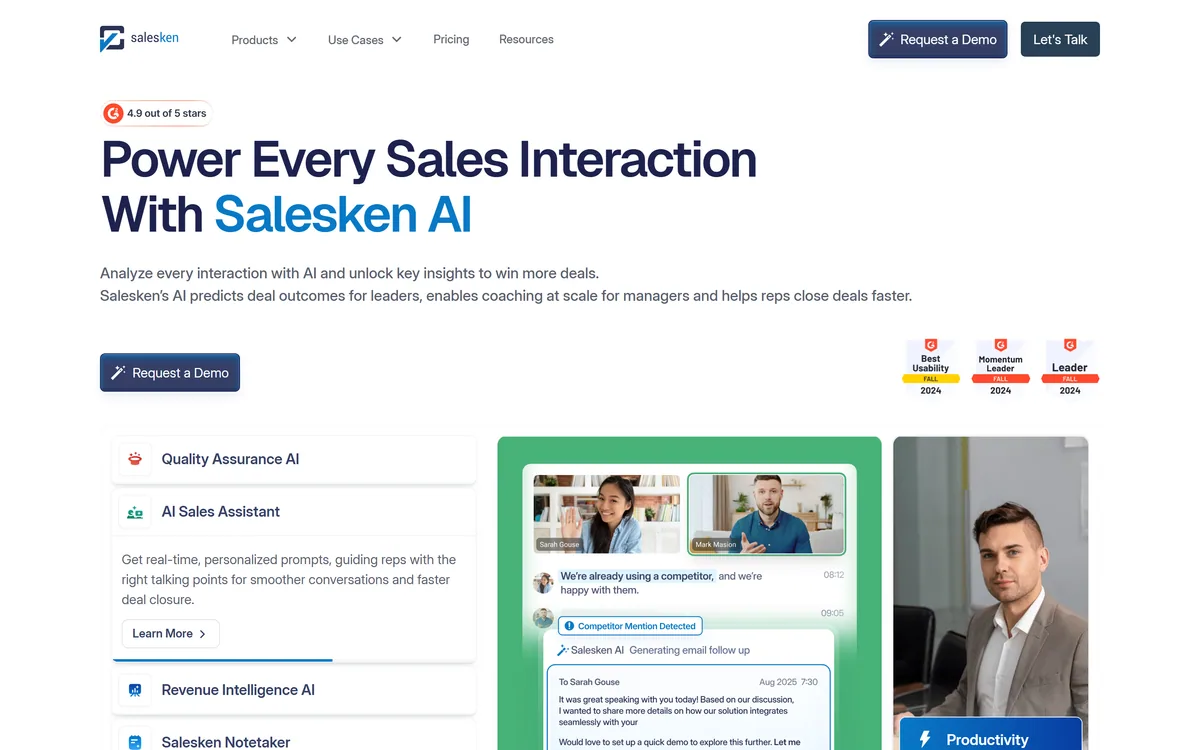
Salesken analyses 100 percent of sales conversations rather than a sample, combining quality assurance scoring, real-time in-call prompts for reps, deal outcome prediction, automatic note-taking and CRM enrichment, with SOC 2, ISO 27001 and GDPR compliance stated.
| Category | Conversation intelligence and revenue intelligence for sales teams |
|---|---|
| Coverage | Stated as evaluating 100 percent of conversations rather than a sample |
| Products | Quality assurance AI, sales assistant, revenue intelligence, notetaker, field sales analytics |
| Real-time | In-call prompts with talking points and objection handling |
| Prediction | Deal outcome forecasting, risk alerts and automated BANT qualification |
| Compliance monitoring | Breaches, objections and critical moments flagged during calls |
| CRM | Transcripts, summaries and action items auto-logged |
| Languages | Analysis, coaching and scoring stated across multiple languages |
| Field sales | Conversations captured outside the contact centre for performance analysis |
| Adoption | Stated as 200-plus businesses worldwide |
| Security | SOC 2 certified, ISO 27001 certified and GDPR compliant |
| Legal | Privacy policy, data processing addendum and terms published in the footer |
The clearest claim on the site is also its best: evaluate 100 percent of conversations with AI, and ditch random sampling.
That is a statistical argument dressed as a feature, and it is worth taking seriously on those terms.
Traditional sales quality assurance works by sampling. A manager listens to two or three calls per rep per month, scores them against a rubric and gives feedback. It is the only thing that was ever possible, and it is close to worthless as measurement.
A rep making forty calls a week has roughly one in fifty reviewed. Whatever conclusion the manager draws is based on a sample far too small to distinguish a pattern from a bad afternoon, and reps know it — which is why QA feedback is so often received as arbitrary.
Scoring every conversation changes the epistemic status of the exercise entirely. You move from an anecdote to a population, and a rep can no longer reasonably say the reviewer caught them on a bad day. That alone justifies the category.
A rep making forty calls a week has one in fifty reviewed. Whatever the manager concludes from that is an anecdote wearing the costume of a measurement.
Any product that records and analyses conversations carries obligations that the marketing page will not walk you through, and they belong in the evaluation rather than in the implementation.
Recording law varies sharply by jurisdiction. Some places require only one party's consent; others require everyone on the call to agree, and the obligation falls on the business doing the recording.
Under GDPR the analysis raises separate questions again, because a recording of a customer conversation is personal data, and inferring intent, sentiment or buying signals from it is processing that needs a lawful basis and a retention policy.
The compliance foundations here are appropriate for the category — SOC 2, ISO 27001, GDPR and a published data processing addendum — which is the necessary groundwork rather than the answer to your specific question.
There is also the internal dimension. Analysing every call means analysing every employee continuously, and how that is introduced determines whether it lands as coaching or as surveillance. Teams that share scores with reps and use them for development get a different reception from teams where the dashboard is management-only. Meeting transcription tools such as Otter.ai raise the same consent questions at lower stakes.
The claimed consequence is full pipeline visibility beyond CRM data, going past logged activities to reveal deal risks, buyer intent and next-best actions.
The gap between what a CRM records and what happened is the real subject here, and every sales leader knows it exists.
A CRM contains what a rep chose to log, written after the fact, in a state of mind shaped by wanting the deal to look healthy. Nobody records that the buyer sounded unconvinced, or that a competitor came up three times, or that the decision-maker was never actually on the call.
Those are precisely the signals that predict outcomes, and they only exist in the conversation itself.
The second thing that changes is what coaching can be built on. Comparing every call against calls that closed produces specific, evidenced feedback rather than a manager's impression — one of the site's own testimonials describes exactly that, feedback on what to say and how to say it, benchmarked against successful calls. The published outcome figures are notably modest: a 12 percent reduction in QA costs, a 2 percent conversion improvement and a 4 percent reduction in managerial costs. Small honest numbers read better than large unexplained ones.
The sales assistant is described as delivering real-time personalised prompts with the right talking points, and live in-call guidance for handling objections.
This is the most ambitious feature in the platform and the one that deserves the most scepticism before deployment.
The appeal is obvious. Feedback delivered a week after a lost call is useless; the moment a rep needs to know how to answer an objection is while the objection is being raised. Closing that gap addresses a genuine failure in how sales coaching works.
The difficulty is cognitive rather than technical. A rep reading a suggestion while listening and speaking is doing two demanding things at once, and the result can be worse than either alone — a noticeable pause, a switch in register, a scripted phrase in the middle of a natural conversation. Buyers hear it.
Our expectation, which a trial should confirm or refute, is that this helps a new rep considerably and irritates an experienced one. The onboarding case is strong: a person in their second week genuinely does not know what to say, and a prompt beats silence. The site's own framing of faster rep ramp-up is the most credible version of the claim. Artisan approaches the pipeline from the other end, automating outreach rather than assisting the call.
Revenue Intelligence AI is described as identifying at-risk deals, understanding buyer intent, generating forecasts and running automated qualification assessment.
Deal prediction from conversation signals is more defensible than prediction from CRM fields, and it still carries two problems worth stating.
The first is that the model learns from your historical outcomes, so it encodes how your team has sold rather than how your market buys. A pattern that predicted losses last year may be a pattern about a rep who left.
The second is self-fulfilment. A rep told a deal is at risk will spend less time on it, and the deal will then fail — confirming a prediction that helped cause the outcome. Any team using risk scores should watch for this deliberately, because the metrics will look excellent while it happens.
Automated qualification has a milder version of the same issue. Inferring budget, authority, need and timeline from what was said is a reasonable heuristic, and it is not a fact — buyers are vague about budget for tactical reasons, and a model reading that as absence of budget is drawing the wrong conclusion. Used as triage across a large pipeline these are genuinely useful. Used as verdicts on individual deals they will be wrong often enough to matter. Forecasting-first platforms like Aviso make the same trade at the portfolio level.
The difference between this landing as coaching and landing as surveillance is set in the first fortnight, not in the configuration.
This order gets adoption rather than resistance.
Quality assurance scoring on every conversation
Real-time in-call prompts and objection handling
Deal risk alerts and outcome prediction
Automated BANT qualification assessment
Call transcription with summaries and action items
Automatic CRM enrichment
Compliance flagging during live calls
Field sales conversation capture and analysis
Sales AI tools differ by which part of the cycle they touch.
| Tool | Focus | Timing | Best for |
|---|---|---|---|
| Salesken | Every conversation, scored and coached | During and after the call | Coaching and QA at scale |
| Aviso | Forecasting and pipeline | After the fact | Revenue leadership decisions |
| Artisan | Outbound prospecting | Before the conversation | Filling the pipeline |
| Otter.ai | Transcription and notes | During the call | Recording what was said |
| A sales manager listening | A few calls a month | Weeks later | Judgement on the calls they heard |
Other tools across prospecting, forecasting and conversation analysis.
Last checked . Read from salesken.ai in a browser session on the date above, with the screenshot captured at the same time.
What we could not confirm: how the 200-plus business figure is counted; how deal predictions are generated or validated; how accurate real-time prompting is in live conversation; which languages are supported; how the published customer percentages were measured; and pricing. Testimonials are vendor-selected. We did not connect a phone system or analyse a call.
The strongest argument Salesken makes is statistical rather than technological: quality assurance built on random sampling tells you almost nothing about a rep who makes forty calls a week and had three reviewed. Moving from a sample to the whole population is a genuine change in what managers can know. Real-time prompting is the more ambitious feature and the one to test hardest, because a rep reading a suggestion mid-sentence is doing two things at once. The published outcome figures are unusually modest, which we read as a point in its favour. AInexfinder Editor Score: 4.0/5.
AInexfinder does not list plan prices or billing details. For current pricing, plans, and trials, visit the official Salesken website.
Visit official website for pricingVendor pricing, credits, and billing policies change over time. Always confirm on the official site before you buy.
Log in to write a review.
No reviews yet. Be the first to share your experience with Salesken.
Assigned reviewer
Daniel ReedSenior AI Tools Reviewer
Daniel reviews AI tools the slow way — by actually using them on real projects. His reviews cover what works, what breaks, and who each tool is genuinely a good fit for.
Daniel and the AInexfinder editorial team research Salesken using public product information, listing evidence, and (when available) hands-on checks. Scores reflect listing completeness and transparency — not paid placement.
HubSpot AI is branded Breeze — an assistant plus a set of agents for prospecting, content, customer service, campaigns, nurture, and revenue, all running on live CRM data, with an Agent Builder for custom ones.
Clay is go-to-market data infrastructure built around waterfall enrichment: instead of one provider, it queries a marketplace of more than 200 in sequence until a field is filled. Claygent AI agents research companies and people, and the results push into a CRM, ad platforms or a native sequencer.
Trellus is an AI dialer that works inside Salesloft, Outreach and HubSpot, offering parallel dialling of up to five lines, real-time call guidance, conversational analytics, voice agents for practice and inbound, and a LinkedIn tool, aimed at multiplying sales conversations.
AutogenAI is an enterprise platform for writing proposals, bids and grant applications. It covers the workflow from qualifying an opportunity through drafting, research, review and compliance, using custom language engines built on each customer's own tone of voice and content library.
Aviso is an agentic revenue intelligence platform for go-to-market teams. It covers forecasting, pipeline inspection, conversation and relationship intelligence, coaching, sales engagement and customer success, with more than 30 prebuilt agentic workflows and a no-code studio for building new agents.
Ironclad is an AI contract lifecycle management platform covering create, review, sign, store, analyze and fulfill. Jurist is its agentic AI contract partner for legal review, Ironclad AI runs behind every workflow stage, and 20+ integrations connect it to Salesforce, Word, Slack, DocuSign and SAP.