Lokalise is a translation management platform built for continuous localisation: strings flow from your repository, design files and CMS into an AI translation pipeline that applies your approved terminology and tone, with role-based human approval before anything ships.
lokalise.com8 viewsAdded April 3, 202662K visitors
Ask a team that has shipped a multilingual product where localisation actually goes wrong, and nobody says the translations were bad. They say a string was added on Tuesday and nobody noticed until a German user reported English text in production.
Localisation fails at the seams: between the developer adding a key, the designer changing a label, the translator working in a spreadsheet dated three weeks ago, and the release that shipped before the file came back.
Lokalise has spent years building for that problem rather than the translation problem, and it shows in the shape of the product. The AI capabilities layered on top are substantial and current, but the reason to choose it is the pipeline underneath. This review covers both, plus the compliance detail that matters if you handle regulated content and the point at which the platform is simply too much.
Lokalise: The Platform Facts
Product type
AI-powered translation management system for apps, games, web and content
Integrations
60+, including GitHub, GitLab, Figma, Jira, Contentful, Webflow, WordPress, AWS and Zapier
File formats
30+
Developer surface
REST API with 95 endpoints, CLI, iOS and Android SDKs, 10 pre-built SDKs, 33 webhooks, MCP server support
AI approach
Orchestration across multiple LLMs, selected by language and content context
Quality controls
Custom AI profiles for brand voice, AI scoring, role-based human approval
Certifications
SOC 2 Type II with annual audits, ISO 27001 (since November 2020), ISO 27017
Privacy
GDPR compliant, HIPAA-aligned through SOC 2
Hosting
AWS, EU regions
Access control
SAML SSO and RBAC; audit logs exportable on Enterprise with 6-month retention
Security testing
Annual penetration testing via YesWeHack
Stated scale
1 million users across 3,000+ companies
Legal entity
Lokalise, Inc.
Pricing model
Tiered subscription with a trial; Enterprise quoted through sales
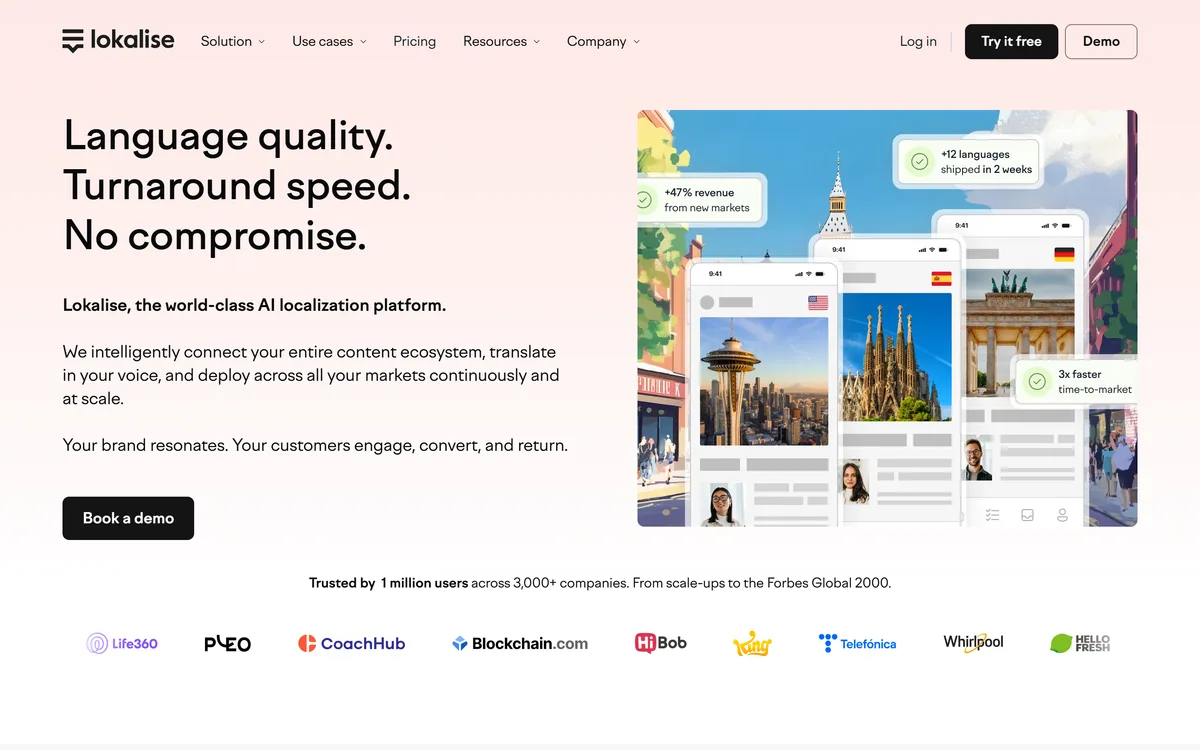
Lokalise's homepage, captured 9 September 2026. The positioning leads on AI, but the substance underneath is a mature translation management system.
Continuous Localisation, Not Bulk Translation
It is a pipeline, not a translator — strings move from GitHub, Figma, Jira and your CMS into translation and back, without anyone handling a spreadsheet.
It routes between multiple language models rather than committing to one, selecting by language and content type.
Brand voice is enforced structurally through custom AI profiles applying your approved terminology and tone, not left to a translator's judgement each time.
Humans stay in the approval path with role-based sign-off, which is what separates a translation management system from a machine translation endpoint.
Compliance is unusually deep: SOC 2 Type II, ISO 27001 and ISO 27017, EU-region AWS hosting, annual penetration testing and SAML SSO.
Sixty Integrations Is The Moat
Lokalise states more than sixty integrations, thirty-plus file formats, thirty-three webhooks and ten pre-built SDKs, alongside a REST API with ninety-five endpoints, a CLI and MCP server support.
That list is the product's actual competitive position, and it is worth understanding why rather than treating it as a feature count. Localisation is not a task you perform; it is a state you maintain. Every string added, every label changed in a design file, every article published in a CMS creates translation debt the moment it lands.
A platform that connects to GitHub and GitLab, Figma, Jira, Contentful, Webflow and WordPress can detect that debt automatically, which is the ground Crowdin competes on too. One that does not requires a person to notice, export, send, receive and re-import — and that person will eventually be on holiday during a release.
The SDKs matter for a related reason. Over-the-air delivery of translations means a copy fix does not require an app store submission, which for mobile teams is the difference between correcting a mistranslation in an hour and correcting it in a fortnight.
MCP server support is a genuinely forward-looking inclusion. It means a coding agent can query and update localisation state directly, which is where a meaningful share of this work is heading.
Localisation is not a task you complete. It is a state you maintain, and every untranslated string is debt accruing from the moment it is written.
Routing Between Models Instead Of Betting On One
Lokalise describes AI orchestration across multiple large language models, selected dynamically by language and content context.
This is a better architecture than it may appear, and the reason is empirical. Model performance in translation is not uniform across languages. A model that handles French and German excellently may be noticeably weaker in Japanese, Turkish or Finnish, where morphology and word order differ more sharply from English.
Committing a platform to one provider means inheriting that provider's weak languages permanently. Routing means a bad language pair can be reassigned when a better model appears, without the customer changing anything.
The practical implication for a buyer is to test in your weakest language rather than your strongest. Everything handles Spanish well, including a raw engine such as DeepL with no pipeline attached. What you need to know is what happens in Korean, Hungarian or Arabic, where the differences between models are largest and where your reviewers will spend their time.
The 95 Percent Figure Needs Unpacking
The site states 95 per cent AI accuracy, alongside claims of ten times faster releases, up to 90 per cent lower costs and fully on-brand output.
Translation accuracy is not a single measurable quantity, which is the first problem with the number. Automated metrics compare output against a reference translation, but a good translation that differs from the reference scores badly, and a fluent but wrong translation can score well. Human evaluation is more meaningful and produces different results depending on who evaluates and against which brief.
The number also cannot be uniform across languages. Any accuracy figure is an average, and the average conceals exactly the information you need — which of your target languages fall below it.
None of this means the figure is dishonest. It means it is not usable as a purchasing input, and no vendor in this category publishes one that is.
What is usable is the structure around the number. Custom AI profiles applying your approved terminology, AI scoring for quality evaluation, and role-based human approval before publication together make quality a managed process rather than a hoped-for property. That architecture is worth more than any percentage, because it is what catches the five per cent.
Test in your hardest language pair, not your easiest — the average hides your worst case.
Load your real glossary before evaluating, since terminology enforcement is most of what separates platforms.
Include your most awkward content type: legal copy, error messages, or anything with strict length limits.
Check how it handles placeholders and variables, which is where machine translation still breaks user interfaces.
Have a native reviewer score output blind against your incumbent process rather than reading vendor benchmarks.
Compliance Depth Is Genuinely Unusual Here
Lokalise publishes SOC 2 Type II with annual audits, ISO 27001 certification held since November 2020, ISO 27017, GDPR compliance, HIPAA alignment through its SOC 2 programme, AWS hosting in EU regions, SAML SSO, role-based access control, exportable audit logs on the enterprise tier, and annual penetration testing conducted through YesWeHack.
That is a deeper set than most tools in any category publish, and considerably deeper than typical for localisation. It matters because of what passes through a translation platform: unreleased product copy, marketing plans before launch, support content containing customer scenarios, and in regulated industries material with genuine legal weight.
ISO 27001 since 2020 is the detail worth noticing. A certification held for years, with the surveillance audits that implies, is stronger evidence of a maintained security programme than a recently obtained one.
EU-region hosting answers the data residency question directly for European buyers, which for public-sector and regulated procurement is frequently a threshold requirement rather than a preference.
The gap to note is placement rather than absence: SSO and exportable audit logs sit at the enterprise tier, with audit log retention stated at six months. If your security policy requires SSO — and most enterprise policies now do — that decides your tier before any feature comparison does.
Running A Localisation Pilot That Proves Something
Localisation platforms demo beautifully and integrate painfully, and the gap between those two experiences is where most disappointment lives. This sequence surfaces it during a trial rather than after signature.
The bar is step four. If a string added in your repository does not appear in the platform without human intervention, you are buying a translation editor rather than a pipeline.
Connect one real integration — your actual repository or CMS, not a sample project. Integration friction is the thing you are testing.
Import your real glossary and style guide, then translate a genuinely awkward content type: error messages, legal copy, or strings with hard length limits.
Translate into your most difficult language pair and have a native speaker score it blind against your current process.
Add a new string in the source system and watch whether it appears in the platform for translation without anyone doing anything.
Push a translation back and confirm it lands correctly, including placeholders and variables, which is where machine translation most often breaks an interface.
Time the whole loop. That figure, not the accuracy percentage, is what tells you whether releases actually get faster.
How Lokalise Is Licensed
Access is a tiered subscription with a trial available, rising to an enterprise tier quoted through sales.
Two things drive placement rather than one. Volume matters — how many keys or words you manage — but so does capability gating, and the second is what usually decides. SAML SSO, exportable audit logs and the deeper administrative controls sit at the enterprise level.
For a small team the practical consequence is straightforward: the lower tiers are genuinely usable, though a lighter platform such as Ailaysa is worth weighing before committing. For a larger organisation, the security requirements in your own policy will typically place you at the enterprise tier regardless of your word count, and it is more honest to plan for that from the start than to price the middle tier and be moved later.
We do not publish amounts, since tiers change. What to establish before committing is which specific tier carries SSO and audit logs, and how the volume meter counts — keys, words or languages — because that determines how cost scales as you add markets.
Localisation Terms That Matter
Five terms that decide whether a platform will fit how your team actually works.
Translation management system (TMS)
The pipeline that moves content between source systems, translators and production. The thing you are actually buying — the translation itself is a component.
Continuous localisation
Translation triggered automatically by source changes rather than run as a periodic batch. The difference between shipping multilingual and shipping English then catching up.
Translation memory
A store of previously approved translations, reused when the same string reappears. Improves consistency and reduces cost the longer you run it — and it is yours, so ask about export.
Glossary and term base
Your approved terminology, enforced automatically. The main defence against a product feature acquiring three different names across five languages.
Over-the-air delivery
Shipping updated translations to a live app without an app store submission. Turns a mistranslation from a fortnight's problem into an hour's.
Key features of Lokalise
Continuous localisation with automated workflows triggered by source changes
Contextual AI translation applying approved terminology and tone of voice
Orchestration across multiple language models, selected by language and content type
Custom AI profiles for brand consistency, with AI scoring for quality evaluation
Role-based human approval before translations reach production
60+ integrations covering repositories, design tools, project management and content systems
REST API, CLI, mobile SDKs, webhooks and MCP server support
SAML SSO, role-based access control and exportable audit logs on Enterprise
Pros & cons
Pros
6
Integration breadth means strings move automatically rather than by someone remembering to export them
Routing between models avoids being locked into one provider's weak language pairs
Compliance depth is genuinely unusual — SOC 2 Type II, ISO 27001 since 2020, ISO 27017 and EU hosting
Human approval is built into the workflow rather than bolted on, which is what makes quality manageable
Mobile SDKs allow copy fixes without an app store submission
MCP support anticipates coding agents participating in the localisation loop
Cons
6
The 95 per cent accuracy claim has no published methodology and no per-language breakdown
SSO and exportable audit logs are gated to the enterprise tier, which decides your tier before features do
Audit log retention is stated at six months, which is short for some compliance regimes
Substantial setup cost — the platform rewards teams large enough to need a pipeline and overwhelms those who are not
The specific models behind the orchestration layer are not disclosed
Release-speed and cost-saving claims are stated without baselines
Best For
Product teams shipping software continuously in multiple languages
Organisations whose content originates across repositories, design files and a CMS
Companies with security or procurement requirements a certification list must satisfy
European businesses needing EU data residency
Teams maintaining a real glossary and tone of voice across many markets
Lokalise Against The Translation Platforms
The market splits into pipeline platforms, raw translation engines and hybrid services. Buying the wrong shape is the most common mistake here.
Tool
Shape
Strongest at
Where it falls short
Lokalise
Translation management pipeline
Integration breadth, developer surface and compliance depth
Heavy for small teams; SSO and audit logs gated to Enterprise
Not a pipeline at all — no workflow, approvals or integrations of this kind
Which Teams Lokalise Fits
The right platform if
You ship software continuously and strings change with every release, so batch translation cannot keep up.
Your content originates in several systems — repository, design files and a CMS — that all need to feed one pipeline.
You have security or procurement requirements that a certification list actually has to satisfy.
You need EU data residency for regulatory or public-sector reasons.
You maintain a real glossary and tone of voice that must be applied consistently across every language.
Avoid it if
You need occasional document translation, where a machine translation tool does the job without a platform.
You are a small team with one or two languages and no automated release process — the platform will cost more in setup than it returns.
Your security policy requires SSO but your budget assumes a mid tier, since SSO sits at the enterprise level.
You need translators sourced as well as managed, which a marketplace-model platform handles more directly.
Your content is a handful of static marketing pages that change twice a year.
Verifying Lokalise
Last checked . Read from lokalise.com, including the security and developer pages, with the screenshot above captured in the same session.
Product confirmed as an AI localisation platform for web apps, mobile apps, games and digital content
Integration count stated as 60+, with GitHub, GitLab, Figma, Jira, Contentful, Webflow, WordPress, AWS and Zapier named
Developer surface confirmed as a REST API with 95 endpoints, a CLI, iOS and Android SDKs, 10 pre-built SDKs and 33 webhooks, with MCP server support stated
File format support stated as 30+
AI orchestration across multiple LLMs confirmed, with dynamic selection by language and content context
Quality controls confirmed as custom AI profiles for brand voice, AI scoring for evaluation, and role-based human approval
Certifications listed on the site as SOC 2 Type II with annual audits, ISO 27001 held since November 2020, and ISO 27017
GDPR compliance and HIPAA alignment through SOC 2 stated, with hosting on AWS in EU regions
SAML SSO and role-based access control confirmed, with exportable audit logs on Enterprise at six-month retention
Annual penetration testing stated as conducted via YesWeHack
Legal entity identified on the site as Lokalise, Inc.
What we could not confirm: the 95 per cent accuracy figure carries no published methodology, evaluation set or per-language breakdown, and translation accuracy is not a single measurable quantity in any case; the release-speed and cost-reduction claims are stated without baselines; the SOC 2 and ISO reports are not public, so scope and any exceptions are unknown; which specific models sit behind the orchestration layer is not disclosed; and no headquarters location is stated on the pages we read.
Other Localisation And Translation Tools
Compare on shape before features — a pipeline, an engine and a marketplace solve genuinely different problems.
Crowdin — the closest direct competitor; the choice usually turns on which integrations you need
Phrase — heavier enterprise localisation, for organisations with formal translation operations
Smartcat — combines the platform with a marketplace for sourcing human linguists
DeepL — raw translation quality without the pipeline, if workflow is not your problem
Ailaysa — a lighter multilingual content platform for smaller teams
Editor's Verdict
4.4/5
Lokalise scores highly because it understands that the hard part of localisation was never translation quality — it is the pipeline. Sixty integrations covering repositories, design files and content systems, thirty-plus file formats, SDKs and a documented API mean strings move without anyone copying a spreadsheet, and routing between models rather than committing to one is the right architectural bet in a field where the best model changes constantly. Compliance depth is unusual: SOC 2 Type II, ISO 27001 and 27017, EU hosting, penetration testing. It loses ground because the headline accuracy figure has no published methodology, because audit logs and SSO sit behind the enterprise tier, and because the platform genuinely rewards teams large enough to need it and overwhelms those who are not. AInexfinder Editor Score: 4.4/5.
Lokalise pricing
AInexfinder does not list plan prices or billing details. For current pricing, plans, and trials, visit the official Lokalise website.
Vendor pricing, credits, and billing policies change over time. Always confirm on the official site before you buy.
Frequently asked questions
What is Lokalise?
A translation management platform for continuous localisation. Content flows automatically from your repository, design files and CMS into an AI translation pipeline that applies your approved terminology and tone, with role-based human approval before anything ships. The translation itself is one component of a larger pipeline.
Is Lokalise free?
No, though a trial is available. It is a tiered subscription rising to an enterprise tier quoted through sales. Tier placement is driven by capability as much as by volume — SAML SSO and exportable audit logs sit at the enterprise level. We do not publish amounts; confirm which tier carries SSO and how the volume meter counts before committing.
How accurate is Lokalise's AI translation?
The site states 95 per cent accuracy, but no methodology, evaluation set or per-language breakdown is published, and translation accuracy is not a single measurable quantity in the first place. Any average also hides which of your target languages fall below it. Test in your hardest language pair with your own glossary loaded rather than relying on the figure.
Which AI models does Lokalise use?
It orchestrates across multiple large language models, selecting between them dynamically based on the language and content type, rather than committing to one provider. The specific models are not disclosed. The architecture is sound — model performance varies sharply by language, so routing avoids inheriting one provider's weak pairs permanently.
Is Lokalise secure enough for regulated content?
Its published posture is unusually deep: SOC 2 Type II with annual audits, ISO 27001 held since November 2020, ISO 27017, GDPR compliance, HIPAA alignment through SOC 2, AWS hosting in EU regions and annual penetration testing via YesWeHack. Ask for the reports themselves and note that audit log retention is stated at six months, which is short for some regimes.
How does Lokalise compare with Crowdin?
They are the closest direct competitors and occupy the same shape — both are translation management pipelines with strong developer integration. The decision usually comes down to which specific integrations you need, how each handles your file formats, and pricing at your volume. Crowdin has particular strength in open source and gaming projects.
Do I still need human translators with Lokalise?
For anything customer-facing, yes, and the platform is designed on that assumption — role-based human approval is built into the workflow. AI does the volume; humans review, especially for marketing copy, legal text, and any language where your reviewers find the machine output weak. That division is the whole point of a management system rather than a translation endpoint.
Daniel reviews AI tools the slow way — by actually using them on real projects. His reviews cover what works, what breaks, and who each tool is genuinely a good fit for.
Daniel and the AInexfinder editorial team research Lokalise using public product information, listing evidence, and (when available) hands-on checks. Scores reflect listing completeness and transparency — not paid placement.
Listings may include affiliate or sponsored placements, which are labeled when present. Editorial scores and cons are not sold. See our affiliate disclosure and review methodology.
CrewAI is an enterprise platform to build and run AI agents: a Discovery layer that finds automation opportunities, a no-code canvas and code-first Python API for building role-based multi-agent workflows, and a control plane that adds tracing, RBAC, audit and human-in-the-loop approvals.
Axiom is a browser-automation and web-scraping platform you can build no-code in a Chrome extension, script in your IDE, or drive agentically through Claude and MCP, running on cloud browsers or your own machine for scrapers, form-fillers, monitors and scheduled workflows.
Kuse is an AI workspace from Kuse Inc. built around scheduled workflows: describe a recurring task in plain language, connect the apps it touches, and let it run. It also generates websites, documents, presentations and spreadsheets, with several model families available.
Formless by Typeform is a conversational AI form builder. Trained on your own data, it asks questions in natural language and answers the respondent's questions back, adapts its path without branching logic, and supports over 120 languages.
Zapier's AI layer adds agents and MCP tool access on top of its automation platform, connecting more than 9,000 apps with governed access so teams can mix AI decisions with deterministic rules under central oversight.
Fillout is a form builder that also handles scheduling, payment collection, PDF generation, e-signatures and workflow routing. Forms can be fully white-labelled down to the favicon, served from your own domain, embedded four ways, and made editable by respondents through login forms.