
Copy.ai has become an AI-native go-to-market platform: workflows and agents that run prospecting, lead processing, deal coaching, ABM, and CRM enrichment across Salesforce, HubSpot, Gong, Outreach, and 2,000+ integrations.
FreemiumWriting & Content
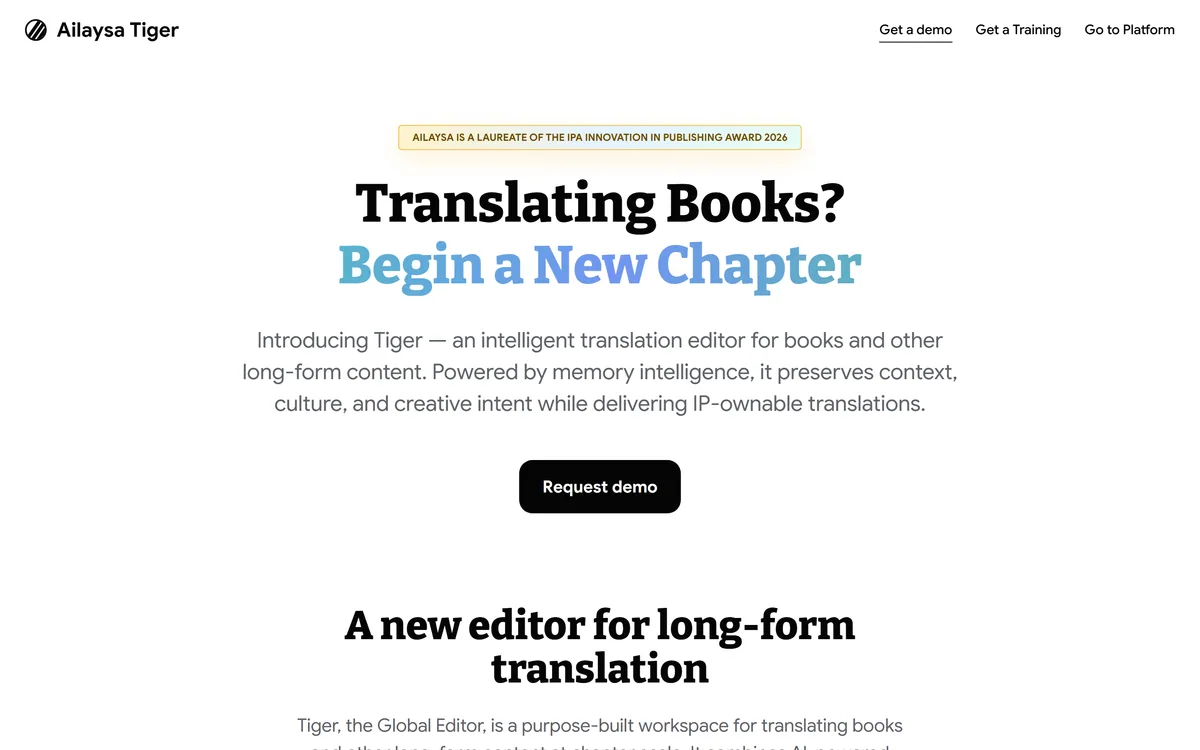
Ailaysa is an AI-assisted translation and localisation workspace designed for books and other long-form content. Its Tiger editor works at chapter scale, uses memory agents to hold style and terminology consistent across a manuscript, and preserves formatting in DOCX, IDML and ePub.
Machine translation solved the sentence a decade ago. Feed DeepL a paragraph and you get something a native speaker will accept, and the remaining argument is about register rather than accuracy.
None of that helps you translate a novel. A book is not a long paragraph — it is a system with recurring characters, invented terminology, an established narrative voice, callbacks that only work if the earlier phrasing is remembered, and a decision made on page 12 that must still hold on page 340.
Ailaysa is built around that specific gap, and this review looks at whether the architecture actually addresses it. What follows covers the memory agent model, why publisher file formats matter more than they sound, what IP ownership means in a translation contract, and where a general-purpose model is still the better tool.
| Company | Ailaysa Technologies Private Limited |
|---|---|
| Category | AI-assisted translation and localisation for long-form content |
| Flagship editor | Ailaysa Tiger |
| Designed for | Books, courseware, knowledge bases and creative long-form content |
| Working unit | Chapter scale, with paragraph-level editing |
| Named capabilities | Full book intelligence analysis, Memory Agents, auto-formatting, collaboration, API access |
| File formats | DOCX, IDML, ePub |
| Target languages | Stated at more than 30 |
| Positioning on rights | Vendor describes the output as IP-ownable translations |
| Human role | Vendor states humans are in control with AI agents in the loop |
| Recognition | IPA Innovation in Publishing Award 2026 |
| Development background | Vendor describes five years of experimentation with publishers and translators |
Anyone who has actually run a book through a general translation workflow knows the failure modes, and they are not the ones people expect.
The output is rarely wrong. It is inconsistent. The protagonist's nickname is rendered three different ways across four chapters. A technical term settles into one translation early, drifts to another by the middle, and reverts near the end. The narrative voice is warm in chapter two and clinical in chapter nine because those chunks were translated in separate sessions with no shared memory.
None of this is visible sentence by sentence. Every individual line passes review. The damage only appears when a reader — or an editor — reads the whole thing in sequence, and by then the fix is a manual consistency pass across the entire manuscript.
There is a second failure that costs more time than anyone budgets for. Translation tools shred formatting. A manuscript goes in as a designed document and comes back as text, which means the typesetting is done twice.
Both problems are structural rather than model problems. A better language model does not fix them, because neither is caused by the quality of any individual translation.
Nothing in a badly translated book is wrong sentence by sentence. It goes wrong across three hundred pages, which is exactly where sentence-level tools cannot see.
Ailaysa's answer is described as Memory Agents that apply style and terminology automatically, sitting alongside a full book intelligence analysis of the manuscript.
It is worth separating this from translation memory, the mechanism Lokalise and the rest of the localisation industry have been built on since the 1990s. Classic translation memory is a lookup: it recognises a segment it has seen before and reuses the previous translation. It is excellent for repetitive material — manuals, product listings, contracts — and close to useless for prose, where sentences rarely repeat verbatim.
What a book needs is not repeated segments but held decisions. How this character's voice sounds. Which register the narrator uses. What the invented terms are and how they were rendered. Those are not lookups, they are constraints that should apply to text the system has never seen.
That is the interesting claim here, and it is the right one to be making. It also means the honest evaluation question is not accuracy on any single chapter but consistency across all of them.
The analysis-first sequencing matters too. Reading the whole manuscript before translating any of it is how a human translator works and how almost no automated pipeline does — most chunk the text and translate the chunks.
Three formats, and the middle one tells you who built this and for whom.
IDML is Adobe InDesign's interchange format. Nobody outside publishing production has heard of it, and nobody inside publishing production can work without it. Supporting IDML means a designed book can be translated and returned as a designed book, with styles, frames and structure intact.
The alternative — the normal path — is that a designer rebuilds the layout in the target language from scratch. For an illustrated book, a textbook or anything with a complex grid, that is often a bigger cost than the translation itself.
ePub covers the digital edition and DOCX covers the manuscript before design. Together the three formats span the whole production chain, which is a strong signal that the team spent the five years with publishers that they say they did.
It also quietly narrows the audience. A tool that speaks IDML is a tool for publishers and translation vendors, not for someone translating their blog.
The vendor describes the output as IP-ownable translations, which sounds like marketing and is actually addressing a live commercial anxiety.
A translation is a derivative work with its own copyright. In conventional publishing that copyright is negotiated — usually held by the publisher, sometimes shared with the translator, always assigned explicitly in a contract. It is an asset that gets licensed, sold and inherited.
When a machine produces the translation, publishers reasonably want to know what they are holding. Whose rights attach to the output, whether the platform retains any claim, whether the text was used to train anything, and whether the result can be licensed onward with clean title.
For a trade publisher preparing a foreign edition, an ambiguous answer to that question is disqualifying regardless of translation quality. Stating it plainly is the correct thing for a vendor in this category to do.
It is still a claim rather than a contract. If you are a publisher, the terms of service and any data processing agreement are where the answer actually lives — read those, not the homepage.
Being specific about the cases where this is the wrong purchase is more useful than another feature list.
Short-form and interface strings. App copy, marketing pages and UI labels are what Lokalise and its peers are built for, with the developer plumbing — string keys, branches, pull requests — that a book workspace has no reason to carry.
One-off passages. If you need a paragraph rendered well right now, a strong general model gets you there in seconds without a project setup.
Languages outside the supported set. Over 30 languages covers the major commercial markets and leaves a long tail uncovered. Check yours specifically before assuming.
Literary work where the translator is the point. Poetry, experimental prose, and anything where the translation is itself an authored act. Assistive tooling can support that work; it cannot replace the judgement that makes it worth reading.
Chapter-scale translation editor with paragraph-level editing
Full manuscript analysis before translation begins
Memory Agents that apply style and terminology consistently
Auto-formatting that preserves document structure
DOCX, IDML and ePub support
Collaboration for translators, editors and reviewers on one manuscript
API access for publishers integrating into an existing pipeline
More than 30 target languages
Human-in-control workflow with AI agents assisting rather than replacing
These are not competing for the same job, which is the most useful thing a comparison can show.
| Tool | Built for | Handles a whole book | Publisher formats |
|---|---|---|---|
| Ailaysa | Books and long-form content | Yes — analysis and memory across the manuscript | DOCX, IDML, ePub |
| DeepL | High-quality sentence and document translation | No cross-chapter consistency layer | Documents, not designed layouts |
| Lokalise | Software strings and product copy | Not the intended shape of content | Code and string formats |
| ChatGPT | Anything, with prompting | Only as far as context allows | Plain text |
Translation rarely stands alone — most publishing projects touch a general model, a string manager and a voice tool before they ship.
Last checked . Read from ailaysa.com during this check, with the screenshot above captured at the same time.
No named customer references were published at the time of this check, so translation quality claims rest on the vendor's own description. Ownership of a translation is settled by the contract and terms of service rather than by a homepage claim — read those directly before committing a title.
Ailaysa has an AInexfinder Editor Score of 4.1/5.
AInexfinder does not list plan prices or billing details. For current pricing, plans, and trials, visit the official Ailaysa website.
Visit official website for pricingVendor pricing, credits, and billing policies change over time. Always confirm on the official site before you buy.
Log in to write a review.
No reviews yet. Be the first to share your experience with Ailaysa.
Assigned reviewer
Daniel ReedSenior AI Tools Reviewer
Daniel reviews AI tools the slow way — by actually using them on real projects. His reviews cover what works, what breaks, and who each tool is genuinely a good fit for.
Daniel and the AInexfinder editorial team research Ailaysa using public product information, listing evidence, and (when available) hands-on checks. Scores reflect listing completeness and transparency — not paid placement.
Copy.ai has become an AI-native go-to-market platform: workflows and agents that run prospecting, lead processing, deal coaching, ABM, and CRM enrichment across Salesforce, HubSpot, Gong, Outreach, and 2,000+ integrations.

Writesonic has become an AI search growth platform — tracking whether your brand appears across 10 AI platforms, running optimisation and citation work through an Action Center, and reporting results against traffic and revenue.
LogicBalls is an AI writing and content platform whose central idea is verification before generation — it asks clarifying questions rather than assuming intent. It offers thousands of task-specific tools across writing, research, analysis and explanation, and claims 15M+ clarified generations.
Smartcat combines AI translation across 280+ languages with a CAT tool, translation memory, a marketplace of 500,000+ linguists, and AI agents for writing, auditing and maintaining content — integrated with Figma, Contentful, WordPress, Git and Salesforce.

Jasper has moved from AI copywriting to orchestrating marketing agents, with 100+ specialised agents, Content Pipelines, the Jasper IQ context hub, Jasper Studio for custom agents, and brand governance across everything a marketing team produces.
Spiral, a product from Every, uses stylometry to build a voice profile from your existing writing, then drafts tweets, blog posts, LinkedIn updates and newsletters in that voice. It adds shareable team styles, a knowledge base, and MCP and API access.