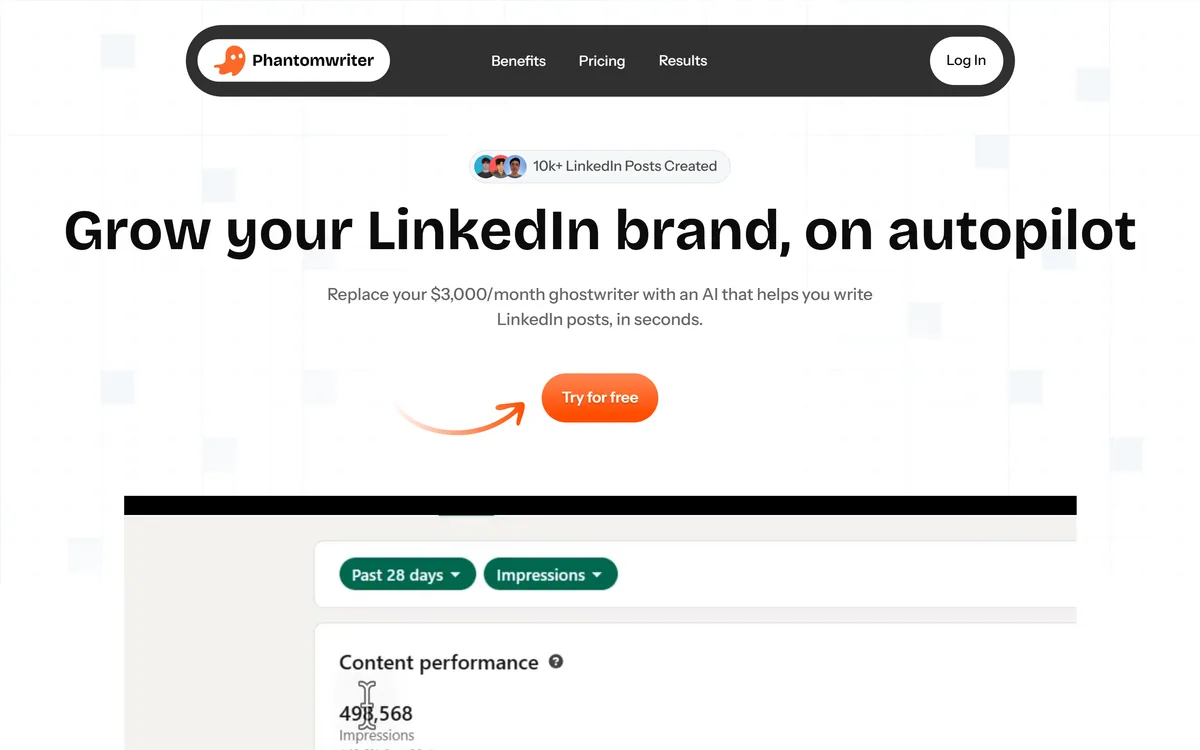
Phantomwriter generates LinkedIn posts by analysing your industry, competitors and ideal customer profile, then producing tailored post ideas and drafts with a content calendar. It states 10k+ posts created and is run by two named founders.
phantomwriter.io7 viewsAdded September 18, 202510K visitors
LinkedIn rewards frequency, and frequency is the thing almost nobody sustains. People post for three weeks, run out of things to say, and stop — which is why the platform is full of accounts whose last update was in 2023.
The bottleneck is rarely writing ability. It is having something to write about on a Tuesday when nothing notable has happened.
Phantomwriter attacks that specific gap: research first, ideas second, drafts third. Whether the output is worth posting is a separate question from whether the sequence is right.
Phantomwriter: LinkedIn Posts On Autopilot
Three steps: analyse your audience, generate tailored post ideas, then draft posts from them.
A content calendar for managing the posting schedule, which is where most consistency fails.
10k+ LinkedIn posts created, per the site, positioned as replacing a human ghostwriter.
Claims of being 100% AI undetectable — a promise nobody in this category can actually guarantee.
Two named founders, with published terms, privacy policy and a refund policy in the FAQ.
Phantomwriter's homepage, captured 9 September 2026, showing the LinkedIn ghostwriting positioning.
Does Automated LinkedIn Content Actually Work?
Phantomwriter describes a three-step process: analysing your industry trends, competitors and ideal customer profile, generating specific post ideas with high potential from that, and then creating posts.
Starting with research rather than with a prompt is genuinely the correct order, and it is what separates this from asking a chatbot to write a LinkedIn post.
The reason is that a good post is a specific thought about something your audience cares about. A generic assistant has no view of your industry, your competitors or who you sell to, so it produces posts that are technically fine and about nothing.
Idea generation is the more valuable half of the product for exactly that reason. Once you have a specific angle, writing four hundred words is not the hard part — and people who post consistently mostly have an idea backlog rather than better writing.
The realistic limit is that research produces topics, not insight. It can tell you what your industry is discussing; it cannot tell you what you actually think about it, and posts that contain no genuine opinion are the ones nobody engages with regardless of how well they are written.
Research produces topics, not insight. It can tell you what your industry is discussing, not what you actually think about it.
The Undetectable Claim Deserves Scrutiny
The site contrasts an old way that is very obviously AI-generated with a new way described as 100% AI undetectable.
That claim should be read carefully, because no product can deliver it and the reasons are worth understanding.
AI detection is unreliable in both directions. Detectors produce false positives on human writing and false negatives on generated text, and their behaviour changes as models change — so guaranteeing an outcome against a moving, unreliable target is not something any vendor controls.
The more useful reading is that the output does not carry the obvious tells: uniform paragraph lengths, hedged phrasing, unearned enthusiasm, the sense that every sentence was equally considered. Avoiding those is a real and achievable quality goal.
On LinkedIn specifically, detection software is beside the point. Nobody runs your posts through a detector — they simply notice that a hundred posts sound the same, and that is a human judgement no undetectability claim addresses.
Idea Generation And The Content Calendar
Alongside writing, Phantomwriter lists idea generation for when you have none, and a content calendar for creating and managing a posting schedule.
The calendar is the least discussed and most practically useful part, because consistency is the actual mechanism on LinkedIn and consistency is a scheduling problem.
Posting well requires a queue. Someone deciding each morning what to post will not post on the mornings that get busy, and the busy mornings are most of them.
Batching solves it structurally — an hour producing a fortnight's posts is a completely different commitment from fifteen minutes a day that keeps not happening.
That is the same argument every social scheduling tool makes and it holds here. Where Phantomwriter differs is that the queue is filled with generated drafts rather than requiring you to have written them, which is either the point or the problem depending on how much you edit — much as approval-first tools such as Apaya resolve it by holding drafts for a human.
The Personal Brand Problem With Ghostwriting
The site positions itself as replacing a human ghostwriter, and it is worth being direct that ghostwriting on LinkedIn is already commonplace rather than novel.
Executives have had speeches written for them for a century, and nobody considers that dishonest, because the ideas are theirs and the words are craft.
The distinction that matters is where the thinking happens. A ghostwriter interviewing you and writing up your view is expressing your thought in better prose. A system generating a plausible opinion you have not formed is producing somebody else's thought under your name.
That difference shows up at the worst moment. Someone reads your post, agrees with it, books a call, and discovers you cannot expand on the argument — which does more damage than not posting at all.
The workable version is therefore to treat generated posts as drafts of positions you actually hold, and to reject the ones you would not defend in conversation. That takes ten minutes and it is what separates a useful tool from a liability.
Use it for the idea backlog, which is the real bottleneck.
Reject any draft expressing a view you could not defend on a call.
Batch a fortnight at a time — daily decisions are what break consistency.
Rewrite one post a week entirely by hand to keep a recognisable voice.
Ignore detectability claims; readers notice sameness, not detectors.
What Automated Posting Cannot Do For You
Even used well, there are limits worth knowing before treating this as a growth strategy.
It cannot supply a reason for people to follow you. Attention on LinkedIn goes to people with a specific point of view or genuine expertise, and consistent competent posts from someone with neither produce consistent indifference.
It cannot do the engagement half. Replies, comments on other people's posts and conversations in direct messages are where LinkedIn relationships actually form, and posting is only the visible part of that.
It cannot protect you from repetition. A system generating posts about your industry will eventually make the same three points repeatedly, and readers notice long before you do.
And it cannot substitute for the underlying work. A consultant with nothing distinctive to say has a positioning problem rather than a content problem, which is the layer strategy tools such as Cleve address and no post generator can.
If your posting spans more than LinkedIn, the calculus changes. Multi-network tools such as Postwise cover X and Threads alongside it, at the cost of the audience research that is this product's actual differentiator — which is the trade to weigh rather than assuming breadth is better.
Posting On LinkedIn Without Sounding Automated
The failure mode is not being caught by a detector. It is a feed of posts that are individually fine and collectively indistinguishable from everyone else's.
This sequence keeps a recognisable voice while still using the tool for the part that actually blocks people.
Fill the idea backlog first — that is the bottleneck the tool genuinely solves.
Discard any generated angle you have no real opinion about.
Add one specific detail from your own experience to every post you keep.
Vary the shape deliberately: some posts short, some long, some awkward.
Batch a fortnight at a time, then schedule rather than deciding daily.
Write one post a week entirely yourself, so your actual voice stays present.
Phantomwriter: Features And Founders
Product type
AI LinkedIn post generator
Positioning
Grow your LinkedIn brand, on autopilot
Process
Analyse your audience, generate tailored post ideas, create posts
Research inputs
Industry trends, competitors and ideal customer profile
Features
Idea generation, AI writing, content calendar
Posts created
10k+ LinkedIn posts, per the site
Marketing claim
100% AI undetectable, stated on the homepage
Founders
Two named founders listed in the footer
Trial
Try for free, per the site
Policies
Terms of Service, Privacy Policy and a refund policy referenced in the FAQ
Is Phantomwriter Right For Your LinkedIn?
Automate posting when
You have opinions and run out of angles rather than out of writing ability.
Your posting stops after three weeks every time you try.
You would batch a fortnight at a time and edit each draft.
You run an agency posting for clients and need volume with structure.
The content calendar would fix the consistency problem you actually have.
Post in your own words when
You would post drafts unedited and could not defend them on a call.
Your positioning is unclear, which is a strategy problem rather than a content one.
Your audience is small enough that direct conversation beats broadcasting.
You are counting on undetectability rather than on saying something worth reading.
Engagement rather than publishing is where your LinkedIn effort should go.
Key features of Phantomwriter
Audience, industry and competitor analysis
Tailored post idea generation
AI post drafting
A content calendar for scheduling
A free trial
Published FAQ covering common questions
Pros & cons
Pros
6
Research before generation is the correct order and the real differentiator
Idea generation addresses the actual bottleneck, which is angles rather than writing
A content calendar targets consistency, which is the mechanism on LinkedIn
Focused on one network rather than spreading across five badly
Two named founders rather than an anonymous operation
A refund policy referenced openly in the FAQ
Cons
7
100% AI undetectable is not something any vendor can guarantee
Detectability is the wrong target — readers notice sameness, not detectors
Research produces topics, not the opinion that makes a post worth reading
Posting views you cannot defend fails at the moment somebody calls you
Generated posts converge on the same few points over time
No registered operating company named in the footer
Cannot help with positioning, which is usually the underlying problem
Best For
Founders and consultants whose LinkedIn posting keeps lapsing
People with opinions but no reliable supply of angles
Agencies producing LinkedIn content for several clients
Anyone who will batch a fortnight and edit each draft
Professionals who need a calendar more than a writer
Phantomwriter Against Other Social Writing Tools
Social writing tools differ by network, by whether they schedule, and by how much you edit.
Last checked . Read from phantomwriter.io in a browser session on the date above, with the screenshot captured alongside.
Positioned as growing your LinkedIn brand on autopilot
10k+ LinkedIn posts created displayed
Described as replacing a human ghostwriter with AI
A three-step process described: analyse your audience, get tailored post ideas, generate posts on autopilot
Research inputs stated as industry trends, competitors and ideal customer profile
Idea generation, AI writing and a content calendar listed as features
100% AI undetectable stated as a differentiator against the old way
Named user testimonials displayed
FAQ questions listed on how it compares to ChatGPT, whether other tools are needed, whether you upload posts yourself, how many posts are needed to grow, and the refund policy
Footer names two founders, with Terms Of Service and Privacy Policy links
What we could not confirm: pricing, which we did not read; whether posts are published automatically or require you to post them, which the FAQ raises but we did not expand; which models generate the writing; how audience and competitor research is actually performed and from what data; what the refund policy states; and the operating company, since the footer names individuals rather than a registered entity. We did not generate any posts.
Editor's Verdict
3.3/5
The sequence Phantomwriter uses is the right one — research the audience, generate ideas from that, then draft — because the reason most LinkedIn posting fails is running out of things to say rather than not knowing how to say them. The content calendar is a sensible inclusion for the same reason. What pulls the score down is the marketing. A headline claim of being one hundred per cent AI undetectable is not a capability anyone can guarantee, and building a LinkedIn presence on posts you did not write is a strategy that works exactly until somebody talks to you. AInexfinder Editor Score: 3.3/5.
Phantomwriter pricing
AInexfinder does not list plan prices or billing details. For current pricing, plans, and trials, visit the official Phantomwriter website.
Vendor pricing, credits, and billing policies change over time. Always confirm on the official site before you buy.
Frequently asked questions
What is Phantomwriter?
Phantomwriter is an AI LinkedIn post generator that analyses your industry, competitors and ideal customer profile, generates tailored post ideas from that research, and drafts posts. It includes a content calendar and states 10k+ posts created.
Why does research-first matter?
Because a good post is a specific thought about something your audience cares about. A generic assistant has no view of your industry, competitors or buyers, so it produces posts that are technically fine and about nothing in particular.
Which part of the product is most valuable?
Idea generation. Once you have a specific angle, writing four hundred words is not the hard part — and people who post consistently mostly have an idea backlog rather than better writing ability.
Can content really be 100% AI undetectable?
No vendor can guarantee that. Detection is unreliable in both directions and changes as models change, so promising an outcome against a moving, unreliable target is not something anyone controls. The useful version of the claim is that output avoids the obvious tells.
Does detectability even matter on LinkedIn?
Not really. Nobody runs your posts through a detector. They notice that a hundred posts sound the same, which is a human judgement no undetectability claim addresses — and it is the failure that actually costs you attention.
Is ghostwriting on LinkedIn dishonest?
Not inherently — executives have had speeches written for a century. The distinction is where the thinking happens. A ghostwriter expressing your view in better prose is craft; a system generating an opinion you have not formed is somebody else's thought under your name.
What is the risk of posting views you did not form?
It surfaces at the worst moment. Someone reads your post, agrees, books a call, and finds you cannot expand on the argument. That does more damage than not having posted at all, which is why rejecting undefendable drafts is the essential step.
Why does the content calendar matter?
Because consistency is the mechanism on LinkedIn and consistency is a scheduling problem. Someone deciding each morning what to post will not post on the busy mornings, and the busy mornings are most of them. Batching a fortnight solves it structurally.
What can it not do for you?
Supply a reason for people to follow you, or do the engagement half. Attention goes to people with a specific point of view, and relationships form in replies and comments rather than in posts. Publishing is only the visible part.
How do I keep a recognisable voice?
Add one specific detail from your own experience to every post you keep, vary the shape deliberately so some are short and some awkward, and write one post a week entirely by hand. Ten minutes of editing is what separates a useful tool from a liability.
Daniel reviews AI tools the slow way — by actually using them on real projects. His reviews cover what works, what breaks, and who each tool is genuinely a good fit for.
Daniel and the AInexfinder editorial team research Phantomwriter using public product information, listing evidence, and (when available) hands-on checks. Scores reflect listing completeness and transparency — not paid placement.
Listings may include affiliate or sponsored placements, which are labeled when present. Editorial scores and cons are not sold. See our affiliate disclosure and review methodology.
Postiv packages LinkedIn strategy, drafting, carousel design, scheduling, analytics and comment replies into a single weekly ritual run by an assistant called Bob, working through the official LinkedIn API rather than a browser extension.
ViralBrain analyses LinkedIn creators you nominate as heroes, extracts the hooks, structures and calls to action behind their posts, and generates drafts in your own voice on a scheduled calendar. It publishes through LinkedIn's official API, offers an MCP server, and ships a large library of free single-purpose tools.
Velocity is a team of AI social-media agents for small businesses, agencies and multi-brand teams that research trends, draft on-brand captions and images, schedule and publish, and analyse results across Instagram, Facebook, YouTube, TikTok, LinkedIn, X and Bluesky.
Copy.ai has become an AI-native go-to-market platform: workflows and agents that run prospecting, lead processing, deal coaching, ABM, and CRM enrichment across Salesforce, HubSpot, Gong, Outreach, and 2,000+ integrations.